 Skip to content
Why 18-Wheeler Accident Compensation Matters for Texas Victims
18 wheeler accident compensation can be the key to financial recovery after a catastrophic crash. If a commercial truck hit you in Texas, you’re likely facing mounting medical bills, lost income, and an uncertain future. While settlement ranges vary widely based on injury severity, you can claim economic, non-economic, and sometimes punitive damages.
Texas law gives you only two years to file a lawsuit, and you can still recover damages even if you’re partially at fault (up to 50%).
Texas leads the nation in commercial vehicle deaths, with thousands of injuries each year. When an 80,000-pound truck collides with a car, it often causes catastrophic injuries like traumatic brain injuries, spinal cord damage, and wrongful death. The financial impact can last a lifetime.
What many victims don’t realize is that there is no “average” settlement amount. Your case is unique. The compensation you deserve depends on your specific injuries, who was at fault, and the available insurance coverage, which for trucks is typically $750,000 to $5 million or more.
This guide will walk you through maximizing your 18-wheeler accident compensation, from understanding what you can claim to navigating Texas law.
Understanding Your Potential 18-Wheeler Accident Compensation
One of the first questions after a truck accident is, “How much is my case worth?” The honest answer is that 18 wheeler accident compensation varies dramatically. Some cases settle for $50,000, while others involving catastrophic injuries can reach millions. According to the Texas Department of Transportation, our state sees tens of thousands of commercial vehicle crashes annually, each with a unique set of circumstances.
Instead of focusing on misleading averages, let’s look at what actually determines your case’s value.
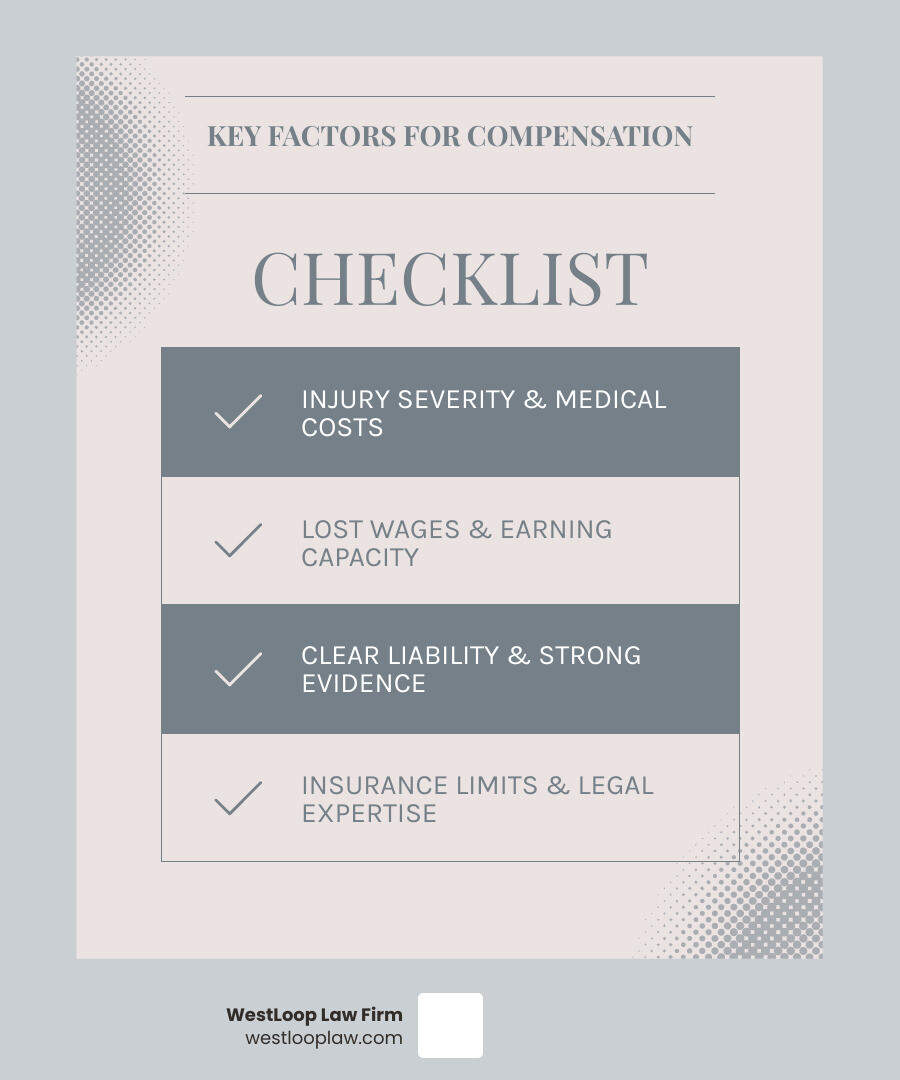
Key Factors That Determine Your Settlement Value
Your compensation depends on several factors that tell the story of how the crash affected your life.
- The severity of your injuries: This is the most significant factor. A traumatic brain injury will result in a much higher settlement than a broken arm.
- Your medical treatment costs: This includes all past and future medical care, from ambulance rides to long-term rehabilitation.
- Lost income: This covers wages you’ve already missed and your reduced earning capacity if you can’t return to your previous job.
- Property damage: This is the cost to repair or replace your vehicle and any personal items inside.
- Liability determination: The more clearly the truck driver was at fault, the stronger your case. Your compensation may be reduced if you share some blame.
- Insurance policy limits: Commercial trucks carry high-limit policies (often $750,000 to $5 million+), which provides a source for fair compensation but also means a tougher fight.
- The strength of your evidence: Clear proof of negligence, like black box data or witness testimony, provides powerful leverage.
- Quality legal representation: An experienced attorney levels the playing field against the trucking company’s legal team.
How Injury Severity Dramatically Impacts Your Claim

The sheer force of a truck crash causes injuries that range from serious to fatal, which is why settlement amounts vary so much.
- Catastrophic injuries: These include traumatic brain injuries, spinal cord damage leading to paralysis, amputations, and severe burns. They fundamentally change a person’s life and require compensation for decades of future care, lost earning capacity, and profound loss of quality of life. These cases regularly settle for millions.
- Wrongful death: In the tragic event of a fatality, compensation can cover funeral expenses, the deceased’s lost financial support, and the family’s emotional suffering. These claims also frequently reach into the millions.
- Moderate injuries: Serious fractures, herniated discs requiring surgery, and concussions can disrupt life for months or years. These cases often settle in the $200,000 to $500,000 range.
- Minor injuries: Whiplash and sprains can still lead to chronic pain. Settlements typically range from $50,000 to $150,000, but it’s crucial not to settle before understanding the full extent of your condition.
Our job is to ensure your 18 wheeler accident compensation reflects your future needs, not just your past expenses.
The Role of Insurance in 18-Wheeler Accident Compensation
Truck accident cases differ from car crashes because of the substantial insurance coverage involved. The Federal Motor Carrier Safety Administration (FMCSA) requires commercial trucks to carry high minimums: $750,000 for general freight and up to $5 million for hazardous materials. Many companies carry even more.
This is a stark contrast to Texas’s minimum personal auto policy of $30,000. While the higher limits mean there’s enough coverage for catastrophic injuries, it also means the insurance companies will fight much harder to minimize what they pay. Their adjusters are trained to reduce or deny claims.
An experienced lawyer is crucial for identifying all available insurance policies—including primary, umbrella, and excess coverage—and fighting to access them. It’s important to know that policy limits typically cap your recovery, so a thorough investigation to find every responsible party and every available policy is essential to securing the compensation you deserve.
What Damages Can You Recover After a Truck Accident?
After an 18-wheeler accident, the legal system aims to restore what you’ve lost through monetary compensation. This isn’t about a windfall; it’s about making you “whole” again. The compensation you can pursue falls into three categories: economic, non-economic, and, in some cases, punitive damages. Documenting every loss is key to maximizing your recovery.

Economic Damages: Calculating Your Financial Losses
Economic damages are the tangible, calculable financial losses you’ve suffered. To build the strongest possible case for your 18 wheeler accident compensation, we track every penny.
- Medical Expenses: This includes everything from the initial emergency room visit to future surgeries, physical therapy, and long-term care.
- Lost Wages and Earning Capacity: You are compensated for the paychecks you’ve missed and, if you can’t return to your old job, for the loss of future earning potential over your lifetime.
- Property Damage: This covers the cost to repair or replace your vehicle and other personal property damaged in the crash.
- Rehabilitation and Out-of-Pocket Costs: This includes therapies to regain function, transportation to appointments, and necessary home modifications like wheelchair ramps.
Non-Economic Damages: Compensation for Your Suffering
Non-economic damages address the profound personal losses that don’t have a price tag. They compensate for the human cost of the accident.
- Pain and Suffering: This covers the physical pain and emotional distress of living with your injuries.
- Mental Anguish: Many victims develop anxiety, depression, or PTSD. Texas law allows compensation for a high degree of mental pain directly resulting from physical injuries.
- Loss of Enjoyment of Life: This recognizes the hobbies, activities, and experiences you can no longer enjoy due to your injuries.
- Disfigurement and Scarring: Visible scars can have a profound psychological impact and serve as a constant reminder of the trauma.
- Loss of Consortium: This allows your spouse to seek compensation for the loss of companionship, affection, and support.
Attorneys often calculate these damages using a multiplier method, where economic damages are multiplied by a factor (typically 1.5 to 5) based on the severity of the injuries.
Punitive Damages: Punishing Gross Negligence
While most 18 wheeler accident compensation is compensatory, punitive damages may be awarded to punish the defendant for particularly reckless behavior. Texas law allows punitive damages when there is clear evidence of fraud, malice, or gross negligence.
In trucking cases, gross negligence could include:
- Driving under the influence (DUI)
- Intentionally falsifying logbooks to violate hours-of-service limits
- Knowingly operating a truck with serious mechanical defects
These damages are not awarded in every case, but they serve as a powerful deterrent to unsafe practices and can significantly increase a settlement.
Navigating the Legal Process for Your Claim
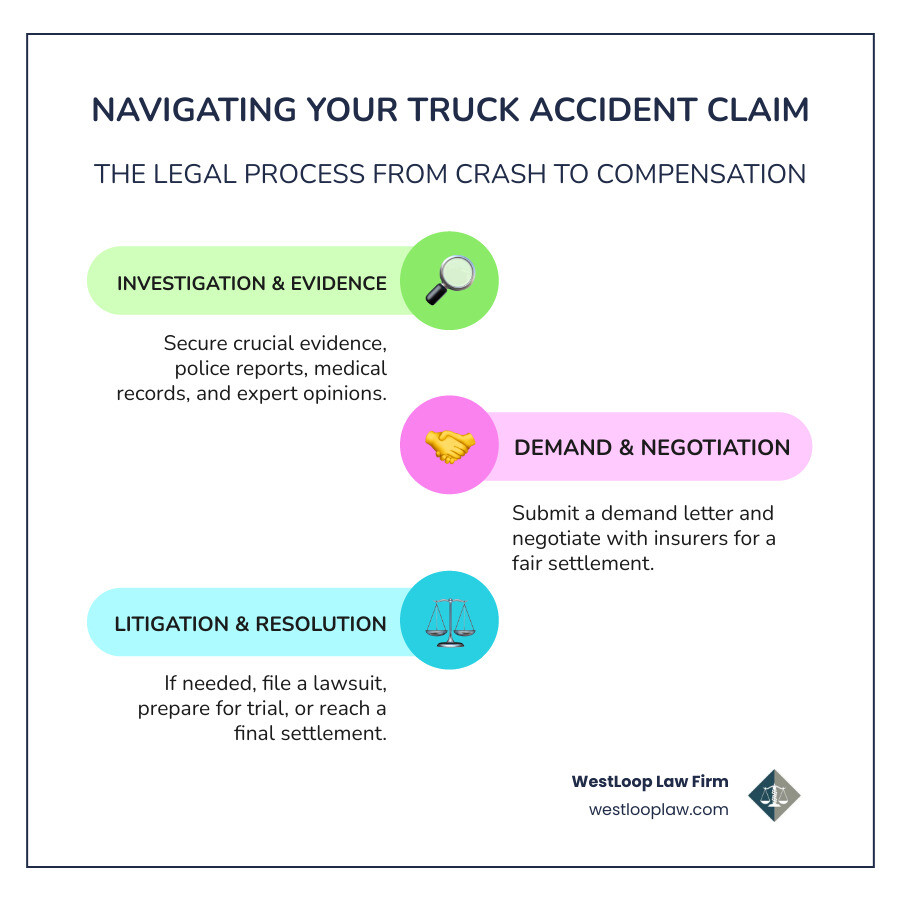
After an 18-wheeler accident, you’re thrust into a legal process that can feel overwhelming. The path to securing your 18 wheeler accident compensation moves in stages: an intensive investigation, a formal demand letter to the insurer, and a period of negotiation. If the insurance company refuses a fair offer, we proceed with a lawsuit. While most cases settle before trial, filing a lawsuit often motivates insurers to negotiate seriously.
Critical First Steps to Protect Your Claim
What you do immediately after an accident can significantly impact your claim. Follow these steps to protect your rights:
- Call 911: An official police report is a crucial piece of evidence.
- Get Medical Attention: See a doctor immediately, even if you feel fine. This documents your injuries and links them to the crash.
- Document the Scene: Take photos and videos of vehicle damage, road conditions, skid marks, and your injuries.
- Collect Witness Information: Get names and phone numbers from anyone who saw the accident.
- Do Not Admit Fault: Avoid saying “I’m sorry” or accepting blame. Stick to the facts when speaking with police.
- Avoid Speaking to Insurance Adjusters: Politely decline to give recorded statements to the trucking company’s insurer. Their goal is to minimize your claim. Tell them your attorney will be in contact.
- Contact a Truck Accident Lawyer: The sooner you hire a lawyer, the faster they can act to preserve critical evidence like black box data and driver logs.
How Fault is Determined in Texas
Determining who is responsible for a truck accident is complex. Texas uses a modified comparative fault rule, also known as the 51% bar rule. You can recover damages as long as you are 50% or less at fault. However, your compensation is reduced by your percentage of fault. If you are found 51% or more at fault, you recover nothing.
To establish fault, we gather evidence such as:
- Police reports
- Eyewitness testimony
- Black box data (EDRs), which records speed, braking, and other pre-crash information
- Driver logs to check for violations of hours-of-service limits
- Maintenance records to uncover neglected safety issues
- Accident reconstruction analysis to scientifically recreate the crash
How Long Do You Have to File a Lawsuit?
Texas law imposes a strict two-year deadline to file a personal injury lawsuit. This is known as the statute of limitations. If you miss this deadline, you lose your right to pursue 18 wheeler accident compensation forever, no matter how strong your case is.
Two years passes quickly, especially while you’re recovering. Acting fast is not just about meeting the deadline; it’s about preserving evidence. Black box data can be overwritten, witnesses can become hard to find, and company records can be “misplaced.” The sooner you contact an attorney, the stronger your case will be.
How a Lawyer Maximizes Your 18-Wheeler Accident Settlement

When you’re recovering from an 18-wheeler accident, you’re up against a trucking corporation and its insurance company, both of which have teams of lawyers dedicated to paying you as little as possible. An experienced attorney levels the playing field.
At WestLoop Law Firm, we focus on personal injury law and know the trucking companies’ playbook. While you focus on healing, we handle the legal battle. We push back against lowball offers, delay tactics, and attempts to shift blame. We also provide access to a network of witnesses—including medical, vocational, and accident reconstruction professionals—to build a winning case.
Crucially, we understand the complex web of federal and state trucking regulations. We know where to find violations that can prove negligence and strengthen your claim for 18 wheeler accident compensation.
Investigation and Evidence Gathering
The evidence needed to win your case won’t be handed over voluntarily. Our investigation begins immediately to preserve critical information before it disappears.
- We secure black box data from the truck’s Event Data Recorder to get an objective account of speed, braking, and other actions before the crash.
- We examine driver qualification files to ensure the driver was properly licensed and medically fit to be on the road.
- We review maintenance and inspection records to find evidence of safety shortcuts, like worn brakes or bald tires.
- We interview witnesses and hire accident reconstructionists to create a clear, scientific picture of how the crash occurred.
Calculating and Proving Your Total Damages
Insurance companies want to settle based only on your current medical bills. We calculate your true damages, which extend far beyond today’s expenses.
We work with medical and economic professionals to document and project all future costs, including ongoing treatment, lost earning capacity, and reduced quality of life. These aren’t guesses; they are detailed financial projections that account for your lifetime losses.
We compile this evidence into a comprehensive demand package and present it to the insurance company, making it clear we are prepared for trial. This aggressive preparation is why most of our cases settle for maximum value. The difference between handling a claim yourself and having experienced legal representation can mean hundreds of thousands of dollars in your final settlement.
Frequently Asked Questions about 18-Wheeler Accident Claims
After a traumatic truck accident, it’s natural to have questions. Here are answers to some of the most common ones we hear from victims in Texas.
Can I get compensation if I was partially at fault for the accident?
Yes. Texas follows a “modified comparative fault rule,” also known as the “51% bar rule.” This means you can still recover 18 wheeler accident compensation as long as you are 50% or less at fault for the crash. Your final settlement will simply be reduced by your percentage of fault. For example, if you are awarded $100,000 but found to be 20% at fault, you would receive $80,000. However, if you are found 51% or more at fault, you are barred from recovering any damages at all.
How long does the 18-wheeler accident settlement process take?
The timeline varies for every case. There is no set schedule, but here are some general estimates:
- Simple cases with minor injuries and clear fault may settle in a few months.
- Typical cases involving more serious injuries often take between six months and a year to resolve, allowing time for medical treatment to conclude.
- Complex cases with catastrophic injuries or disputed fault can take one to three years, especially if a lawsuit is necessary.
We never rush a settlement at the expense of your recovery. Our goal is to secure compensation that covers all your losses, both present and future.
Do I have to pay taxes on my settlement money?
For the most part, no. According to the IRS, compensation you receive for physical injuries, medical expenses, and pain and suffering tied to those physical injuries is not taxable.
However, some portions of a settlement can be taxed. This typically includes:
- Compensation for lost wages (as it replaces taxable income).
- Money for emotional distress that is not directly caused by a physical injury.
- Punitive damages, which are almost always considered taxable income.
Because tax implications can be complex, we strongly advise consulting with a tax professional to review your specific settlement.
Get the Compensation You Deserve
Here’s the bottom line: you deserve fair compensation for what you’ve been through, and you don’t have to fight this battle alone. The aftermath of an 18-wheeler accident is overwhelming, with mounting bills, lost income, and physical and emotional pain. Meanwhile, the insurance company is already working to minimize what they owe you.
At WestLoop Law Firm, we focus on helping people just like you. Our experienced personal injury attorneys in Houston fight to secure the maximum 18 wheeler accident compensation for our clients. We know the insurance companies’ tactics and how to beat them.
We work on a contingency fee basis, which means you pay nothing upfront. We only get paid if we win your case. Our success is tied directly to yours.
Don’t wait. The two-year statute of limitations in Texas is strict, and critical evidence can disappear quickly. The sooner you act, the stronger your case will be.
You’ve been through enough. Let us handle the legal fight while you focus on your recovery. We offer a free, no-obligation case evaluation to review your situation and answer your questions.
Contact an experienced Houston trucking accident lawyer today and let’s start fighting for the justice and compensation you deserve.