 Skip to content
When a Houston 18 Wheeler Accident Means You Need Legal Help
After a Houston 18 wheeler accident, get medical care, save any photos and crash information you have, and avoid giving a recorded statement to the trucking insurer before you understand your options. Legal help may be important when injuries are serious, fault is disputed, several companies may share blame, or vital evidence could disappear.
Truck crashes can become complicated fast. A collision between two 18-wheelers on the Katy Freeway near SH-99 sent one truck over an elevated barrier, injured two people, and required fuel containment and major roadway closures. Cases involving falling trucks, cargo, bridge strikes, or fuel spills can require a closer look at the driver, motor carrier, cargo handlers, maintenance records, and electronic truck data.
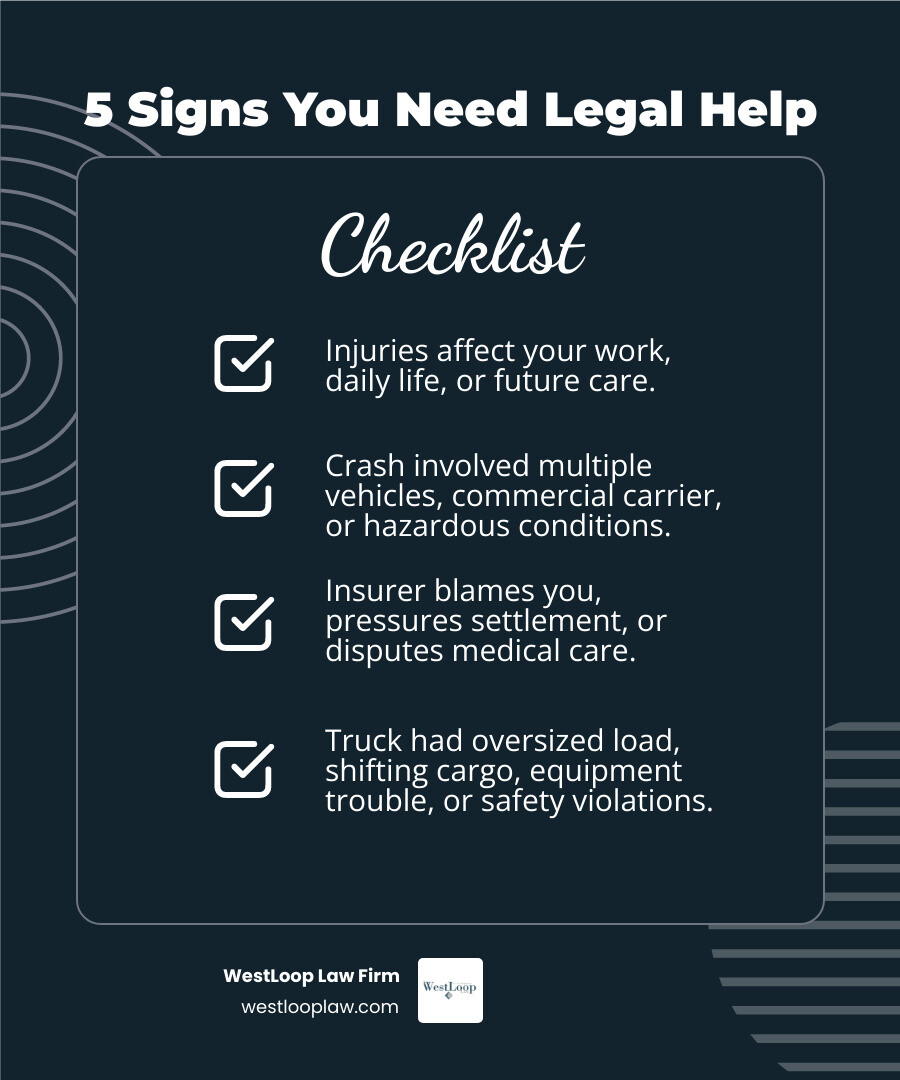
You may need help if:
- Your injuries affect your work, daily life, or future care.
- The crash involved multiple vehicles, a commercial carrier, or hazardous conditions.
- An insurer blames you, pressures you to settle, or disputes your medical care.
- The truck may have had an oversized load, shifting cargo, equipment trouble, or safety-rule violations.
- A family member was seriously hurt or killed.
Westloop Law Firm can help injured Texans understand the evidence, possible responsible parties, and next steps after a serious truck crash.
Key Houston 18 wheeler accident vocabulary:
When to Seek Legal Help After a Houston 18 Wheeler Accident
Commercial trucking serves as the lifeblood of commerce across Southeast Texas, but the sheer scale of these massive commercial vehicles means that any error on the road can result in catastrophic damage. Commercial carriers operate under extensive federal safety rules established by the Federal Motor Carrier Safety Administration (FMCSA), as well as specific Texas state traffic laws.
When an 18-wheeler collides with a standard passenger vehicle, the crash forces are rarely distributed evenly. Because commercial semi-trucks can weigh up to 80,000 pounds or more when fully loaded, ordinary passenger cars, SUVs, and pickup trucks bear the brunt of the impact. Navigating the aftermath requires a solid understanding of how commercial carrier claims operate, and our 18-Wheeler Accident Houston Ultimate Guide outlines why these situations require immediate attention.
1. The Crash Involved Catastrophic Injuries, Over-the-Barrier Falls, or Hazmat Spills

The sheer physical size and weight of commercial tractor-trailers mean that collisions on Houston freeways can quickly escalate into multi-vehicle pileups, rollovers, or barrier breaches. On elevated freeway interchanges, such as where the Katy Freeway crosses State Highway 99 (Grand Parkway), a heavy collision can cause a commercial vehicle to breach concrete guardrails. When a semi-truck cab or trailer plunges off an overpass, the resulting impact threatens motorists traveling on both upper and lower mainlanes.
Beyond structural collisions, hazardous materials present immediate dangers to Houston commuters. Even when a commercial truck is carrying ordinary dry freight, ruptured saddle tanks can release hundreds of gallons of combustible diesel fuel across highway lanes. In more severe instances, trucks hauling industrial chemicals—such as battery acid or zinc chloride—can trigger regional environmental emergencies. For example, an I-10 East Freeway hazmat spill near Mercury Drive blocked westbound lanes for hours while emergency crews worked to contain spilled materials and clear the roadway.
Catastrophic crashes often require:
- Emergency extrications using heavy-duty hydraulic tools to free trapped motorists.
- Emergency medical airlift operations to transport critically injured victims to Houston trauma centers.
- Long-term hospitalization, surgeries, and rehabilitation for traumatic brain injuries, spinal cord trauma, or severe fractures.
2. Complex Multi-Party Liability Arises in Your Houston 18 Wheeler Accident
Unlike a typical two-car crash where only individual drivers and their personal auto insurers are involved, a commercial vehicle wreck routinely involves multiple corporate entities. Identifying every responsible party is critical for securing full financial recovery.
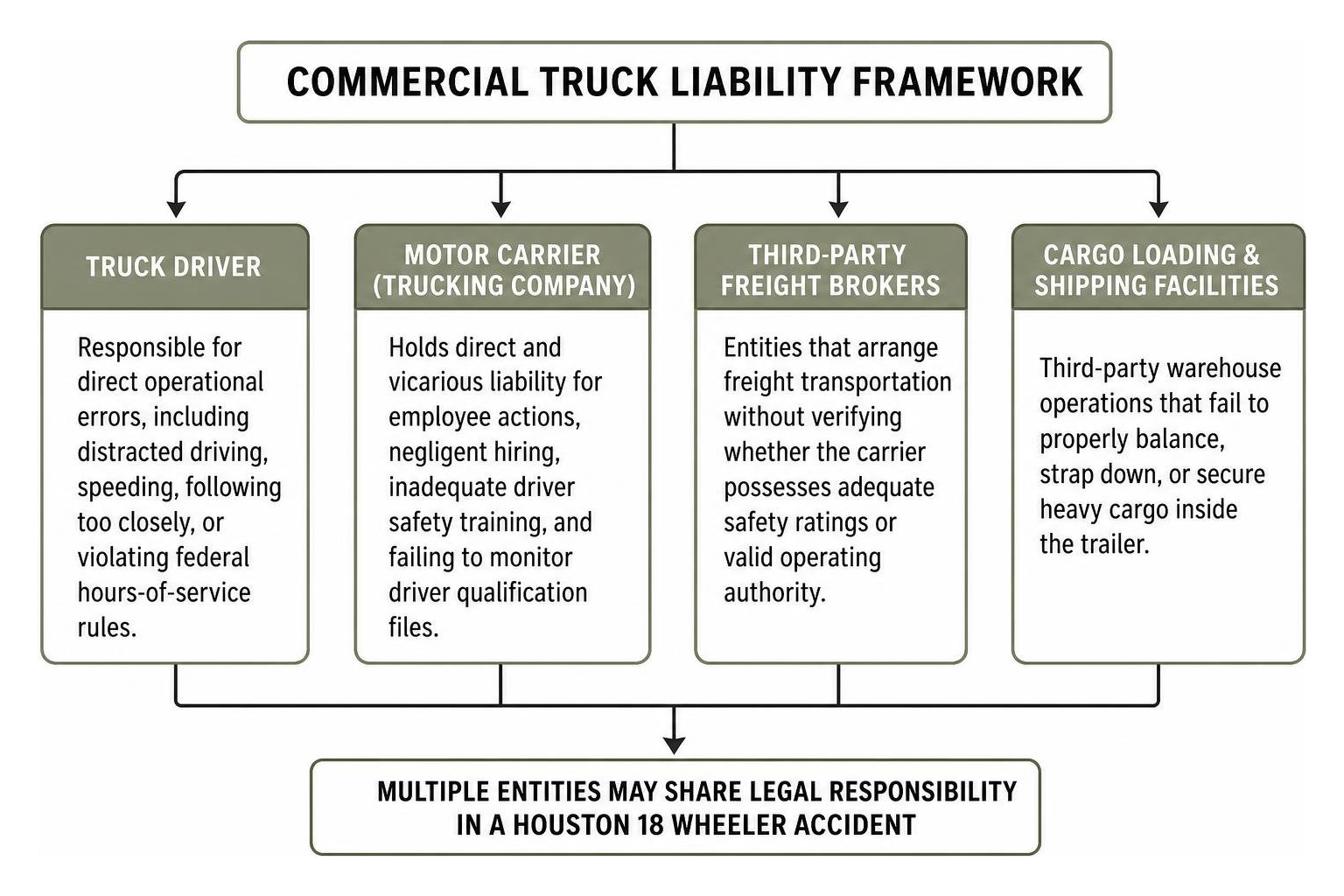
When an 18-wheeler causes a wreck in Houston, several distinct entities may share legal responsibility:
- The Truck Driver: Responsible for direct operational errors, including distracted driving, speeding, following too closely, or violating federal hours-of-service rules.
- The Motor Carrier (Trucking Company): Holds direct and vicarious liability for employee actions, negligent hiring, inadequate driver safety training, and failing to monitor driver qualification files.
- Third-Party Freight Brokers: Entities that arrange freight transportation without verifying whether the carrier possesses adequate safety ratings or valid operating authority.
- Cargo Loading and Shipping Facilities: Third-party warehouse operations that fail to properly balance, strap down, or secure heavy cargo inside the trailer.
- Maintenance and Repair Contractors: Third-party service shops that perform substandard brake replacements, tire installations, or safety inspections.
- Equipment and Parts Manufacturers: Companies responsible for defective steering mechanisms, faulty hitching equipment, or tire blowouts.
Sorting out these corporate layers requires thorough investigation. A knowledgeable Houston 18-Wheeler Accident Lawyer can review corporate bills of lading, dispatch records, and maintenance logs to hold every negligent party accountable.
3. Structural Violations, Shifting Cargo, or Oversized Loads Caused the Collision
Improperly secured freight and non-compliant oversized loads create serious road hazards across Greater Houston. When flatbed trailers haul heavy steel pipes, machinery, or industrial components without adequate bulkheads and tie-downs, sudden braking can cause the cargo to shift forward with tremendous force. In severe incidents, such as when unsecured metal pipes penetrated a truck cab on the I-610 North Loop, the driver and surrounding motorists face life-threatening hazards.
Another frequent threat on Houston roadways involves over-height commercial vehicles striking bridge infrastructure. The Houston Avenue Bridge over Interstate 10 has a vertical clearance of 14 feet 3 inches. Because standard Texas vehicle height without an oversized load permit is capped at 14 feet, tall cargo leaves an extremely narrow margin of error.

Bridge strikes create substantial legal and physical fallout:
- Recurring Incidents: The Houston Avenue Bridge has been struck well over 70 times since 2025, generating more than $401,000 in Texas Department of Transportation (TxDOT) inspection and repair costs in 2025 alone.
- Debris Hazards: A bridge impact can send concrete chunks, steel fragments, and dislodged cargo crashing into trailing passenger vehicles, as demonstrated during an incident involving an oversized load striking the Houston Avenue bridge.
- Statutory Penalties: Under Section 621.504 of the Texas Transportation Code, operating an unpermitted over-height vehicle into a bridge is a Class B misdemeanor punishable by up to a $500 fine and up to 30 days in county jail.
- Strict Financial Liability: Under Texas House Bill 799 (enacted in 2019), vehicle owners are held strictly liable for all financial damages caused to a bridge or overpass.
To learn more about how carrier non-compliance leads to roadway dangers, review our guide on the 5 Common Causes of Truck Accidents.
4. Commercial Insurers Dispute Fault or Offer Unfair Settlements After a Houston 18 Wheeler Accident
Commercial motor carriers carry commercial liability insurance policies worth hundreds of thousands—or even millions—of dollars. Because high policy limits create substantial financial exposure, commercial insurance adjusters and corporate defense teams act swiftly following a crash.
Within hours of a major wreck, trucking companies often deploy rapid-response teams, including private investigators and collision reconstruction professionals, to inspect the scene, interview witnesses, and minimize the company’s liability. Insurers may attempt to shift blame onto passenger car drivers, claim medical treatments are excessive, or offer quick, low-ball settlements before the injured party understands the full extent of their future medical needs.
Protecting a claim requires taking proactive measures to demand and secure vital trucking records:
- Engine Control Module (ECM) Data: Often referred to as the truck’s “black box,” this device records vehicle speed, braking patterns, throttle position, and engine fault codes in the seconds leading up to an impact.
- Electronic Logging Device (ELD) Records: Federal law mandates electronic logs to track a commercial driver’s hours of service and identify potential fatigue violations.
- Internal Dashcam and Telematics: In-cab driver-facing and forward-facing video feeds, along with GPS tracking data, provide clear visual and route evidence.
- Formal Spoliation Letters: Prompt legal preservation notices stop trucking companies from destroying, altering, or overwriting electronic data during routine computer system maintenance.
Understanding your financial options helps counter these defense tactics, as detailed in our Houston Truck Accident Settlements Complete Guide.
5. Fatal Collisions Require Coordinated Personal Injury and Probate Claims
When an 18-wheeler collision results in a tragic loss of life, the legal challenges expand beyond standard personal injury law. Surviving families must navigate both Texas wrongful death statutes and Harris County probate procedures to hold negligent trucking companies accountable.
Texas law provides two primary paths for legal recovery after a fatal crash:
| Claim Type | Legal Authority | Who Can File | Recoverable Damages |
|---|---|---|---|
| Wrongful Death | Texas Civil Practice & Remedies Code § 71.002 | Surviving spouse, children, and parents | Lost financial support, loss of companionship, mental anguish, lost inheritance |
| Survival Action | Texas Civil Practice & Remedies Code § 71.021 | Estate representative / heirs through probate | Conscious pain and suffering of the deceased, medical bills incurred before death, funeral expenses |
Navigating both claims simultaneously requires careful coordination between personal injury litigation and the formal opening of an estate in probate court. Establishing an estate, appointing an administrator, and properly determining legal statutory beneficiaries ensures that any settlement or jury verdict is distributed in full accordance with Texas law. We handle these delicate matters with compassion, providing families with integrated personal injury and probate representation during their most difficult moments.
Understanding Commercial Truck Accident Liability and Evidence in Greater Houston
Resolving a commercial vehicle collision claim requires a deep understanding of standard passenger vehicle accidents versus commercial fleet litigation. The following comparison outlines the critical differences:
| Factor | Passenger Car Collision Claim | Commercial 18-Wheeler Crash Claim |
|---|---|---|
| Applicable Regulations | Texas Transportation Code | Texas Transportation Code & FMCSA Federal Regulations |
| Insurance Policy Limits | Minimum $30,000 / $60,000 Texas liability | $750,000 to $5,000,000+ commercial motor carrier policies |
| Electronic Evidence | Basic vehicle event data (if available) | ECM black box telemetry, ELD logs, GPS tracking, inward/outward dashcams |
| Potentially Liable Parties | Individual driver | Driver, carrier, broker, cargo loaders, maintenance shops, manufacturers |
| Defense Strategy | Insurance claims adjuster | Dedicated rapid-response defense teams, accident reconstructionists |
| Driver Oversight Records | Basic driving history | Comprehensive driver qualification files, drug/alcohol screenings, logbook audits |
Key Evidence to Preserve Immediately
Commercial trucking companies routinely overwrite electronic telemetry data within 30 to 90 days if formal preservation steps are not taken. Securing this critical evidence requires immediate action:
- ECM and Event Data: Captures precise vehicle speed, brake application, cruise control status, and steering inputs during the crash sequence.
- ELD and Logbook Data: Reveals whether the commercial driver exceeded federal driving hour limits or falsified duty status records.
- Driver Qualification Files (DQF): Documents the driver’s commercial driver’s license (CDL) verification, background checks, medical examiner certificates, and prior safety violations.
- Post-Crash Inspection Reports: Conducted by the Texas Department of Public Safety (DPS) or Harris County Sheriff’s Office Commercial Vehicle Enforcement Unit to identify mechanical brake failures, bald tires, or out-of-service violations.
- Dispatch and Communication Logs: Records exchanges between the motor carrier dispatcher and the driver to determine if unreasonable delivery deadlines encouraged speeding or reckless driving.
Houston Freight Corridors and High-Risk Crash Hotspots
Greater Houston serves as one of the largest intermodal shipping and freight hubs in North America. High traffic volumes combined with ongoing highway construction make several regional freight corridors particularly prone to commercial vehicle accidents:
Houston TranStar provides real-time traffic monitoring, incident mapping, and live camera feeds across these heavily traveled corridors to assist emergency responders and alert commuters to major lane closures.
Steps to Protect Your Rights After a Texas Semi-Truck Crash
The actions you take immediately following a commercial vehicle collision can have a lasting impact on your physical recovery and legal rights. Following a clear plan helps protect your interests:
- Call 911 and Request Law Enforcement: Ensure that Houston Police or the Harris County Sheriff’s Office responds to the scene. A formal Texas Peace Officer’s Crash Report (CR-3) provides vital initial documentation.
- Seek Immediate Medical Evaluation: Even if you believe your injuries are minor, internal trauma, concussions, and soft-tissue damage can worsen over several days. Prompt medical records establish a clear link between the crash and your physical injuries.
- Document the Crash Scene Thoroughly: If it is safe to do so, take extensive photos and videos of all vehicle positions, property damage, skid marks, road conditions, cargo spills, and commercial DOT numbers printed on the truck cab.
- Collect Witness Information: Obtain names, phone numbers, and statements from independent witnesses who saw the collision occur.
- Decline Recorded Statements to Insurance Adjusters: Do not provide recorded audio statements or sign blanket medical release authorizations for the trucking company’s insurance provider before speaking with legal counsel.
- Issue Formal Preservation Demands: Send formal spoliation letters to the commercial carrier and its insurer to prevent the deletion of black box data, dashcam video, and driver logs.
For additional practical recommendations on managing the aftermath of a wreck, consult our 6 Smart Houston 18-Wheeler Accident Claims Tips.
Frequently Asked Questions About Houston 18 Wheeler Accidents
What caused the recent Katy Freeway 18-wheeler crash near SH-99?
The Katy Freeway crash involved a multi-commercial vehicle collision between two 18-wheelers on the eastbound mainlanes near State Highway 99 (Grand Parkway). The force of the impact forced one tractor-trailer through the elevated concrete barrier, leaving the vehicle to fall from the overpass. Emergency responders transported two vehicle occupants to local hospitals with minor injuries, while hazmat and environmental response teams contained diesel fuel spilled from the ruptured saddle tanks. The Harris County Sheriff’s Office conducted the primary investigation into the cause of the impact.
Who is liable when an oversized truck hits a bridge on I-10?
Under Texas law, legal liability for an over-height bridge strike falls squarely on the motor carrier and commercial driver. Under Texas House Bill 799, commercial vehicle owners are held strictly liable for all structural repair and engineering inspection costs incurred by TxDOT. If the commercial truck was operating without the required oversized load permits from the Texas Department of Motor Vehicles, the driver may also face criminal Class B misdemeanor charges under Section 621.504 of the Texas Transportation Code. In addition to state property damage, the trucking company is financially responsible for injuries, secondary collisions, or falling debris damage suffered by nearby motorists.
How long do I have to file an 18-wheeler accident claim in Texas?
Under Section 16.003 of the Texas Civil Practice and Remedies Code, the statute of limitations for personal injury and wrongful death claims in Texas is generally two years from the date of the collision. However, waiting to take legal action can severely harm your case. Crucial electronic logging data, black box telemetry, and dashcam videos can be legally erased or overwritten by commercial carriers within weeks if formal legal preservation demands are not issued promptly.
Standing Up for Injured Texans and Grieving Families
A commercial truck collision can disrupt your life in an instant, leaving you to deal with painful injuries, costly medical care, lost income, and intense pressure from corporate insurance carriers. When a commercial carrier violates federal safety standards, overloads freight, or acts recklessly on Houston highways, injured motorists deserve strong advocacy to protect their rights and hold the responsible parties accountable.
At Westloop Law Firm, we provide compassionate, thorough representation for clients across Houston. Whether you are dealing with a catastrophic injury claim or navigating the complexities of probate following the tragic loss of a family member, our team is dedicated to guiding you through every stage of the legal process. If you or a loved one has been harmed in a commercial truck crash, reach out to our team for dedicated Houston personal injury legal support to discuss your case and understand your options today.