 Skip to content
18-wheeler Accident Lawyer: Your 2025 Ultimate Guide
Understanding the Devastating Impact of 18-Wheeler Accidents
An 18-wheeler accident lawyer is a personal injury attorney who focuses on commercial truck crashes. They help victims steer complex federal regulations, identify multiple at-fault parties, and fight for maximum compensation against large trucking companies and their insurers.
An experienced lawyer will:
- Investigate the crash using accident reconstructionists.
- Identify all liable parties, from the driver to the trucking company and manufacturers.
- Gather critical evidence like black box data and driver logs before it’s lost.
- Handle all communications with insurance companies to protect you from their tactics.
- Maximize your compensation for all medical bills, lost income, and pain and suffering.
- Work on a contingency fee basis, so you pay nothing unless you win.
Collisions with semi-trucks in Texas have devastating consequences. Texas leads the nation in fatal truck accidents, and the sheer size difference—an 80,000-pound truck versus a 4,000-pound car—often results in catastrophic injuries like traumatic brain injuries, spinal cord damage, and wrongful death.
These cases are far more complex than typical car crashes. They involve multiple defendants, intricate federal safety regulations, and aggressive corporate legal teams backed by insurance policies worth millions. Trucking companies immediately deploy investigators to protect their interests, making it crucial for victims to have a knowledgeable advocate on their side.
This guide explains what you need to know about hiring an 18-wheeler accident lawyer in Texas, from establishing liability to securing the compensation you need to protect your future.
The High Stakes: Why 18-Wheeler Wrecks Are More Complex
When an 80,000-pound commercial truck collides with a 4,000-pound passenger car, the outcome is tragically predictable. The immense force of impact leads to catastrophic injuries you rarely see in other accidents, including traumatic brain injuries, spinal cord damage leading to paralysis, and severe burns. These are not injuries you recover from quickly; they are life-altering.
Several factors make these cases uniquely challenging:
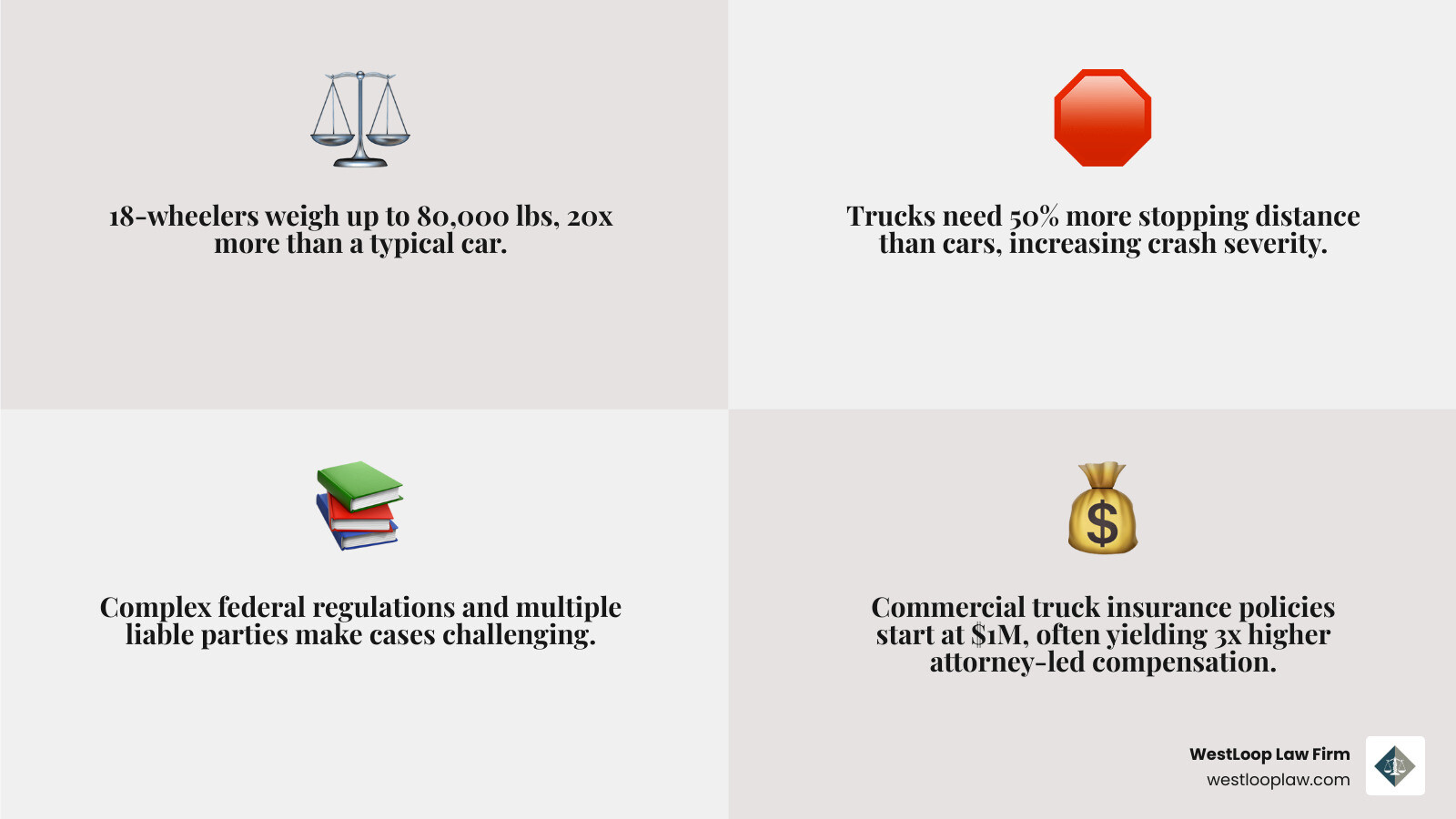
- Size and Weight Disparity: A fully loaded truck is 20 times heavier than a car and needs up to 50% more distance to stop. This physical reality means truckers often cannot avoid a collision, even if they react in time.
- Multiple Liable Parties: Unlike a simple car crash, fault can extend beyond the driver to the trucking company, the cargo loaders, or the manufacturer of a faulty part.
- Complex Regulations: The trucking industry is governed by a maze of Federal Motor Carrier Safety Administration rules on driver hours, truck maintenance, and safety equipment. Violations are often key to proving negligence.
- High-Value Insurance Policies: Trucking companies carry insurance policies starting at $1 million. While this seems beneficial, it means insurers fight aggressively to minimize payouts, using trained adjusters to blame victims and settle for less than a claim is worth.
You are not on a level playing field. While you recover from serious injuries, the trucking company and its insurer deploy teams to protect their bottom line. Legal representation with deep knowledge in this area is essential.
Unique Challenges in an 18-Wheeler Case
Investigating a truck accident requires technical knowledge because the evidence is far more complex than in a car crash. Modern trucks have Event Data Recorders (EDRs), or black boxes, that capture critical data like speed, braking, and steering inputs just before a crash.
Other crucial evidence includes:
- Driver logs to check for violations of hours-of-service rules.
- Maintenance records to see if the company cut corners on repairs.
- Cargo manifests to determine if an improperly secured load caused the crash.
This evidence must be preserved immediately. Spoliation of evidence—where a trucking company “loses” or destroys unfavorable data—is a serious risk. Their rapid response teams are sent to the scene to control the narrative, not to find the truth. An experienced 18-wheeler accident lawyer acts fast by sending spoliation letters and, if needed, seeking court orders to protect this data. We deploy our own investigators and reconstruction professionals to secure the scene and download EDR data before it’s erased. For more on this, see our guide on The Crucial Role of Evidence in Motorcycle Accident Claims A Guide for Houston Victims.
Common Injuries and Long-Term Consequences

The injuries from 18-wheeler accidents are often permanent and life-changing.
- Traumatic Brain Injuries (TBI): The violent force can cause the brain to slam against the skull, leading to long-term cognitive issues or severe disability.
- Spinal Cord Injuries: A crushed or severed spine can result in paralysis, changing a person’s life in an instant. Our Houston Spine Injury Lawyer Guide offers more information on these cases.
- Amputations: Crushing forces may leave limbs unsalvageable, creating lifelong physical and psychological challenges.
- Severe Burns: Fuel spills or fires can cause excruciating burns requiring years of surgery. Learn more from our Houston Burn Injury Lawyer page.
- Internal Organ Damage: Blunt force trauma can cause life-threatening internal bleeding and organ damage.
- Wrongful Death: Tragically, many victims do not survive, leaving families to cope with immense grief and financial instability.
Beyond the initial trauma, victims face a lifetime of long-term medical care and a potential loss of earning capacity. This is why securing comprehensive compensation is critical to protecting your family’s future.
Establishing Fault: Who Can Be Held Liable?
In an 18-wheeler accident, liability is rarely limited to the driver. A thorough investigation often reveals a network of negligent parties, and identifying each one is key to recovering the full compensation you deserve.

Potential at-fault parties include:
- The Truck Driver: The most obvious party, liable for actions like speeding, distracted driving, or violating federal hours-of-service rules.
- The Trucking Company: Often holds significant liability. Under “vicarious liability,” employers are responsible for their employees’ on-the-job actions. They can also be directly negligent for hiring unqualified drivers, failing to provide proper training, or pressuring drivers to ignore safety rules.
- Cargo Loaders and Shippers: If improperly loaded or overloaded cargo shifts and causes the driver to lose control, the company that loaded the truck can be held accountable.
- Vehicle and Parts Manufacturers: Defective equipment is a common factor. When faulty brakes, tires, or steering systems contribute to a crash, the manufacturer may be liable. Brake defects alone are found in a high percentage of investigated truck crashes.
- Maintenance Companies: A third-party mechanic who performs shoddy repairs or fails to identify a critical mechanical issue shares responsibility for the accident.
Proving liability requires a deep understanding of traffic law, federal trucking regulations, and product liability. We work with professionals to trace the chain of responsibility and build a strong case. For more on this, read our guide on Proving Liability Houston Personal Injury Cases.
Common Causes of 18-Wheeler Accidents
Understanding the common causes of these crashes helps us identify where to look for evidence of negligence.
- Driver Fatigue: Truckers work long hours, and fatigue is a leading cause of accidents. Federal hours-of-service safety regulations exist to prevent this, but pressure from trucking companies often leads to violations.
- Distracted Driving: Using cell phones, GPS devices, or other onboard systems diverts a driver’s attention with deadly consequences. A federal study found that 71% of large-truck crashes occurred when the driver was not focused on the road.
- Speeding: A speeding 18-wheeler is an unstoppable force. Given that big rigs need much more distance to stop, exceeding the speed limit is exceptionally dangerous.
- Driving Under the Influence (DUI): Truck drivers are held to a stricter BAC limit of 0.04%, but alcohol and drug use remains a serious problem in the industry.
- Improper Training: Many drivers report receiving inadequate training before they start driving. Trucking companies that cut corners on training put everyone at risk.
- Unsafe Lane Changes: Due to massive blind spots, unsafe lane changes are a leading cause of truck crashes. Drivers who fail to check these zones properly are often at fault.
- Improperly Loaded Cargo: Unbalanced or unsecured cargo can shift, causing the truck to become unstable, jackknife, or roll over.
- Poor Vehicle Maintenance: The Large Truck Crash Causation Survey found that over half of crash-involved trucks had at least one mechanical violation, such as issues with brakes, tires, or steering.
Your Legal Journey: Steps to Take and Compensation to Expect
The moments after a truck accident are chaotic and overwhelming. The actions you take can significantly impact your health and your legal claim. Here’s a step-by-step guide on what to do and what compensation you can expect.
Immediate Steps After a Crash
To protect your health and your rights, follow these critical steps after a collision:
- Prioritize Safety and Call 911: If possible, move your vehicle to a safe location. Texas law requires you to report any accident involving injury. Calling 911 creates an official police report and brings emergency medical services to the scene.
- Seek Immediate Medical Attention: Adrenaline can mask serious injuries like internal bleeding or TBIs. Getting checked by a medical professional right away creates a crucial record linking your injuries to the crash. For more guidance, see our post on What to do if you are hit by a truck in Houston, TX.
- Document Everything: Use your phone to take photos and videos of the accident scene, vehicle damage, road conditions, and any visible injuries. This evidence is invaluable.
- Exchange Information: Get the truck driver’s name, license, and insurance details. Crucially, get the trucking company’s name and DOT number. Also, collect contact information from any witnesses.
- Do Not Admit Fault: Avoid saying anything that could be interpreted as an apology or admission of fault, like “I’m sorry.” Do not give a recorded statement to any insurance adjuster without legal counsel.
- Contact an 18-Wheeler Accident Lawyer: Before speaking with the trucking company’s insurer, consult an attorney. Their insurance adjuster’s job is to minimize your payout. A lawyer levels the playing field from the start.
What Compensation Can You Recover?
Compensation, or damages, is intended to cover every loss you have suffered. These damages are typically divided into two categories.
Economic damages are your tangible, financial losses:
- Medical Bills: All costs for emergency care, hospitalization, surgery, physical therapy, and future medical needs.
- Lost Wages: Income lost from missing work. If you cannot return to your job, this includes loss of earning capacity—the income you would have earned for the rest of your career.
- Property Damage: The cost to repair or replace your vehicle and any other damaged property.
Non-economic damages compensate for the intangible, human cost of the accident:
- Pain and Suffering: For the physical pain and emotional distress you have endured.
- Mental Anguish: For anxiety, depression, PTSD, and other psychological trauma.
- Disfigurement: For permanent scarring or physical alterations.
- Loss of Consortium: For the negative impact on your relationship with your spouse and family.
Our resource on Calculating Damages Car Accident Injury Attorney provides more insight. Most cases settle out of court, but we prepare every case for trial. This readiness gives us leverage to negotiate a fair settlement. If the insurance company refuses to be reasonable, we are fully prepared to fight for you in court.
Why You Need an Experienced 18-Wheeler Accident Lawyer
After a truck accident, you might consider handling the claim yourself to save money. However, facing a trucking company and its insurer alone is like entering a boxing match unprepared—you are severely outmatched. These companies have deep pockets and legal teams dedicated to protecting their profits by minimizing payouts.

An experienced 18-wheeler accident lawyer levels the playing field. Statistics show that claimants with legal representation receive significantly higher compensation—often up to three times more. This is because an attorney understands the true value of your claim and won’t let you accept a lowball offer.
Trucking companies and their insurers use aggressive tactics. They dispatch rapid response teams to control the accident scene and may even try to make evidence disappear. Their adjusters will contact you quickly, acting friendly while trying to get a recorded statement to use against you. They may offer a quick, inadequate settlement before you understand the full extent of your injuries and future costs. Once you accept, you forfeit your right to seek further compensation.
Navigating the complex web of Federal Motor Carrier Safety Regulations is another reason you need a knowledgeable attorney. We know how to find violations related to driver hours, maintenance, and cargo loading to prove negligence. This specific knowledge is often the key to winning your case. Our goal is to maximize your compensation by accounting for all current and future medical needs, lost earning capacity, and your pain and suffering. For more on this, see our guide on The Importance of Hiring a Truck Accident Lawyer in Houston.
What to Look for in an 18-Wheeler Accident Lawyer
Not all personal injury attorneys are equipped for these complex cases. When choosing representation, look for these key qualities:
- Experience with Federal Trucking Laws: Your lawyer must have a deep understanding of the Federal Motor Carrier Safety Regulations to identify violations and establish liability.
- Trial Experience: Insurance companies are more likely to offer a fair settlement if they know your attorney has a proven track record of winning in court.
- Resources for Investigation: A serious firm has the financial resources to hire accident reconstructionists, download black box data, and conduct a thorough investigation.
- Access to Professional Witnesses: Your case may require testimony from medical professionals, economists, and trucking industry professionals. A good lawyer has a network of these professionals ready.
- Positive Client Reviews: Testimonials from past clients, especially in truck accident cases, reveal a firm’s responsiveness, client service, and ability to deliver results.
- Contingency Fee Structure: Reputable firms work on a contingency fee basis. This means you pay no upfront costs, and the firm only gets paid if you win your case. This aligns our interests with yours and ensures you can afford top-tier representation.
To help you choose, use our guide: 5 Questions to Ask Before Hiring a Truck Accident Lawyer.
Special Considerations for Texas Truck Accidents
Texas has the unfortunate distinction of leading the nation in fatal truck crashes. The sheer volume of commercial traffic on highways in Houston and across the state creates a high-risk environment. In 2022, Dallas County alone saw nearly 4,000 commercial vehicle crashes, according to the Texas Department of Transportation. If you’re injured in Texas, you face a legal landscape with unique challenges.
One major hurdle is House Bill 19 (HB 19), a law that benefits the trucking industry. It forces most truck accident lawsuits into two phases. First, you must prove the driver was negligent. Only then can you proceed to a second phase to hold the trucking company liable for its own negligence, such as poor training or maintenance. This makes it harder to hold companies accountable, making an experienced 18-wheeler accident lawyer who understands this law essential.
Texas also uses a proportionate responsibility rule. This means your compensation is reduced by your percentage of fault. If you are found 51% or more at fault, you are barred from recovering any damages at all. Insurers will exploit this rule to shift blame onto you, so fighting against unfair fault allegations is critical.
How a Texas 18-Wheeler Accident Lawyer Builds Your Case
Building a successful case in Texas means skillfully combining federal trucking regulations with state-specific laws. An experienced lawyer knows how to steer this complex framework.
| Aspect | General Trucking Regulations | Texas-Specific Rules |
|---|---|---|
| Statute of Limitations | Varies by state | Two years from the date of the accident |
| Phased Lawsuits | Not applicable in most states | House Bill 19 requires proving driver negligence before pursuing company liability |
| Comparative Negligence | Varies by state | Modified comparative negligence; 51% or more fault bars recovery |
| Punitive Damages | Available in cases of gross negligence | Must prove gross negligence or malice; capped at 2x economic damages plus non-economic damages up to $750,000, or $200,000 (whichever is greater) |
| Evidence Preservation | Federal regulations require certain record retention | Texas law allows spoliation claims if evidence is destroyed |
The statute of limitations in Texas gives you only two years to file a lawsuit. This deadline passes quickly, as investigations are complex and evidence can disappear. It is vital to contact a lawyer early. Learn more about this deadline in our guide on the Texas Statute of Limitations.
In cases of extreme recklessness, we can pursue punitive damages. These are intended to punish the defendant and deter future misconduct. To win them, we must prove the defendant acted with gross negligence. While Texas law caps these damages, they can still significantly increase your total recovery.
Throughout the process, we manage your medical treatment and costs, working with providers to document your injuries and calculate all future expenses. This ensures every penny of your medical care is accounted for in your claim. Navigating this legal environment is challenging, but dedicated representation is your best path to justice.