 Skip to content
Experienced premises liability lawyer 2025: Maximize
Understanding Your Rights After an Injury on Someone Else’s Property in Houston
An Experienced premises liability lawyer in Houston helps injury victims hold property owners accountable when dangerous conditions on their property cause harm. These attorneys investigate accidents, gather evidence, prove negligence, and fight for maximum compensation for medical bills, lost wages, and pain and suffering after incidents in places like Downtown Houston, the Galleria area, or along I-10.
When you need an Experienced premises liability lawyer in Houston:
- You were injured in a slip and fall, trip and fall, or other accident on someone else’s property in Houston
- The property owner failed to maintain safe conditions or warn of hazards
- You suffered injuries requiring medical treatment from hospitals like Houston Methodist, Memorial Hermann, or HCA Houston Healthcare
- You’re facing mounting medical bills and lost wages while recovering
- The property owner or their insurance company denies responsibility or offers inadequate compensation
Imagine rushing into an office building off Allen Parkway on a rainy Houston afternoon. Your shoes slip on the polished marble floor. No wet floor signs. No entrance mats. The result? A fractured wrist and a concussion that keeps you out of work for weeks.
This scenario happens more often than you might think. Property owners in Texas have a legal duty to keep their premises reasonably safe for visitors. When they fail to do so, serious injuries can result.
Premises liability law holds property owners responsible when someone gets hurt due to unsafe conditions on their property. Whether it’s a slippery floor at the Galleria, a poorly lit stairway in an apartment complex off Westheimer, or a dangerous condition at a business along I-10, property owners must take reasonable steps to prevent foreseeable harm.
The challenge is proving the property owner knew about the danger and failed to fix it. Insurance companies often deny claims or offer settlements that don’t cover your full damages. That’s where legal knowledge of Houston premises liability claims becomes critical.
This guide explains how premises liability claims work in Texas, what you need to prove, and how an experienced lawyer can help you steer the complex legal process to secure the compensation you deserve.
Understanding the Foundations of a Premises Liability Claim in Texas
At its core, premises liability in Texas is about holding property owners responsible for injuries that occur on their property due to unsafe conditions. This isn’t just about simple accidents; it’s about negligence—a failure to act with the reasonable care that a prudent property owner would use to keep their premises safe.
The property owner’s duty of care is a cornerstone of any premises liability claim in Houston. This duty isn’t one-size-fits-all; it varies significantly depending on why you were on the property. Texas law categorizes visitors into different classifications, and each category dictates the level of care owed by the property owner.
The general duty to not cause harm to others is a foundational legal concept in many jurisdictions. For instance, Article 1457 of the Civil Code of Quebec similarly establishes a broad obligation not to cause injury to another, which helps illustrate how Texas premises liability fits within wider negligence principles.
Duty of Care Owed to Different Visitors
In Texas, your legal status as a visitor is crucial in determining the duty of care the owner owes you. Generally, there are three main classifications:
-
Invitees: These are individuals who enter a property with the owner’s express or implied invitation for the owner’s benefit. This typically includes customers in a retail store along Westheimer Road, patrons at a restaurant in the Heights, or clients in an office building downtown. For invitees, property owners owe the highest duty of care. They must not only warn of known dangers but also actively inspect the property for unknown hazards and take reasonable steps to make the premises safe.
-
Licensees: These are social guests, such as friends visiting your home or someone you’ve given permission to use your property for their own purposes. The property owner must warn licensees of known dangerous conditions but does not have a duty to inspect the property for unknown hazards. If a property owner in a Houston suburb knows about a loose handrail but doesn’t warn their social guest, they could be liable.
-
Trespassers: These individuals enter a property without any invitation or permission. Property owners owe trespassers a very limited duty, generally only to avoid intentionally or maliciously harming them. However, if a property owner is aware of frequent trespassing, they may have a duty to warn of very dangerous conditions.
A critical exception to the trespasser rule is the attractive nuisance doctrine, particularly relevant for child trespassers. This doctrine applies when a property has a dangerous condition that is likely to attract children, such as an unfenced swimming pool, an abandoned building, or construction equipment.

If a property owner knows or should know that children are likely to trespass and be injured by such a condition, they have a duty to take reasonable steps to protect those children, such as putting up fences or posting warnings. This doctrine recognizes that children, especially in Houston’s neighborhoods, may not fully appreciate dangers.
The concept of “foreseeable harm” is central to all these duties. A property owner is generally only liable for injuries caused by hazards they knew about, or reasonably should have known about. If a danger is completely unforeseeable, it’s much harder to prove negligence. This principle of accountability for negligent acts is also reflected in many tort law systems, such as the general negligence rules described in the Wikipedia article on negligence.
Here is a quick comparison of the duty of care owed to different visitors in Texas:
| Visitor Type | Definition | Duty of Care Owed by Property Owner in Texas |
|---|---|---|
| Invitee | An individual on the property for the owner’s benefit (e.g., a customer). | Highest duty. Must warn of known dangers and inspect for/fix unknown hazards. |
| Licensee | A social guest with permission to be on the property. | Must warn of known dangers. No duty to inspect for unknown hazards. |
| Trespasser | An individual on the property without permission. | Duty to not intentionally harm. Exceptions apply for known, frequent trespassers and children (attractive nuisance doctrine). |
How Texas Law Defines an “Occupier”
In Texas, the term “occupier” is broader than just the property owner. It refers to the person or entity who has control over the premises at the time of the injury. This can include:
- Property Owners: The individual or company that legally owns the land and buildings.
- Property Managers: A company or individual hired to manage the daily operations and maintenance of a property, such as an apartment complex off the 610 Loop or a commercial building downtown.
- Tenants: In some cases, a tenant renting a property can be considered an occupier if they have control over the area where the injury occurred. For instance, if a tenant hosts a party at their rental home in Sugar Land and fails to address a known hazard within their rented space, they could be held liable.
The party with control over the premises has a responsibility to ensure its safety. This can sometimes lead to shared liability, where multiple parties (e.g., a landlord and a tenant) might share responsibility for an injury if they both failed to address a dangerous condition under their control.
The idea that the person in control of premises has a legal duty to visitors is echoed in other jurisdictions. For example, Ontario’s Occupiers’ Liability Act similarly focuses on the obligations of an “occupier” who has control over property, helping to illustrate how Houston premises liability concepts fit within broader North American legal approaches.
Common Premises Liability Scenarios and Determining Fault in Houston
Premises liability cases in Houston can stem from a wide array of hazardous conditions, leading to serious injuries and significant financial burdens for victims. The underlying theme is a property owner’s failure to maintain a reasonably safe environment.

Some of the most common premises liability scenarios we see in Houston include:
- Slip and Fall Accidents: The most frequent type of claim, often caused by wet floors, uneven surfaces, or debris in walkways. A spill in an H-E-B aisle off Buffalo Speedway or a poorly maintained sidewalk in Midtown are common examples.
- Negligent Security: Inadequate security, such as poor lighting in parking lots near NRG Stadium or broken gates at apartment complexes off the Beltway, can lead to assaults or robberies.
- Dog Bites and Animal Attacks: Owners are generally responsible for controlling their pets and can be held liable if their animal injures a lawful visitor.
- Swimming Pool Accidents: Unfenced, unsupervised, or poorly maintained pools pose a serious drowning risk, especially for children.
- Unsafe Property Conditions: This broad category includes structural defects like broken stairs, damaged flooring, or falling objects in shopping centers along Highway 59 or I-45.
- Elevator and Escalator Accidents: Injuries caused by poorly maintained or malfunctioning elevators and escalators in downtown Houston office towers or Galleria-area malls.
Slips, trips, and falls are by far the most prevalent of premises liability injuries, often leading to concussions, broken bones, and spinal cord injuries.
When is a Property Owner Liable?
A Houston property owner is generally liable for an injury if they were negligent in maintaining a safe environment. This negligence usually involves:
- Actual Knowledge of a Hazard: The owner or their employees knew about the dangerous condition (e.g., a reported broken step in an apartment complex near the Texas Medical Center) but failed to fix it.
- Constructive Knowledge (Should Have Known): The owner should have known about the hazard because it existed long enough for a reasonable person to find and fix it. For example, if a large pothole has been in a shopping center parking lot off Highway 59 for weeks, the owner likely had constructive knowledge.
Liability also hinges on the owner’s failure to act responsibly by:
- Failing to Warn: Not placing clear warnings (like “Wet Floor” signs) around a known hazard.
- Failing to Make Safe: Not repairing or removing the dangerous condition in a reasonable time.
- Creating an Unreasonable Risk of Harm: The condition posed an unreasonable risk of injury to lawful visitors.
For example, if an H-E-B employee sees a spill and does nothing, the store has actual knowledge and is likely liable. If the spill remains for a long time, the store could be liable based on constructive knowledge, as they should have found it.
You can find a general overview of how courts think about fault and liability in these situations in the Wikipedia article on premises liability, which is broadly consistent with how Houston premises liability cases are analyzed.
When is a Property Owner NOT Liable?
A property owner is not always liable for an injury. Common situations where they may not be at fault include:
- Open and Obvious Dangers: If a hazard is so obvious that a reasonable person would have seen and avoided it (like ignoring a “Wet Floor” sign at the Galleria), the owner may not be liable.
- Plaintiff’s Own Negligence (Comparative Fault): Texas follows a modified comparative negligence rule. If you are partially at fault, your compensation is reduced. If you are found to be more than 50% at fault, you cannot recover any damages.
- No Notice of the Hazard: If a hazard appears moments before an accident, the owner may not be liable as they had no reasonable time to address it.
- Trespasser Injuries (in most cases): As discussed, property owners owe a minimal duty of care to trespassers, with some exceptions.
- Assumption of Risk: If you knowingly and voluntarily exposed yourself to a known risk, you may have assumed the risk of injury.
Common Defenses Used by Property Owners
When you file a premises liability lawsuit in Houston, expect the property owner and their insurance company to use several common defenses:
- Comparative Fault: Arguing that you were partially or entirely responsible for your own injuries (e.g., you were distracted or not paying attention walking down Main Street).
- Lack of Notice: Claiming they did not know, and could not have reasonably known, about the dangerous condition.
- The “Open and Obvious” Defense: Asserting the hazard was so apparent that you should have seen and avoided it.
- Blaming a Third Party: Attempting to shift liability by claiming a contractor or another person created the hazard.
- Arguing the Condition Was Not Dangerous: Claiming the condition was not actually hazardous.
Navigating these defenses requires an Experienced premises liability lawyer in Houston who understands Texas law and can effectively counter these arguments with strong evidence and legal strategy.
Proving Your Case: The Four Essential Elements of Negligence in a Houston Premises Liability Claim
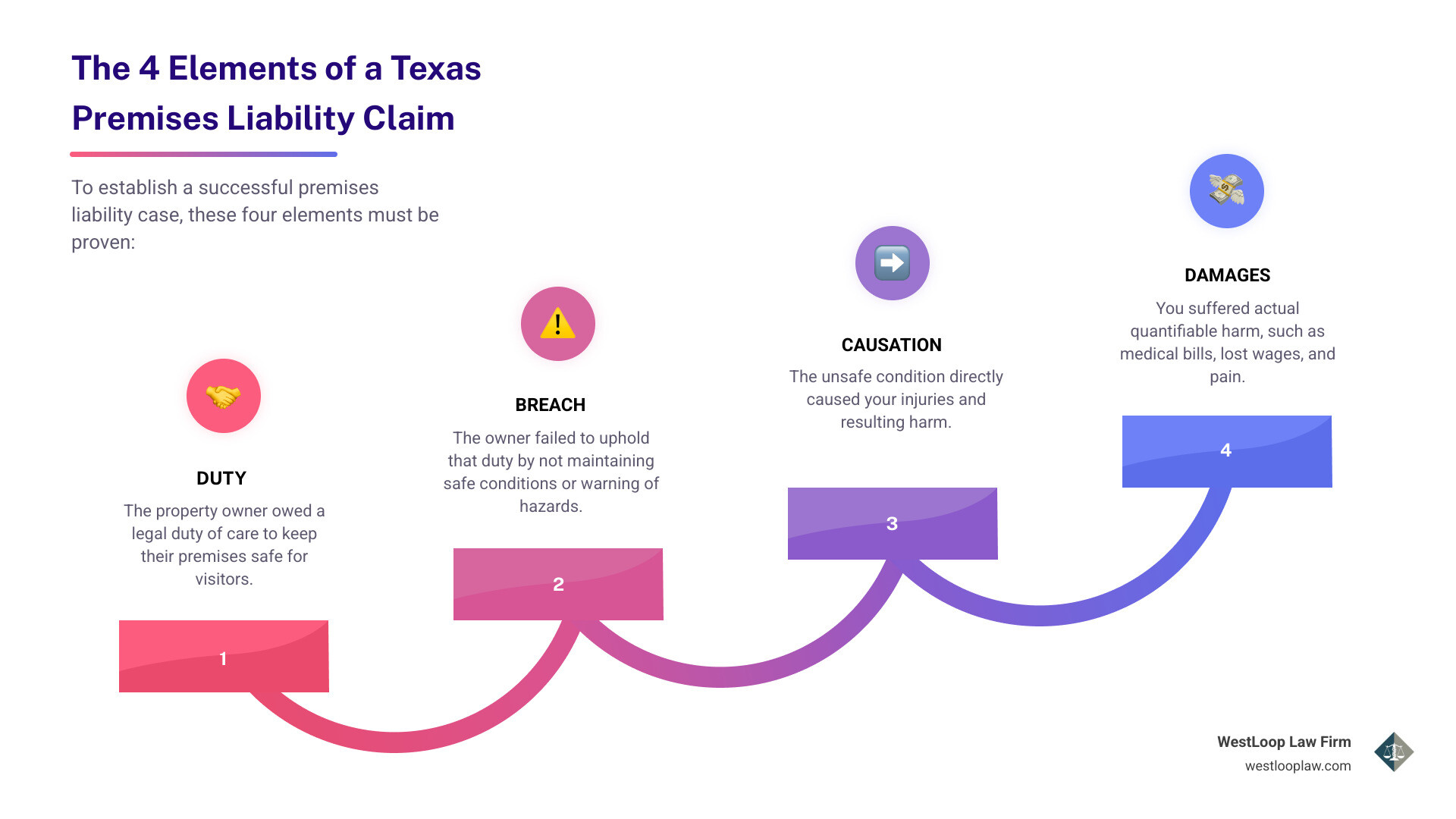
To successfully win a premises liability claim in Texas, you must prove four key elements of negligence: Duty, Breach, Causation, and Damages. Each element must be established with sufficient evidence.
Establishing Duty and Breach
First, you must establish that the property owner owed you a duty of care. This involves proving:
- The defendant was the owner or occupier of the property where the injury occurred. This can be complex with multiple parties like tenants or management companies responsible for Houston properties along routes such as Westheimer Road or the 610 Loop.
- Your status as a visitor (invitee, licensee, or trespasser) at the time of the incident, which defines the specific duty of care owed to you.
- The property owner breached their duty of care by failing to act as a reasonable property owner would. This can be proven through evidence like maintenance logs, safety policies, and witness testimony.
How Causation is Proven in a Premises Liability Case
Proving causation—a direct link between the property owner’s breach of duty and your injury—is often the most challenging part of a case. Texas law requires proving two types of causation:
- Cause-in-Fact (or “But For” Causation): This means the injury would not have occurred “but for” the property owner’s negligence. For example, “But for the uncleaned spill at the Houston grocery store, I would not have slipped and broken my leg.”
- Proximate Cause (or Legal Cause): This element focuses on foreseeability. The injury must be a reasonably foreseeable consequence of the owner’s negligence. A fall from a broken step is foreseeable; being struck by a meteor after the fall is not.
Connecting the breach of duty directly to the injury requires meticulous evidence. A Houston premises liability lawyer can work to rule out other potential causes of your injury, ensuring the property owner’s negligence is clearly established as the direct cause. Your medical records from trusted Houston hospitals like Houston Methodist or Memorial Hermann are critical in establishing this link.
For a general explanation of how courts think about causation in negligence cases, you can review the Wikipedia article on causation in English law. While it addresses a different jurisdiction, many of the core ideas about cause-in-fact and foreseeability are conceptually similar to how Texas courts analyze causation in premises liability claims.
The Crucial Role of an Experienced Premises Liability Lawyer in Houston
When you’re injured on someone else’s property in Houston, the legal process can be daunting. You’re likely dealing with physical pain, emotional distress, and mounting medical bills. Trying to steer complex Texas premises liability laws and negotiate with insurance companies on your own is overwhelming. This is where an Experienced premises liability lawyer in Houston becomes your strongest ally.
We handle every aspect of your claim, allowing you to focus on your recovery. Our role includes:
- Investigating the Accident: We examine the scene, gather facts, and interview witnesses to determine what happened and who is at fault, whether the incident occurred downtown, in the Energy Corridor, or off Highway 290.
- Preserving Evidence: We act quickly to secure photos, documents, and witness statements before they are lost.
- Calculating Damages: We assess all your losses, including current and future medical bills, lost wages, and pain and suffering.
- Negotiating with Insurance Companies: We use our knowledge of Texas law to negotiate with insurers and fight for the maximum compensation you deserve.
- Filing a Lawsuit: If a fair settlement isn’t reached, we are prepared to file a lawsuit and represent you in a Houston court.
- Navigating the Texas Legal System: We guide you through the complex legal process, ensuring deadlines are met and your rights are protected.
Texas has strict deadlines (statutes of limitations) for filing claims. Missing them can bar you from recovering compensation. An Experienced premises liability lawyer in Houston will ensure your claim is filed on time.
For context on how limitation periods function in many legal systems, see the overview in the Wikipedia article on statutes of limitations. Houston premises liability cases must comply with the specific deadlines set by Texas law.
How an Experienced Houston Premises Liability Lawyer Gathers Critical Evidence
Building a strong premises liability case in Houston requires compelling evidence. We know what evidence is crucial and how to obtain it, including:
- Photographs and Videos of the Scene: Photos of the hazard (like a cracked Houston sidewalk), the surrounding area, and any warning signs (or lack thereof).
- Incident Reports: A copy of the report filed with the property owner or manager.
- Witness Statements: Accounts from anyone who saw the accident.
- Medical Records and Bills: Records from hospitals like Houston Methodist or Memorial Hermann prove your injuries and treatment costs.
- Professional Testimony: In complex cases, we may consult with engineers or medical professionals to provide professional opinions on the accident and your injuries.
- Security Camera Footage: Footage from surveillance cameras on commercial properties, like those along I-10 or the 610 Loop, can be powerful evidence.
- Maintenance and Inspection Records: These show whether the owner was diligent in maintaining the property.
Maximizing Your Compensation with an Experienced Houston Premises Liability Lawyer
Our goal at WestLoop Law Firm is to help you recover the full compensation you deserve for your injuries. This includes both economic and non-economic damages:
- Economic Damages: These are quantifiable financial losses, such as:
- Medical bills (past and future)
- Lost wages (including lost earning capacity if your injury impacts your ability to work long-term)
- Rehabilitation costs
- Out-of-pocket expenses related to your injury
- Non-Economic Damages: These are more subjective losses that impact your quality of life, including:
- Physical pain and suffering
- Mental anguish and emotional distress
- Loss of enjoyment of life
- Disfigurement or scarring
We calculate all your damages, including future medical needs. Insurance companies often make lowball offers. We fight these tactics to ensure your settlement reflects the true impact of your injuries. With an Experienced Houston premises liability lawyer on your side, you significantly improve your chances of securing the maximum possible compensation.
What to Do Immediately After an Injury on Someone Else’s Property in Houston
The moments immediately following an injury on someone else’s property in Houston are critical. The steps you take can significantly impact your health and any future premises liability claim.
- Seek Immediate Medical Attention: Your health is the top priority. Get checked out by a doctor or go to a hospital like Memorial Hermann, Houston Methodist, or Ben Taub Hospital, even if you feel fine. This creates an official record of your injuries.
- Report the Incident: Inform the property owner or manager about your injury as soon as possible. Ask for an incident report to be filed and get a copy.
- Document the Scene: Use your phone to take pictures and videos of the hazard, the surrounding area, and any lack of warning signs. Note the date, time, and conditions, such as rain or poor lighting on streets like Westheimer Road or Washington Avenue.
- Get Witness Information: If anyone saw the accident, ask for their name and phone number.
- Do Not Admit Fault or Sign Documents: Avoid saying anything that suggests you were at fault. Do not sign any documents from the property owner or their insurer without first consulting with an Experienced premises liability lawyer in Houston.
- Preserve Evidence: Keep the shoes and clothing you were wearing at the time of the accident.
Taking these steps can help protect your health and preserve crucial evidence for your Houston premises liability claim.
Conclusion: How a Houston Premises Liability Lawyer at WestLoop Law Firm Can Help
Premises liability law in Houston, Texas, is designed to protect individuals injured due to a property owner’s negligence. However, navigating these complex laws, proving fault, and securing fair compensation can be a significant challenge.
Acting quickly after an injury is paramount, as evidence can disappear and strict legal deadlines must be met. The value of professional legal guidance from an Experienced premises liability lawyer in Houston cannot be overstated. We are here to investigate your claim, gather critical evidence, negotiate with insurance companies, and fight for your rights.
At WestLoop Law Firm, we are dedicated to providing compassionate and effective legal representation to injury victims in Houston, Texas. We understand the physical, emotional, and financial toll an injury can take, and we are here to shoulder the legal burden so you can focus on healing.
If you or a loved one has been hurt on property in Houston—whether along I-10, near the Galleria, in Midtown, or anywhere else in the Greater Houston area—WestLoop Law Firm is ready to help you understand your legal options and pursue the compensation you deserve.
For more information on how we handle slip and fall cases, visit our page on the topic: Slip and Fall Cases.