 Skip to content
Houston dog bite laws 2025: Crucial Guide
Why Understanding Houston Dog Bite Laws Matters After an Attack
Houston dog bite laws combine Texas state statutes with local ordinances that determine when a dog owner can be held responsible for injuries. If you or a loved one has been bitten by a dog in Houston, here’s what you need to know right away:
Quick Answer: Houston Dog Bite Liability
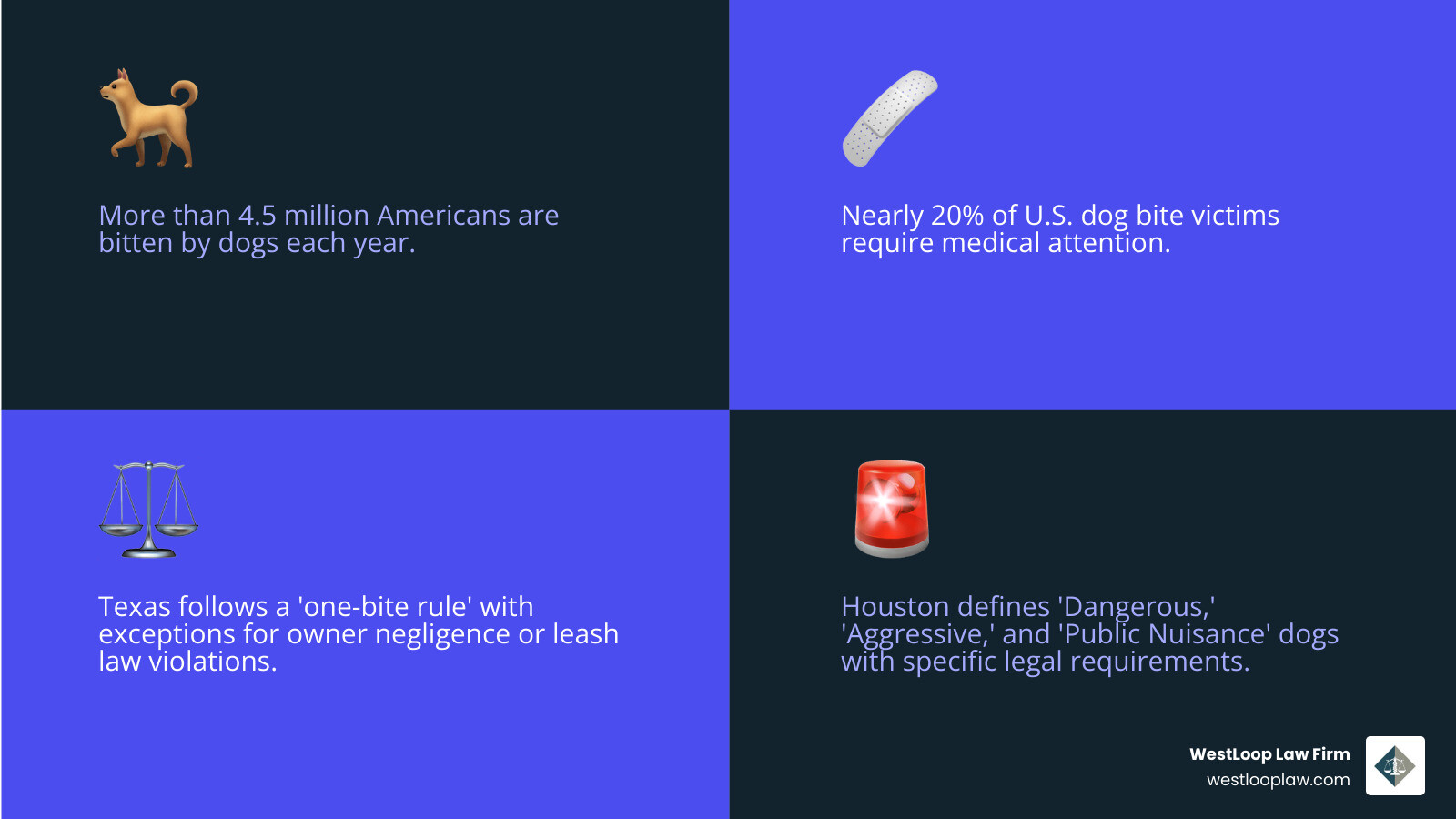
- Texas follows the “one-bite rule” – owners are typically not liable for a dog’s first bite unless they knew the dog was dangerous
- Exceptions exist – owners can be liable even for first bites if they violated Houston’s leash laws, acted negligently, or knew their dog had aggressive tendencies
- Houston has strict leash ordinances – dogs must be restrained in public spaces, and violations can establish owner liability
- Three dog classifications – Houston defines “Dangerous Dogs,” “Aggressive Dogs,” and “Public Nuisance Dogs” with different legal requirements
- Criminal charges are possible – serious injuries can result in third-degree felonies; fatal attacks can be second-degree felonies
- Victims must act quickly – report bites to BARC (call 311), seek medical attention, and document everything
Each year, over 4.5 million Americans are bitten by dogs, with nearly 20% requiring medical attention. If you’re a victim in Houston, navigating your rights while dealing with injuries and financial stress can be overwhelming. The legal landscape is complex, involving Texas state law, Houston city ordinances, and Harris County regulations. These rules dictate owner responsibilities for restraint and insurance, and the procedures for victims, like reporting the bite and filing claims.
Whether you were attacked near Memorial Park, along Buffalo Bayou, or in your neighborhood near I-10 or Highway 59, understanding Houston dog bite laws is crucial. This guide will explain owner liability, immediate steps to take after a bite, and how the legal process works.
Understanding Texas’s “One-Bite Rule” and Its Exceptions
In Texas, dog bite liability often hinges on the “one-bite rule.” This rule generally protects an owner from liability for their dog’s first bite, but only if they had no prior knowledge of the dog’s aggressive tendencies. The idea is that an owner couldn’t prevent an attack they couldn’t foresee. However, this is not a “free bite” pass. There are significant exceptions, especially under Houston dog bite laws, that can hold an owner responsible even for a first-time incident. For a deeper understanding of the state’s animal regulations, you can refer to Chapter 822 Regulations of Animals of the Texas Health and Safety Code.
How Negligence Voids the One-Bite Rule in Houston
The ‘one-bite rule’ does not apply if the owner was negligent. In Houston, negligence is a common way to establish liability. It means the owner failed to use reasonable care to prevent the bite. Examples of negligence include:
- Failure to Restrain: Not leashing or containing a dog, allowing it to escape through a broken fence or open gate.
- Unsecured Property: Having a fence that is inadequate to contain the animal, even with a “Beware of Dog” sign.

- Ignoring Known Aggression: Leaving a dog unsupervised that has shown aggressive tendencies (growling, lunging), even if it hasn’t bitten before. This is especially true if children are nearby.
- Violating Local Ordinances: Breaking Houston or Harris County’s animal control laws is strong evidence of negligence.
If an owner could have prevented the bite but didn’t, they can be held liable. This can also apply to landlords who know about a dangerous dog on their property and do nothing. Our firm helps victims prove negligence to hold responsible parties accountable, even for a first bite.
The Impact of Houston’s Leash Laws on Liability
Houston dog bite laws are heavily influenced by the city’s strict leash ordinances. Violating these laws can directly establish liability for a dog bite, often bypassing the ‘one-bite rule.’ If a dog is off-leash in a public area and bites someone, the owner is typically considered negligent by default.
Houston’s Code of Ordinances requires dogs to be restrained in public spaces, with exceptions only for designated off-leash dog parks. You can review these regulations in ARTICLE IV. – DOGS AND CATS | Code of Ordinances | Houston, TX . An animal not under restraint is considered “at large” and a public nuisance under Harris County rules. If a dog bites someone while “at large,” the owner’s violation of the leash law is clear evidence of negligence.
For example, if a dog is loose in a park near the Galleria area and bites a jogger, the owner’s failure to use a leash strengthens the victim’s case. This violation demonstrates a lack of reasonable care, making it easier to prove liability.
A Closer Look at Specific Houston Dog Bite Laws
Beyond the ‘one-bite rule’ and general negligence, Houston dog bite laws include specific city and Harris County ordinances that define aggressive animal behavior and owner responsibilities. These local rules are enforced by authorities like BARC (Bureau of Animal Regulation and Care). When a dog bite occurs in Houston, BARC is the primary agency for reporting and investigation, and their involvement is crucial for any subsequent legal claim.
Defining Dangerous, Aggressive, and Nuisance Dogs in Houston
Houston dog bite laws legally define different types of problematic dog behavior. These classifications—’Dangerous Dog,’ ‘Aggressive Dog,’ and ‘Public Nuisance Dog’—determine an owner’s responsibilities and the actions authorities can take.
| Dog Classification | Legal Definition & Criteria -|
| Dangerous Dog | Makes an unprovoked attack causing bodily injury outside of its secure enclosure. OR Commits unprovoked acts outside an enclosure, causing a person to reasonably fear an attack. (Texas Health & Safety Code) -|
| Aggressive Dog | Bites or causes a skin-breaking injury to a person or domestic animal, without provocation, while off its owner’s property. (City of Houston Ordinance) -|
| Public Nuisance Dog | Unreasonably annoys humans, endangers life or health, or interferes with the rights of others. Examples include being repeatedly at large, damaging property, or excessive barking. (City of Houston Ordinance) -|
Bodily Injury vs. Serious Bodily Injury: The distinction between ‘Bodily Injury’ and ‘Serious Bodily Injury’ is crucial under Houston dog bite laws. ‘Bodily injury’ is defined as physical pain, illness, or any impairment of physical condition. ‘Serious bodily injury’ is an injury that creates a substantial risk of death or that causes death, serious permanent disfigurement, or protracted loss or impairment of the function of any bodily member or organ. This distinction often determines whether a case is handled as a civil matter or can escalate to criminal charges against the owner.
Key Owner Responsibilities Under Houston Dog Bite Laws
Responsible dog ownership in Houston involves specific legal duties. Adhering to these rules is crucial for public safety and can impact liability in a bite case. Key responsibilities for dog owners in Houston and Harris County include:
- Rabies Vaccination: Texas law requires all dogs to be vaccinated for rabies by four months of age. A lapse in vaccination can lead to severe consequences after a bite, including mandatory quarantine.
- Dog Licensing: Harris County requires all dogs over three months old to be licensed with Harris County Public Health (HCPH), which requires proof of rabies vaccination.
- Restraint Regulations: Houston and Harris County have strict leash laws. Dogs must be restrained in public. An unrestrained animal is considered a stray and public nuisance. Tethering is also regulated, with restrictions on time, location (near schools), and weather conditions.
- Requirements for Owners of Declared “Dangerous Dogs”: If a dog is declared “dangerous,” the owner must:
- Register the dog with local animal control.
- Keep it in a secure enclosure with specific requirements.
- Obtain at least $100,000 in liability insurance.
- Comply with other rules like microchipping.
- Report any subsequent attacks within 48 hours.
Failure to follow these legally binding regulations can result in fines, impoundment, and increased liability.
Immediate Steps for a Dog Bite Victim in Houston
A dog bite is a traumatic experience. The steps you take immediately after are critical for your health and for preserving your legal rights. If you are bitten by a dog in Houston, take the following actions:
- Seek Medical Attention Immediately: Your health is the priority. Dog bites can cause serious infections (rabies, tetanus), nerve damage, and tissue trauma. Even minor bites need professional assessment. Go to an urgent care, your doctor, or an ER like Memorial Hermann or HCA Houston Healthcare for immediate treatment.
- Report the Bite to BARC or Harris County Animal Control: Officially document the incident by reporting it. In Houston, call 311. In unincorporated Harris County, contact Harris County Animal Control. This creates an official record and initiates an investigation, including a mandatory 10-day rabies quarantine for the dog.
- Document Everything: Take clear photos of your injuries, the location of the attack, the dog (if safe), and any damaged property. This documentation is vital for a legal claim.
- Identify the Dog and Owner: If it’s safe, get the owner’s name, address, and phone number. Ask for the dog’s name, breed, and vaccination status. Avoid confrontation.
- Gather Witness Information: Ask any witnesses for their names and contact information. Their testimony can be very helpful.
- Do Not Speak to Insurance Adjusters Without Legal Counsel: The owner’s insurance company will likely contact you to minimize their payout. Do not give a statement, sign anything, or accept an offer without first consulting an attorney, as you could harm your claim.
- Contact a Legal Representative: Once you’ve received medical care, contact a personal injury firm like ours. We can help you steer Houston dog bite laws, protect your rights, and pursue the compensation you deserve.
How to Report a Dog Bite and Initiate a Dangerous Dog Declaration
Reporting a dog bite and initiating a dangerous dog declaration are critical steps with legal implications for your claim. In Houston, this process involves BARC (Bureau of Animal Regulation and Care).
Here’s how it works:
- Contact 311: To report a bite in Houston, call 311. You’ll be connected with BARC to provide details of the incident.
- File a Sworn Affidavit: To have a dog declared dangerous or aggressive, you must file a sworn, notarized affidavit with BARC detailing the attack. Emailed statements are not enough. Find more information on the City of Houston’s BARC website.
- The Investigation: BARC will investigate by interviewing you, the owner, and witnesses, and reviewing the dog’s history. Provide all evidence you have, such as photos and medical records.
- After the Report:
- Determination: If BARC finds the dog dangerous or aggressive, the owner is notified.
- Serious Bodily Injury: If the injury was serious, a Municipal Court hearing will determine the dog’s fate.
- Compliance: If found dangerous without causing serious injury, the owner has 30 days to comply with requirements like getting insurance and a secure enclosure.
- Appeals: Owners have 15 days to appeal a dangerous dog determination.
- No Determination: If BARC doesn’t declare the dog dangerous, you may still be able to pursue it in a Justice of the Peace court.
This administrative process creates an official record that is invaluable for a personal injury lawsuit, as it can prove the owner’s knowledge of the dog’s aggressive nature.
Potential Consequences for the Dog Owner
When a dog bite incident leads to injuries, the consequences for the dog owner can be significant, extending beyond emotional distress to serious legal and financial liabilities. Our firm helps victims pursue these claims, ensuring owners are held accountable under Houston dog bite laws.
The primary consequence for a dog owner in a civil case is liability for damages incurred by the victim. These damages can include:
- Medical Bills: This is often the largest component. Dog bites can result in extensive medical treatment, including emergency room visits, stitches, antibiotics, reconstructive surgery, physical therapy, and psychological counseling.
- Lost Wages: If the victim’s injuries prevent them from working, they can claim compensation for lost income, both current and future.
- Pain and Suffering: This non-economic damage covers the physical pain, emotional distress, disfigurement, and loss of enjoyment of life caused by the bite.
- Other Out-of-Pocket Expenses: This can include transportation costs to medical appointments, prescription costs, and any other related expenses.
Homeowner’s Insurance Coverage Explained
A crucial aspect of recovering compensation for dog bite incidents often involves the dog owner’s homeowner’s insurance policy. Many homeowner’s insurance policies in Texas typically cover dog bite incidents, treating them as a personal liability claim. This means the insurance company would be responsible for paying damages up to the policy limits.
However, there are important caveats:
- Policy Exclusions: Some homeowner’s insurance policies have specific exclusions. For example, certain dog breeds deemed “dangerous” (like Pit Bulls, Rottweilers, or German Shepherds, though breed-specific legislation varies) might be excluded from coverage. Owners of these breeds might need to purchase separate liability insurance or face having their policy canceled.
- Limited Coverage: Some policies might cap dog bite liability at a lower amount than other personal liability claims.
- Rental Properties: If the dog owner is a renter, their renter’s insurance policy might offer some liability coverage, but it’s often more limited than a homeowner’s policy. Landlords can also be held liable if they knew of a dangerous dog on their premises and failed to act.
It’s vital for dog owners to review their insurance policies carefully to understand their coverage. For victims, our firm investigates available insurance policies to determine the potential sources of recovery.
Understanding Criminal Charges for Severe Dog Attacks
While most dog bite cases fall under civil liability, there are circumstances under Houston dog bite laws where a dog owner could face criminal charges, especially in severe incidents. This typically occurs when the owner’s negligence or intent reaches a criminal level, or if their dog is already known to be dangerous.
When a dog bite becomes a crime:
- Knowledge of Danger: A key factor is whether the dog owner knew their animal was dangerous. The research states: “If a dog owner knows that it is a dangerous animal and it makes an unprovoked attack outside of its secure area, that person can be charged and convicted of a crime if the dog causes serious bodily injury or death.”
- Unprovoked Attack Outside Secure Area: The attack must be unprovoked and occur in a place other than a secure enclosure. This means if a known dangerous dog escapes and attacks, the owner is at high risk of criminal charges.
- Serious Bodily Injury: If the attack results in serious bodily injury, the owner can be charged with a third-degree felony. Serious bodily injury, as defined in Texas law, is an injury that creates a substantial risk of death or causes serious permanent disfigurement, or protracted loss or impairment of the function of any bodily member or organ.
- Fatal Attack: Tragically, if a dog attack results in the death of the victim, the owner can be charged with a second-degree felony. These severe penalties underscore the gravity of owner responsibility.
These criminal provisions are often associated with what is commonly known as “Lillian’s Law” in Texas, which was enacted to impose stricter penalties on owners of dangerous dogs. Proving an owner’s criminal negligence requires a higher standard of proof than civil negligence, but when met, it can lead to devastating consequences for the owner, including imprisonment and substantial fines. Our role is typically in the civil aspect, helping victims recover damages, but we are well aware of the criminal implications that can arise from severe dog attacks in Houston.
How Legal Counsel Steers Houston’s Complex Dog Bite Laws
Navigating the intricacies of Houston dog bite laws can feel like trying to untangle a ball of yarn while blindfolded, especially when you’re recovering from an injury. This is where a personal injury firm like WestLoop Law Firm can provide invaluable assistance. We act as your guide and advocate, ensuring your rights are protected and you receive the compensation you deserve.
Here’s how our legal team can assist individuals who have been victims of dog bites in Houston:
- Investigating the Incident: We don’t just take your word for it; we gather evidence. This includes obtaining animal control reports, witness statements, medical records, and photographic evidence. We investigate the dog’s history, looking for any prior incidents or aggressive behaviors that the owner should have known about.
- Proving Owner Negligence: As we’ve discussed, the ‘one-bite rule’ has many exceptions, and proving negligence is often key. We build a case demonstrating that the dog owner failed in their duty of care—whether through violating leash laws, failing to secure their property, or ignoring known aggressive tendencies.
- Calculating Damages: Dog bite injuries can be costly, both financially and personally. We carefully calculate all your damages, including current and future medical expenses, lost wages, pain and suffering, emotional distress, and any property damage. This ensures no aspect of your loss is overlooked.
- Negotiating with Insurance Companies: Dealing with insurance adjusters can be intimidating. They are trained to minimize payouts. We handle all communications and negotiations with the dog owner’s insurance company, protecting you from common tactics used to devalue claims and ensuring you receive a fair settlement.
- Representing Victims in Court: If a fair settlement cannot be reached through negotiation, we are prepared to take your case to court. We advocate fiercely on your behalf, presenting a compelling case to a judge or jury to secure the compensation you need.
- Navigating the Dangerous Dog Declaration Process: If the dog involved needs to be declared dangerous, we can guide you through the administrative process with BARC, ensuring your sworn statements are properly filed and followed up on, which can be crucial evidence for your civil case.
Our firm’s combined background in personal injury and probate law allows us to approach these cases with a comprehensive understanding, making sure all legal avenues are explored for our clients in Houston. We understand the physical, emotional, and financial toll a dog bite can take, and we are committed to providing effective advocacy.
Conclusion
Navigating the complexities of Houston dog bite laws can be a daunting experience for anyone involved. As we’ve seen, Texas follows the ‘one-bite rule,’ but this rule is riddled with exceptions, particularly when negligence, leash law violations, or known aggressive tendencies are at play. Houston city ordinances and Harris County regulations further define what constitutes a ‘dangerous dog,’ ‘aggressive dog,’ or ‘public nuisance dog,’ each carrying specific responsibilities for owners.
For victims, acting quickly and methodically after a dog bite is paramount. Seeking immediate medical attention, reporting the incident to BARC or animal control, thoroughly documenting everything, and gathering witness information are all critical steps. These actions not only protect your health but also lay the groundwork for any potential legal claim.
For dog owners, understanding your responsibilities—from rabies vaccinations and restraint laws to the stringent requirements for declared dangerous dogs—is essential. Failure to comply can lead to significant civil liabilities for damages and, in severe cases, even criminal charges.
The legal landscape surrounding dog bites in Houston is intricate, and the emotional and financial stakes can be high. If you or a loved one has been affected by a dog bite, you don’t have to face it alone. Acting quickly to understand your rights and options is your best defense.
Contact our team for guidance on your Houston dog bite case. We are here to help you understand your legal options and pursue the justice and compensation you deserve.