 Skip to content
Medical Malpractice Wrongful Death Attorney: Expert Justice 2025
When Tragedy Strikes: Understanding Your Legal Options After a Preventable Death in Houston
A medical malpractice wrongful death attorney helps families seek justice and compensation when a loved one dies due to preventable medical errors. If you’re searching for focused legal help in Houston, here’s what an attorney can do for you:
- Investigate medical errors that led to death (surgical mistakes, misdiagnosis, medication errors)
- Prove negligence by establishing that healthcare providers violated the standard of care
- Calculate damages including medical bills, funeral costs, lost income, and loss of companionship
- Handle complex legal procedures, including gathering medical records and consulting professional witnesses
- Negotiate with insurance companies or represent your family in court
- Work on contingency, meaning no upfront costs—you only pay if they win your case
Who Can File in Texas: Surviving spouse, children, parents, or the estate’s personal representative
Time Limit: Generally two years from the date of death under Texas law
Losing a loved one is devastating. When that death results from a mistake at the Texas Medical Center, a surgical error at Houston Methodist Hospital, or negligence at any Houston healthcare facility, your grief can be compounded by a sense of injustice.
Medical errors are a leading cause of death in the United States. Behind the statistics are families left to cope with unexpected loss while facing mounting medical bills and funeral expenses.
In Houston, wrongful death cases can arise from many situations, including accidents on I-10 or the Houston Ship Channel, workplace injuries, or defective products. Cases involving medical negligence, however, carry unique challenges. They require attorneys who understand both personal injury law and the complex medical issues involved.
A Houston medical malpractice wrongful death attorney can answer your questions and handle the legal burden so you can focus on healing.
Medical malpractice wrongful death attorney vocab to learn:
Understanding Wrongful Death and Medical Malpractice in Texas
To understand the role of a medical malpractice wrongful death attorney, it’s important to know the two legal concepts involved: wrongful death and medical malpractice.
In Texas, a wrongful death occurs when one party’s negligence causes another person’s death. This can result from many incidents, such as a car accident on the Katy Freeway or a workplace incident at a Houston construction site. Surviving family members may have grounds for a claim.
Medical malpractice is a specific type of negligence. The American Board of Professional Liability Attorneys (ABPLA) defines medical malpractice as a negligent act or omission by a medical provider that causes injury. It means a healthcare professional failed to provide the level of care that a prudent, similarly-trained professional would have. When this failure results in a patient’s death at a facility like Houston Methodist Hospital, it becomes a medical malpractice wrongful death case.
The “standard of care” is the level of skill a reasonably careful healthcare professional in the same field would have used in a similar situation. A failure to meet this standard that leads to death is the basis of the claim.
Here’s a quick comparison:
| Feature | Medical Malpractice Claim | Wrongful Death Claim |
|---|---|---|
| Primary Focus | Injury to a patient due to medical negligence | Death of an individual due to another’s negligence or wrongful act |
| Who Files | The injured patient | Surviving family members or the deceased’s estate |
| Damages Sought | Medical expenses, lost wages, pain and suffering | Funeral costs, lost financial support, loss of companionship, grief, pain and suffering of the deceased before death |
| Relationship to Death | Can lead to death, but not always | Always involves a death |
| Legal Basis | Breach of professional medical standard of care | Negligence, carelessness, or wrongful act leading to death (can include medical malpractice) |
| Goal | Compensation for patient’s injuries | Compensation for the losses suffered by the surviving family members due to the death |
When medical negligence leads to death, the two concepts merge, requiring a medical malpractice wrongful death attorney to steer the legal complexities.
The Legal Definition of Negligence
At the heart of any claim is negligence. For a medical malpractice wrongful death claim in Houston to succeed, we must prove four key elements:
- Duty of Care: A doctor-patient relationship existed, establishing that the healthcare provider owed a legal duty to the patient.
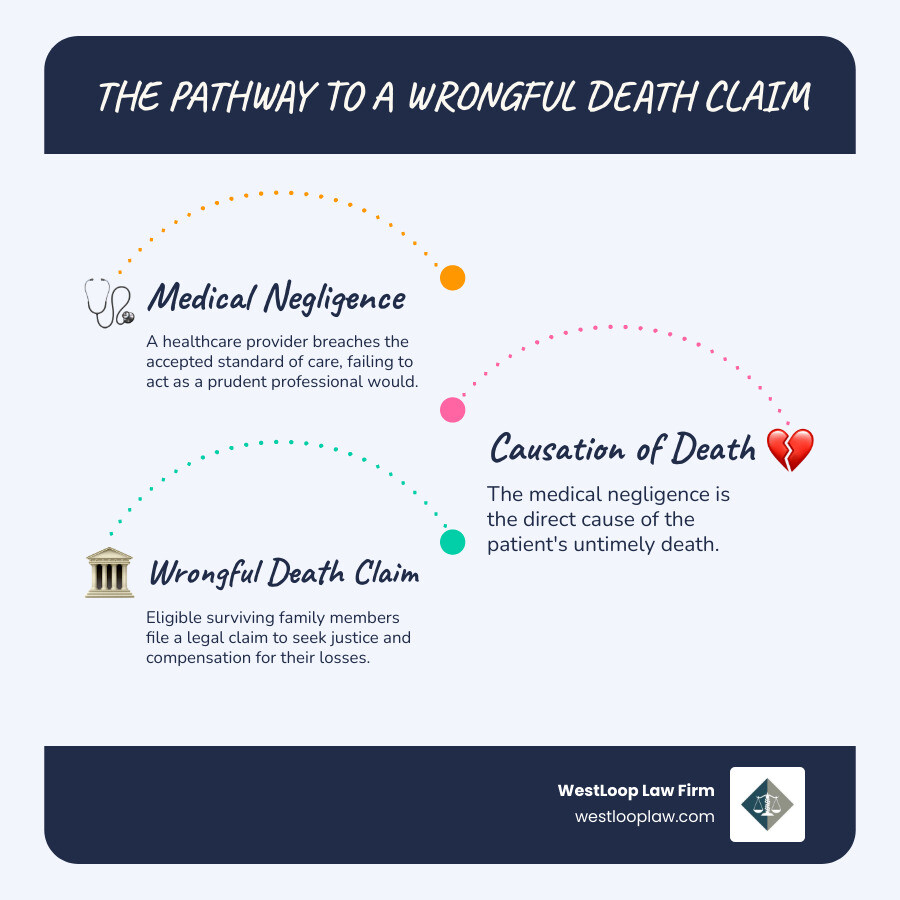
- Breach of Standard of Care: The provider violated that duty by failing to meet the accepted standard of care. As we learn more about medical negligence, it occurs when a health care professional fails to provide the expected level of care that a prudent, similarly-skilled professional would have.
- Causation: The breach of care directly caused or contributed to the patient’s death. This requires showing a clear link between the provider’s negligence and the fatal outcome.
- Damages: The death resulted in actual damages or losses for the surviving family members.
Proving all four elements is essential for a successful claim and requires a deep understanding of both medical and legal principles.
Common Causes and Key Elements of a Houston Wrongful Death Claim
Wrongful death cases in Houston can arise from many tragic circumstances. While our focus is on medical malpractice, it’s helpful to understand the broader context.

Beyond medical errors, common causes of wrongful death in Houston include:
- Car Accidents: Negligent driving on highways like I-10, the Southwest Freeway (US-59), or Loop 610.
- Workplace Incidents: Accidents at industrial facilities along the Houston Ship Channel or on construction sites.
- Defective Products: Poorly designed or manufactured products that lead to an unexpected death.
- Negligent Security: A death occurring on a property due to inadequate security measures.
However, medical errors are a leading cause of death. According to a study from Johns Hopkins University School of Medicine, medical errors are the third leading cause of death in the United States. This highlights the need for families to seek guidance from a medical malpractice wrongful death attorney.
Key Elements You Must Prove
As outlined previously, a successful wrongful death lawsuit in Houston requires proving four key elements: a duty of care was owed, that duty was breached (negligence), the breach caused the death, and the death resulted in damages. The burden of proof is a “preponderance of the evidence,” meaning it is more likely than not that the defendant’s negligence caused the death.
Common Medical Errors Leading to Wrongful Death
Many types of medical errors can lead to a medical malpractice wrongful death claim, often occurring at facilities like the Texas Medical Center or other Houston hospitals. Common examples include:
- Surgical Mistakes: Operating on the wrong body part, leaving instruments inside a patient, or anesthesia complications.
- Anesthesia Errors: Administering an incorrect dosage or failing to monitor a patient’s vital signs.
- Misdiagnosis or Delayed Diagnosis: When a serious condition like cancer or a heart attack is diagnosed incorrectly or too late, preventing effective treatment.
- Medication Errors: Prescribing the wrong medication or dosage, or failing to identify dangerous drug interactions.
- Birth Injuries: Negligence during childbirth, such as improper use of instruments or failure to monitor fetal distress, leading to the death of the infant or mother.
- Poor Follow-Up Care: Inadequate post-operative monitoring or failure to address complications.
Each scenario represents a potential breach of the standard of care. Our team works with families in Houston to investigate these complex situations and build strong cases.
How a Houston Medical Malpractice Wrongful Death Attorney Can Help
The aftermath of a loved one’s death from medical negligence is a painful and confusing time. Navigating the legal system for a medical malpractice wrongful death claim can feel overwhelming. A dedicated Houston medical malpractice wrongful death attorney is an invaluable ally, providing comprehensive support and strategic guidance.

Our role is to alleviate the legal burden, allowing you to focus on healing. We handle every step of the process, from investigation to resolution:
- Thorough Investigation: We carefully investigate the death, gathering all medical records, interviewing witnesses, and collecting evidence from facilities like the Texas Medical Center.
- Evidence Analysis: We secure and analyze complex medical charts, test results, and physician’s notes to identify deviations from the standard of care.
- Working with Medical Professionals: We consult with board-certified physicians and other medical professionals who review the evidence, establish the proper standard of care, and determine how the defendant’s actions fell short.
- Calculating Total Losses: We carefully assess all economic and non-economic damages, including funeral costs, lost income, loss of companionship, and emotional trauma.
- Negotiating with Insurance Companies: We handle all communications with insurance adjusters, protecting your rights and fighting for a fair settlement.
- Court Representation: If a fair settlement isn’t reached, we are prepared to represent your family in a Houston courtroom, presenting a compelling case to a jury.
- Contingency Fee Basis: We work on a contingency fee basis, meaning you pay no upfront legal fees. We only get paid if we successfully recover compensation for you.
The Critical Role of Medical Witnesses
In a medical malpractice wrongful death case, medical witnesses are critical. These are healthcare professionals in the same field as the defendant. Their testimony is essential to:
- Establish the Standard of Care: Define what a reasonably prudent physician would have done.
- Prove Breach of Duty: Explain how the defendant deviated from that standard.
- Clarify Complex Issues: Translate medical terminology into understandable terms for a jury.
- Establish Causation: Provide the crucial link between the provider’s negligence and the death.
How a Wrongful Death Claim Differs from a Personal Injury Claim
While related, these claims have key differences:
- Who Files: A personal injury claim is filed by the living victim. A wrongful death claim is filed by surviving family members or the estate.
- Damages: Personal injury damages cover the victim’s losses. Wrongful death damages cover the family’s losses due to the death. Texas law also allows for a “survival action,” which lets the estate recover damages the deceased could have claimed if they had lived, such as pre-death pain and suffering.
Filing a Claim in Houston: Eligibility, Deadlines, and Damages
Navigating the legal landscape after a wrongful death in Houston requires a clear understanding of Texas law. Our firm’s combined knowledge in injury and probate law is particularly helpful, as these claims often interact with probate court proceedings. The Texas Wrongful Death Act and the Texas Survival Statute outline who can file, what damages can be recovered, and the critical deadlines.
Who Is Eligible to File a Lawsuit in Texas?
Texas law specifies that the following individuals can bring a wrongful death claim:
- The deceased’s surviving spouse
- The deceased’s children (biological and adopted)
- The deceased’s parents
If these family members do not file a claim, the personal representative of the deceased’s estate can file on behalf of the beneficiaries. Typically, all eligible individuals must file a single claim jointly.
What Damages Can Be Recovered in Houston?
A wrongful death claim aims to provide financial stability and a sense of justice. Recoverable damages fall into two categories:
- Economic Damages: These are quantifiable financial losses:
- Funeral and Burial Expenses: Costs for the funeral, burial, or cremation.
- Medical Bills: Expenses from the injury until the time of death.
- Lost Income/Earning Capacity: The financial support the deceased would have provided.
- Lost Inheritance: The value of assets the deceased would have accumulated.
- Loss of Services: The monetary value of household services and support the deceased provided.
- Non-Economic Damages: These compensate for intangible losses:
- Loss of Companionship: The loss of love, comfort, and society.
- Mental Anguish: The emotional pain and grief of surviving family members. Families often benefit from grief counseling to cope with such loss.
- Pain and Suffering of the Deceased: A survival action can recover damages for the pain the deceased endured before their death.
Be aware that Texas law caps non-economic damages in medical malpractice cases, which affects the total recoverable in a medical malpractice wrongful death claim. Our team helps Houston families understand these limits.
Understanding the Texas Statute of Limitations
One of the most critical aspects of a wrongful death claim in Houston is the statute of limitations, a strict deadline for filing a lawsuit.
In Texas, the statute of limitations for a wrongful death lawsuit is two years from the date of death. Missing this deadline can permanently bar your right to seek compensation.
While rare exceptions like the “findy rule” may apply if the cause of death was not immediately findable, relying on them is risky. It is essential to consult a Houston medical malpractice wrongful death attorney as soon as possible to preserve evidence and meet all legal deadlines.
Frequently Asked Questions about Houston Wrongful Death Claims
We understand you likely have many questions during this difficult time. Here are some common questions we hear from families in Houston:
What is the first step I should take if I suspect wrongful death?
Your first step should be to contact a law firm with a background in handling wrongful death cases in Houston. They can help preserve evidence and advise you on the strict legal deadlines, such as the two-year statute of limitations in Texas, ensuring your rights are protected from the start.
How much does it cost to hire an attorney for a wrongful death case?
Most wrongful death attorneys in Houston work on a contingency fee basis. This means you do not pay any upfront fees. The attorney’s fee is a percentage of the compensation they recover for you, so you only pay if they successfully win or settle your case.
Can I still file a claim if the person who died was partially at fault?
Yes, Texas follows a “modified comparative fault” rule. This means you can still recover damages as long as your loved one was 50% or less at fault for the incident that caused their death. The amount of compensation would be reduced by their percentage of fault.
Holding Negligent Parties Accountable in Houston
The unexpected loss of a loved one due to someone else’s negligence, especially a medical error, leaves an indelible mark on a family. While no legal action can erase the pain, pursuing a medical malpractice wrongful death claim in Houston serves multiple crucial purposes: it seeks justice for your loved one, provides financial stability for your family, and can even help prevent similar tragedies from happening to others.
At WestLoop Law Firm, we combine our knowledge in personal injury and probate law, offering a unique and comprehensive approach to these sensitive cases. We understand the profound impact such a loss has, and we are committed to providing compassionate yet determined legal guidance to families across Houston, from the busy streets of downtown to the quiet neighborhoods.
If you believe your loved one’s death was preventable and caused by medical negligence or any other wrongful act, we encourage you to take the next step. Contact us today for a confidential consultation. Let us help you understand your rights and explore your legal options. You don’t have to face this challenge alone.