 Skip to content
Houston Work Accident Attorney: 5 Steps to Justice
Why Injured Houston Workers Need a Houston Work Accident Attorney
If you’re injured on the job in Houston, a houston work accident attorney can help you steer the complex legal system and fight for the compensation you deserve. Here’s what you need to know right away:
Your Legal Options After a Houston Work Accident:
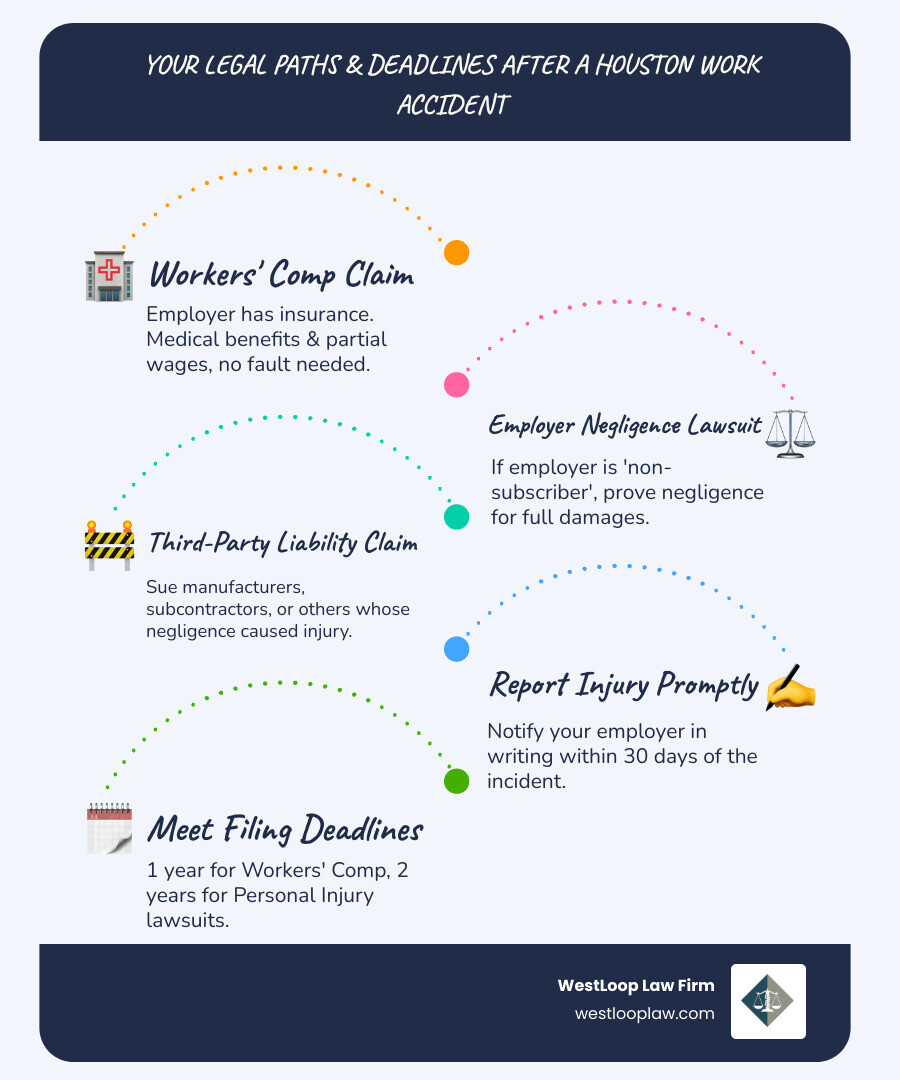
- Workers’ Compensation Claim – File with your employer’s insurance (if they have it) for medical benefits and partial wage replacement, regardless of fault.
- Personal Injury Lawsuit Against Employer – Sue your employer directly if they’re a “non-subscriber” (don’t carry workers’ comp insurance) and you can prove negligence.
- Third-Party Liability Claim – File a lawsuit against anyone other than your employer who caused your injury (manufacturers, subcontractors, property owners, other drivers).
Critical Deadlines in Texas:
- 30 days to report your injury to your employer in writing
- 1 year to file a workers’ compensation claim
- 2 years to file a personal injury lawsuit
Getting hurt at work turns your life upside down. The physical pain is bad enough, but then come the medical bills, the missed paychecks, and the stress of figuring out how you’ll support your family while you heal.
Houston’s workforce faces unique dangers. From construction sites along the I-10 corridor to refineries near the Port of Houston, from warehouses in the Energy Corridor to maritime operations at the Ship Channel, workers across our city risk serious injury every day. In 2023 alone, 15 workers were killed on the job in Houston, with an additional six fatalities in the greater metro area.
Here’s what makes work injury cases in Texas different from most other states: private employers are not required to carry workers’ compensation insurance. This means your legal options depend heavily on whether your employer is a “subscriber” or “non-subscriber” to the workers’ comp system.
A Houston work accident attorney helps you identify which path gives you the best chance at full recovery. They handle the insurance companies, meet the tight deadlines, gather evidence, and fight for every dollar you’re owed while you focus on healing.
Houston work accident attorney terms you need:
- Houston oilfield injury lawyer
- Houston offshore injury attorney
- Catastrophic injury attorney houston
Your First Steps After a Houston Work Accident
Being hurt on the job in Houston can be disorienting and painful. What you do immediately after a work accident can significantly impact your ability to secure compensation and protect your legal rights. These initial steps are crucial, whether your accident happens on a construction site downtown, in a warehouse near the I-10 corridor, or at a busy facility in the Texas Medical Center.

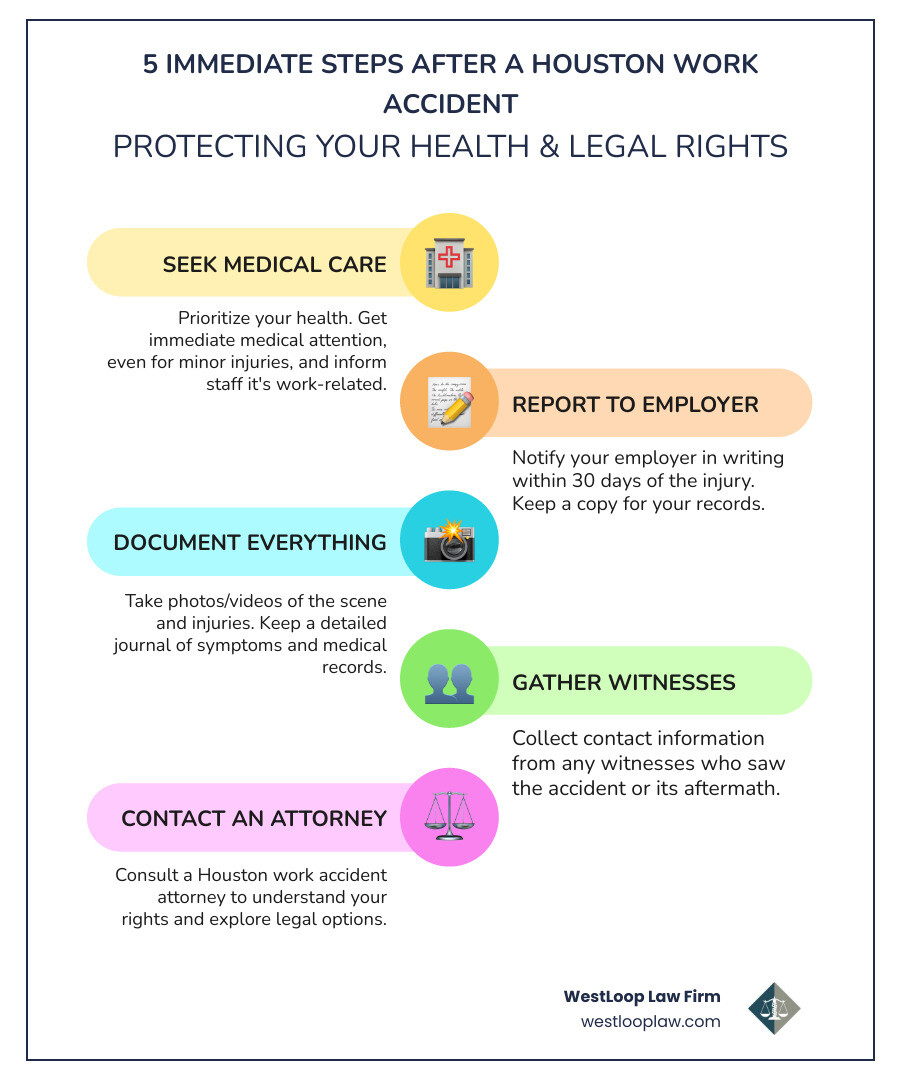
Seek Immediate Medical Attention
Your health is paramount. Even if you think your injury is minor, seek medical attention right away. What seems like a small bump or bruise could mask a more serious underlying issue. Go to an emergency room, an urgent care clinic, or see your primary care physician.
When you receive medical care, it is vital to inform the medical staff that your injury is work-related. This ensures that your medical records accurately reflect the cause of your condition, which is critical documentation for any future claim. In Texas, if your employer has workers’ compensation insurance, you may need to see a doctor within their approved workers’ compensation health care network. Make sure to follow all recommended follow-up appointments and treatment plans diligently.
Report the Injury to Your Employer
After addressing your immediate medical needs, your next step is to report the injury to your employer. Texas law requires injured workers to report their injury to their employer within 30 days to be eligible for workers’ compensation benefits. We advise reporting it as soon as possible, and always in writing.
Even if you’ve told your supervisor verbally, a written notice creates an undeniable record. Use any company accident report forms available, but also consider sending an email or certified letter detailing the incident, the date, time, location, and nature of your injury. Keep a copy of this report for your own records. This simple step can prevent disputes down the line about whether or when the injury was reported.
Document the Scene and Your Injuries
The more evidence you gather, the stronger your potential claim. If possible and safe to do so, take photos or videos of the accident scene, including any hazardous conditions, defective equipment, or visible injuries. Get contact information from any witnesses who saw what happened.
Beyond the immediate scene, keep a detailed journal of your symptoms, pain levels, and how the injury impacts your daily life. Preserve any equipment or clothing involved in the accident. Maintain a meticulous record of all medical appointments, treatments, prescriptions, and especially any days you miss from work. This documentation will be invaluable as we build your case.
Understanding Your Legal Pathways: Workers’ Comp vs. Lawsuits
Navigating the legal aftermath of a work accident in Houston can feel like traversing a maze. The path you take depends largely on whether your employer carries workers’ compensation insurance, a unique aspect of Texas law. Whether your injury occurred at the busy Port of Houston or a quiet office, understanding these differences is key.
Here’s a quick comparison of the two main legal avenues:
| Feature | Workers’ Compensation Claim | Personal Injury Lawsuit |
|---|---|---|
| Employer Coverage | Employer must have workers’ comp insurance | Employer is a “non-subscriber” (does not have workers’ comp) OR a third party is at fault |
| Fault | No-fault system (don’t need to prove employer negligence) | Must prove negligence (employer or third party) |
| Damages Recoverable | Medical bills, partial lost wages, specific disability benefits | Full medical bills, full lost wages, lost earning capacity, pain and suffering, mental anguish, disfigurement, punitive damages (in some cases) |
| Right to Sue Employer | Generally cannot sue employer directly (exclusive remedy) | Can sue employer directly |
| Third-Party Claims | Yes, if someone other than employer caused injury | Yes, if someone other than employer caused injury |
The Texas Workers’ Compensation System
Texas is distinctive because it is the only state where workers’ compensation insurance is not required for most private businesses. If your employer does offer workers’ compensation coverage, then, under Section 408.001 of the Texas Labor Code, you are generally limited to workers’ comp benefits and cannot file a lawsuit against your employer. This is known as the “exclusive remedy” rule.
The workers’ compensation system in Texas is a “no-fault” system. This means you don’t have to prove your employer was negligent to receive benefits. If your injury occurred on the job, you are typically eligible. Benefits include coverage for medical expenses and a portion of your lost wages (known as income benefits). To apply for workers’ comp, you will need to complete form DWC-041 and submit it to the Texas Division of Workers’ Compensation Insurance within one year of your injury.
While workers’ comp can provide a safety net, it has limitations. It generally does not cover non-economic damages like pain and suffering or mental anguish, and income benefits are only a percentage of your average weekly wage.
What If My Employer Is a “Non-Subscriber”?
This is where Texas law offers a critical difference. If your employer does not offer workers’ compensation coverage (they are a “non-subscriber”), then you can (and should) file a lawsuit against them directly. In such cases, you must prove that your employer’s negligence caused your injury.
Employer negligence can take many forms:
- Unsafe Work Conditions: Failing to maintain a safe work environment, such as slippery floors, inadequate lighting, or dangerous equipment.
- Inadequate Training: Not providing proper training for tasks or machinery, leading to accidents.
- Defective Equipment: Supplying faulty tools or machinery without proper maintenance or warnings.
- Lack of Safety Protocols: Failing to implement or enforce necessary safety rules.
Crucially, if your employer is a non-subscriber, they lose certain legal defenses they would typically have, such as “assumption of the risk” or “contributory negligence.” This can make it easier for us to prove their fault and secure full compensation for your injuries.
Pursuing a Third-Party Personal Injury Lawsuit
Even if your employer does carry workers’ compensation, you might still have the option to pursue a personal injury lawsuit against a “third party.” A third party is any individual or entity, other than your employer, whose negligence contributed to your workplace injury.
Common examples of third-party liability claims in Houston work accidents include:
- Defective Machinery Manufacturers: If a faulty piece of equipment, like a crane at a construction site or a machine in a manufacturing plant, caused your injury, we might sue the manufacturer.
- Negligent Subcontractors: On a large project, another company’s subcontractor might cause an accident due to their carelessness.
- At-Fault Drivers: If you were injured in a vehicle accident while driving for work (e.g., a delivery driver on the I-45), and another driver was at fault, you can sue that driver.
- Property Owners: If your injury was due to unsafe conditions on property owned by someone other than your employer, a premises liability claim might be appropriate.
A third-party lawsuit allows you to recover a broader range of damages than workers’ compensation, including full medical expenses, lost wages, lost earning capacity, physical impairment, disfigurement, and, significantly, compensation for your pain and suffering and mental anguish.
Maximizing Your Recovery: Compensation and Claim Value
When you’ve been injured at work in Houston, securing fair compensation is about more than just covering immediate medical bills. It’s about ensuring your financial stability as you heal and for your future. The value of your claim depends on many factors, and our goal is to maximize every aspect of your recovery.
What Compensation Can I Recover?
The types of compensation you can recover vary significantly between a workers’ compensation claim and a personal injury lawsuit against a non-subscriber employer or a third party.
In a personal injury lawsuit, you can seek “full damages,” which typically include:
- Medical Bills: Covering all past and future medical expenses related to your injury, including doctor visits, surgeries, medications, rehabilitation, and assistive devices.
- Lost Wages: Reimbursement for the income you’ve already lost due to being unable to work.
- Lost Earning Capacity: Compensation for the income you will likely lose in the future if your injury prevents you from returning to your previous job or working at the same capacity.
- Physical Impairment: Damages for the physical limitations or permanent loss of function caused by your injury.
- Disfigurement: Compensation for any scarring or physical changes that impact your appearance.
- Pain and Suffering: This covers the physical pain and emotional distress you endure as a result of your injury.
- Mental Anguish: Compensation for the psychological impact, such as anxiety, depression, or PTSD, especially common after severe workplace incidents in high-stress environments like the oil and gas fields.
Workers’ compensation benefits, on the other hand, primarily cover medical expenses and a percentage of lost wages, but generally do not include compensation for pain and suffering.
How a Houston Work Accident Attorney Determines Claim Value
Determining the true value of a work accident claim is a complex process. It involves a thorough evaluation of all the tangible and intangible losses you’ve suffered. Our approach is meticulous, considering every detail:
- Severity of Injury: The nature and extent of your injuries are primary. A catastrophic injury, such as a spinal cord injury or amputation, will naturally lead to a higher claim value than a minor sprain.
- Total Medical Costs: We calculate not just your current medical bills but also project future medical needs, including long-term care, rehabilitation, and potential surgeries.
- Impact on Future Earnings: This involves looking at your pre-injury income, your potential for career advancement, and how your injury will affect your ability to earn a living going forward.
- Impairment Rating Calculation: For workers’ compensation claims, an “impairment rating” (IR) is determined by a physician after you reach Maximum Medical Improvement (MMI). The Texas Workers’ Compensation Act § 408.124 outlines guidelines for this. The IR is a percentage reflecting the permanent damage to your body as a whole, and it directly influences the amount of Impairment Income Benefits (IIBs) you receive.
- Role of Insurance Companies: Insurance companies, whether workers’ comp or third-party, are businesses. Their goal is to minimize payouts. We negotiate aggressively with them, armed with strong evidence and a clear understanding of your claim’s full worth. We counter their lowball offers and fight to ensure you receive what is rightfully yours.
Handling Permanent Disability and Long-Term Needs
Some work accidents in Houston result in permanent disabilities, drastically altering a worker’s life. If your injury leads to a long-term or permanent impairment, the compensation structure shifts to address these ongoing needs.
After you reach Maximum Medical Improvement (MMI)—the point at which your condition is not expected to improve further, as defined by the Texas Department of Insurance—your Temporary Income Benefits (TIBs) will end. You may then become eligible for:
- Impairment Income Benefits (IIBs): Based on your impairment rating, you typically receive 3 weeks of benefits for every 1% of impairment.
- Supplemental Income Benefits (SIBs): If your impairment is significant and you haven’t been able to return to work earning at least 80% of your pre-injury wages, SIBs might be available for up to 401 weeks.
- Lifetime Income Benefits (LIBs): Reserved for the most severe injuries, such as total and permanent loss of use of two body parts, spinal cord injuries resulting in paralysis, or severe brain injuries. These benefits are paid for the rest of your life.
Beyond income benefits, we also consider the long-term medical care you’ll require, including ongoing physical therapy, medications, and potential adaptive equipment. In some cases, vocational rehabilitation may be necessary to help you transition to a new career path if you can no longer perform your previous job duties. We work to ensure that all these long-term needs are factored into your claim value.
Why You Need a Houston Work Accident Attorney on Your Side
When you’re recovering from a work injury, the last thing you need is the added stress of legal battles and paperwork. That’s where a dedicated houston work accident attorney steps in. We act as your shield, navigating the complexities so you can focus on healing.
How a Lawyer Manages Your Claim
Our role is comprehensive, ensuring every aspect of your claim is handled with precision and care:
- Evidence Gathering: We carefully collect all necessary evidence, from accident reports and medical records to witness statements and professional testimony. This includes investigating every detail, interviewing witnesses, and reviewing safety protocols, especially crucial in industries like construction or oil and gas.
- Communicating with Insurance Adjusters: Insurance companies are notorious for trying to minimize payouts. We handle all communications, protecting you from tactics designed to undervalue your claim or elicit statements that could harm your case.
- Filing Legal Paperwork Correctly: The legal system is filled with deadlines and specific procedures. We ensure all forms, including initial claims like DWC-041, and lawsuits are filed accurately and on time, preventing costly delays or denials.
- Calculating Full Damages: We go beyond immediate costs to calculate the full extent of your damages, including future medical expenses, lost earning capacity, and non-economic losses like pain and suffering.
- Fighting Claim Denials: If your workers’ compensation claim is denied, we can appeal the decision, challenging the reasons for denial with compelling evidence and legal arguments.
- Handling Retaliation: It is illegal for an employer to retaliate against an employee for filing a work injury claim. If you face wrongful termination, demotion, or harassment after reporting an injury, we can take legal action to protect your rights and seek compensation for such actions.
The Cost of Hiring a Work Accident Lawyer
We understand that concerns about legal fees can deter injured workers from seeking help. That’s why we operate on a contingency fee basis. This means:
- No Upfront Costs: You don’t pay us any fees out of your pocket to start your case.
- “No Win, No Fee” Structure: We only get paid if we successfully recover compensation for you. Our fee is a percentage of the settlement or award we secure. If we don’t win, you don’t owe us attorney fees.
- Free Initial Consultation: We offer a complimentary consultation to discuss your case, evaluate your legal options, and explain how we can help, all without any obligation. This allows you to understand your situation and our approach before making any commitments.
This arrangement allows injured workers in Houston to pursue justice without the burden of immediate financial strain, ensuring that everyone has access to quality legal representation.
Frequently Asked Questions about Houston Work Accident Claims
When you’re injured on the job in Houston, you likely have many questions about your rights and what comes next. Here are some of the most common inquiries we address:
What are the most common work accidents in Houston?
Houston’s diverse economy means a wide range of workplace hazards. Based on data from the Occupational Safety and Health Administration and our own experience, some of the most common work accidents in Houston include:
- Construction Accidents: Falls from heights, scaffolding collapses, struck-by incidents, and heavy machinery accidents are unfortunately frequent on Houston’s many construction sites, from downtown high-rises to suburban developments.
- Oil and Gas Industry Incidents: Explosions, burns, chemical exposure, and equipment malfunctions are risks faced by workers in Houston’s vast energy sector, both on land and offshore.
- Warehouse Injuries: Heavy lifting injuries, slips and falls, forklift incidents, and being struck by falling objects are common in the numerous distribution centers and warehouses around the city.
- Transportation Incidents: Workers who drive as part of their job, such as delivery drivers or truck drivers on major Houston arteries like the I-45 or Beltway 8, are at risk of vehicle accidents.
- Falls from Height: Whether from ladders, roofs, or liftd platforms, falls remain a leading cause of serious injury across various industries.
- Heavy Machinery Accidents: Operating or working near large equipment in manufacturing, construction, or industrial settings carries a significant risk of severe injury.
What is the statute of limitations for a work injury claim in Texas?
Understanding deadlines is critical, as missing them can forfeit your right to compensation:
- Workers’ Compensation Claims: In Texas, you generally have one year from the date of your injury to file a workers’ compensation claim with the Texas Division of Workers’ Compensation. You must also report the injury to your employer within 30 days.
- Personal Injury Lawsuits: For personal injury lawsuits, such as against a non-subscriber employer or a third party, Texas law provides a two-year statute of limitations from the date of the injury.
These deadlines are strict. We cannot stress enough the importance of acting quickly after a work accident in Houston to protect your legal options.
What are the rights of undocumented workers injured on the job in Texas?
It is a common misconception that undocumented workers have no legal recourse after a workplace injury. This is simply not true in Texas. Undocumented workers who are injured on the job have specific legal rights:
- Right to File a Lawsuit: In Texas, immigration status is not a barrier to filing a personal injury lawsuit against an employer (if they are a non-subscriber) or a negligent third party.
- Eligibility for Medical Care: Injured workers, regardless of status, are entitled to receive necessary medical treatment for their work-related injuries.
- Compensation for Lost Wages: Undocumented workers can seek compensation for lost wages due to their inability to work after an injury.
- Protection Against Retaliation: Employers cannot legally retaliate against any worker, including undocumented workers, for reporting a work injury or pursuing a claim.
We believe that every worker in Houston deserves justice if they are injured due to someone else’s negligence, regardless of their immigration status.
Get the Justice You Deserve for Your Houston Work Injury
Workplace accidents are a harsh reality. According to the Bureau of Labor Statistics, there were 5,190 fatal work injuries recorded in the U.S. in 2021, with over 10 percent (533) of all fatal work injuries in the country happening right here in Texas. Beyond fatalities, millions more suffer nonfatal injuries each year. These aren’t just numbers; they represent real people, real families, and real hardship.
If you’ve been injured on the job in Houston, you don’t have to face the recovery process, the medical bills, and the insurance companies alone. Your path to recovery and justice begins with understanding your rights and taking decisive legal action.
At Westloop Law Firm, we are committed to helping injured workers in Houston steer the complexities of work accident claims. Our dedicated approach, combined with our deep understanding of Texas law and local Houston dynamics, ensures that we fight tirelessly for the compensation you deserve. Let us handle the legal burden while you focus on what truly matters: your health and your future.
Don’t get worked over; get justice. We are here to listen to your story and provide the clear, compassionate legal guidance you need.
Contact a Houston personal injury lawyer for a free consultation today.