 Skip to content
What You Need to Know About Car Accident Compensation in Houston
Car accident compensation in Houston is money you can recover after a crash caused by someone else’s negligence. It covers your medical bills, lost wages, property damage, and pain and suffering — under Texas law.
Here’s a quick overview of what Houston car accident victims can typically recover:
| Type of Compensation | What It Covers | Examples |
|---|---|---|
| Economic damages | Measurable financial losses | Medical bills, lost wages, vehicle repairs |
| Non-economic damages | Personal impact of the injury | Pain and suffering, mental anguish, loss of enjoyment |
| Punitive damages | Punishment for extreme misconduct | Drunk driving, gross negligence |
Key facts to know right away:
- Texas is an at-fault state — the driver who caused the crash is responsible for your damages
- You have 2 years from the crash date to file a lawsuit (Texas Civil Practice and Remedies Code §16.003)
- If you are 51% or more at fault, you cannot recover anything under Texas law
- Typical settlements range from $15,000 to $50,000 for minor injuries — serious injuries often result in far higher awards
- Texas minimum liability coverage is only 30/60/25, which frequently falls short of covering real losses
Houston’s roads — including I-10, I-45, and Loop 610 — see tens of thousands of crashes every year. In 2023 alone, Houston recorded 40,077 total crashes, including 158 fatal accidents. If you were hurt in one of them, understanding your rights is the first step toward getting fair compensation.
This guide walks you through everything: the types of damages available, how fault affects your payout, what insurance limits mean for your case, and the steps to protect your claim from day one.
Car accident compensation Houston further reading:
Understanding Car Accident Compensation Houston
When you get behind the wheel in Houston, you are sharing the road with millions of other drivers. Most of the time, we get to our destinations safely. But when a crash occurs, Texas law steps in to determine who pays.
Texas operates under a traditional fault-based insurance system. This means the person who caused the wreck is legally obligated to pay for the resulting damages. To recover car accident compensation Houston, you must prove that the other driver was negligent. In legal terms, negligence means they failed to act with the level of care that a reasonable person would have used in the same situation — such as texting while driving down I-45 or running a red light near the Galleria.
The compensation you can recover is broadly split into two main categories: economic and non-economic damages. Here is a quick breakdown to help you understand how they compare:
| Feature | Economic Damages | Non-Economic Damages |
|---|---|---|
| Definition | Quantifiable, out-of-pocket financial losses | Subjective, non-monetary losses |
| How It’s Proven | Bills, receipts, pay stubs, tax returns | Medical journals, psychological evaluations, testimony |
| Examples | Emergency room bills, physical therapy, lost wages | Pain and suffering, mental anguish, disfigurement |
| Capped in Texas? | No | No (in standard car accident cases) |
Navigating the aftermath of a collision can feel like trying to navigate the West Loop during Friday afternoon rush hour. To make sense of the steps ahead, it helps to understand the underlying rules. For a detailed breakdown of how these claims move from the pavement to a payout, check out our guide on What to Know About the Injury Claim Process in Houston TX.
Economic Damages in a Houston Car Accident
Economic damages are the foundation of any injury claim because they represent real, green-dollar losses that you can prove with a paper trail. If you have a receipt, a bill, or a pay stub for it, it likely falls under economic damages.
The most substantial part of economic damages is almost always your medical expenses. If you are rushed to a trauma center like those in the Texas Medical Center, the bills accumulate rapidly. Economic damages cover:
- Emergency room care and ambulance transportation
- Diagnostic imaging like X-rays, MRIs, and CT scans
- Surgeries, hospital stays, and doctor visits
- Physical therapy, chiropractic care, and rehabilitation
- Prescriptions and medical devices (like crutches or braces)
- Estimated costs for future medical treatments if your injuries require ongoing care
Additionally, if your injuries keep you away from your job, you can recover your lost wages. This includes not just your base salary, but also missed overtime, bonuses, commissions, and paid time off you were forced to use. If your injuries cause a long-term disability that prevents you from returning to your career, you can seek compensation for your lost earning capacity.
Property damage is also included here, covering the cost to repair your vehicle or its fair market value if the insurance company decides it is a total loss. To see how these numbers are added up to form a demand, read our article on Calculating Damages Car Accident Injury Attorney.
Non-Economic Damages and Pain and Suffering
While economic damages pay for your bills, non-economic damages are designed to compensate you for the actual human toll of the accident. How do you put a price tag on the inability to hold your child, the chronic back pain that keeps you awake at night, or the anxiety of driving past the intersection where you were hit?
Under Texas law, non-economic damages include:
- Physical pain and suffering: The actual physical discomfort caused by your injuries.
- Mental anguish: Post-traumatic stress disorder (PTSD), severe anxiety, depression, and fear of driving after the wreck.
- Physical impairment: The loss of the ability to participate in hobbies, sports, or daily activities you once enjoyed.
- Disfigurement: Compensation for permanent scars, amputations, or physical changes caused by the crash or subsequent surgeries.
- Loss of consortium: The negative impact the injury has on your relationship with your spouse.
Because these losses do not come with a handy receipt, insurance companies and legal teams use specific methods to calculate their value. The most common is the multiplier method, where your total economic damages are multiplied by a number (typically between 1.5 and 5) depending on the severity of your injuries. Another approach is the per diem method, which assigns a daily dollar value to your pain and suffering and multiplies it by the number of days it takes you to reach maximum medical recovery.
To explore how these intangible losses are successfully argued and structured in settlements, read The Ultimate Guide to Car Wreck Injury Settlements.
Punitive Damages under Texas Law
In rare cases, a third tier of compensation comes into play: punitive damages (also known as exemplary damages). Unlike economic and non-economic damages, which are meant to restore the victim, punitive damages are designed to punish the wrongdoer and deter others from acting similarly.
Under the Texas Civil Practice and Remedies Code, you cannot receive punitive damages for simple negligence. You must prove by “clear and convincing evidence” that the at-fault driver acted with fraud, malice, or gross negligence. Gross negligence means the driver was aware of an extreme risk of harm but chose to proceed anyway, showing a conscious indifference to the safety of others.
Common examples in Houston car crashes include:
- Driving under the influence of drugs or alcohol
- Engaging in street racing on local freeways
- Fleeting the scene of a crash (hit-and-run)
Texas law places strict statutory caps on exemplary damages under Civil Practice & Remedies Code §41.008. Generally, punitive damages are limited to the greater of:
- $200,000, or
- Twice the amount of economic damages plus an equal amount of non-economic damages (up to $750,000).
How Texas Modified Comparative Negligence Affects Your Payout
One of the most common tactics insurance adjusters use to reduce payouts is pointing the finger back at the victim. They might argue you were speeding, failed to avoid the crash, or were distracted. In Texas, sharing fault does not automatically end your case, but it does heavily influence your final recovery.
Texas uses a rule called modified comparative negligence, often referred to as the 51% bar rule. Under this legal framework, you can recover compensation as long as your share of the responsibility for the crash is 50% or less. If you are found to be 51% or more at fault, you are legally barred from recovering a single penny from the other driver.
If you are partially at fault but remain under the 51% threshold, your compensation is reduced by your exact percentage of blame.
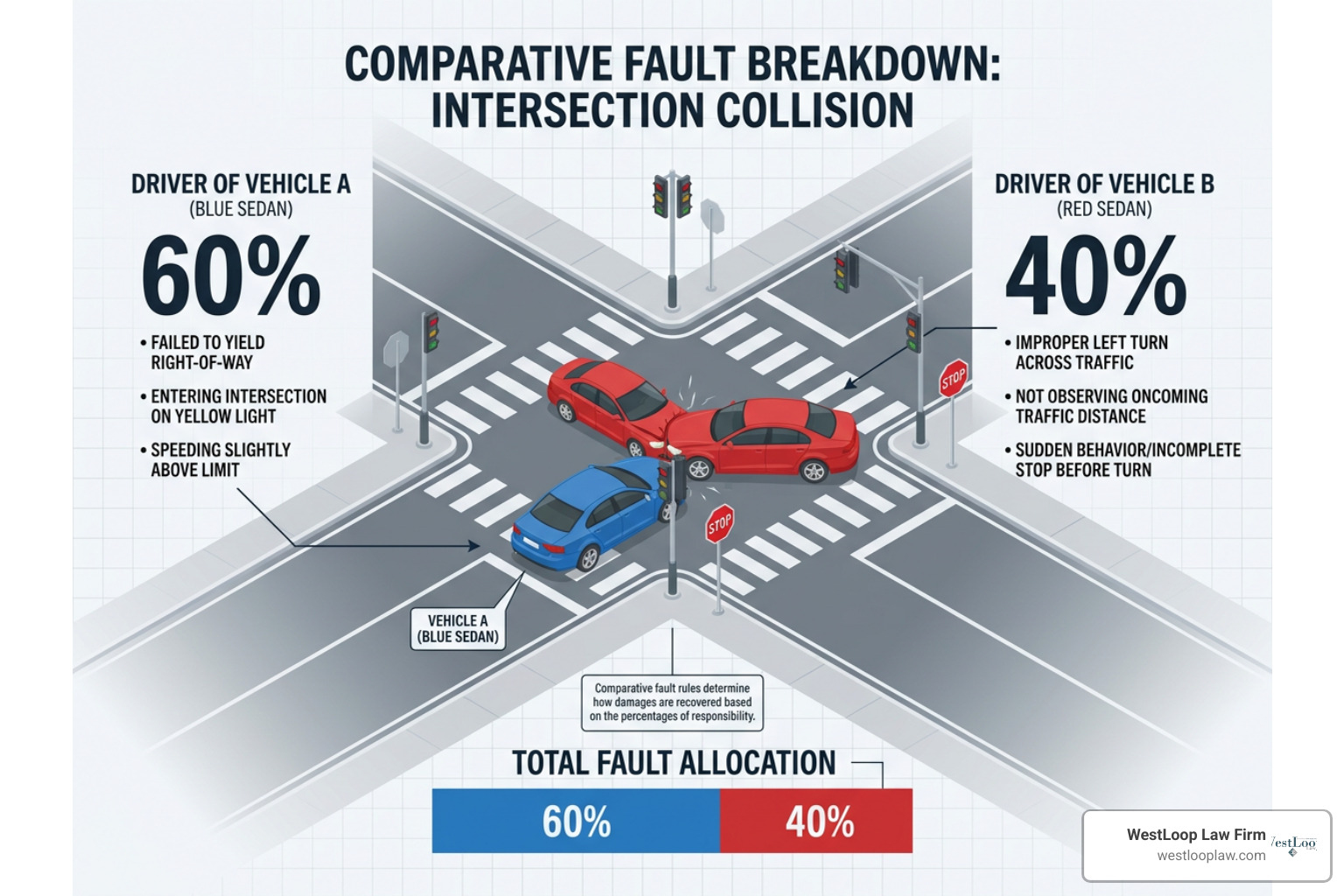
Let’s look at a quick real-world example: Imagine you are driving through an intersection in Downtown Houston. Another driver runs a red light and broadsides your car. However, the insurance company proves you were driving 10 mph over the speed limit at the time. The jury determines your total damages are $100,000, but finds you 20% responsible for the crash because of your speed.
- Your total award: $100,000
- Deduction for fault (20%): -$20,000
- Your final payout: $80,000
Because even a small shift in fault can cost you thousands of dollars, gathering strong evidence early is vital to keep the blame where it belongs. For more details on how we combat fault-shifting tactics, read the Westloop Law Firm – Houston Car Accident Guide.
Average Settlement Ranges and Influencing Factors in Houston
If you search online, you will find that the average car accident settlement in Houston typically ranges from $15,000 to $50,000. However, averages can be incredibly misleading. A minor rear-end fender bender on Westheimer Road might settle for $5,000, while a catastrophic collision involving an 18-wheeler on the East Loop can result in a multi-million-dollar recovery.
Several key factors dictate where your specific claim will fall on this wide spectrum:
- Severity of your injuries: Soft tissue injuries like whiplash command lower settlements than hard injuries like broken bones, traumatic brain injuries (TBI), or spinal damage.
- Total medical costs: The higher your medical bills, the higher the starting point for your settlement negotiations.
- Impact on employment: A construction worker or surgeon who cannot work due to a hand injury will recover more lost wages than someone who can easily work from home.
- Clarity of liability: If the other driver was clearly drunk and ran a stop sign, the insurer is more likely to offer a fair settlement quickly to avoid a trial.
- Available insurance policy limits: This is often the hard ceiling on what you can recover, which we will explore below.
To read more about realistic settlement structures and what to expect based on your specific injuries, see our detailed post: What is the Average Car Accident Settlement in Houston?.
How Insurance Policy Limits Impact Car Accident Compensation Houston
You could have a clear-cut case worth $200,000 in medical bills and lost wages, but if the driver who hit you carries only the minimum insurance required by law, recovering that money can be a major uphill battle.
Texas law mandates that all drivers carry a minimum liability coverage of 30/60/25. Here is what those numbers actually mean:
- $30,000 maximum payout for bodily injury to a single person in an accident.
- $60,000 maximum payout for bodily injury total per accident (if multiple people are hurt).
- $25,000 maximum payout for property damage per accident.
If you sustain a severe injury requiring surgery and a stay at the Texas Medical Center, your bills will easily blow past the $30,000 limit on day one. When damages exceed the at-fault driver’s policy limits, the insurance company is generally not obligated to pay a penny more than their policy cap. While you can technically sue the individual driver for their personal assets, most drivers who carry minimum limits do not have the cash or property to satisfy a major judgment.
If your accident involved a government vehicle or road defect, different rules apply. You can learn more about filing claims against municipal entities by visiting the City of Houston Legal Department – Filing a Claim.
Uninsured and Underinsured Motorist Coverage in Houston
Because minimum policy limits are so low, and because roughly 14% of Texas drivers carry no insurance at all, having a safety net is essential. This is where Uninsured/Underinsured Motorist (UM/UIM) coverage comes into play.
UM/UIM is an optional coverage you buy from your own insurance company. In Texas, insurance companies are legally required to offer it to you, and you must reject it in writing if you do not want it. We highly recommend keeping this coverage on your policy.
- Uninsured Motorist (UM): Steps in if you are hit by a driver who has no insurance, or if you are the victim of a hit-and-run crash where the driver is never found.
- Underinsured Motorist (UIM): Steps in when the at-fault driver’s policy limits are too low to cover your total damages.
For example, if you have $100,000 in medical bills and the at-fault driver has the minimum $30,000 limit, their insurance will pay the $30,000. Your UIM policy can then step in to cover the remaining $70,000, up to your own policy limits.
Key Challenges: Medical Liens, Pre-Existing Conditions, and Gaps in Treatment
Recovering car accident compensation Houston is rarely a straight line. Insurance companies employ highly trained adjusters whose primary goal is to pay you as little as possible. They often use three main hurdles to devalue your claim:
- Pre-Existing Conditions: If you had a bad back or a prior neck injury before the crash, the insurer will claim the accident didn’t cause your pain — your pre-existing condition did. However, Texas follows the eggshell plaintiff rule. This means the defendant must take you as they find you. If the crash aggravated or worsened your pre-existing condition, you are legally entitled to compensation for that worsening.
- Gaps in Treatment: If you wait two weeks after the crash to see a doctor, or if you skip physical therapy sessions, the insurance company will pounce. They will argue that either your injuries weren’t that serious, or that some other event caused your pain during that gap. Consistent medical documentation is your best shield against this tactic.
- Medical Liens and Subrogation: If your health insurance or Medicaid paid for your medical treatment after the crash, they will likely place a lien on your eventual settlement. This means they expect to be paid back out of your recovery.
Navigating these complex legal and financial hurdles requires a strategic approach. To learn how to counter these insurance tactics and keep more money in your pocket, check out our guide on How to Maximize Compensation for Your Car Accident Claim.
Crucial Steps to Take After a Crash in Houston
What you do in the minutes, hours, and days following a car crash on a busy Houston highway can make or break your ability to recover compensation.
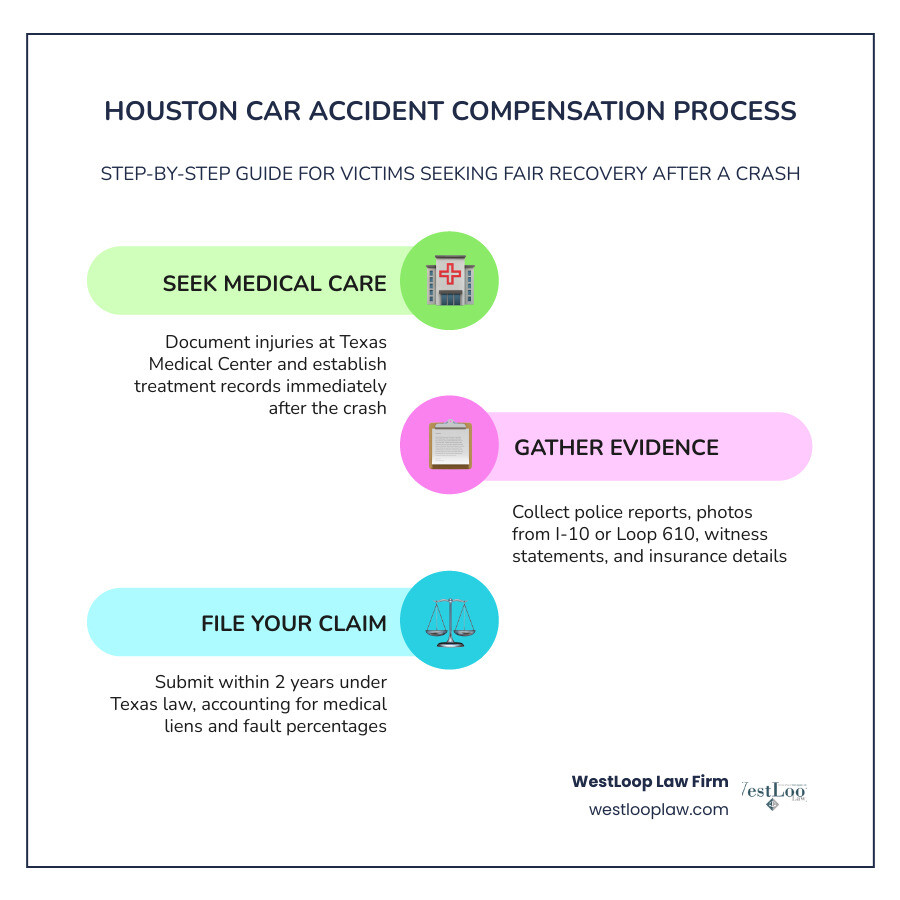
Immediate Actions to Secure Car Accident Compensation Houston
If you are involved in a collision, take these steps immediately to protect your health and your legal rights:
- Move to safety: If possible, pull your vehicle out of active traffic to the shoulder of the road and turn on your hazard lights.
- Call 911: Report the crash to the Houston Police Department or Harris County Sheriff’s Office. A formal police report is vital evidence for your claim.
- Check for injuries: Check yourself and your passengers. Even if you feel fine, adrenaline can mask severe injuries like internal bleeding or concussions.
- Exchange information: Get the other driver’s name, phone number, address, driver’s license number, and insurance details. Avoid discussing who caused the crash or apologizing — simple pleasantries can be twisted into admissions of fault later.
- Seek medical care immediately: Go to an emergency room, urgent care, or your primary doctor within 24 hours of the crash.
For additional immediate steps and legal advice on dealing with early insurance calls, see the Westloop Law Firm – Houston Car Accident Legal Advice.
Gathering Evidence and Documentation on Houston Roads
Houston’s massive freeways like Loop 610, I-10, and I-45 are cleared quickly after an accident to keep traffic moving. This means your window to gather evidence at the scene is incredibly small.
If you are physically able, collect the following evidence before the tow trucks arrive:
- Photos of all vehicles involved, showing the damage from multiple angles
- Photos of the surrounding road conditions, skid marks, traffic signs, and any debris
- Photos of your visible injuries
- Contact information for any witnesses who stopped to help
- The responding police officer’s name and badge number
To understand how to compile this evidence into an airtight case that insurance companies cannot ignore, read our article on Winning Your Houston Settlement Car Wreck Case.
The Texas Statute of Limitations and Legal Deadlines
Time is not on your side after a car wreck. Under the Texas Civil Practice and Remedies Code Section 16.003, the statute of limitations for personal injury claims is two years from the date of the accident.
If you do not file a formal lawsuit in a Texas court before this two-year window closes, you lose your right to seek compensation forever. While two years sounds like a long time, building a strong case, negotiating with insurers, and preparing a lawsuit takes months of diligent work.
There are very few exceptions to this rule:
- Minors: If the victim was under 18 at the time of the crash, the two-year clock generally does not start ticking until their 18th birthday.
- Government Claims: If you were hit by a city-owned vehicle (like a METRO bus or a city maintenance truck), you must file a formal notice of claim much faster — often within 180 days depending on the government entity involved.
Whether you are dealing with a daily commute from Sugar Land or navigating the busy streets of central Houston, missing these strict deadlines will derail your recovery. To learn more about navigating these legal minefields, check out Car Accident Lawyer Houston: The Sugar Land Commute is a Legal Minefield.
Frequently Asked Questions about Houston Car Accident Claims
What is the average car accident settlement in Houston?
There is no single “average” payout because every crash involves different injuries, wages, and insurance policies. While minor injuries might settle between $15,000 and $50,000, severe injuries requiring surgery or causing permanent disability often result in six- or seven-figure recoveries.
Can I still recover compensation if I was partially at fault for the Houston crash?
Yes, under Texas’s modified comparative negligence law, you can recover compensation as long as you are 50% or less at fault. However, your final payout will be reduced by your percentage of blame. If you are 51% or more at fault, you cannot recover any damages.
How do medical liens affect my net settlement in Texas?
If your health insurance, Medicare, or a medical provider paid for your treatments under a letter of protection, they may place a lien on your settlement. This means those bills must be paid directly out of your final settlement before you receive your portion. A skilled legal team can often negotiate these liens down to maximize your net recovery.
Conclusion
Securing fair car accident compensation Houston requires navigating a complex web of insurance policies, state laws, and medical bills. Insurance carriers are businesses focused on protecting their bottom line, and their initial settlement offers are routinely 30% to 50% below what you actually deserve.
At Westloop Law Firm, we believe you shouldn’t have to fight corporate insurance giants while trying to heal. Our team combines a deep understanding of Texas personal injury law with probate litigation to provide highly effective, compassionate representation for injured Houstonians. We handle your case on a contingency fee basis — meaning you pay us nothing upfront, and we only get paid if we win your case.
If you or a loved one has been injured on a Houston road, do not wait until the two-year clock runs out. Contact us today to schedule your free consultation and take the first step toward securing the compensation you deserve. Learn more about how we can help by visiting our Car Accident Lawyer in Houston page.