 Skip to content
What You Need to Know About a Trucking Log Book Dispute in Houston
A trucking log book dispute can cost a commercial driver thousands of dollars in fines, trigger an out-of-service order, and leave lasting damage on their CSA score — all from a single roadside inspection on a Houston highway like I-10 or I-45.
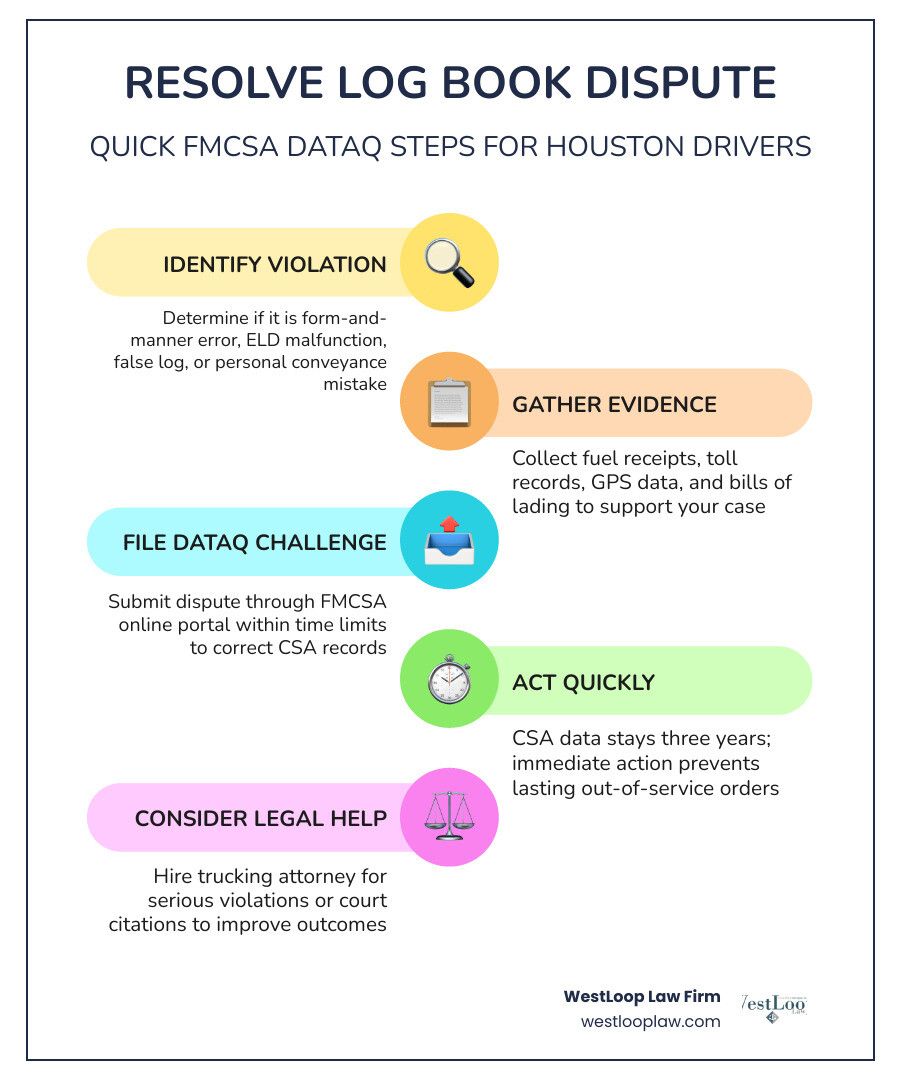
Here is a quick overview of how to resolve one:
- Identify the violation type — Was it a form-and-manner error, an ELD malfunction, a false log allegation, or a personal conveyance mistake?
- Gather supporting documents — Fuel receipts, toll records, GPS data, and bills of lading can all support your case.
- File a DataQ challenge — Use the FMCSA’s online DataQs portal to dispute inspection records you believe are inaccurate.
- Act quickly — CSA data stays on your record for up to three years. The sooner you dispute, the better.
- Consider legal help — For serious violations or court citations, working with a trucking attorney can significantly improve your outcome.
Nearly 24,000 out-of-service violations in 2023 were tied to falsified logbooks, according to FMCSA roadside inspection data. Another 29,000 violations occurred because drivers had no record of duty status at all. These numbers show how common — and how serious — logbook issues have become for drivers and carriers operating in and around Houston.
Whether you are a driver who received a citation at a weigh station, or someone injured by a fatigued driver whose logs don’t tell the full story, understanding how these disputes work is the first step toward protecting your rights.
Key Trucking log book dispute vocabulary:
Common Causes of a Trucking Log Book Dispute in Houston
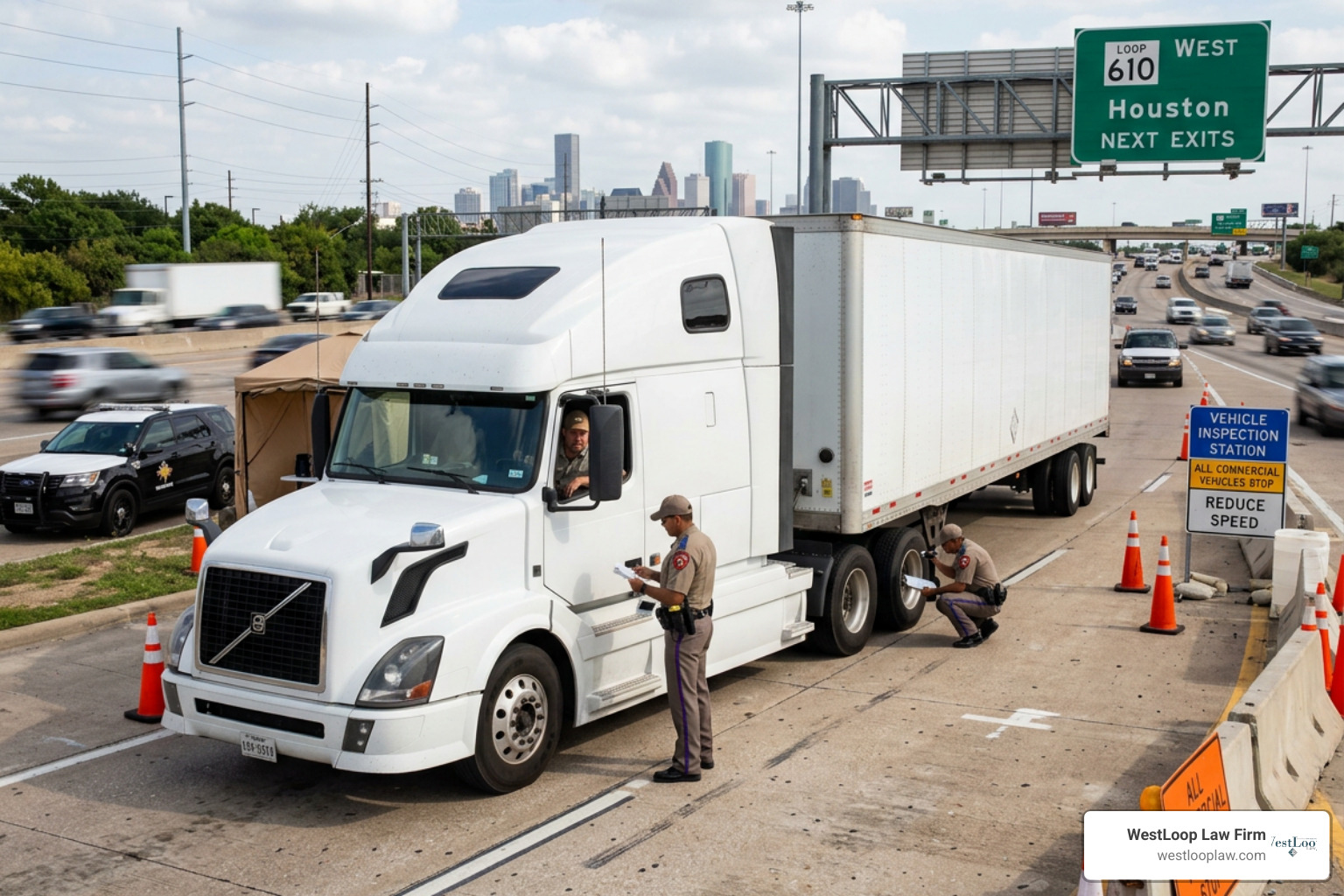
When commercial vehicle inspectors pull a rig over near Loop 610 or set up a roadside checkpoint along US-290, they do not just look at the tires and brakes. They dive straight into the driver’s Record of Duty Status (RODS). While the Federal Motor Carrier Safety Administration (FMCSA) transition to Electronic Logging Devices (ELDs) was supposed to make logbook errors a thing of the past, it actually created a brand-new landscape for a trucking log book dispute.
Today, logbook disputes typically stem from a few common issues:
- Hours of Service (HOS) Violations: These are the classic infractions. Drivers are limited to 11 hours of driving within a 14-hour window after 10 consecutive hours off-duty. Exceeding these limits, or failing to take the mandatory 30-minute break after 8 hours of cumulative driving, triggers immediate red flags.
- ELD Malfunctions: Technology is wonderful—until it stops working. If an ELD screen freezes, loses its connection to the engine control module, or fails to record data correctly, a driver can easily be flagged for having “no record of duty status.” Under federal rules, drivers must carry blank paper logs to use during a malfunction, but confusion over when and how to switch to paper often leads to citations.
- Personal Conveyance Errors: This is one of the most heavily disputed areas of trucking law. Personal conveyance allows a driver to use the commercial vehicle for personal travel while off-duty (for example, driving to a nearby restaurant or hotel after parking for the night). However, if a driver uses personal conveyance to advance a load or move closer to a receiver, inspectors will classify it as on-duty driving time, resulting in a false log citation.
- Form and Manner Mistakes: These are minor administrative errors, such as forgetting to input the shipping document numbers, failing to list co-driver information, or leaving the carrier name blank. While they seem trivial, they still count as compliance violations and drag down safety scores.
- False Logs and Trip Reconstruction: Gone are the days when a driver could simply write whatever they wanted on a paper log grid. Today, law enforcement officers use advanced tools to cross-reference logs in real-time. Through license plate readers, scale-house cameras, and commercial databases, officers can reconstruct a truck’s entire multi-state trip. If a driver’s paper logs or ELD entries say they were resting in San Antonio, but a roadside camera network captured their license plate rolling through Houston at that exact timestamp, a severe falsification violation is issued. You can read more about how this technology works in this detailed report on Roadside camera networks and trip reconstruction.
In many cases, systemic scheduling pressures from carriers force drivers into these compromising positions. When a carrier sets unrealistic delivery windows, they may actively encourage or turn a blind eye to log manipulation. This operational pressure is a key element of Houston trucking firm negligence, exposing both the driver and the carrier to severe legal liabilities if a crash occurs.
How to Determine If a Logbook Violation Is Worth Disputing
Not every logbook citation should be fought with the same level of intensity, but ignoring them entirely is rarely a smart business decision. To determine whether a trucking log book dispute is worth pursuing, drivers and fleet managers must weigh the immediate cost of the dispute against the long-term damage of letting the violation stand.
| Violation Severity | Average CSA Points | Impact on Employability | Dispute Priority |
|---|---|---|---|
| Form and Manner (e.g., missing trailer number) | 1 to 2 points | Very Low | Low (unless part of a pattern) |
| ELD Malfunction (no paper backup) | 5 points | Low to Moderate | Medium (highly winnable with proof) |
| HOS Out-of-Service (exceeding driving limits) | 7 points | High | High (critical for keeping your job) |
| Falsification of Logs (intentional fraud) | 7 to 10 points | Extremely High (career-ending) | Critical / Immediate Action Required |
Let’s break down the real-world consequences that make a dispute necessary:
CSA Score Damage
The FMCSA’s Compliance, Safety, Accountability (CSA) program assigns points to drivers and motor carriers for every roadside violation. These points are weighted based on safety risks and remain on a carrier’s record for two years and a driver’s Pre-Employment Screening Program (PSP) record for three years. High CSA scores make carriers targets for frequent DOT audits and roadside inspections.
Out-of-Service (OOS) Orders
If an inspector finds a serious HOS violation or a falsified log, they will place the driver out of service immediately. This means the truck is parked on the side of the highway or at a truck stop for a mandatory rest period (usually 10 to 34 hours). The financial loss of a missed delivery, combined with the OOS black mark on your record, can be devastating.
Insurance Rate Surges
Insurance companies look closely at logbook compliance. A pattern of HOS violations or a single log falsification charge signals to underwriters that a carrier represents a high risk. This can cause premiums to skyrocket, sometimes forcing small owner-operators out of business entirely. To understand how insurance companies evaluate these risks, read our guide on Houston trucking insurance claims.
Driver Employability
For individual CDL holders, a clean PSP record is their ticket to high-paying fleet jobs. Many top-tier carriers will not hire a driver who has a logbook falsification or multiple HOS violations on their record within the last three years. If you are involved in an accident, those logs will be scrutinized by medical professionals at facilities like Memorial Hermann Hospital and by legal teams to determine if fatigue played a role in the collision.
Step-by-Step Guide to Resolving a Trucking Log Book Dispute
If you have decided to challenge a logbook violation, you must follow a structured administrative and legal process. Resolving a trucking log book dispute is not about arguing with an officer on the side of the road; it is about presenting clear, objective evidence through the proper channels.
Here is the step-by-step process we recommend:
- Do Not Argue at the Scene: Be polite and professional during the roadside inspection. Note any discrepancies quietly, take screenshots of your ELD screen if necessary, and accept the inspection report.
- Audit the Log Immediately: As soon as you park safely, download your ELD raw data and cross-reference the exact time of the alleged violation against your physical location and engine status.
- Identify the Dispute Channel:
- If the violation is an administrative error on an inspection report, use the FMCSA DataQs portal.
- If you received a physical traffic ticket or citation that requires a court appearance, you must resolve it through the Houston traffic courts or the relevant local jurisdiction where the ticket was issued.
- Draft a Clear, Fact-Based Argument: Avoid emotional statements. Use precise language, citing the specific Federal Motor Carrier Safety Regulations (FMCSRs) that apply to your situation.
- Submit Your Dispute with Evidence: Upload your documentation to the DataQs system or present it to the prosecutor or judge handling your traffic citation.
For motor carriers, keeping a close eye on these disputes is a key part of maintaining compliance. Under the law, a carrier’s hiring and monitoring practices are heavily scrutinized. Failure to address log violations can be used as evidence of Houston trucking negligence and hiring history, proving that a company allowed unsafe drivers to remain behind the wheel.
Gathering Evidence for a Trucking Log Book Dispute
The outcome of any logbook dispute rests entirely on the quality of your evidence. Because logbook entries are compared against real-world data, you must gather independent, third-party records that prove your ELD or paper logs were accurate.
To build a strong defense, collect the following supporting documents:
- Fuel and Diesel Exhaust Fluid (DEF) Receipts: These receipts contain exact timestamps and location data, which can verify your off-duty or sleeper berth status at a specific time.
- Toll Road Records: Toll transponder logs (such as Texas EZ TAG records) show exactly when your commercial vehicle passed through a toll plaza, helping to prove or disprove driving times.
- GPS Tracking and Telematics Data: Most modern fleet management systems record independent GPS coordinates that can confirm your truck was stationary when your ELD registered an “on-duty” status.
- Bills of Lading (BOL) and Gate Receipts: Time-stamped gate passes from shippers and receivers prove when you arrived at and departed from a facility, which is incredibly useful for disputing “yard move” or loading-dock violations.
- ELD Malfunction Logs and IT Support Tickets: If your ELD experienced a hardware or software error, keep a copy of the diagnostic trouble codes and any communication with your ELD provider’s support team.
In serious cases, such as a post-accident investigation, an attorney will issue formal spoliation letters to ensure the carrier preserves all of this critical data before it is automatically overwritten or deleted. Understanding the strict Federal regulations on logbook falsification is essential, as missing or altered data can lead to severe civil penalties and punitive damages.
Filing a DataQ Challenge vs. Court Litigation for a Trucking Log Book Dispute
Drivers often confuse the two primary methods of fighting a logbook violation: filing an administrative DataQ challenge and defending against a citation in court. These are two completely separate tracks, and a successful strategy often requires handling both simultaneously.
The DataQs Portal (Administrative Track)
The DataQs system is an online platform run by the FMCSA that allows drivers and carriers to request a review of federal and state data that they believe is incomplete or incorrect.
- What it does: It removes or modifies violations on your commercial driver PSP record and your carrier’s CSA profile.
- How it works: You submit an electronic dispute detailing the error, upload your supporting evidence, and submit it. The challenge is reviewed by the specific state agency (such as the Texas Department of Public Safety) that issued the violation.
- The catch: DataQs only changes your safety record. It does not dismiss a physical traffic ticket, and it does not eliminate any court-ordered fines.
Court Litigation (Judicial Track)
If a roadside officer issues you a physical citation (a ticket) along with your inspection report, you must resolve that ticket in a local court, such as a Houston traffic court.
- What it does: It determines whether you are guilty of a traffic infraction or misdemeanor and decides what fines or penalties you must face.
- How it works: You or your legal representative must appear in court, negotiate with the prosecutor, or present your case to a judge.
- The catch: Winning in court does not automatically clear your CSA score. Once a ticket is dismissed or reduced in court, you must submit those court certified documents through a DataQ challenge to get the points removed from your federal safety record.
Navigating these dual tracks along busy shipping corridors like I-45 requires a coordinated legal approach to ensure a single paperwork mistake does not permanently derail your career.
Frequently Asked Questions About Houston Trucking Log Book Disputes
What are the most common ELD errors that lead to a trucking log book dispute?
The most common ELD issues include synchronization failures between the engine and the logging software, which can mistakenly register driving time under an “unidentified driver” profile. Other frequent issues include incorrect personal conveyance settings, where the system automatically switches a driver to “on-duty” because they exceeded a pre-set speed limit, and hardware malfunctions that prevent roadside officers from transferring the digital log files during an inspection.
How long do I have to file a DataQ challenge after a roadside inspection in Houston?
While the FMCSA allows you to dispute data on your record for up to three years (which matches the lifespan of the data on your PSP record), you should file your DataQ challenge as quickly as possible. Ideally, disputes should be submitted within days of receiving the inspection report. Fresh evidence is easier to gather, and resolving the issue quickly prevents high CSA points from driving up your carrier’s insurance premiums or triggering an unexpected DOT audit.
Can a trucking log book dispute affect my personal injury claim after a Houston truck accident?
Yes, absolutely. In a truck accident lawsuit, the driver’s logbook is one of the most critical pieces of evidence. If our investigation reveals that a driver falsified their logs to hide HOS violations, it provides powerful proof of driver fatigue and carrier negligence.
This evidence can transform a standard personal injury claim into a case that supports punitive damages, which are designed to punish reckless behavior. If you or a loved one were taken to a local trauma center like Ben Taub Hospital after a crash, securing these logs immediately is vital. For a complete look at how this process works, consult our comprehensive Houston trucking accident guide.
Conclusion
Resolving a trucking log book dispute is a complex but necessary task to protect your commercial driving career, your fleet’s safety rating, and your financial security. Whether you are dealing with a minor form-and-manner error or fighting a serious allegation of logbook falsification, presenting clear, structured evidence is the key to a successful outcome.
At Westloop Law Firm, we understand the heavy toll that commercial vehicle accidents and regulatory disputes take on families and business owners in Houston, Texas. We combine our deep knowledge of personal injury law with practical advocacy to protect our community and ensure that safety standards are upheld on our shared roads.
If you have been injured in an accident involving a commercial vehicle, or if you need legal guidance to navigate a complex trucking liability issue, we are here to help. Contact us today to secure the dedicated legal representation you deserve, or explore our Houston truck accident lawyers ultimate guide to learn more about protecting your rights.