 Skip to content
What You Need to Know About Houston Motorcycle Settlement Probate
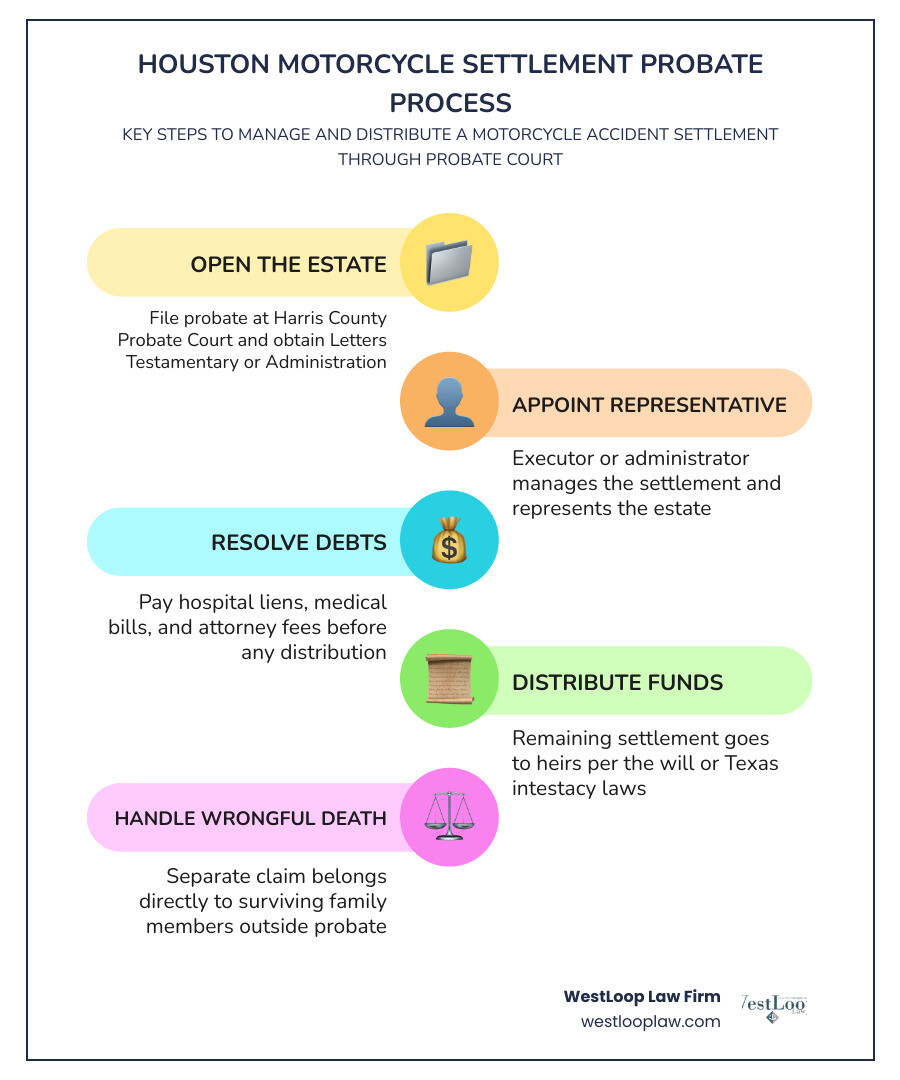
Houston motorcycle settlement probate is the legal process of managing and distributing a motorcycle accident settlement through the Texas court system after the rider has passed away. If you’re dealing with this right now, here’s a quick overview of what it involves:
Quick Answer: How Houston Motorcycle Settlement Probate Works
- Open the estate — File for probate at Harris County Probate Court and get Letters Testamentary or Letters of Administration.
- Appoint a personal representative — The executor or administrator manages the settlement on behalf of the estate.
- Resolve debts first — Hospital liens, medical bills, and attorney fees must be paid before funds reach heirs.
- Distribute remaining funds — What’s left goes to beneficiaries under the will or Texas intestacy laws.
- Handle wrongful death separately — A wrongful death claim runs alongside probate and belongs directly to surviving family members.
Losing someone in a motorcycle crash is devastating. Then come the legal questions — and fast.
Texas roads like Loop 610 and I-10 see serious motorcycle accidents every year. In 2020 alone, there were 7,481 motorcycle crashes across Texas, resulting in 482 deaths — a 17% increase over the year before. When a rider doesn’t survive, families are left not just grieving, but also navigating an unfamiliar legal process while medical bills pile up.
That process is probate. And when there’s a motorcycle accident settlement involved, it adds another layer of complexity.
Whether the estate is straightforward or contested, understanding how probate intersects with a motorcycle accident settlement in Houston can make a real difference in how much — and how quickly — your family receives.
Simple Houston motorcycle settlement probate glossary:
- most common injury from motorcycle accident
- Houston motorcycle injury claim
- attorney for motorcycle accidents
Understanding the Houston Motorcycle Settlement Probate Process
When a motorcyclist passes away due to injuries sustained in a collision, any pending or future legal settlement becomes an asset of their estate. To manage this asset, the family must navigate the Harris County Probate Court system. You cannot simply cash a settlement check made out to a deceased loved one; the law requires a structured process to ensure the money is handled legally and fairly.
The probate process begins by formally establishing who has the legal authority to act on behalf of the deceased rider. This person is known as the personal representative.
If the rider left behind a valid will, they likely named an executor. The court will verify the will and issue Letters Testamentary, which officially authorize the executor to handle the estate’s affairs, including signing settlement releases and managing bank accounts.
If there is no will, the court will appoint an administrator and issue Letters of Administration. This process is vital because insurance companies will not negotiate or release settlement funds to just anyone; they require proof of court-appointed authority to avoid future liability. For a detailed breakdown of how this administration functions, you can read our Houston probate administration guide.
How Texas Probate Laws Affect the Timing of a Settlement
Time is a critical factor when dealing with a Houston motorcycle settlement probate case. Under Texas law, specifically the Texas Civil Practice and Remedies Code, there is a strict two-year statute of limitations to file a personal injury or wrongful death lawsuit. If probate is not opened in a timely manner, you may run out of time to secure the court authority needed to file a lawsuit or finalize a settlement.
Furthermore, Texas probate laws require the personal representative to publish a notice to creditors. This notice gives medical providers, credit card companies, and other lenders a specific window to present claims against the estate.
Because of these mandatory waiting periods, a probate case can easily add several months to the timeline of an insurance settlement. Understanding these procedural steps is essential to avoid unnecessary distribution delays. If you want to know more about the local court timelines, check out our guide on Houston probate court procedures.
The Role of the Executor in a Houston Motorcycle Settlement Probate Case
Being named an executor or administrator is not just a title; it is a heavy fiduciary duty. This means you are legally obligated to act in the best financial interests of the estate and its beneficiaries, putting their needs above your own.
In a motorcycle accident case, the executor’s responsibilities include:
- Investigating the crash and preserving evidence (such as the motorcycle and riding gear).
- Hiring qualified legal representation to pursue the injury claim.
- Reviewing and signing settlement offers with insurance adjusters.
- Ensuring that wrongful death claims and survival actions are filed correctly.
- Paying off valid estate debts and distributing the remainder to the rightful heirs.
Because an executor can be held personally liable for mismanaging funds, having a reliable legal team by your side is incredibly important. You can learn more about how we assist personal representatives with our dedicated legal representation for Houston estates.
Wrongful Death vs. Survival Actions in Texas Motorcycle Accidents
When a fatal motorcycle crash occurs in Houston, Texas law allows for two distinct types of legal claims. While they often arise from the same tragic event, they serve completely different purposes and distribute money to different people.
| Feature | Wrongful Death Claim | Survival Action |
|---|---|---|
| Who Benefits? | Surviving spouse, children, and parents directly. | The deceased rider’s estate (distributed via will or intestacy). |
| What Damages are Covered? | Lost financial support, emotional pain, loss of companionship. | Deceased rider’s pre-death pain, medical bills, and funeral costs. |
| Does it Go Through Probate? | No, funds bypass the estate entirely. | Yes, funds must go through the probate process. |
| Subject to Creditor Claims? | Generally protected from the deceased’s creditors. | Subject to hospital liens and estate debts. |
A wrongful death claim is designed to compensate the immediate family for their personal loss. This includes the emotional trauma of losing a partner or parent, as well as the loss of the financial support the rider would have provided. Because these funds belong directly to the family members, they do not pass through the probate estate and are generally safe from the deceased’s creditors.
A survival action, on the other hand, represents the personal injury claim the rider would have brought had they survived. It “survives” their death. This claim recovers compensation for the physical pain and mental anguish the rider suffered between the moment of the crash and their passing, as well as the medical bills incurred at the hospital. Because these damages belong to the deceased person, the settlement must go into the probate estate.
For more information on filing these claims, visit our page on Houston wrongful death claims. It is also worth noting that settlement authority must be clear-cut; a historic Texas appellate decision, the ruling on settlement authority in BMW of N. Am., LLC v. Gunn, highlighted how important proper court appointments are when attempting to finalize or challenge injury settlements years down the road.
Distributing Settlement Funds to Heirs Under Texas Law
Once survival action funds enter the probate estate, they must be distributed. If the rider had a will, the funds are distributed according to their written wishes. However, if they died without a will (intestate), Texas intestacy laws dictate who receives the money based on family relationships.
This distribution can become complicated if there are minor beneficiaries. Under Texas law, children under 18 cannot directly receive large sums of money from a legal settlement.
In these cases, the court will often require the funds to be placed into a structured trust or a court-approved registry account until the child reaches adulthood. Managing these requirements correctly is vital to protect the children’s financial future and keep the estate in compliance with local court rules.
Resolving Liens, Medical Bills, and Insurance Policy Limits
Before a single dollar of a survival settlement can be paid out to heirs, the estate must resolve outstanding debts. Because approximately 94% of motorcycle accidents result in physical injury, fatal crashes often involve extensive emergency medical treatment.
When a rider is rushed to a local trauma center like Memorial Hermann Hospital or Ben Taub Hospital, the hospital will often file a statutory hospital lien against any future third-party liability settlement. Under Texas Property Code Chapter 55, a hospital has a right to be paid directly from the settlement proceeds for the emergency services provided within the first 72 hours of admission.
In addition to hospital liens, health insurance companies or government programs (like Medicare or Medicaid) may assert subrogation rights to claw back money they spent on the victim’s care. Resolving these liens requires aggressive negotiation; a skilled lawyer can often get these medical bills significantly reduced, leaving more money for the grieving family. You can read more about how this process works on our page about resolving accident liens in Houston.
Navigating Insurance Policy Limits in a Houston Motorcycle Settlement Probate Claim
The total amount of money available in a motorcycle accident settlement is heavily dictated by insurance policy limits. Texas law requires drivers to carry a minimum bodily injury liability coverage of:
- $30,000 per injured person
- $60,000 per accident
- $25,000 for property damage
These minimum limits (often referred to as 30/60/25 coverage) are rarely enough to cover the catastrophic costs of a fatal motorcycle crash.
If the at-fault driver only has minimum coverage, the estate may need to look for other sources of recovery, such as the deceased rider’s own Underinsured Motorist (UIM) policy. If no other insurance coverage exists, the estate may have to attempt to pursue the personal assets of the negligent driver, though this is often difficult if the driver has limited means.
To prevent these financial headaches before an accident ever occurs, riders should prioritize comprehensive estate planning. For tips on how to structure your assets and insurance, read our guide on estate planning for riders.
How to Avoid Probate Delays and Open an Estate in Harris County
Opening probate in Harris County requires specific paperwork and a clear understanding of local court procedures. To initiate the process, you must file an application for probate with the county clerk, along with:
- The original written will (if one exists).
- A certified copy of the death certificate.
- A formal valuation of the estate’s known assets.
- The required filing fees.
Once filed, there is a mandatory waiting period before the judge can hold a hearing to officially appoint the personal representative.
For families who want to spare their loved ones from this complex court process, proactive planning is key. Texas allows motorcycle owners to bypass probate for their physical bike by setting up a Transfer on Death (TOD) designation on the vehicle’s title through the Texas Department of Motor Vehicles.
Additionally, establishing joint ownership with rights of survivorship or utilizing living trusts can keep major assets out of the courtroom entirely. For a complete look at these strategies, read our guide on avoiding probate in Texas.
Frequently Asked Questions about Houston Motorcycle Settlement Probate
Navigating the intersection of personal injury settlements and estate law is challenging. Here are answers to some of the most common questions families ask us during this difficult time.
How long does the probate process take for a motorcycle accident settlement in Houston?
The timeline for probate in Harris County varies depending on whether the deceased had a will and if the estate is contested. Generally, a straightforward probate administration takes between 6 to 12 months.
However, if there is an ongoing personal injury lawsuit or complex negotiations with insurance companies, the settlement portion of the case can extend the timeline to a year or more. The mandatory creditor notification period alone takes several months to resolve legally.
Can a motorcycle accident settlement bypass probate court in Texas?
Yes, but only under specific circumstances. Wrongful death claim settlements bypass probate entirely because they belong directly to the surviving family members, not the estate.
For survival actions or other estate assets, you may be able to bypass formal probate using a Small Estate Affidavit if the total value of the estate (excluding the homestead) is under $75,000 and there is no will. Additionally, assets with designated beneficiaries or joint ownership with rights of survivorship automatically bypass the court.
Who is responsible for paying the deceased rider’s medical bills from the settlement?
The deceased rider’s estate is responsible for paying valid medical bills and hospital liens. These debts must be settled out of the survival action proceeds or other estate assets before any funds can be distributed to heirs or beneficiaries.
Importantly, surviving family members are generally not personally responsible for paying these medical bills out of their own pockets or out of their direct wrongful death settlement check.
Conclusion
Losing a loved one in a motorcycle accident is one of the most painful experiences a family can go through. Dealing with insurance adjusters, hospital liens, and the Harris County probate court only adds to that heavy burden.
At Westloop Law Firm, we combine our deep knowledge of personal injury law and probate administration to provide compassionate, seamless legal advocacy for Houston families. We handle the legal complexities so you can focus on healing and honoring your loved one’s memory.
If you need help navigating a motorcycle accident settlement or opening probate in Harris County, please don’t carry this weight alone. Contact our Houston attorneys today for a supportive, confidential consultation.