 Skip to content
What You Need to Know Before Filing Houston Big Rig Accident Claims
Houston big rig accident claims are among the most complex personal injury cases in Texas — and the stakes are high.
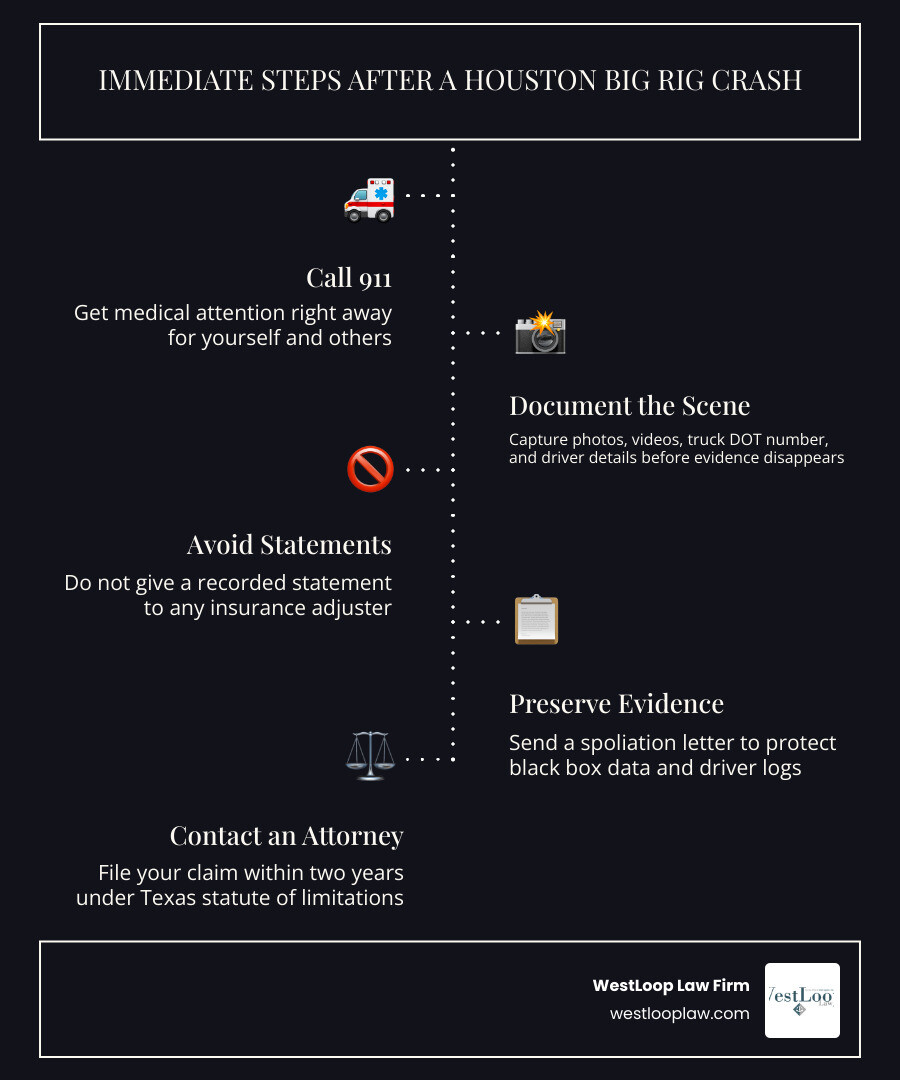
Here is what you need to do right away:
- Call 911 and get medical attention immediately
- Document the scene — photos, videos, truck DOT number, driver information
- Do not give a recorded statement to the trucking company’s insurance adjuster
- Preserve evidence — black box data and driver logs can disappear fast
- Contact a Houston truck accident attorney as soon as possible to protect your rights
- Send a spoliation letter through your attorney to prevent destruction of records
- File your claim within two years — Texas law sets a strict statute of limitations
If you were hit by a commercial truck on I-10, Loop 610, or anywhere in Harris County, you are not dealing with a simple fender-bender. A fully loaded 18-wheeler can weigh up to 80,000 pounds — roughly 16 times more than a passenger car. The injuries are often catastrophic. The legal process is far more complicated than a typical car accident claim.
In 2023 alone, Texas reported over 20,000 crashes involving commercial vehicles, with Harris County leading the state in big rig collisions. Nationally, large truck accidents kill more than 5,000 people every year.
What makes these cases especially difficult is what happens right after the crash. Trucking companies and their insurers often send investigators to the scene within hours — sometimes before you have even left the hospital. They are already building their defense while you are still figuring out what happened.
That is why acting quickly — and strategically — matters so much.
The 7 proven strategies below will show you exactly how to protect your claim, identify everyone responsible, and pursue the full compensation you deserve.
Houston big rig accident claims terms simplified:
1. Secure Critical Evidence Immediately After the Crash
When you are involved in a collision with a massive tractor-trailer on busy freight corridors like the Grand Parkway (SH-99) or Beltway 8, the physical evidence at the scene starts degrading the moment the lanes are cleared. To win Houston big rig accident claims, gathering and protecting this evidence is your absolute first line of defense.
Unlike standard passenger car crashes, commercial trucking operations generate a massive digital and paper trail. Two of the most critical pieces of technology on a modern big rig are the Electronic Data Recorder (EDR)—commonly known as the truck’s “black box”—and the Electronic Logging Device (ELD).
The black box records vital technical data from the seconds leading up to a collision, including:
- The truck’s speed before the impact
- Sudden deceleration or braking patterns
- Steering angles and throttle positions
- Whether the driver was wearing a seatbelt
- System faults or mechanical warnings active at the time of the crash
Meanwhile, the ELD tracks the driver’s active hours behind the wheel. Because federal guidelines place strict limits on how long commercial drivers can operate without resting, these digital logs are crucial for proving driver fatigue.
However, you cannot count on the trucking company to save this data for you. In fact, standard corporate data retention policies mean this information can be overwritten or deleted in as little as 30 days. To prevent this, we must immediately issue a formal “spoliation letter.” This legal notice demands that the trucking carrier, trailer owner, and physical damage adjusters preserve all digital and physical evidence related to the crash under threat of severe court penalties.
Additionally, we look for physical evidence such as dashcam footage, nearby highway traffic cameras, and witness statements. In cases of severe collisions, we cross-reference the evidence collection process with the rigorous NTSB accident investigation standards to ensure no stone is left unturned.
2. Identify All Liable Parties Beyond the Truck Driver
A common mistake many victims make when pursuing Houston big rig accident claims is assuming the truck driver is the only party responsible. While the driver’s immediate actions behind the wheel—such as distracted driving or taking a corner too fast—may have triggered the crash, commercial trucking operations involve a web of corporate entities.
To maximize your recovery, we must look deeper into the entire logistics chain. Depending on the facts of your crash, multiple parties can be held legally liable:
- The Trucking Company (Motor Carrier): Trucking companies are heavily regulated. Under the legal doctrine of vicarious liability, carriers are generally held responsible for the negligent acts of their employees while they are on the clock.
- Cargo Loading Companies: If a truck’s cargo is improperly loaded, it can shift during transit, leading to devastating jackknife accidents or rollovers on highway ramps. Shippers and loaders must follow strict weight and securement rules.
- Maintenance Providers: Commercial big rigs travel hundreds of thousands of miles a year, requiring constant upkeep. If a third-party mechanic or maintenance contractor ignores worn brake pads, bald tires, or failing steering components, they can be held liable for mechanical failures.
- Parts Manufacturers: If a catastrophic tire blowout or a brake failure occurs due to a design or manufacturing defect, the company that built those components may be sued under product liability law.
If you have been injured, consulting an experienced Houston Big Rig Accident Attorney is critical to mapping out this network of liability and ensuring that every responsible corporate entity is brought to the negotiating table.
Proving Liability in Houston Big Rig Accident Claims
Proving who is at fault requires demonstrating that a specific party failed in their legal duty of care. For instance, we can establish vicarious liability by proving the driver was an employee acting within the scope of their employment. However, trucking companies often try to shield themselves by classifying their drivers as independent contractors.
We combat this defense by looking at the actual control the company exercised over the driver’s schedule, equipment, and routes. Furthermore, we can pursue direct claims against the carrier for negligent hiring, negligent training, or negligent supervision if they allowed a driver with a history of safety violations or drug abuse to operate an 80,000-pound vehicle.
This is particularly common around the Port of Houston freight corridors, where heavy traffic, tight shipping deadlines, and constant turnarounds put immense pressure on drivers and logistics companies. When corporate profits are prioritized over public safety, systemic negligence is often the true cause of the crash.
3. Leverage Federal and Texas Trucking Regulations
The commercial trucking industry does not operate under the same rules as everyday commuter traffic on Interstate 45 or Highway 59. Instead, it is governed by a strict set of safety standards established by the Federal Motor Carrier Safety Administration (FMCSA) and the Texas Department of Public Safety.
Understanding how to use these regulations is one of the most powerful tools in winning Houston big rig accident claims.
The FMCSA sets clear guidelines on:
- Hours-of-Service (HOS): Drivers are strictly limited on how many hours they can drive in a single day and week to prevent extreme driver fatigue.
- Drug and Alcohol Testing: Carriers must conduct pre-employment, random, and post-accident substance testing.
- Driver Qualification Files: Companies must maintain records of a driver’s commercial driver’s license (CDL) status, medical examinations, and annual road tests.
- Vehicle Inspection and Maintenance: Under 49 CFR Part 396, drivers and motor carriers must perform pre-trip and post-trip inspections and keep detailed records of all repairs.
When we investigate a crash, we look for violations of these rules. If a driver exceeded their HOS limits, or if a carrier skipped mandatory safety inspections, we can argue “negligence per se.” This legal concept means that because the defendant violated a safety statute designed to protect the public, they are presumed negligent as a matter of law. This shifts the burden of proof and makes it much harder for their insurance company to deny liability.
For a deeper look at how these rules impact your case, you can read our guide on How to Navigate a Houston Big Rig Crash Claim.
Key Factors That Influence Houston Big Rig Accident Claims
Many victims expect that because commercial trucks carry multi-million dollar insurance policies, getting a fair settlement will be straightforward. In reality, the opposite is true. The presence of high-value policies means that insurance companies will fight harder, use more aggressive tactics, and spend more money to minimize or deny your payout.
One of the most significant factors in these negotiations is a corporate structure known as Self-Insured Retention (SIR). Many large trucking companies do not use standard insurance for the first portion of a claim. Instead, they have an SIR policy, meaning they pay the first $100,000, $250,000, or even $1,000,000 of any claim directly out of their own corporate pockets.
Because they are paying with their own money, these companies employ in-house claims adjusters whose sole job is to protect the company’s bottom line. These adjusters are highly incentivized to find any reason to blame you for the accident or downplay your injuries.
To help you understand how these dynamics play out, we have put together a Houston Truck Accident Settlements Complete Guide. To show you just how different these cases are from standard passenger car claims, review the comparative breakdown below:
| Feature | Passenger Car Claims | Houston Big Rig Accident Claims |
|---|---|---|
| Typical Insurance Limits | $30,000 to $100,000 | $1,000,000 to $5,000,000+ |
| Primary Defendants | The individual driver | Driver, carrier, cargo loader, manufacturer, etc. |
| Evidence Required | Police report, basic photos, medical bills | Black box data, ELD logs, maintenance files, FMCSA records |
| Defense Tactics | Standard insurance adjusters | In-house legal teams, rapid-response investigators |
| Regulatory Framework | Texas Transportation Code | Texas Transportation Code + Federal FMCSA Regulations |
4. Document All Catastrophic Injuries and Financial Losses
Because of the sheer size and weight of an 18-wheeler, collisions rarely result in minor injuries. Victims often face life-altering physical trauma that requires immediate, high-level emergency medical care at major regional trauma centers like Memorial Hermann Hospital or Ben Taub Hospital in the Texas Medical Center.
Common catastrophic injuries sustained in big rig crashes include:
- Traumatic Brain Injuries (TBIs): Caused by violent impacts or modern underride collisions, leading to long-term cognitive and physical impairment.
- Spinal Cord Damage: Often resulting in partial or complete paralysis, requiring lifetime medical assistance and home modifications.
- Complex Fractures and Amputations: Severe crushing injuries to limbs that often require multiple reconstructive surgeries or prosthetic care.
- Internal Organ Damage: Severe internal bleeding or blunt-force trauma to vital organs.
To build a successful claim, every single injury, medical treatment, and financial loss must be meticulously documented. This means keeping track of ambulance rides, emergency room bills, surgical fees, prescription costs, physical therapy sessions, and future rehabilitation estimates.
Maximizing Compensation for Houston Big Rig Accident Claims
To secure the maximum compensation possible, we look far beyond your current medical bills. A comprehensive claim must account for the long-term, lifetime impact of your injuries. This includes calculating your “loss of earning capacity” if you can no longer return to your previous job or work at all.
We also pursue non-economic damages, which compensate you for physical pain, mental anguish, disfigurement, and loss of enjoyment of life. In the most tragic cases where a loved one is killed, we help families file wrongful death claims to recover funeral costs, loss of financial support, and loss of companionship.
For more details on maximizing your recovery, refer to our 18 Wheeler Accident Houston Ultimate Guide.
5. Avoid Early Lowball Settlement Offers from Insurance Companies
Within days of your accident, while you are still recovering in a hospital bed, the trucking company’s insurance adjuster may reach out to you. They may seem incredibly friendly, polite, and eager to help. They might even offer you a quick check to cover your current medical bills and lost wages.
Do not fall for this trap.
This is a classic corporate defense strategy designed to settle your claim for a tiny fraction of what it is actually worth. Once you sign a settlement agreement and release liability, your case is closed forever. If you later discover that you need an additional spinal surgery, or if your doctor determines that you can never return to work, you cannot go back and ask for more money.
Furthermore, these adjusters will often ask you to provide a recorded statement “just to get your side of the story.” They will ask leading questions designed to get you to admit fault, downplay your pain, or agree to facts that damage your case.
Never give a recorded statement, sign medical authorization releases, or accept any money from a commercial insurer without consulting a legal representative first. A dedicated advocate will handle all communications on your behalf, protecting you from these predatory tactics and ensuring your future care is fully valued.
6. File Your Lawsuit Within the Texas Statute of Limitations
In Texas, you do not have unlimited time to seek justice after a commercial truck wreck. Under the Texas Civil Practice and Remedies Code Section 16.003, the statute of limitations for personal injury and wrongful death claims is generally two years from the date of the accident.
While two years might sound like a long time, waiting to take action can destroy your case:
- Skid marks and physical road evidence fade within days.
- Vehicles are repaired, sold, or scrapped, destroying mechanical evidence.
- Witness memories fade, or witnesses move away and become impossible to locate.
- Trucking companies are only legally required to keep certain logs for a limited time under FMCSA rules.
If you miss the two-year filing deadline, the Texas courts will almost certainly dismiss your case, leaving you with no legal recourse to recover compensation for your medical bills and losses.
There are very few, highly specific exceptions to this rule (such as claims involving minors), which is why it is vital to have a legal team review your case immediately to ensure your rights are fully protected.
7. Partner with a Dedicated Houston Truck Accident Attorney
Navigating the complex legal, regulatory, and financial landscape of a commercial truck claim on your own is an uphill battle against multi-billion-dollar corporations. To level the playing field, you need a dedicated advocate on your side.
When you work with us, we immediately take the burden off your shoulders. We launch an independent investigation, hire accident reconstruction professionals, secure black box and ELD data, and build a trial-ready case. If you are worried about the cost of hiring legal representation, you can rest easy: we operate on a contingency fee arrangement.
This means:
- You pay zero upfront costs or hourly fees.
- We cover all litigation expenses, including filing fees and professional witness costs.
- We only get paid if we successfully recover compensation for you through a settlement or jury verdict.
By partnering with a dedicated Houston Trucking Accident Lawyer, you send a clear message to the trucking company that you will not accept a lowball offer.
Frequently Asked Questions About Houston Truck Accidents
What makes big rig accidents different from typical car accidents in Houston?
Big rig accidents involve commercial trucks that weigh up to 80,000 pounds, causing far more severe, catastrophic injuries than standard car crashes. Additionally, these claims involve multiple potentially liable corporate defendants, complex federal FMCSA safety regulations, and commercial insurance policies with multi-million-dollar limits that are aggressively defended by corporate legal teams.
Can I still recover compensation if I was partially at fault for the crash?
Yes. Texas follows a modified comparative negligence system, also known as the “proportionate responsibility” rule. Under this law, you can still recover compensation as long as you were 50% or less at fault for the accident. However, your final compensation will be reduced by your percentage of responsibility. For example, if you are awarded $100,000 but found to be 20% at fault, you will receive $80,000. If you are found to be 51% or more at fault, you are barred from recovering any compensation.
How long does it take to resolve a commercial truck accident claim in Harris County?
The timeline for resolving a truck claim varies widely depending on the complexity of the case. A straightforward claim with clear liability may settle in several months once your medical treatment is complete. However, complex cases involving disputed liability, multiple defendants, or severe, life-altering injuries can take a year or more, especially if the case must go to court in Harris County. We prepare every case for trial to ensure we have the strongest possible leverage during negotiations.
Elevate Your Claim with Proven Houston Legal Advocacy
When you are facing a mountain of medical bills, lost income, and the physical pain of recovering from a commercial truck crash, you do not have to fight the trucking and insurance companies alone.
At WestLoop Law Firm, we combine deep legal knowledge with a compassionate, client-first approach. We understand how a single collision on a Houston freeway can disrupt your family’s life and future financial security. Our legal team is prepared to investigate your crash, cut through corporate red tape, and pursue the maximum compensation you deserve.
If you or a loved one has been injured, we are here to help you secure your physical and financial recovery. Contact a dedicated Houston Trucking Accident Lawyer today by visiting the WestLoop Law Firm Homepage to schedule your free, confidential consultation. Let us carry the legal burden so you can focus on healing.