 Skip to content
Can You Recover a Settlement If You Are 20 Percent at Fault in Texas?
What to Do First
- Seek medical attention promptly, even if you feel fine, and document all injuries.
- Preserve evidence within 24 to 72 hours, including dashcam footage, vehicle-damage photos, and witness contact information.
- Avoid giving a recorded statement to an insurance adjuster before obtaining legal guidance.
- Request a copy of the Texas Peace Officer’s Crash Report (Form CR-3) and review it for accuracy.
- Note the two-year Texas statute of limitations for most personal-injury claims, along with any shorter government notice deadlines that may apply.
Yes. If you were 20% at fault for a car accident in Houston or elsewhere in Texas, you can generally still seek a settlement because Texas allows recovery when your share of responsibility is 50% or less. Your compensation is reduced by your percentage of fault, so a 20% fault finding generally leaves you eligible to recover 80% of your proven damages.
Texas governs shared-fault situations through its proportionate responsibility statute, codified under Chapter 33 of the Texas Civil Practice and Remedies Code. Being partially responsible for a crash does not automatically prevent you from pursuing compensation for medical bills, property damage, lost earnings, and pain and suffering.
When your fault is evaluated at 20%, you remain within the legal limit for financial recovery. Your overall recovery is reduced in proportion to your assigned percentage of fault.
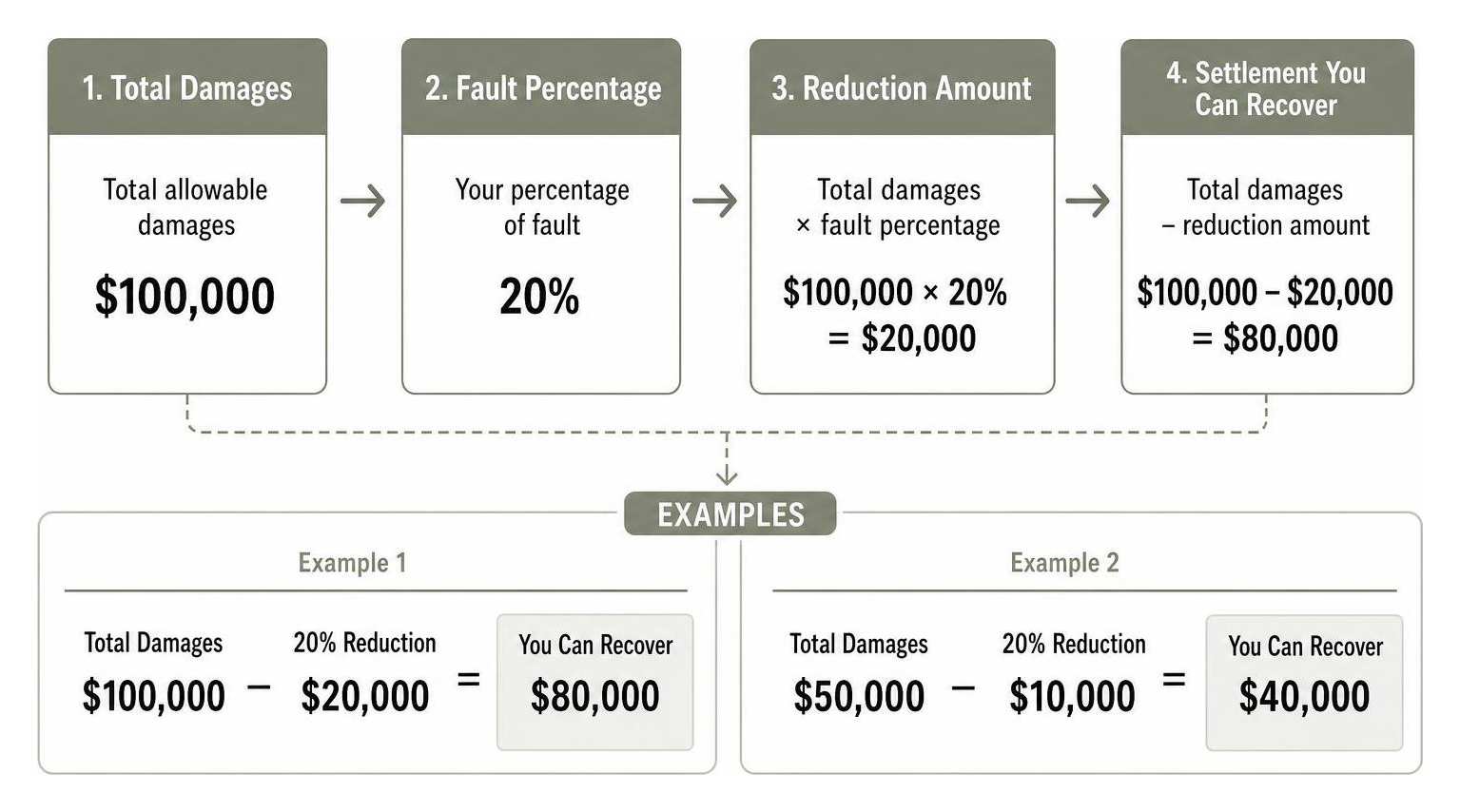
Because your share of fault is 20%, you can generally collect 80% of your total allowable damages. For example:
- If your overall damages, including medical costs, lost wages, and pain and suffering, equal $100,000, a 20% fault finding reduces the recovery by $20,000, leaving $80,000.
- If your damages total $50,000, deducting 20% leaves $40,000.
Shared fault is common in Texas driving environments. On congested Houston routes such as the West Loop (I-610), the Katy Freeway (I-10), and Beltway 8, adjusters may assign percentages of liability to more than one driver after a collision.
Understanding how local courts apply comparative negligence in Houston can help you protect the value of your claim.
How Does Texas’s 51 Percent Bar Rule Affect Your Settlement Calculation?
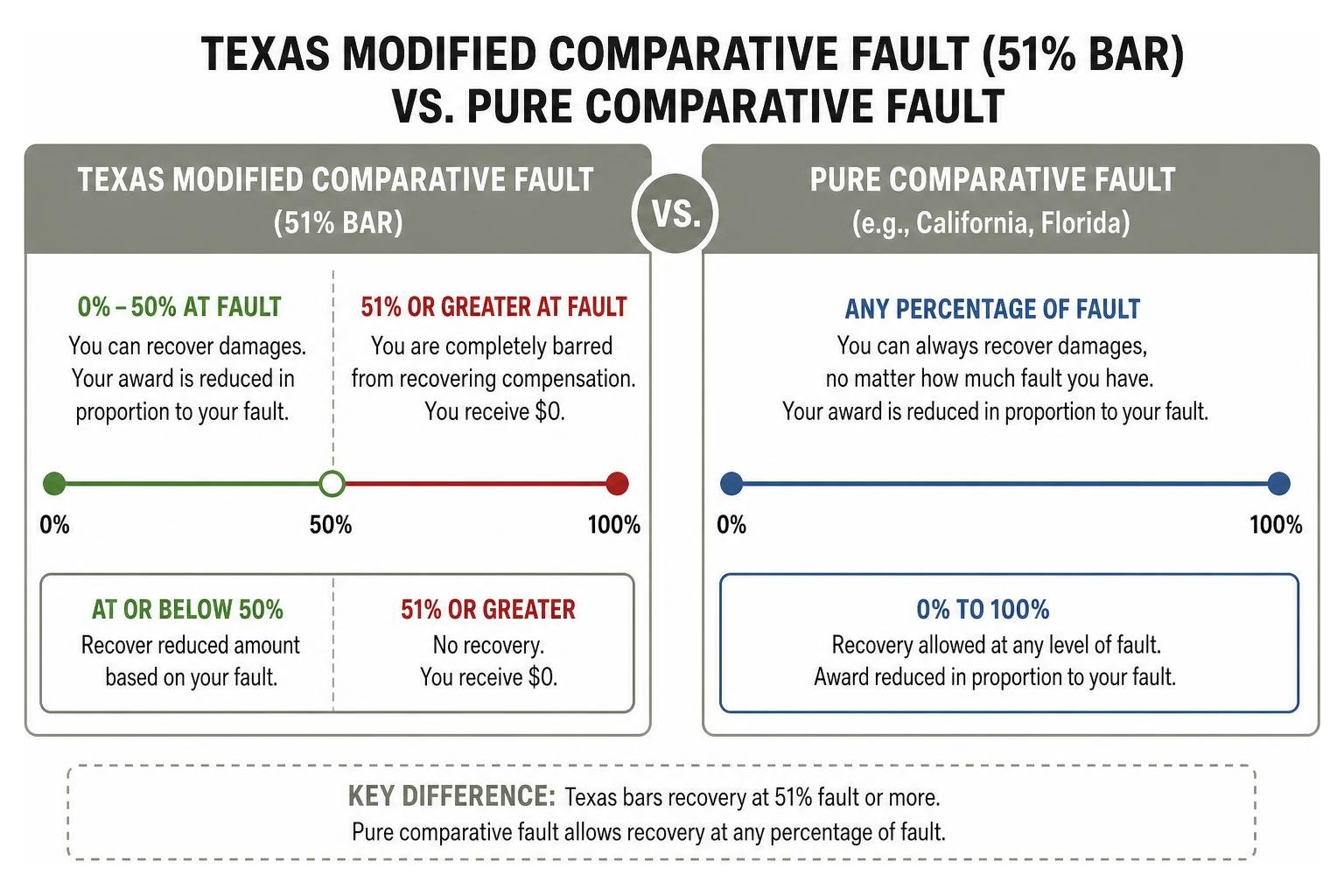
Texas operates under a modified comparative fault system with a strict 51% bar rule. This system differs fundamentally from pure comparative fault states (like California or Florida), where a motorist who is 90% or even 99% at fault can still recover damages for the small percentage caused by someone else.
In Texas, the 51% threshold acts as an absolute legal cutoff:
- 0% to 50% At Fault: You can recover damages. Your total award is reduced in direct proportion to your fault.
- 51% or Greater At Fault: You are completely barred from recovering compensation from other drivers. You receive $0.
The Settlement Calculation Formula
Insurance adjusters, judges, and juries in Harris County Civil Courts at Law calculate shared-fault payouts using a straightforward mathematical equation:
$$\text{Final Recovery} = \text{Total Allowable Damages} \times (1 – \text{Your Percentage of Fault}) – \text{Settlement Credits}$$
To see how this formula applies across varying degrees of assigned fault, consider this comparative breakdown on a hypothetical $100,000 injury claim:
| Assigned Fault Percentage | Total Claim Value | Fault Deduction | Final Amount Recoverable | Legal Eligibility |
|---|---|---|---|---|
| 0% Fault | $100,000 | $0 | $100,000 | Full Recovery |
| 20% Fault | $100,000 | $20,000 | $80,000 | Recover 80% of Claim |
| 40% Fault | $100,000 | $40,000 | $60,000 | Recover 60% of Claim |
| 50% Fault | $100,000 | $50,000 | $50,000 | Recover 50% (Max Threshold) |
| 51% Fault | $100,000 | $100,000 | $0 | Total Bar — Zero Recovery |
Recovering Economic and Non-Economic Losses
Your 20% reduction applies equally across all eligible forms of compensatory damages recognized under Texas law:
- Economic Damages: Quantifiable out-of-pocket financial losses, including emergency room treatment at facilities like Memorial Hermann or Ben Taub Hospital, surgical costs, physical therapy, prescription medication, vehicle repair estimates, and past and future lost earnings.
- Non-Economic Damages: Intangible losses, including physical pain, emotional anguish, loss of enjoyment of life, physical impairment, and disfigurement. Unlike medical malpractice claims, Texas places no statutory caps on non-economic damages in standard motor vehicle accident claims.
Understanding how the 51% bar and proportionate responsibility rules apply to jury verdicts is essential to protecting the value of your claim, and the team at Westloop Law Firm can walk you through how these rules affect your specific situation.
What Tactics Do Insurance Companies Use to Push Fault Past 50 Percent?

While keeping your fault at 20% allows you to collect 80% of your damages, insurance carriers have a massive financial incentive to shift that number. If the defense adjuster can inflate your liability from 20% to 51%, their payment obligation drops from thousands of dollars to zero.
Because Texas uses the 51% cutoff, insurers routinely deploy specific tactics to shift blame onto injured motorists:
1. Misinterpreting Recorded Statements
Shortly after a collision on roads like I-45 or the Southwest Freeway (US-59), adjusters often contact victims requesting a “routine recorded statement.” Adjusters use scripted, leading questions designed to elicit ambiguous admissions, such as asking if you were tired, looking at your GPS, or could have braked earlier. They then use these statements to argue you were inattentive, turning a 20% fault allocation into majority liability.
2. Disputed Speed and Avoidability Arguments
Even when the other driver clearly violated traffic laws (such as running a red light or failing to yield when turning left), insurance defense teams frequently argue that your speed contributed to the severity of the crash. They may claim that driving 3 to 5 mph over the posted speed limit on roads like Westheimer or Memorial Drive prevented you from taking evasive action, attempting to persuade a jury that your actions were the primary cause of the wreck.
3. Designating a “Responsible Third Party”
Under Chapter 33.004 of the Texas Civil Practice and Remedies Code, a defendant can file a motion to designate a “responsible third party.” This allows the defense to assign blame to other entities—such as a non-party driver, a road construction contractor on Loop 610, or a vehicle parts manufacturer. By diluting fault across multiple entities, they attempt to reduce their own payout while increasing your comparative share above the 50% threshold.
4. Navigating Texas Insurance Limits and Uninsured Motorists
Texas law mandates minimum liability auto insurance limits of 30/60/25:
- $30,000 for bodily injury per person
- $60,000 for bodily injury per accident
- $25,000 for property damage
Compounding this issue, approximately 14.1% of Texas motorists drive without any auto insurance. When facing low liability limits or uninsured drivers, adjusters for your own underinsured motorist carrier may attempt to assign comparative fault to limit what they pay under your policy.
Common comparative negligence arguments raised by Texas auto insurance adjusters include:
- Failure to keep a proper lookout
- Driving at an unsafe speed for road conditions
- Failure to take timely evasive action
- Improper lane usage or failing to signal
- Following too closely in stop-and-go freeway traffic
Understanding how Texas fault rules interact with these minimum insurance limits is critical to protecting your claim, and the team at Westloop Law Firm can help you evaluate your coverage options.
How Can You Preserve Critical Evidence to Keep Your Fault at 20 Percent or Lower?
Preserving objective evidence immediately after a collision is the most effective way to prevent an insurance company from inflating your fault percentage. In the days following an accident, physical evidence disappears, witnesses forget details, and traffic camera footage is routinely overwritten.
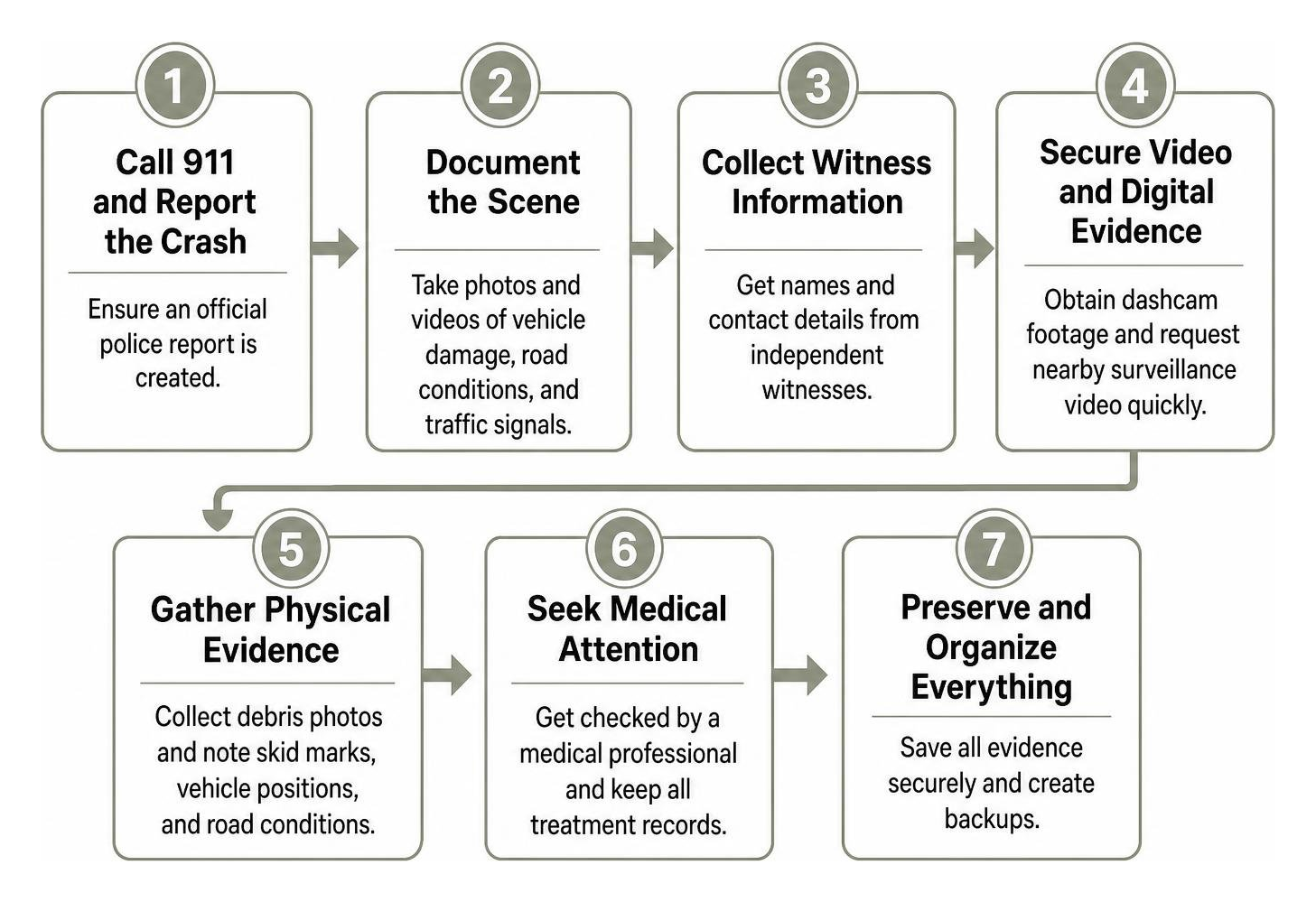
To protect your claim and keep your fault assessment at or below 20%, follow this evidence preservation protocol:
Secure Video and Digital Evidence (Within 24 to 72 Hours)
- Dashcam Footage: Download and back up all front and rear dashcam recordings immediately.
- Surveillance Cameras: Request security camera footage from nearby commercial businesses, gas stations, or office buildings along corridors like Richmond Avenue or Westheimer Road before their systems overwrite the data.
- Traffic Cameras: While Texas Department of Transportation (TxDOT) cameras generally stream live video without archiving, municipal or toll road cameras (such as those along the Harris County Toll Road Authority network) may retain records for a limited window.
Analyze the Texas Peace Officer’s Crash Report (Form CR-3)
Law enforcement officers from the Houston Police Department, Harris County Sheriff’s Office, or Texas Department of Public Safety will file a standard Form CR-3. Inspect this report carefully:
- Review the contributing factors section where officers assign numeric fault codes.
- Check the narrative and crash diagram for factual inaccuracies regarding vehicle positioning or point of impact.
- If the report contains errors, work with legal counsel to submit supplemental statements or objective evidence to amend the official record.
Document Physical Damage and Road Conditions
- Take comprehensive photographs of both vehicles from multiple angles, focusing on crush patterns, paint transfer, and airbag deployment.
- Photograph roadway evidence, including skid marks, yaw marks, road debris, obstructed traffic signs, and weather conditions.
- Document your physical injuries through photographs immediately after the incident and throughout your medical recovery.
Understand Critical Texas Claim Deadlines
Under Texas Civil Practice and Remedies Code Section 16.003, the statute of limitations for personal injury and property damage claims is exactly two years from the date of the collision. Missing this filing deadline permanently terminates your right to recover damages in a Texas civil court.
Furthermore, if your collision involved a government-owned vehicle (such as a City of Houston maintenance truck or a METRO transit bus), the Texas Tort Claims Act requires formal administrative notice within six months. Certain municipalities have even stricter notice windows—some as short as 60 to 90 days from the crash date.
Knowing how to file a Houston accident insurance claim properly from day one helps preserve essential evidence and avoid costly administrative mistakes.
When Should You Hire a Texas Car Accident Lawyer for a Shared-Fault Claim?
When an insurance carrier alleges that you share fault for a collision, your claim requires careful legal management. Disputed-fault cases carry high financial stakes because an unrepresented driver faces the risk of an adjuster raising their liability from 20% to 51%, extinguishing the claim entirely.
Securing skilled legal representation protects your recovery in several concrete ways:
1. Stopping Fault Inflation
We work with accident reconstruction professionals, biomechanical engineers, and digital forensic investigators to establish exact vehicle speeds, braking distances, and points of impact. This objective data refutes unfounded claims by insurance carriers seeking to push your fault past the 50% line.
2. Leveraging the Texas 18% Prompt Payment Penalty
Under Texas Insurance Code Section 542.060 (the Prompt Payment of Claims Act), auto insurers that fail to meet strict statutory deadlines for acknowledging, investigating, and paying valid claims face an 18% per annum statutory interest penalty plus reasonable attorney’s fees. When insurance carriers use bad-faith comparative negligence arguments to stall settlement payments, holding them accountable under Section 542 provides significant settlement leverage.
3. Handling Multi-Party and Commercial Liability
If your wreck involved a commercial vehicle, a rideshare driver, or multiple vehicles on a busy interstate like I-10 or I-45, allocating fault becomes significantly more complex. We manage interactions across all defense adjusters, corporate risk managers, and insurance carriers to ensure fault is attributed where it belongs.
Consulting a knowledgeable car accident attorney ensures your rights remain protected when liability is contested.
If you were injured in a collision anywhere in Harris County or the surrounding areas, our team at Westloop Law Firm is prepared to evaluate your case. A qualified Houston car accident lawyer can investigate liability, counter insurance tactics, and advocate for the compensation you deserve.
Frequently Asked Questions About 20 Percent Fault Car Accidents in Texas
Can the other driver’s insurer reduce my pain and suffering settlement if I am 20% at fault?
Yes. Under Texas proportionate responsibility laws (Texas Civil Practice and Remedies Code Chapter 33), comparative fault applies across your entire damage recovery, including both economic and non-economic damages.
If a jury or claims adjuster evaluates your pain, suffering, and mental anguish at $60,000 and your medical expenses at $40,000 (total damages of $100,000), your 20% assigned fault reduces each category proportionally by 20%. You would receive $48,000 for pain and suffering and $32,000 for medical expenses, resulting in an $80,000 total recovery. Texas law does not cap non-economic damages in motor vehicle collisions, meaning your pain and suffering compensation is limited only by what the evidence supports minus your fault percentage.
What happens if the other driver has no insurance and I share 20% fault?
If the primarily at-fault driver has no liability insurance, you must seek compensation through your own insurance policy options:
- Personal Injury Protection (PIP): Under Texas Insurance Code Section 1952.151, all Texas personal auto policies include PIP coverage unless you explicitly rejected it in writing. PIP covers 100% of reasonable medical expenses and 80% of lost income up to your policy limit (typically $2,500, $5,000, or $10,000). Crucially, PIP is no-fault coverage; your 20% fault does not reduce your PIP payout in any way.
- Uninsured/Underinsured Motorist (UM/UIM) Coverage: UM/UIM steps into the shoes of the at-fault driver to cover bodily injury and property damage. However, because UM/UIM is fault-based, your insurer will apply the 20% comparative negligence reduction to your claim, paying 80% of your proven damages up to your policy limits.
- Policy Stacking Nuances: While intra-policy stacking (combining coverage limits across multiple vehicles under a single personal policy) is generally restricted in Texas, inter-policy stacking may be available if you are covered under multiple separate auto policies.
Partnering with a personal injury lawyer in Houston helps resolve complex insurance disputes and navigate tricky coverage limits.
Does moving from 20% fault to 25% fault significantly change my payout?
Yes. Even small percentage shifts result in substantial financial losses, especially on serious injury claims. Every single percentage point of fault assigned to you represents money taken directly out of your net recovery:
- On a $100,000 claim: Moving from 20% fault ($80,000 recovery) to 25% fault ($75,000 recovery) costs you $5,000.
- On a $250,000 claim: Moving from 20% fault ($200,000 recovery) to 30% fault ($175,000 recovery) costs you $25,000.
- On a $500,000 catastrophic injury claim: Moving from 20% fault to 35% fault costs you $75,000.
Because defense insurers understand the compounding dollar effect of “fault creep,” they fight aggressively for every 5% increment. Keeping your fault allocation as low as possible directly preserves your financial compensation.
Taking Control of Your Settlement: Protecting Your Rights After a Texas Crash
Sharing minor fault for a motor vehicle collision in Texas does not prevent you from recovering substantial financial compensation. Under the state’s 51% modified comparative fault rule, being 20% at fault ensures you retain the legal right to collect 80% of your total economic and non-economic damages.
However, because reaching 51% liability creates an absolute bar to financial recovery, insurance companies will work to inflate minor driving errors into primary responsibility. Protecting your recovery requires proactive steps:
- Do not give recorded statements to opposing insurance adjusters without legal guidance.
- Preserve all objective proof—including dashcam files, 911 audio records, electronic crash data, and witness contact information—within the first 72 hours.
- Seek immediate medical attention and document the progression of your injuries with medical providers.
- Monitor all Texas filing deadlines, including the strict two-year personal injury statute of limitations and short municipal notice periods.
At Westloop Law Firm, we focus our practice on advocating for injured Texans across the greater Houston area. We combine deep knowledge of personal injury litigation with dedicated client advocacy to reconstruct accident events, defeat unfair fault allocations, and recover the maximum compensation our clients deserve.
If you were involved in a shared-fault collision, contact our legal team today to review your case and protect your settlement rights.