 Skip to content
What Does It Mean If an I-10 Houston Police Report Assigns You Partial Fault?
What to do first:
- Get a copy of your Texas Peace Officer’s Crash Report (Form CR-3) from the TxDOT Crash Records Information System (CRIS) or the Houston Police Department records portal.
- Seek immediate medical evaluation, even if you feel fine, to document any injuries tied to the collision.
- Do not give a recorded statement to the other driver’s insurance adjuster before speaking with a Houston car accident attorney.
- Preserve all evidence, including dashcam footage, photos of vehicle damage, and contact information for witnesses.
- Request a professional case assessment to review the crash dynamics and your proportionate fault exposure.
When an officer from the Houston Police Department (HPD), the Harris County Sheriff’s Office, or the Texas Department of Public Safety (DPS) responds to a crash on the Katy Freeway (I-10), their primary goal is clearing lanes, restoring traffic flow, and tending to immediate medical emergencies. In the rush to clear one of the busiest stretches of highway in the country, the officer completes a standard Texas Peace Officer’s Crash Report (Form CR-3).
If that report indicates you contributed to the collision, it is critical to understand what that finding actually represents:
- An initial field opinion, not a court ruling: A police officer’s crash report reflects an on-the-spot assessment based on limited physical evidence, short conversations, and driver statements. The responding officer did not witness the collision and is not a judge or jury.
- Insurance adjuster leverage: Insurance companies routinely review Form CR-3 for specific numeric codes in the “Factors and Conditions” section. If an adjuster finds a code assigned to your vehicle—such as “failed to control speed” or “faulty evasive action”—they will quickly use it to justify reducing your payout or denying your claim entirely.
- A non-binding civil finding: In Texas civil courts, an officer’s opinion regarding who caused a collision is generally treated as hearsay. The report itself does not legally prevent you from filing an insurance claim or pursuing a lawsuit in the Harris County Civil Courts at Law.
On high-density Houston corridors like I-10—where over 220,000 vehicles travel daily between the Energy Corridor, Loop 610, and downtown—officers face intense pressure to clear vehicles from travel lanes under Texas “Steer It, Clear It” guidelines. Because speed takes priority over deep analysis during active traffic conditions, these initial reports frequently omit subtle road hazards, obscured sightlines, or aggressive driving maneuvers by third parties.
How Does Texas Proportionate Responsibility Affect Your Ability to Recover Damages?
Texas handles multi-party accident liability under a legal doctrine known as proportionate responsibility, codified in Chapter 33 of the Texas Civil Practice and Remedies Code. This modified comparative fault framework determines whether you can recover compensation and how much money you ultimately receive.
Under Texas law, each party involved in an incident is assigned a percentage of responsibility totaling 100%. Your financial recovery depends directly on where your assigned percentage lands:
- You are 0% at fault: You can recover 100% of your economic and non-economic damages from the at-fault driver’s insurance carrier.
- You are between 1% and 50% at fault: You remain legally entitled to recover compensation, but your final payout is reduced in direct proportion to your share of responsibility. For instance, if your total damages equal $100,000 and you are assigned 20% fault, you recover $80,000.
- You are 51% or more at fault (The 51% Bar Rule): You cross the legal threshold and are completely barred from recovering any financial compensation from the other driver, regardless of how catastrophic your injuries or vehicle losses may be.
Because crossing the 51% line eliminates an insurer’s obligation to pay, opposing adjusters aggressively try to shift blame onto you. For additional state insights on these disputes, review the Texas Department of Insurance guidance on dealing with the other driver’s insurance.
First-Party Coverage and Personal Injury Protection (PIP)
While third-party liability claims depend on proportionate responsibility, your first-party auto coverage operates differently. In Texas, auto insurers are legally required to include Personal Injury Protection (PIP) on every policy unless the policyholder specifically rejects it in writing.
PIP provides immediate reimbursement for reasonable medical expenses, ambulance transport to centers like Memorial Hermann or Ben Taub Hospital, and lost wages—regardless of who caused the wreck. Even if an HPD report lists you as partially responsible, your PIP benefits remain accessible without reducing your future legal claims.
How Do Specific I-10 Driving Conditions Complicate Proportionate Responsibility?
Assigning fault on Interstate 10 is rarely straightforward. The freeway’s unique structural and operational characteristics create complex crash scenarios where multiple contributing factors collide:
- Managed and HOV Lane Transitions: Merging across continuous double-white lines or entering the Katy Managed Lanes near Beltway 8 creates sudden speed differentials that frequently lead to multi-vehicle side-swipes.
- Rapid Traffic Bottlenecks: Commuters routinely travel at 70 mph before abruptly encountering stop-and-go conditions near the Loop 610 interchange or the I-45 downtown split. When a rear-end collision occurs, insurers often attempt to blame the lead driver for sudden braking rather than the trailing driver for following too closely.
- Feeder Road Merges and Blind Spots: Entering the main freeway lanes from frontage roads along Dairy Ashford, Gessner, or Bunker Hill requires navigating short acceleration ramps, often resulting in disputed merge accidents.
- Commercial Truck Traffic: Heavy freight haulers traveling through Houston share narrow travel lanes through construction corridors, leading to underride crashes and multi-lane pileups where fault must be divided among three or more motorists.
How Can You Challenge or Correct an Inaccurate Texas Crash Report?
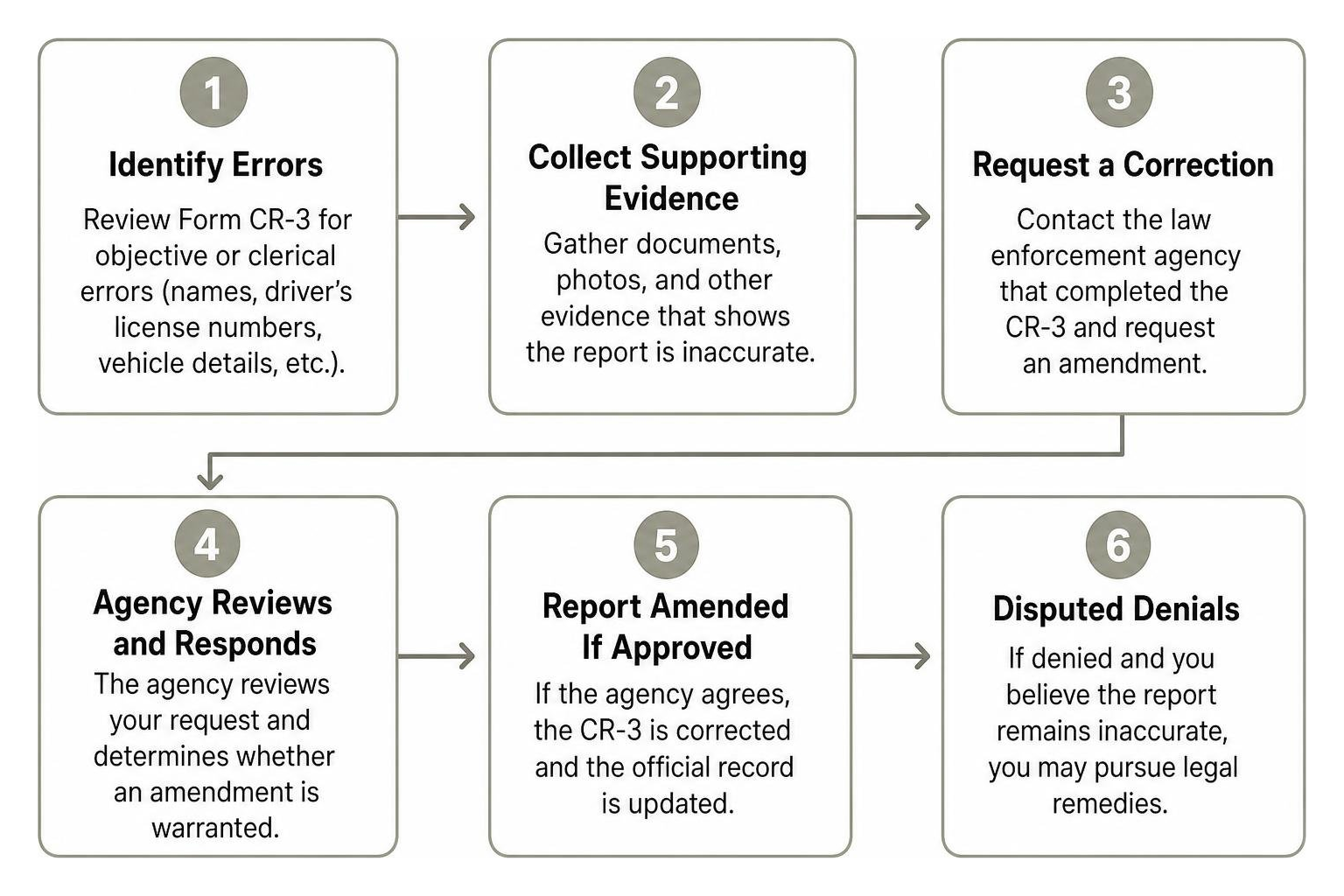
Discovering that an officer wrote an inaccurate narrative or checked the wrong fault box on Form CR-3 can be alarming. While you cannot simply erase an officer’s notes, Texas law establishes formal channels for correcting and amending official crash records.
1. Identify Objective Factual Errors
Law enforcement agencies will readily amend objective, clerical mistakes. Review your Form CR-3 for errors involving:
- Misspelled driver names, incorrect driver’s license numbers, or wrong phone numbers
- Inaccurate vehicle identification numbers (VIN), makes, models, or license plate tags
- Incorrect insurance policy numbers or carrier information
- Errors regarding the precise time, date, or mile marker on I-10
- Wrong road conditions, light levels, or weather notations
2. Address Subjective Officer Judgments
Challenging an officer’s opinion—such as an assigned contributing factor code like “speeding” or “failed to yield”—requires a formal supplemental request. The investigating officer who drafted the original report is typically the only person authorized to file a Texas Peace Officer’s Supplemental Crash Report (Form CR-3S).
To request a supplemental narrative:
- Obtain the officer’s name, badge number, and division (e.g., HPD Central Patrol, Traffic Enforcement Division).
- Gather verifiable physical evidence that contradicts the officer’s initial hypothesis (dashcam footage, business surveillance, eyewitness statements).
- Submit a respectful, documented request through the department’s records division showing why the physical evidence refutes the initial field observation.
3. Understand the Legal Standing of Form CR-3
If an officer refuses to modify their subjective opinion, do not panic. Under the Texas Rules of Evidence, police crash reports are largely inadmissible hearsay when offered to prove negligence in a civil jury trial. Juries in Harris County make independent fault determinations based on live witness testimony, physical debris patterns, and objective forensic data—not an officer’s unsworn field notes.
What Evidence Can Disprove or Reduce Your Assigned Percentage of Fault?
To overcome an unfavorable police report and demonstrate that the other motorist bears primary responsibility, you must build an independent, objective evidentiary record.
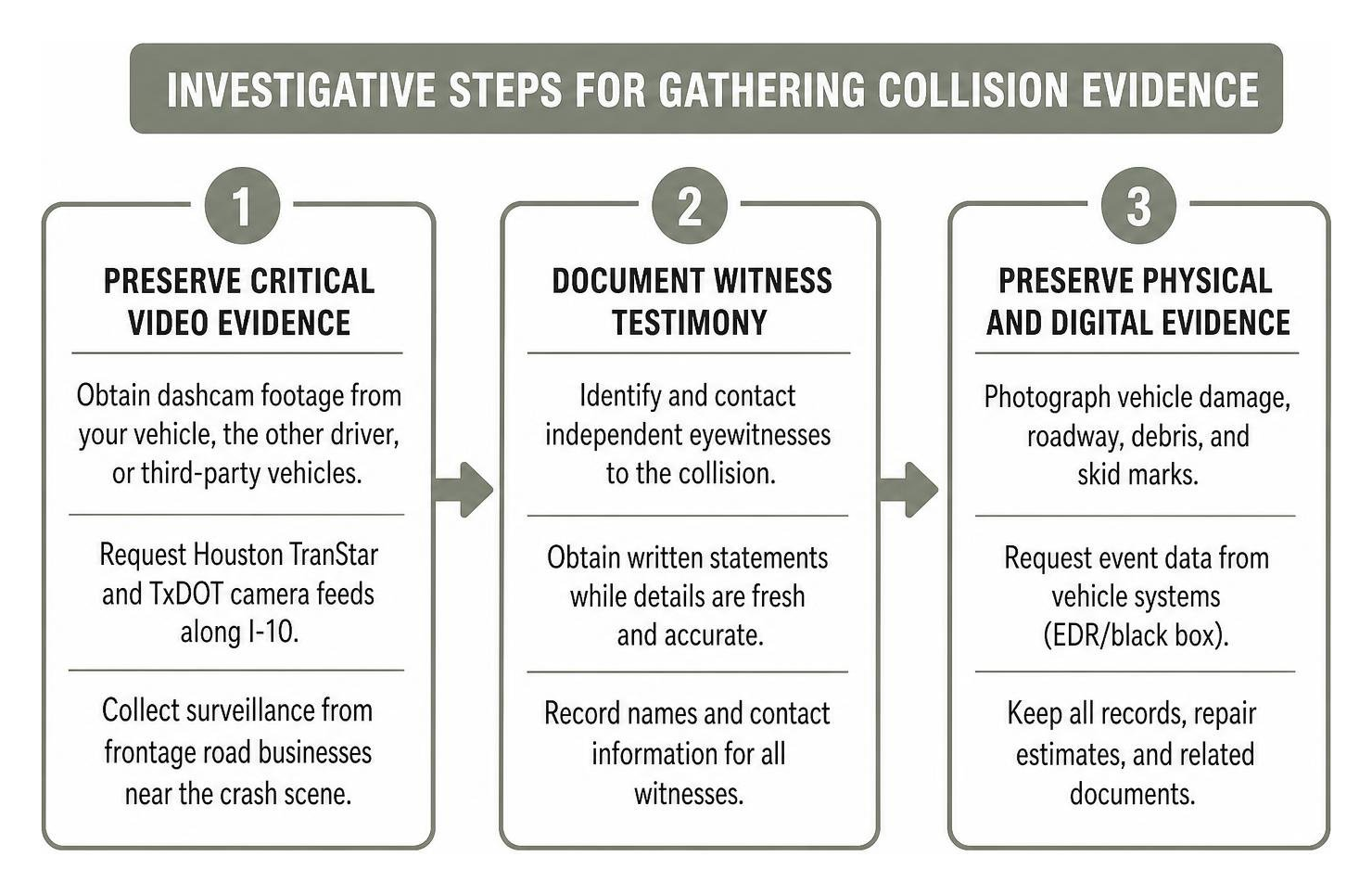
The most effective types of evidence we utilize to establish accurate liability include:
- Commercial and Passenger Dashcam Footage: High-definition video from your vehicle, the other driver’s car, or third-party rideshare and freight vehicles provides unambiguous visual proof of lane position, turn signals, and traffic signal sequences.
- Houston TranStar and TxDOT Camera Feeds: Houston TranStar monitors an extensive network of closed-circuit traffic cameras along I-10, Loop 610, and Beltway 8. Because these feeds are typically not archived indefinitely, formal preservation requests must be dispatched immediately following a collision.
- Frontage Road Business Surveillance: Gas stations, office buildings, and retail plazas lining the I-10 feeder roads (particularly near Memorial City Mall and the Energy Corridor) often maintain exterior security cameras that capture highway entrance ramps and intersections.
- Event Data Recorder (EDR) “Black Box” Downloads: Modern passenger cars and commercial semi-trucks record critical operational metrics leading up to a crash, including vehicle speed, throttle position, brake application, seatbelt status, and steering angles.
- Crash Reconstruction Modeling: Qualified accident reconstruction professionals can analyze skid marks, crush damage depths, paint transfers, and final vehicle resting points to scientifically recalculate vehicle trajectories and prove the other driver’s fault.
When Should You Contact a Houston Car Accident Attorney for an I-10 Crash?
When an initial police report places partial or total blame on your shoulders, dealing directly with an opposing insurance company becomes a significant financial liability. Insurance adjusters are trained negotiators whose performance metrics center on minimizing claim reserves.
Retaining a skilled Houston car accident lawyer levels the playing field in several vital ways:
- Shielding You from Coercive Statements: Adjusters often call shortly after a crash asking leading questions to lock you into admitting fault. We handle all communications to protect your rights under Texas proportionate responsibility rules.
- Conducting Independent Investigations: While city agencies must clear the highway quickly, our team deploys private investigators and forensic professionals to inspect the scene, photograph skid patterns, and preserve critical digital data before it is lost or overwritten.
- Complying with the Texas Statute of Limitations: Under Texas Civil Practice and Remedies Code § 16.003, you generally have two years from the date of the collision to file a personal injury or property damage lawsuit. Missing this deadline permanently forfeits your right to recover damages. However, waiting even a few months can cause crucial electronic evidence along I-10 to disappear.
At Westloop Law Firm, we provide aggressive civil litigation representation paired with comprehensive legal counseling. Our combined background in personal injury litigation and Texas probate law allows our firm to deliver uniquely robust advocacy for complex multi-vehicle collisions, catastrophic injury claims, and wrongful death actions where estate representation is required.
To evaluate your case and review your I-10 crash report with our team, contact Westloop Law Firm in Houston today.
What Are the Most Common Questions About Partial Fault on I-10?
Can I still receive a settlement in Texas if the police report says I was 20% at fault?
Yes. Under Texas Civil Practice and Remedies Code Chapter 33, being assigned 20% fault does not prevent you from recovering financial compensation. As long as your share of fault does not exceed 50%, you can recover your damages reduced by your proportion of responsibility. For example, if your total medical bills, lost earnings, and vehicle repair costs reach $50,000, a 20% fault assignment allows you to collect $40,000 from the other driver’s insurer.
What if the other driver’s insurance company refuses to pay based solely on the police report?
Insurance companies frequently issue claim denials based entirely on an officer’s preliminary findings on Form CR-3. When an insurer refuses fair payment, you can submit an evidentiary rebuttal package containing independent surveillance footage, witness affidavits, and black box downloads. If the insurer maintains an unreasonable denial despite contradictory physical evidence, filing a formal lawsuit in the Harris County Civil Courts at Law allows your attorney to subpoena the officer, challenge their field assumptions, and present the objective facts to a jury.
How quickly must I take action after an accident on I-10 in Houston?
While the legal statute of limitations in Texas gives you two years to initiate formal court proceedings, practical investigative deadlines are much shorter. Private business surveillance along the Katy Freeway feeder roads is often overwritten within 7 to 30 days. Similarly, TxDOT and Houston TranStar traffic feeds require swift preservation notices. To build the strongest claim possible, you should secure your crash report, seek immediate medical treatment, and consult with legal counsel within days of the accident.
Action Steps to Protect Your Rights After an I-10 Crash
When an officer’s report unfairly points the finger at you following an I-10 collision, taking decisive, disciplined action is the best way to safeguard your financial recovery:
- Obtain Official Copies of Form CR-3: Secure your report directly from the TxDOT Crash Records Information System (CRIS) or the Houston Police Department records portal.
- Seek Immediate Medical Evaluation: Even if you feel fine, adrenaline can mask soft-tissue damage, concussions, or internal trauma. Visit a local healthcare provider promptly to establish a medical record tied to the collision.
- Decline Recorded Interviews: Do not provide recorded audio statements or sign blanket medical release waivers for the other driver’s insurance adjuster without legal representation.
- Preserve Your Physical Evidence: Do not repair your vehicle immediately if liability is disputed. Keep your dashcam memory cards, preserve damaged personal property, and take detailed photos of your visible injuries.
- Request a Professional Case Assessment: Let a seasoned legal advocate review the crash dynamics, evaluate proportionate fault exposure, and coordinate an independent investigation.
Disputed fault on Houston’s busiest freeway does not have to derail your financial future. By understanding your rights under Texas law and acting quickly to preserve the facts, you can effectively contest an inaccurate police report and pursue the full compensation you deserve.