 Skip to content
Does Texas Basic Liability Coverage Pay for Your Injuries and Vehicle Repairs?
What to Do First After an Accident with an Uninsured Driver
- Call 911 immediately to have the Houston Police Department, Harris County Sheriff’s Office, or Texas DPS dispatch an officer and generate an official Texas crash report (Form CR-3).
- Document all scene evidence, including photos of vehicle damage, license plates, the other driver’s identification, and nearby roadways or intersection layouts.
- Seek prompt medical attention at an emergency room such as Memorial Hermann or Ben Taub Hospital to treat injuries and establish medical documentation.
- Notify your auto insurer of the accident while avoiding recorded statements until you have evaluated your policy rights.
- Request your complete insurance file and declarations page to confirm whether Personal Injury Protection (PIP) or Uninsured/Underinsured Motorist (UM/UIM) coverage is available.
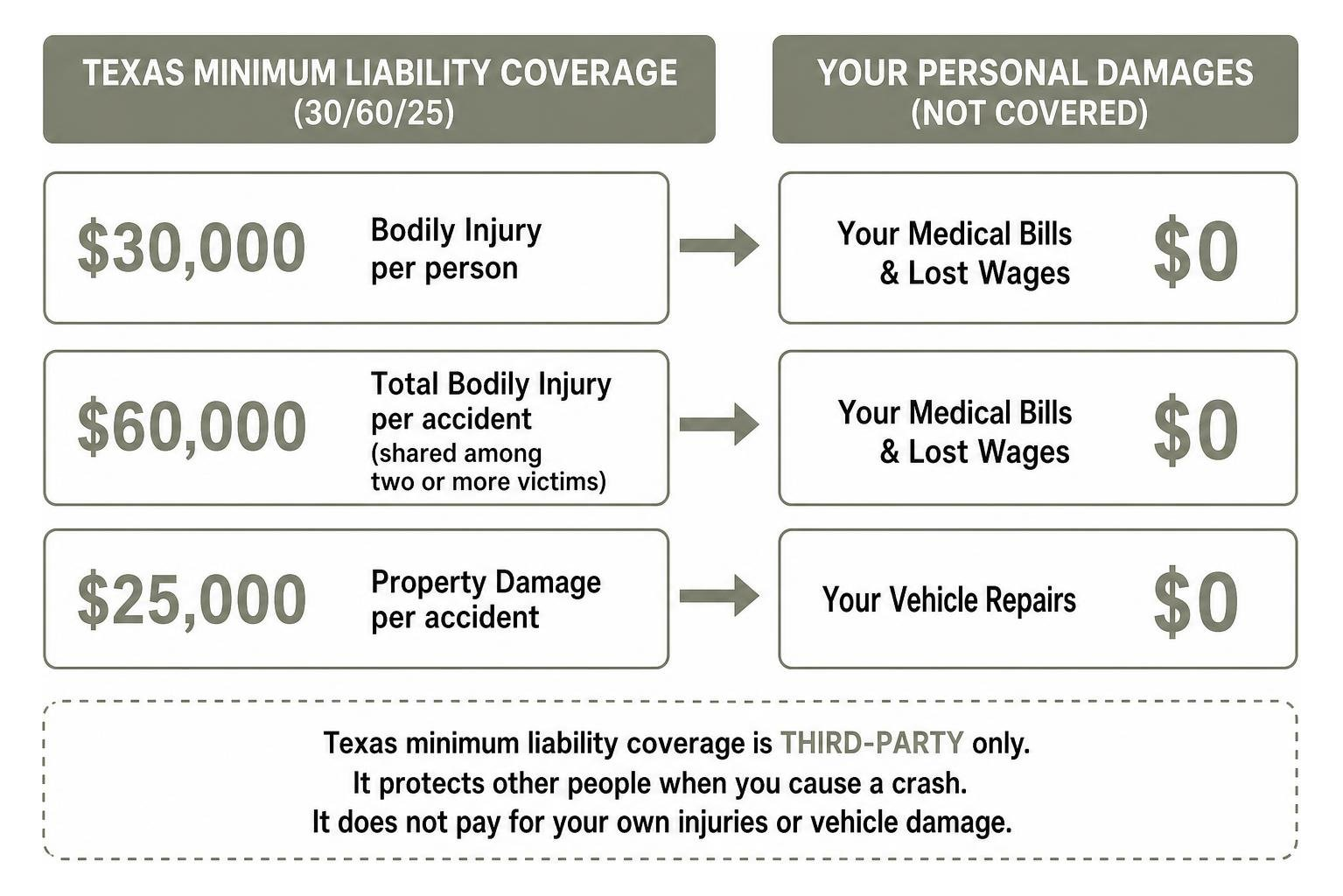
If you carry only the state-mandated minimum auto insurance in Texas, your policy will pay $0 toward your medical bills, lost wages, or vehicle damage following a crash caused by an uninsured motorist.
Texas operates under a fault-based (tort) insurance system. Under this structure, the driver who causes a wreck is legally liable for paying the damages, and their auto insurance is supposed to cover the losses. Under Texas law, all drivers must maintain minimum liability limits of 30/60/25:
- $30,000 for bodily injury per person
- $60,000 for total bodily injury per accident (shared among two or more victims)
- $25,000 for property damage per accident
These minimum liability coverages are strictly third-party coverages. They exist solely to protect other people when you cause an accident on roads like Loop 610 or the Katy Freeway (I-10). They do not provide first-party compensation for your own vehicle repairs or hospital bills at facilities like Memorial Hermann or Ben Taub Hospital.
The Role of Personal Injury Protection (PIP) and UM/UIM Coverage
To protect yourself against negligent drivers on Houston roadways, Texas auto insurance policies offer additional endorsements. The two most critical are:
- Personal Injury Protection (PIP): Under the Texas Insurance Code, PIP covers 80% of lost income and reasonable medical expenses resulting from a collision, regardless of who caused the crash. Every auto insurer in Texas is required by law to include at least $2,500 in PIP coverage on standard policies unless you explicitly rejected it in writing.
- Uninsured/Underinsured Motorist (UM/UIM) Coverage: This coverage steps directly into the shoes of the at-fault driver. If an uninsured driver rear-ends you on Beltway 8 or sideswipes you on I-45, your UM policy pays your bodily injury and vehicle repair expenses up to your chosen policy limits.
Many drivers assume they only purchased “basic coverage” when, in reality, their carrier failed to obtain a valid, signed rejection form for PIP or UM/UIM benefits. If your insurer cannot produce that signed rejection, Texas law dictates that the coverage automatically applies to your policy. Reviewing your policy declarations page with a Houston insurance claim attorney can uncover whether you have access to forgotten or improperly excluded coverage.
Coverage Comparison: Texas Basic Liability vs. Optional Coverages
| Policy Type | Pays for Third-Party Damage? | Pays for Your Medical Bills? | Pays for Your Car Repairs? | Covers Uninsured Hit-and-Run Crashes? |
|---|---|---|---|---|
| Texas Basic Liability (30/60/25) | Yes (up to limits) | No ($0) | No ($0) | No |
| Collision & Comprehensive | No | No | Yes (minus deductible) | Yes (property damage only) |
| Personal Injury Protection (PIP) | No | Yes (regardless of fault) | No | Yes (medical & lost income only) |
| Uninsured Motorist (UM/UIM) | No | Yes (up to UM limits) | Yes (subject to standard $250 deductible) | Yes |
What Legal Options Can You Pursue to Recover Compensation from an Uninsured Driver?
When you do not have UM/UIM coverage and the at-fault driver has no insurance, recovering compensation requires a strategic approach. We examine several legal pathways to identify recovery sources after serious wrecks.
Option 1: Filing a Direct Personal Injury Lawsuit in Harris County
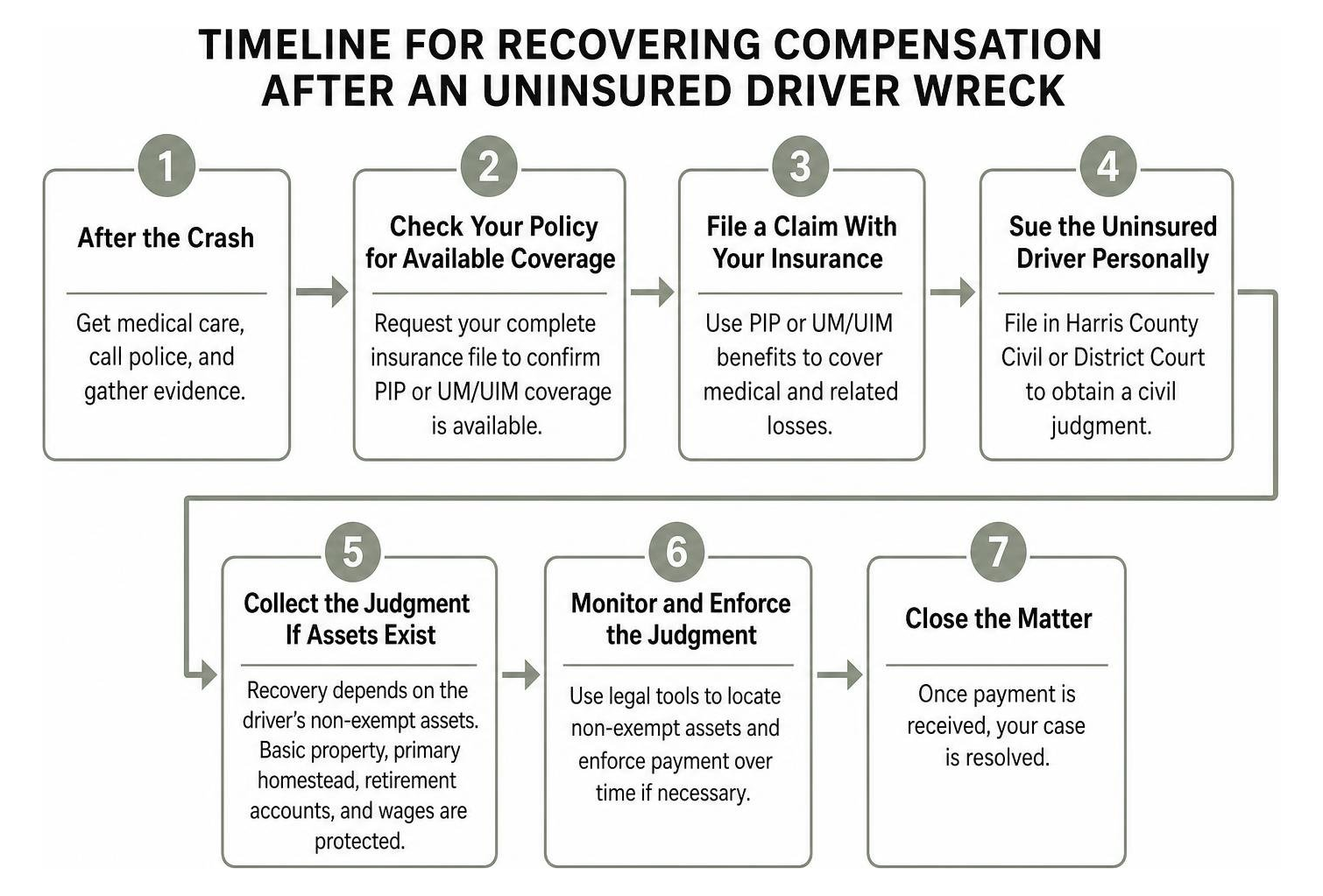
You have the legal right to file a personal injury lawsuit against the at-fault motorist in the Harris County Civil Courts at Law or Harris County District Court. If we prove the driver’s negligence caused the collision, the court will enter a formal judgment requiring them to pay for your medical bills, repair bills, lost income, physical impairment, and pain and suffering.
However, collecting on that judgment presents severe practical obstacles under Texas law. Texas has some of the most debtor-friendly asset protection laws in the United States:
- Texas Homestead Exemption: An individual’s primary residence (up to 10 acres in an urban area like Houston) is generally protected from judgment creditors.
- Personal Property Protections: Under Chapter 42 of the Texas Property Code, personal property valued up to $50,000 for an individual ($100,000 for a family) is exempt from seizure, including personal vehicles, clothing, home furnishings, and tools of the trade.
- Prohibition on Wage Garnishment: The Texas Constitution prohibits the garnishment of current wages for civil judgments arising from personal injury claims.
If the at-fault driver has no non-exempt real estate, bank funds, or corporate investments, they are legally considered judgment-proof. Obtaining a piece of paper stating they owe you $100,000 does not guarantee you will collect that money.
Option 2: Investigating Third-Party and Commercial Liability
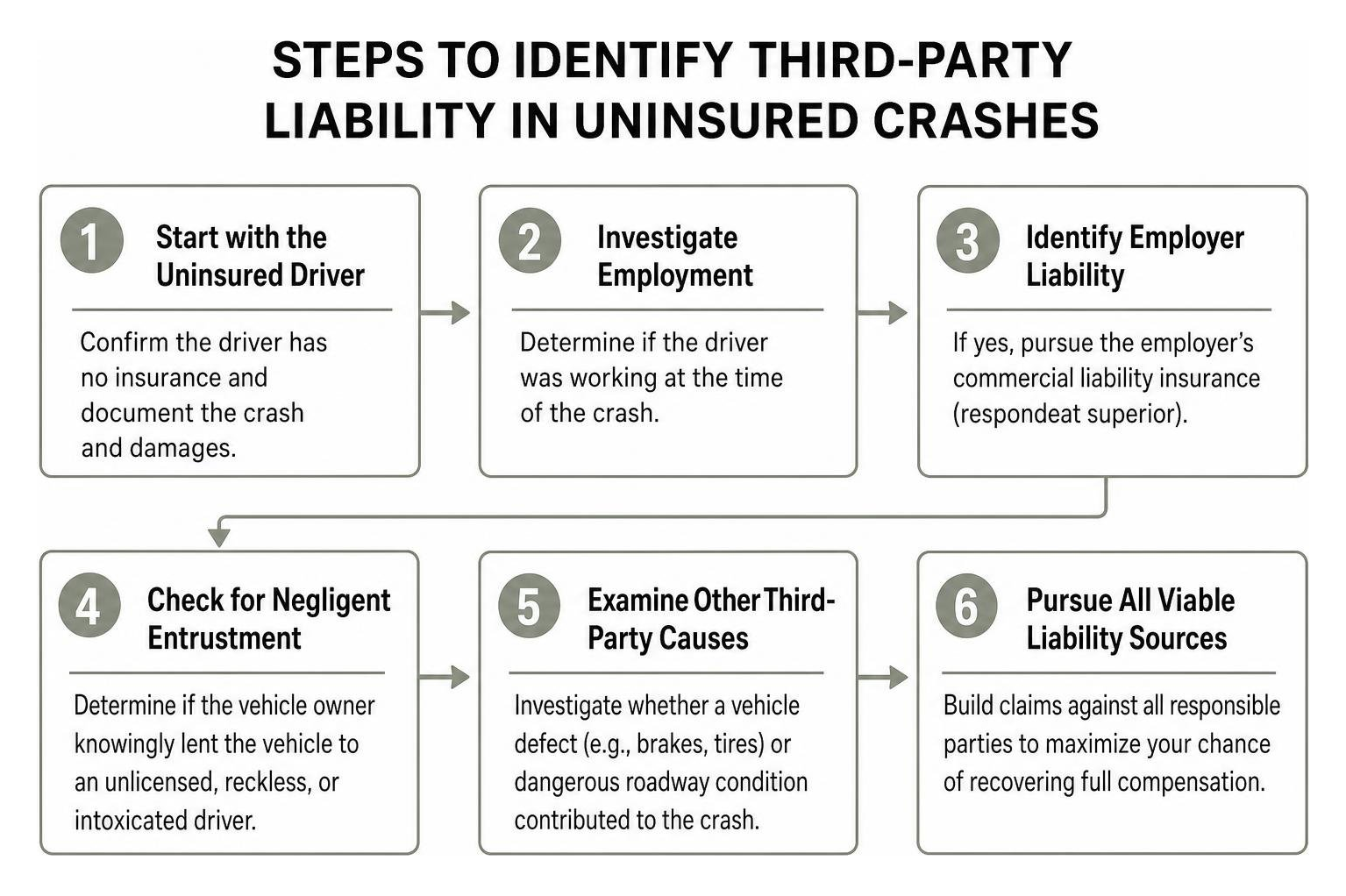
Experienced attorneys do not stop at the uninsured driver’s personal finances. We investigate whether third parties share vicarious or direct liability for the collision:
- Employer Liability (Respondeat Superior): Was the uninsured driver operating the vehicle within the course and scope of their employment? If they were making deliveries, commuting between job sites, or driving a work-related route on Loop 610 or Westheimer Road, their employer’s commercial liability insurance policy may cover your damages.
- Negligent Entrustment: If the vehicle owner knowingly lent their car or truck to an unlicensed, reckless, or intoxicated driver, the vehicle owner can be held independently liable.
- Auto Defect or Third-Party Negligence: If a mechanical failure (such as defective brakes or tire blowouts) or a dangerous roadway condition contributed to the crash, claims against auto manufacturers or maintenance contractors may provide a path to financial recovery.
Option 3: Navigating Texas Comparative Fault Rules
Under Chapter 33 of the Texas Civil Practice and Remedies Code, Texas enforces a 51% modified comparative-fault bar (proportionate responsibility). You can recover compensation as long as you were 50% or less at fault for the accident.
- If you are found to be 0% at fault, you are eligible for 100% of your recoverable damages.
- If you are assigned partial responsibility (for example, 20% fault), your total compensation is reduced by that exact percentage. Understanding the details of comparative negligence in Houston TX helps clarify how insurance adjusters and juries distribute fault.
- If an insurer attempts to shift blame to reduce payouts, knowing how courts handle claims when a driver is partially at fault for a car accident in Texas is critical to protecting your net recovery.
- If your fault exceeds 50% (51% or higher), Texas law bars you from recovering any compensation from other parties.
Option 4: Health Insurance, Hospital Liens, and Medical Reductions
When auto insurance coverage is missing, your private health insurance, Medicare, or Medicaid can cover immediate trauma care at local hospitals. However, Texas hospitals frequently file Chapter 55 Hospital Liens against prospective accident settlements. Our role involves negotiating these medical liens, auditing billings, and leveraging subrogation laws to lower what you owe out of pocket.
What Immediate Steps Should You Take After a Houston Crash with an Uninsured Driver?
The actions you take in the hours and days immediately following an uninsured crash on Houston roads directly dictate your ability to recover compensation.
1. Contact Law Enforcement for an Official Crash Report
Always contact the Houston Police Department (HPD), the Harris County Sheriff’s Office, or the Texas Department of Public Safety (DPS). Do not let an uninsured driver convince you to settle matters off the record. A responding officer will create an official Texas Peace Officer’s Crash Report (Form CR-3), which documents:
- Driver statements and citations issued for driving without insurance (Texas Transportation Code § 601.051).
- Diagrams of vehicle points of impact and roadway conditions.
- Contact details for registered owners and independent eyewitnesses.
2. Document the Scene Thoroughly
Preserve physical and digital evidence before vehicles are towed to Harris County storage lots:
- Photograph vehicle damage, license plates, the other driver’s identification, and insurance cards (even if expired).
- Capture wide-angle shots of skid marks, traffic signals, intersection layouts, and any construction zones along corridors like I-45, Loop 610, or Highway 290.
- Look for commercial security cameras or Houston TranStar traffic cameras that may have recorded the impact.
3. Seek Prompt Medical Care
Seek medical attention at an urgent care or Houston emergency room immediately, even if your symptoms seem minor. Adrenaline often masks soft tissue tears, concussions, and internal injuries. Prompt medical documentation links your injuries directly to the wreck, preventing insurance carriers from arguing that your pain originated elsewhere.
4. Notify Your Auto Insurance Provider Carefully
Report the incident to your carrier to satisfy policy reporting deadlines. However, stick strictly to verified facts and avoid providing recorded statements until you understand how to file a Houston accident insurance claim successfully with legal counsel.
5. Monitor the Texas Statute of Limitations
Under the Texas statute of limitations (Texas Civil Practice and Remedies Code § 16.003), you generally have two years from the exact date of the collision to file a personal injury or property damage lawsuit. Failing to take action within this statutory timeframe permanently terminates your legal right to seek financial recovery in a Texas court. Reviewing how soon to file a personal injury claim in Texas ensures all court deadlines and discovery requirements are met on time.
Why Should You Consult a Houston Car Accident Lawyer After an Uninsured Crash?
Handling an uninsured driver claim on your own while carrying basic liability coverage can quickly lead to financial loss. Insurance carriers have teams of adjusters focused on minimizing payouts, denying PIP claims, and disputing whether UM coverage was waived.
At Westloop Law Firm, we work to protect injured Houstonians facing severe financial strain after an auto collision. Our practice brings together background knowledge in personal injury litigation and probate law. This combined background allows us to manage complex multi-party claims, resolve wrongful death actions involving estates, and identify hidden financial assets that other firms might overlook.
How Legal Representation Protects Your Recovery
- Conducting Asset and Background Searches: We investigate the at-fault motorist’s employment status, commercial connections, and property holdings to determine if a lawsuit is financially practical.
- Uncovering Overlooked Insurance Coverage: We demand full policy underwriting files from your insurance company to confirm whether a signed UM/UIM or PIP rejection form actually exists.
- Evaluating Total Case Worth: We analyze past medical records, future care projections, and wage loss data using principles that determine the average car accident settlement in Houston.
- Negotiating Medical Liens and Expenses: We negotiate directly with healthcare providers, collection agencies, and health insurance subrogation carriers to significantly reduce outstanding medical balances.
- Executing Strategic Case Management: We apply proven approaches to maximize compensation for your car accident claim across every potential recovery source.
Working with a knowledgeable Houston uninsured motorist lawyer or car accident lawyer in Houston provides the legal backing necessary to hold negligent parties accountable while protecting your long-term financial security.
Frequently Asked Questions About Houston Accidents Involving Uninsured Drivers
Can I Sue an Uninsured Driver Personally in Harris County Civil Court?
Yes, you can file a civil lawsuit against an uninsured driver in the Harris County Civil Courts at Law (for claims up to $250,000) or the Harris County District Courts. If successful, the judge or jury will issue a formal civil judgment against the defendant.
However, collecting money from that judgment depends entirely on the defendant’s financial status. Under the Texas Property Code and Texas Constitution, basic personal property, primary homesteads, retirement accounts, and current wages are protected from seizure or garnishment. A personal lawsuit is generally effective only if the at-fault party holds non-exempt investment properties, commercial accounts, or unencumbered business assets.
Will My Insurance Rates Go Up If I Report a Crash Involving an Uninsured Driver in Texas?
Under the Texas Insurance Code, auto insurance companies are generally prohibited from raising your policy premiums or adding surcharges solely because you were involved in a collision where you were not at fault.
Reporting an accident to your insurer is contractually mandatory under your policy agreement. Notifying your carrier promptly also safeguards you in the event that the uninsured driver later makes a fraudulent injury or property damage claim against your liability coverage.
How Do I Know If I Signed Away My Uninsured Motorist Protection in Texas?
Under Texas Insurance Code § 1952.101, an auto insurer cannot issue a motor vehicle liability policy in Texas without including Uninsured/Underinsured Motorist (UM/UIM) coverage, unless the named insured rejects the coverage in writing.
To determine whether you actually waived this protection:
- Examine your insurance Declarations Page (Dec Page) for UM/UIM bodily injury and property damage line items.
- Request a complete copy of your signed policy application and waiver forms from your insurance agent.
- Have an attorney review the documents. If your insurance company cannot produce a valid, signed written rejection form bearing your signature, Texas courts will treat UM/UIM coverage as an active part of your policy as a matter of law.
Strategic Steps to Protect Your Rights and Secure Your Financial Recovery
Carrying basic liability coverage in Houston leaves you vulnerable to the 20% of Texas drivers who operate vehicles without insurance. When an uninsured driver hits you, finding compensation requires reviewing insurance files, identifying liable third parties, and managing medical costs.
Take these steps to protect your claim:
- Request your complete insurance file to confirm whether PIP or UM/UIM coverage is available under Texas law.
- Preserve all crash documentation, including the Texas CR-3 police report, witness statements, and scene photographs.
- Do not provide recorded statements to insurance adjusters before consulting legal counsel.
- Protect your filing deadlines under the Texas two-year statute of limitations.
- Upgrade your auto policy going forward to include robust UM/UIM and PIP limits to protect against future incidents.
If you were injured by an uninsured or underinsured driver in Harris County or the surrounding Houston area, you do not have to handle the financial and legal fallout alone. Contact Westloop Law Firm today to review your insurance policy, discuss your legal options, and consult with our Houston car wreck attorneys. We can help you identify every available avenue for financial recovery.