 Skip to content
What to Do First After a Personal Injury in Houston
If you were hurt due to someone else’s negligence, a claim for personal injury in Houston allows you to pursue compensation for medical expenses, lost wages, and pain and suffering. Taking prompt action protects both your health and your legal claim:
- Seek immediate medical treatment: Visit an emergency center or physician to treat and document all injuries.
- Report the accident: Contact law enforcement after a collision or notify property managers following a slip-and-fall.
- Preserve evidence: Keep photographs of the scene, witness contact details, medical bills, and accident reports.
- Protect your rights: Avoid signing settlement agreements or giving recorded statements to insurance adjusters before understanding your legal options.
- Monitor statutory deadlines: Texas generally enforces a two-year filing deadline for personal injury lawsuits.
- Contact WestLoop Law Firm: If you have questions about your rights or next steps, contact WestLoop Law Firm to discuss your Houston personal injury claim.
Houston injuries happen across busy transportation corridors, industrial worksites, commercial retail centers, and medical facilities. Proving a successful claim requires demonstrating that another party owed a duty of care, breached that duty, and directly caused documented losses. Working with an experienced Houston personal injury lawyer ensures your damages are properly cataloged. You can also consult a personal injury attorney in Houston or explore comprehensive insights from a personal injury law firm to understand how Texas liability statutes apply to your case.

Understanding Personal Injury in Houston and Texas Law

Navigating civil litigation requires a grasp of how state statutes interact with everyday accidents. When someone suffers harm due to another party’s negligence, the legal foundation rests on four core elements: duty of care, breach of duty, causation, and actual damages. Every motorist on Texas roads, every property owner inviting patrons inside, and every healthcare provider treating patients owes a recognized duty of care under state law.
When establishing liability, Personal Injury: Understanding Your Rights in Houston serves as a helpful baseline for injured victims. Texas tort reform statutes place specific requirements on claimants, particularly regarding evidentiary thresholds and procedural milestones. Furthermore, auto insurance claims in Texas often intersect with first-party coverages. For instance, Personal Injury Protection (PIP) is mandatory for insurance carriers to offer on Texas auto policies unless the policyholder rejects it in writing. PIP covers immediate medical expenses and an established percentage of lost wages regardless of who caused the collision.
Key Deadlines for Personal Injury in Houston Claims
Timing plays a decisive role in civil claims. Under Texas law, injured individuals must adhere to a strict two-year statute of limitations. This deadline requires a lawsuit to be officially filed in the appropriate court within two calendar years from the exact date the cause of action accrued.
Failing to meet this timeline generally results in the court dismissing the petition with prejudice, permanently barring recovery. While limited tolling exceptions exist—such as legal disability, minority status of the victim, or delayed discovery of latent injuries—relying on exceptions is risky. Additionally, claims against governmental entities, such as the City of Houston or Harris County Transit agencies, involve much shorter formal notice deadlines, sometimes requiring written notice in as little as 90 to 180 days.
Texas Modified Comparative Fault Rules
Texas operates under a modified comparative fault framework, formally known as proportionate responsibility. Governed by the 51% bar rule, an injured claimant can only recover financial damages if their share of responsibility for the incident is 50% or less.
If a jury or insurance adjuster determines that a plaintiff is 51% or more at fault, the plaintiff is completely barred from receiving any compensation. If the plaintiff is 50% or less at fault, their overall financial compensation is reduced in direct proportion to their percentage of responsibility.
| Fault System Type | 0% At-Fault Plaintiff | 30% At-Fault Plaintiff | 51% At-Fault Plaintiff |
|---|---|---|---|
| Pure Comparative Fault | Recovers 100% of damages | Recovers 70% of damages | Recovers 49% of damages |
| Texas Modified Comparative Fault (51% Bar) | Recovers 100% of damages | Recovers 70% of damages | Recovers 0% (Barred from recovery) |
Common Types and Causes of Injury Claims
Houston’s massive geographic footprint and industrial foundation create unique risk factors for serious accidents. Whether traveling through congested highway corridors or visiting large entertainment venues, physical hazards can quickly lead to life-altering outcomes.
Types of Incidents Leading to Personal Injury in Houston
Accident claims across Harris County arise from diverse scenarios:
- Freeway and Highway Collisions: Catastrophic multi-vehicle wrecks frequently occur along major transportation arteries, including I-45, I-10, Loop 610, and Beltway 8. Heavy commuter traffic combined with high speeds creates frequent collision zones.
- Commercial Trucking Crashes: Given Houston’s proximity to Port Houston and distribution hubs, 18-wheelers and commercial freight haulers share local lanes daily, often leading to severe collisions due to driver fatigue, improper maintenance, or cargo shifts.
- Industrial and Plant Incidents: Chemical refining and energy production facilities along the Houston Ship Channel carry elevated risks of toxic exposure, pipeline fires, and industrial explosions.
- Premises Liability and Slip-and-Falls: Commercial properties, shopping centers, and apartment complexes must maintain safe premises, free from broken flooring, inadequate security, or slick walking surfaces.
- Spectator and Event Safety: Major sports venues and entertainment arenas must implement reasonable crowd safety protocols and protective barriers to prevent spectator injuries from high-velocity objects or structural hazards.
- Medical Malpractice: Substandard medical care, surgical errors, or diagnostic failures at regional healthcare centers can result in permanent disability or wrongful death.
Evaluating Total Damages and Settlement Value
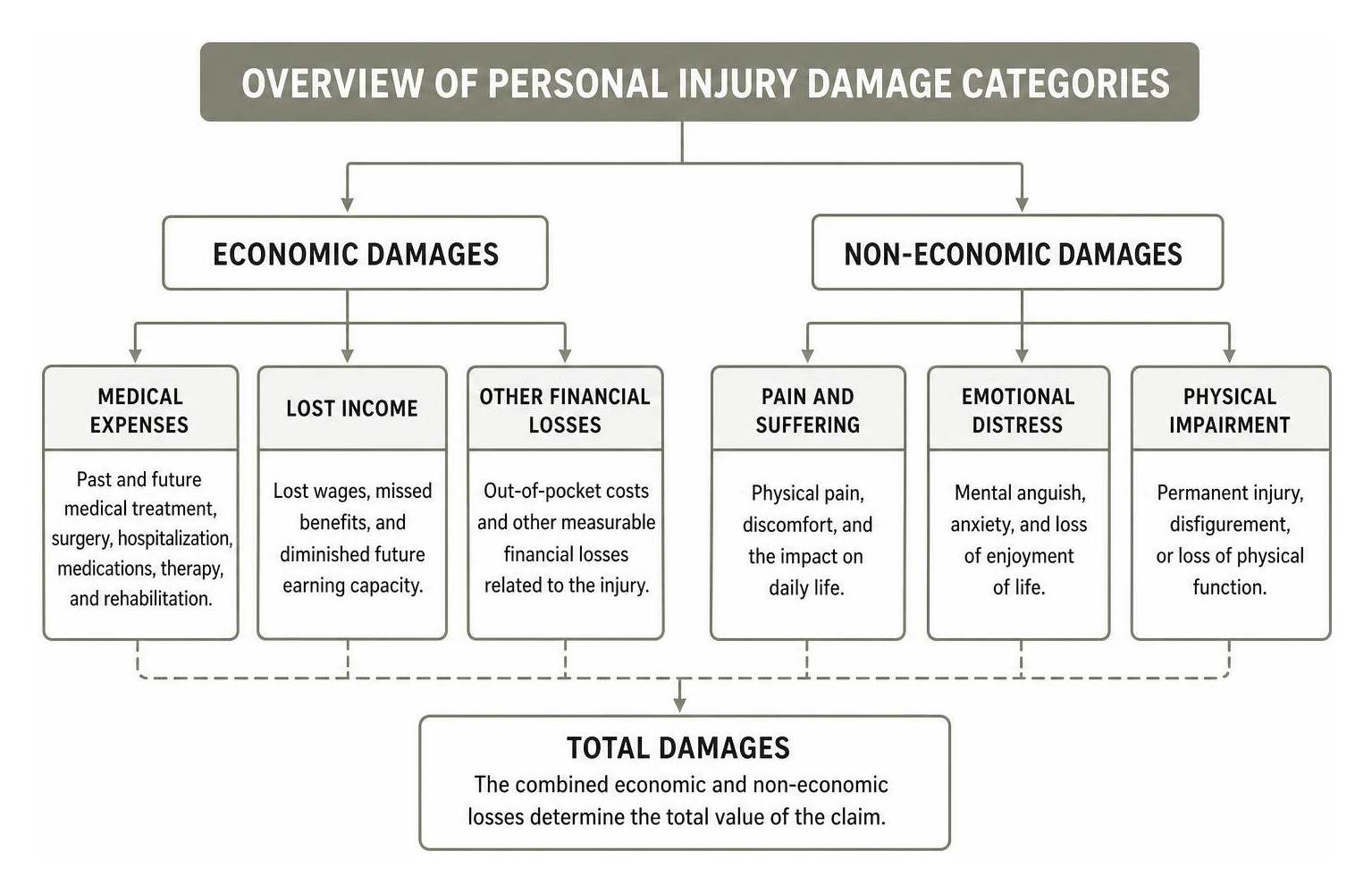
Calculating the true scope of a claim requires analyzing tangible and intangible losses. Determining how much a Houston personal injury case is worth involves assessing past and future medical treatments, surgical costs, physical rehabilitation, lost wages, diminished future earning capacity, physical pain, mental anguish, and physical impairment.
Accident victims often face compounding costs after emergency transport to facilities like Memorial Hermann-Texas Medical Center or Ben Taub Hospital. Capturing these losses requires detailed documentation, from billing statements to vocational reports.
The Steps to Securing Compensation After an Accident
Achieving a fair financial recovery requires an orderly approach to investigating, documenting, and presenting a claim. Knowing how to file personal injury lawsuits in Houston empowers victims to navigate the civil court process effectively:
- Initial Incident Investigation: Gathering collision reports from the Houston Police Department or Harris County Sheriff’s Office, securing surveillance footage, and preserving physical evidence.
- Medical Treatment and Diagnostic Clarity: Completing all recommended medical evaluations to establish a clear causal link between the accident and the diagnosed injuries.
- Comprehensive Demand Package: Assembling medical records, billing ledgers, wage verification letters, and impact statements into a formal demand presented to the liable party’s insurer.
- Negotiation Phase: Engaging in structured dialogue with insurance adjusters to seek a fair settlement that covers all current and future damages.
- Filing a Formal Petition: If insurance negotiations stall, initiating a lawsuit in the Harris County Civil Courts at Law or Harris County District Courts to formally pursue recovery.
Why Legal Representation Matters
Navigating high-stakes civil litigation demands seasoned advocacy. Insurance carriers frequently attempt to minimize payouts or shift fault onto the injured person to trigger the 51% bar rule. Understanding why you need a Houston personal injury lawyer on your side is essential when facing corporate legal teams or complicated liability disputes.
At WestLoop Law Firm, our background spans both personal injury litigation and probate matters. When an accident results in catastrophic outcomes or the tragic loss of a loved one, personal injury claims frequently intersect with Texas probate requirements for wrongful death and survival actions. Having combined proficiency in civil injury advocacy and estate administration ensures that all legal pathways remain protected for victims and their families. For dedicated assistance, you can consult a personal injury lawyer in Houston to evaluate your case.
Frequently Asked Questions About Personal Injury Claims
What is the statute of limitations for filing an injury lawsuit in Texas?
In Texas, the standard statute of limitations for personal injury lawsuits is two years from the date the accident or injury occurred. Missing this filing deadline almost always results in a complete forfeiture of your right to seek financial damages through the civil court system. Certain claims, particularly those involving public entities, require formal administrative notice within a much shorter timeframe.
Can I recover compensation if I was partially at fault for the accident?
Yes, under Texas proportionate responsibility laws, you can still recover compensation as long as your percentage of fault is 50% or less. Your total recovery will simply be reduced by your percentage of responsibility. However, if you are determined to be 51% or more at fault for the incident, Texas law bars you from recovering any financial compensation from other parties.
What types of damages can I recover in a Houston injury settlement?
Claimants can pursue economic damages, non-economic damages, and in certain extreme cases, exemplary (punitive) damages. Economic damages cover direct financial losses such as emergency room visits, ongoing therapies, prescription costs, lost earnings, and property repairs. Non-economic damages compensate for subjective losses, including physical pain, emotional distress, physical disfigurement, and loss of enjoyment of life.
Navigating Your Legal Path Forward in Harris County
Experiencing a sudden accident can disrupt your health, livelihood, and financial stability. Protecting your rights under Texas civil law requires acting swiftly, preserving critical scene evidence, and meeting all statutory deadlines. If you have questions about your options after an accident, contact WestLoop Law Firm to discuss your Houston personal injury claim and the next steps for pursuing compensation.