 Skip to content

How to Use a Financial POA at a Houston Bank
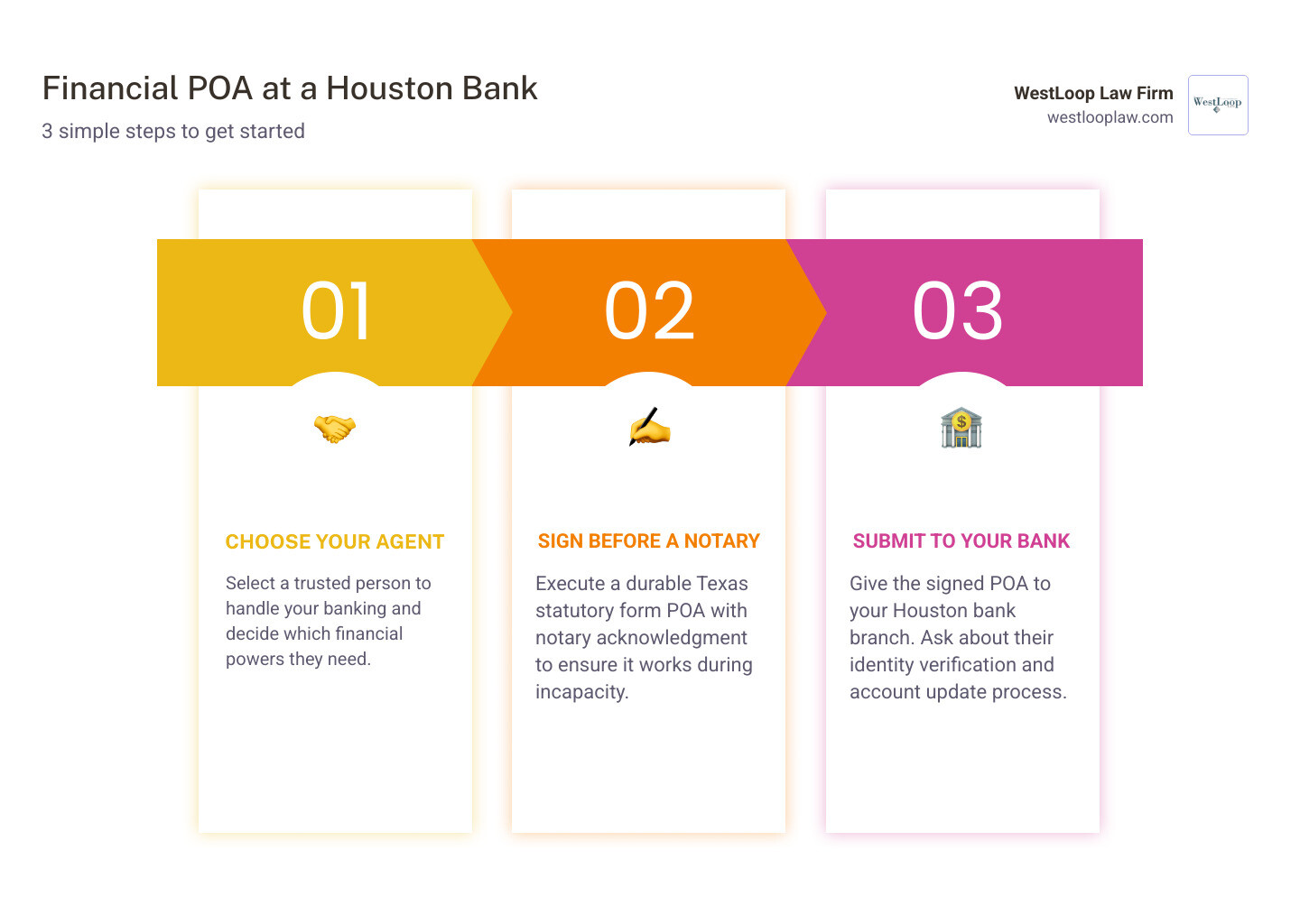
What to do first:
- Choose someone you trust to handle your money and decide which powers they need.
- Sign a Texas financial power of attorney before a notary. If you want it to work during incapacity, make sure it is durable.
- Give the document to your Houston bank and ask what it needs to verify your agent’s identity and authority.
A financial POA for a Houston bank lets your agent handle the banking tasks you authorize, such as paying bills while you recover from an injury. It does not give them power to make medical decisions. Set it up before you need it, so the bank has time to review the document and you can resolve questions while you can still act for yourself.
Quick look at financial poa houston bank:
Understanding Texas Financial POA Rules and Core Authority
Navigating the Texas Estates Code requires a clear understanding of how authority is delegated. A statutory durable power of attorney gives your chosen agent the legal standing to manage assets, pay debts, and interact with financial institutions on your behalf. While many people assume one legal form covers everything, Texas law maintains a strict boundary between medical and monetary choices. When managing financial and medical affairs, you must execute separate documents: a Medical Power of Attorney for healthcare choices and a Statutory Durable Power of Attorney for your finances.
Your financial agent acts as a fiduciary. Under Texas law, a fiduciary holds the highest standard of care and loyalty, meaning they must:
- Act strictly in your best interest rather than their own.
- Avoid conflicts of interest or commingling your funds with their personal accounts.
- Maintain meticulous records and receipts for every single transaction.
- Provide a formal, comprehensive accounting of all funds whenever requested by you or an authorized court.
If you are navigating personal injury recovery following a crash on Loop 610, I-10, I-45, or Beltway 8, your designated agent can manage settlement funds and pay hospital invoices while you heal. In Texas personal injury matters, claims often involve Personal Injury Protection (PIP) auto coverage, the state’s 51% modified comparative-fault bar (which prevents recovery if you are more than 50% at fault), and a strict two-year statute of limitations from the date of the incident. Having a dependable agent in place guarantees these legal and financial deadlines are managed even if you are incapacitated.
Scope of Authority Under the Texas Statutory Form
The Texas statutory durable power of attorney form provides a clear checklist of powers. You can grant initial authority across broad categories or restrict your agent to specific tasks. These statutory powers include:
- Banking and Financial Transactions: Opening and closing accounts, writing checks, initiating wire transfers, and managing safe deposit boxes.
- Real Estate Transactions: Signing deeds, managing mortgages, and executing leases on properties throughout Harris County.
- Investment and Business Operations: Buying or selling stocks, voting proxies, managing commodities, and overseeing partnership agreements.
- Tax Matters: Filing federal returns with the IRS, contesting local property valuations, and signing tax authorizations.
- Government and Elder Care Planning: Applying for state and federal benefits, addressing long-term care needs, and utilizing Houston elder law strategies to protect your legacy.
Effective Dates, Springing Powers, and Termination Triggers
A financial power of attorney can take effect immediately upon signing or become effective only upon your documented incapacity (known as a “springing” power). While springing powers sound appealing for privacy, they often create significant delays at local bank branches along Westheimer Road or Louisiana Street because institutions require certified physician letters before granting account access.
Under Texas Estates Code Section 751.131 and related provisions, a power of attorney automatically terminates upon:
- Your death (at which point your will and probate proceedings take over).
- A formal written revocation executed by you while you possess mental capacity.
- The complete fulfillment of the specific purpose outlined in the document.
- The appointment of a permanent guardian of your estate by the Harris County probate courts.
- Divorce, if your spouse was designated as your agent, pursuant to Texas Estates Code Section 751.132.
Setting up a complete durable power of attorney prevents your family from having to file for emergency guardianship at the Harris County Civil Courts at Law downtown, sparing you substantial time and unnecessary public filings.
How to Establish and Revoke a Financial POA for a Houston Bank

To establish a valid document in Texas, you must be at least 18 years of age and of sound mind at the time of execution. The document must be signed by you and acknowledged before a licensed notary public.
| Feature | General Power of Attorney | Durable Power of Attorney | Springing Power of Attorney |
|---|---|---|---|
| Effective Date | Immediately upon signing | Immediately upon signing | Only upon certified incapacity |
| Survives Incapacity? | No; ends when principal loses capacity | Yes; remains fully active | Yes; activates upon incapacity |
| Primary Use | Short-term transactions (e.g., real estate closings) | Long-term life and estate planning | Individuals hesitant to grant immediate power |
| Bank Acceptance | Fast, but fragile | Highest acceptance rate | Often delayed by medical reviews |
When life circumstances change, you hold the absolute right to cancel the authority you granted, provided you maintain legal capacity. If you need to remove an agent, follow our guide on how to revoke a power of attorney in Houston. To make the revocation legally binding:
- Draft a formal, written “Revocation of Power of Attorney” identifying the original document by date and agent name.
- Sign the revocation before a notary public.
- Deliver written copies via certified mail with return receipt requested to every financial institution where you maintain accounts.
- Demand the physical return of all outstanding original copies from your former agent.
Submitting a Financial POA to a Houston Bank: Acceptance and Verification Rules
Submitting paperwork to a bank requires patience and preparation. Under Texas Estates Code Chapter 751, Texas banks must accept a properly executed statutory durable power of attorney within a set statutory review period (typically seven business days), request an agent’s certification of facts, or request a formal opinion of counsel.
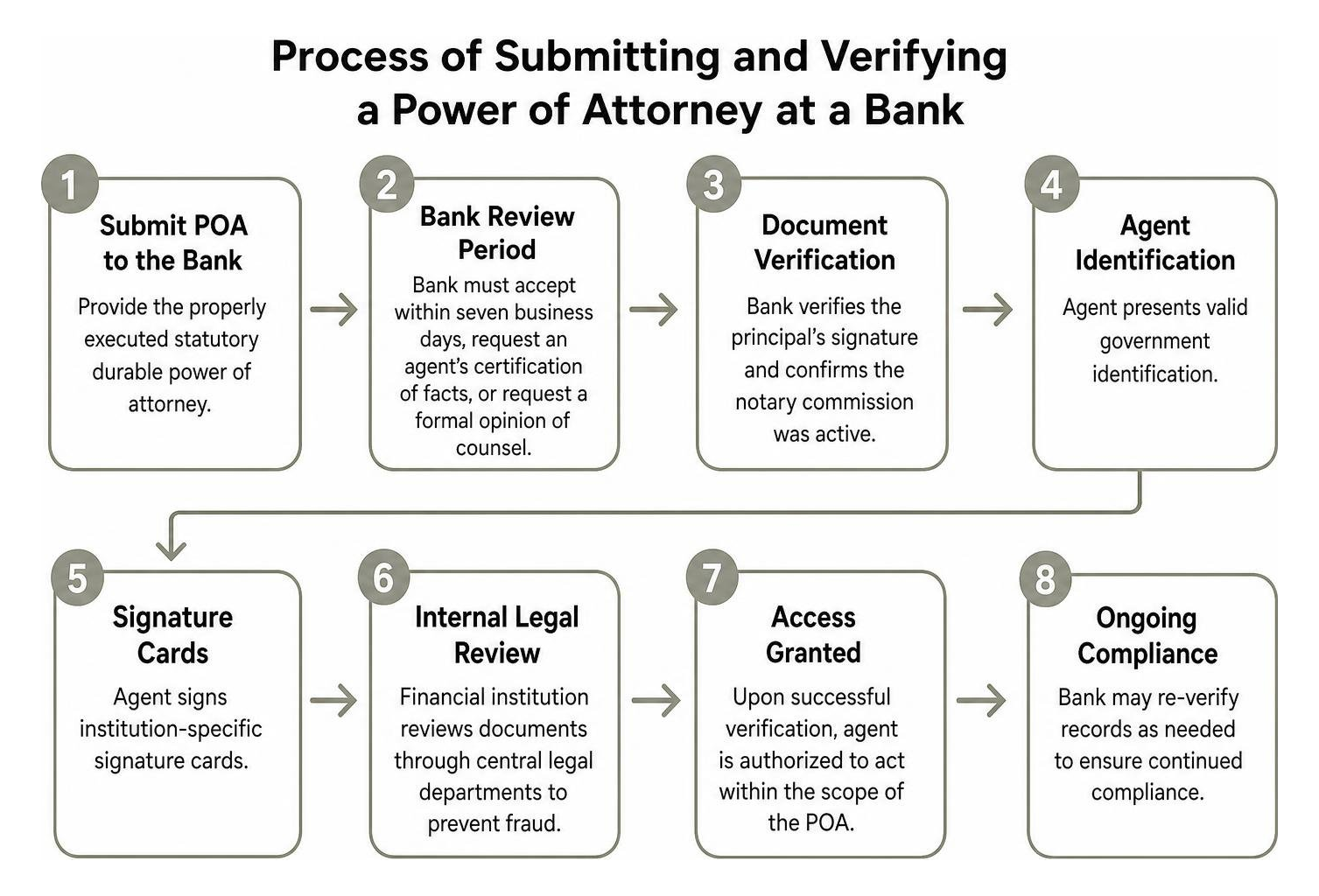
Financial institutions regularly review documents through their central legal departments to prevent fraudulent withdrawals. Branch managers will verify the principal’s signature, confirm the notary commission was active, and require the designated agent to present valid government identification and sign institution-specific signature cards.
Managing Account Transitions When Using a Financial POA at a Houston Bank Post-Merger
Corporate mergers and acquisitions can complicate existing banking authorizations. A prime local example is when Bank of Houston merged into City Bank effective April 1, 2026.
Prior to the merger, Bank of Houston operated as an independent, locally focused institution established in 1892, with 43 employees, $685.58 million in total assets, $596.71 million in deposits, and a Tier 1 Leverage Ratio of 9.51% as of March 31, 2026. For complete historical filing metrics, families can review the Bank of Houston Financial Reports.
When an institution transitions under regulatory identifiers (RSSD ID 583754 and FDIC Certificate 3178), existing powers of attorney remain legally enforceable under Texas contract law, but operational hurdles emerge:
- Successor banks update their internal routing, customer databases, and signature card systems.
- Legacy accounts under the original bank name must be re-verified under City Bank’s administrative guidelines.
- Agents should provide an original or certified copy of the statutory durable POA along with their updated contact details to ensure continuous account management without disruption during branch transitions.
Safeguarding Assets: Selecting an Agent and Preventing Abuse
Choosing your financial agent is one of the most significant choices in your lifetime. You should never appoint someone out of family obligation or guilt. Select an individual who demonstrates daily financial stability, integrity, and organizational skill. Reviewing our guide to Houston powers of attorney will help you evaluate prospective candidates.
To protect yourself against financial exploitation:
- Require Joint Oversight: Designate co-agents or mandate that your agent send quarterly financial ledger statements to an independent third party, such as your CPA.
- Limit Gifting Powers: Explicitly restrict or prohibit the agent from gifting assets to themselves or altering beneficiary designations unless approved in writing.
- Monitor Bank Accounts Online: Maintain read-only digital access to your accounts so you can review transactions as long as you are able.
Elder Care Planning, Medicaid Eligibility, and Veterans Benefits
A well-crafted power of attorney is indispensable for long-term elder care. As families face the rising costs of nursing facilities across the Greater Houston area, strategic asset management becomes necessary.
Under Texas Medicaid guidelines, transferring assets within the five-year “look-back” period can trigger substantial penalty periods of ineligibility. If your durable POA does not expressly authorize specific gifting strategies or the creation of qualified trusts (such as Miller Trusts or Supplemental Needs Trusts), your agent will be unable to protect your estate or secure Medicaid and VA Aid & Attendance pension benefits. Coordinating with our team for Houston estate planning legal representation guarantees your documents contain the exact authority needed for long-term preservation without running afoul of federal regulations.
Frequently Asked Questions About Houston Banking Powers of Attorney
Can a Houston bank refuse to accept a valid Texas statutory durable power of attorney?
A Texas bank cannot arbitrarily refuse a properly drafted and executed statutory durable power of attorney. Under Texas Estates Code Chapter 751, a financial institution must accept the document or provide a written explanation for refusal within seven business days. Legitimate reasons for refusal include:
- The bank has actual knowledge that the power of attorney has been revoked.
- The bank has filed a suspicious activity report (SAR) regarding suspected elder financial exploitation.
- A good-faith belief that the principal was incapacitated or coerced when signing.
If a bank improperly rejects your document, you can seek a court order through Harris County courts compelling acceptance and potentially recovering reasonable attorney fees.
How did the Bank of Houston merger into City Bank impact existing powers of attorney?
The April 1, 2026 merger of Bank of Houston into City Bank did not invalidate existing durable powers of attorney executed under Texas law. However, because internal account systems were consolidated under the successor institution, agents must visit a local branch with their original notarized POA, government-issued identification, and the updated account numbers to execute new internal signature cards.
What is the difference between an immediate and a springing financial POA in Texas?
An immediate power of attorney grants your agent lawful authority the moment the document is notarized, allowing them to assist you right away with bill payments and business affairs. A springing power of attorney remains completely dormant until a specific triggering condition occurs—almost always your documented medical incapacity. While springing authority protects against premature use, it frequently creates practical hurdles at financial institutions, which will refuse transactions until your agent delivers formal written physician certifications verifying your incapacity.
Securing Your Family’s Financial Future in Houston
Establishing a dependable, statutory-compliant financial power of attorney ensures your household bills, investments, and business operations proceed smoothly during an unexpected illness or injury. Rather than leaving your family to navigate bank legal departments or courtrooms alone, proactive planning provides immediate authority when it matters most.
At Westloop Law Firm, our team combines background in probate and injury law to protect your assets and advocate for your rights across Greater Houston. Connect with us online to schedule a consultation with our Houston estate planning attorneys and put an airtight financial protection plan in place today.