 Skip to content

What to Ask a Houston Work Injury Lawyer After an Accident
What to do first:
- Get medical care and tell your employer about the injury as soon as you can.
- Save photos, witness names, medical records, and any written reports.
- Ask a Houston work injury lawyer whether your employer has workers’ compensation coverage, what deadlines apply, and whether you may have a claim against someone other than your employer.
Texas does not require most private employers to carry workers’ compensation insurance. That choice can change how you seek payment for medical bills and lost wages. Before you rely on an insurance claim alone, ask what rights you may have and what evidence you need to keep. This guide covers the questions to bring to that conversation.
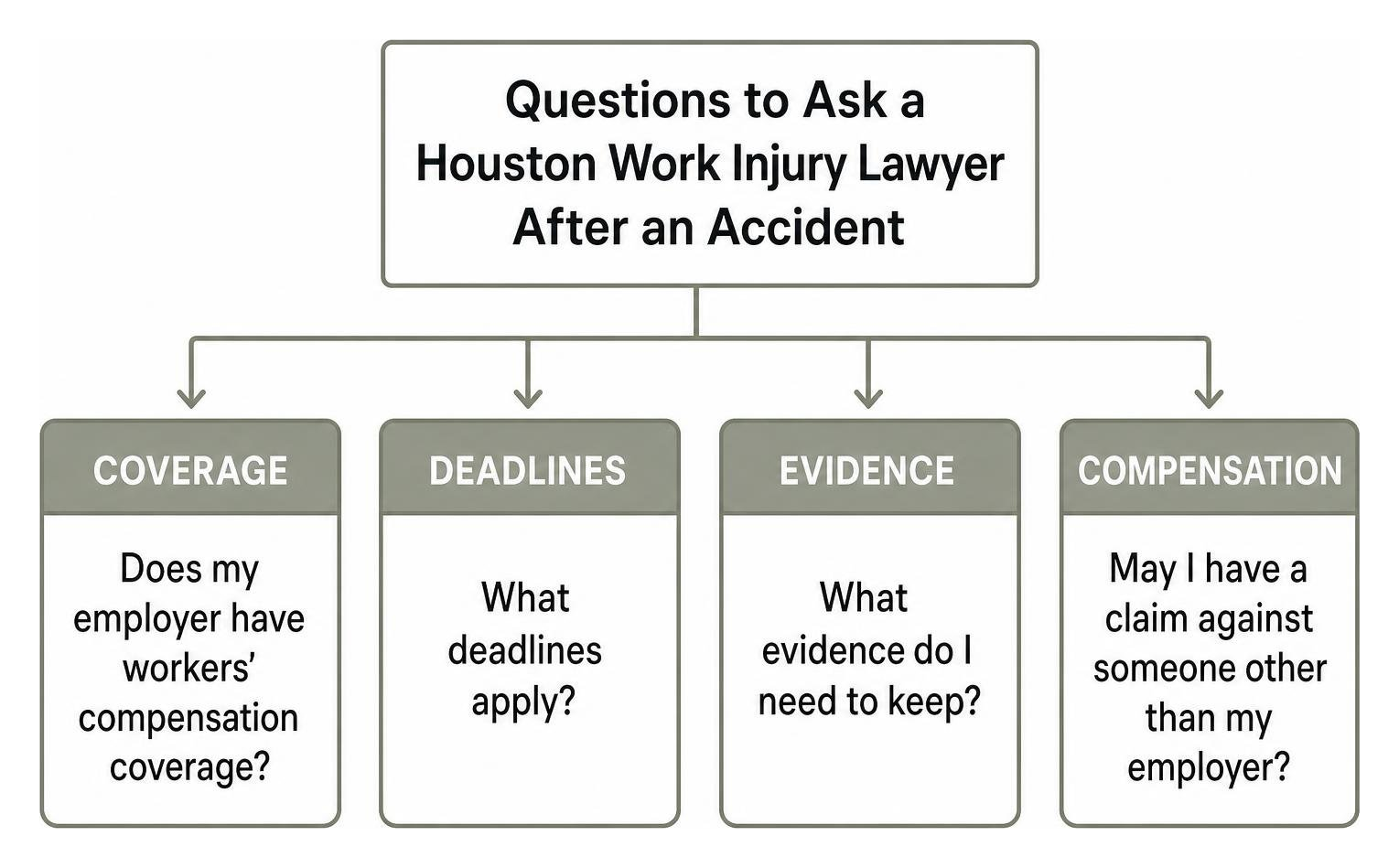
Easy houston work injury lawyer word list:
Understanding Texas Workplace Injury Laws and Your Rights
Working in the greater Houston area places employees in some of the most demanding industrial, logistics, and construction environments in the country. From refineries along the Houston Ship Channel to booming commercial builds off Loop 610 and I-10, physical labor keeps our city moving. However, Texas regularly reports some of the highest workplace casualty rates in the nation. In 2022 alone, Texas recorded 476 workplace fatalities, with the construction sector accounting for 30% of those deaths. Across Harris County, employers reported tens of thousands of serious nonfatal injuries, including more than 1,200 work-related amputations over recent reporting periods.
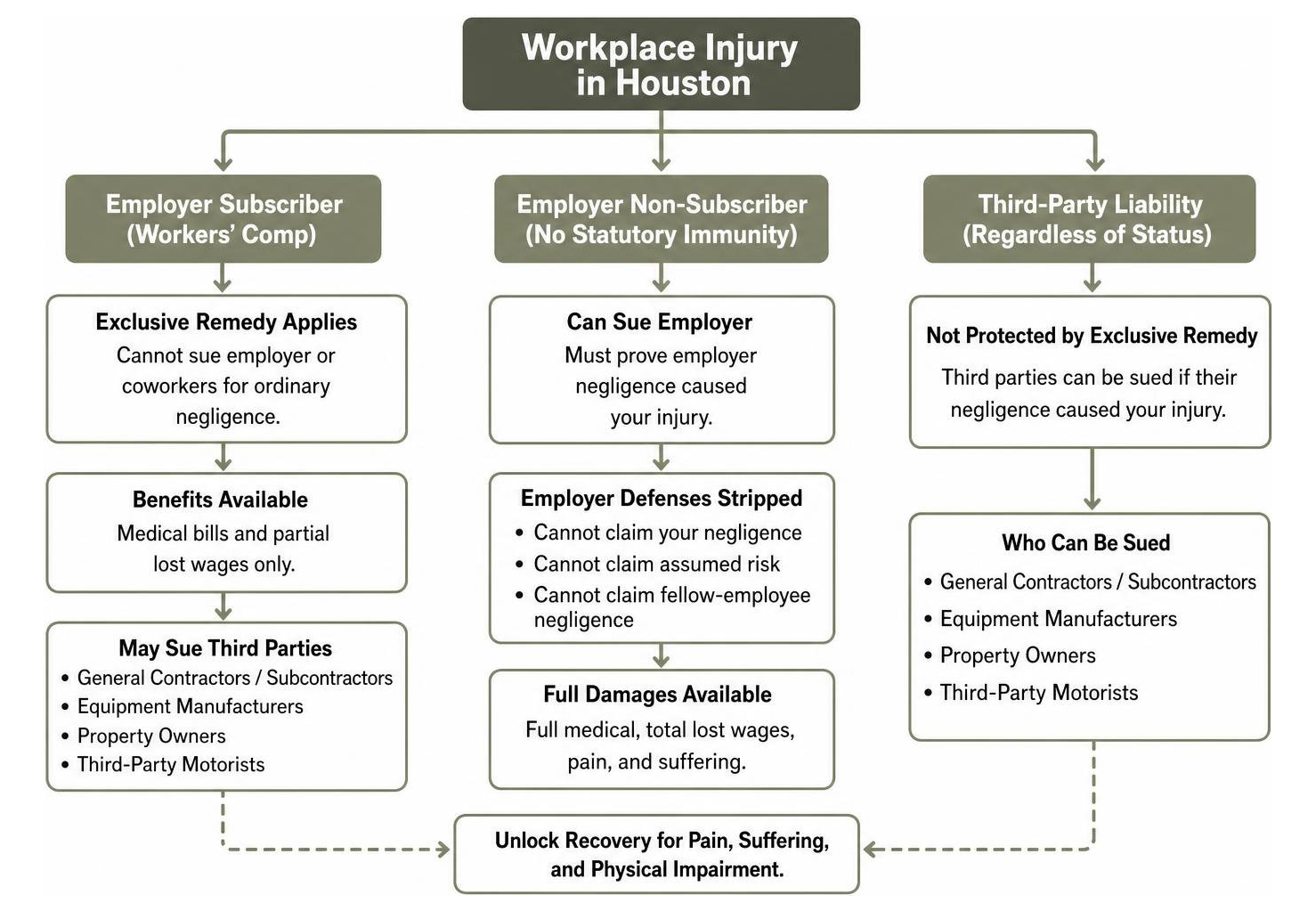
When you are hurt on the job, Texas law functions quite differently from almost every other state. The Texas Workers’ Compensation Act gives private employers the option to opt out of state-regulated workers’ compensation insurance. Employers who carry traditional workers’ comp are called “subscribers,” while those who opt out are known as “non-subscribers.” Knowing which category your employer falls into is the single most important factor determining how your claim proceeds.
| Feature | Subscriber Employer (Workers’ Comp) | Non-Subscriber Employer (Opt-Out) |
|---|---|---|
| Coverage Type | State-regulated statutory policy | Private ERISA plan or self-insured |
| Fault Required? | No-fault system | Must prove employer negligence |
| Ability to Sue Employer | Barred by exclusive remedy (except gross negligence) | Full personal injury lawsuit permitted |
| Available Damages | Medical bills and partial lost wages only | Full medical, total lost wages, pain, and suffering |
| Employer Defenses | Protected from civil lawsuits | Stripped of common-law defenses (cannot blame employee) |
When you suffer harm in Houston work accidents, understanding these legal boundaries prevents you from accepting inadequate settlements that fail to cover your long-term medical care.
How Texas Non-Subscriber Rules Impact Your Claim
If your company is a non-subscriber, they do not have statutory workers’ compensation immunity. While these employers often maintain private benefit plans that mimic workers’ comp, those plans are designed to protect company profits rather than fully compensate injured workers.
When you file an injury lawsuit against a non-subscriber in Texas, state law strips the employer of standard common-law defenses. This means the employer cannot argue that:
- Your own negligence contributed to the injury (contributory negligence).
- You assumed the risks inherent in your job duties.
- A fellow employee’s negligence caused the accident (the fellow-servant rule).
To win a non-subscriber claim, you only need to prove that the employer’s negligence—even in a minor way, such as failing to provide adequate training, proper tools, or sufficient staffing—caused your injury. Learning how to navigate Houston workers’ comp claims and non-subscriber disputes requires understanding how these company plans operate behind closed doors.
Workers’ Comp Exclusive Remedy vs. Third-Party Lawsuits
When an employer subscribes to standard workers’ comp, the law enforces an “exclusive remedy” rule. This rule prevents you from filing a traditional personal injury lawsuit against your direct employer or coworkers for ordinary negligence. In exchange, you receive defined medical and wage benefits regardless of who caused the accident.
However, the exclusive remedy doctrine does not shield third parties whose negligence contributed to your harm. On complex job sites across Houston—such as manufacturing plants along Highway 225 or construction corridors near Beltway 8—multiple entities work side by side. You can file a third-party lawsuit against:
- General Contractors or Subcontractors: Other companies on the job site that created dangerous hazards.
- Equipment Manufacturers: Companies that designed or sold defective machinery, power tools, or safety harnesses.
- Property Owners: Commercial landowners who failed to correct dangerous site conditions.
- Third-Party Motorists: Drivers who strike you while you travel for work along I-45 or Loop 610.
A qualified Houston industrial accident attorney can investigate the site to identify every liable third party, unlocking financial recovery for pain, suffering, and physical impairment that workers’ comp never pays.
Critical Steps to Take Immediately After a Workplace Accident in Houston
The actions you take in the minutes, hours, and days following an on-the-job accident dictate whether you recover fair compensation. Following these steps helps protect your health and preserves key evidence before it disappears.

Reviewing these 7 key steps to take following an injury in Houston provides a reliable blueprint for protecting your claim:
- Obtain Immediate Emergency Medical Care: Your health comes first.
- Report the Accident in Writing: Provide prompt notice to supervisory staff.
- Document the Worksite Scene: Capture photos and video footage of the hazard.
- Collect Coworker Contact Information: Identify all eyewitnesses.
- Secure Physical Evidence: Keep damaged gear, tools, and clothing intact.
- Track Your Symptoms and Expenses: Keep detailed records of treatments and missed days.
- Consult an Attorney Before Signing Documents: Never give recorded statements to insurers alone.
Reporting the Injury and Securing Emergency Medical Care
Under the Texas Labor Code, you must notify your employer within 30 days of the injury date (or from the date you discovered an occupational illness). Failing to provide notice within this 30-day window can destroy your right to benefits.
Seek immediate emergency treatment at local facilities such as Memorial Hermann-Texas Medical Center, Ben Taub Hospital, or Houston Methodist. Tell every treating physician that your injury happened at work so they record it accurately in your medical charts. Insurance adjusters review these initial emergency intake notes looking for discrepancies to deny coverage.
Preserving Evidence and Documenting Safety Violations
Workplace conditions change quickly. Defective scaffolding gets dismantled, spilled chemicals get washed away, and broken machinery gets repaired hours after an incident. If you are physically able, take photos and videos of the hazard, missing safety guards, and surrounding conditions.
Obtain names and contact details for all eyewitnesses before management transfers them or contractors leave the site. Our legal team uses formal spoliation letters to stop employers from erasing surveillance footage, altering maintenance logs, or destroying black-box data. Solid evidence is vital for proving liability in Houston personal injury cases brought before Harris County juries.
Key Questions to Ask When Hiring a Houston Work Injury Lawyer
Before hiring legal representation, you should interview prospective attorneys to ensure they possess the trial skills and resources necessary to handle complex industrial claims. Reviewing the top questions to ask your Houston personal injury lawyer will prepare you for your initial meeting.
1. How Will You Investigate and Prove Employer or Third-Party Negligence?
Ask the attorney how they plan to gather evidence, inspect the worksite, and handle federal regulatory standards. An effective investigation involves:
- Subpoenaing internal safety inspection reports and company training records.
- Cross-referencing worksite violations against Occupational Safety and Health Administration (OSHA) regulations.
- Taking formal depositions of site supervisors, safety managers, and equipment operators.
- Retaining accident reconstruction professionals, biomechanical engineers, and industrial safety consultants.
A dedicated workplace injury lawyer understands how to uncover hidden safety shortcuts taken to boost corporate speed at the expense of worker safety.
2. What Specific Damages Can You Help Me Recover?
Ask the attorney to detail the full range of damages available under your claim’s specific structure. In a third-party lawsuit or non-subscriber claim, you can pursue damages that workers’ comp does not provide, including:
- Past and Future Medical Expenses: Emergency surgeries, hospital stays, physical therapy, prescription medication, and assistive devices.
- Lost Earnings and Earning Capacity: Compensation for past missed paychecks and your reduced capacity to earn a living in the future.
- Physical Pain and Mental Anguish: Compensation for daily physical discomfort, anxiety, depression, and post-traumatic stress.
- Physical Impairment and Disfigurement: Damages for permanent mobility loss, scarring, or amputations.
When accidents cause life-altering harm, pursuing catastrophic injury damages ensures your family has the resources to handle long-term medical needs.
3. How Do Your Legal Fees and Contingency Agreements Work?
Ask for complete transparency regarding legal fees. Reputable Houston personal injury law firms represent injured workers on a contingency-fee basis. This means:
- You pay zero upfront costs or retainers to start your case.
- The law firm advances all necessary litigation expenses, including filing fees, professional consultant fees, and deposition court reporter fees.
- The firm only collects an agreed-upon percentage of the final recovery if they secure a settlement or courtroom verdict.
- If no money is recovered, you owe no attorney fees.
Scheduling a free consultation allows you to discuss fee agreements openly and review your legal options without financial pressure.
Deadlines and Legal Challenges in Harris County Work Injury Litigation
Filing a personal injury claim in Houston requires maneuvering through complex state laws, strict procedural rules, and aggressive corporate defense tactics. If your case cannot be resolved through settlement negotiations, it will proceed to the Harris County Civil Courts at Law or the Harris County District Courts in downtown Houston. Working with a focused Houston injury litigation lawyer ensures your case complies with all local court rules and deadlines.
Texas Statute of Limitations and Employer Notice Requirements
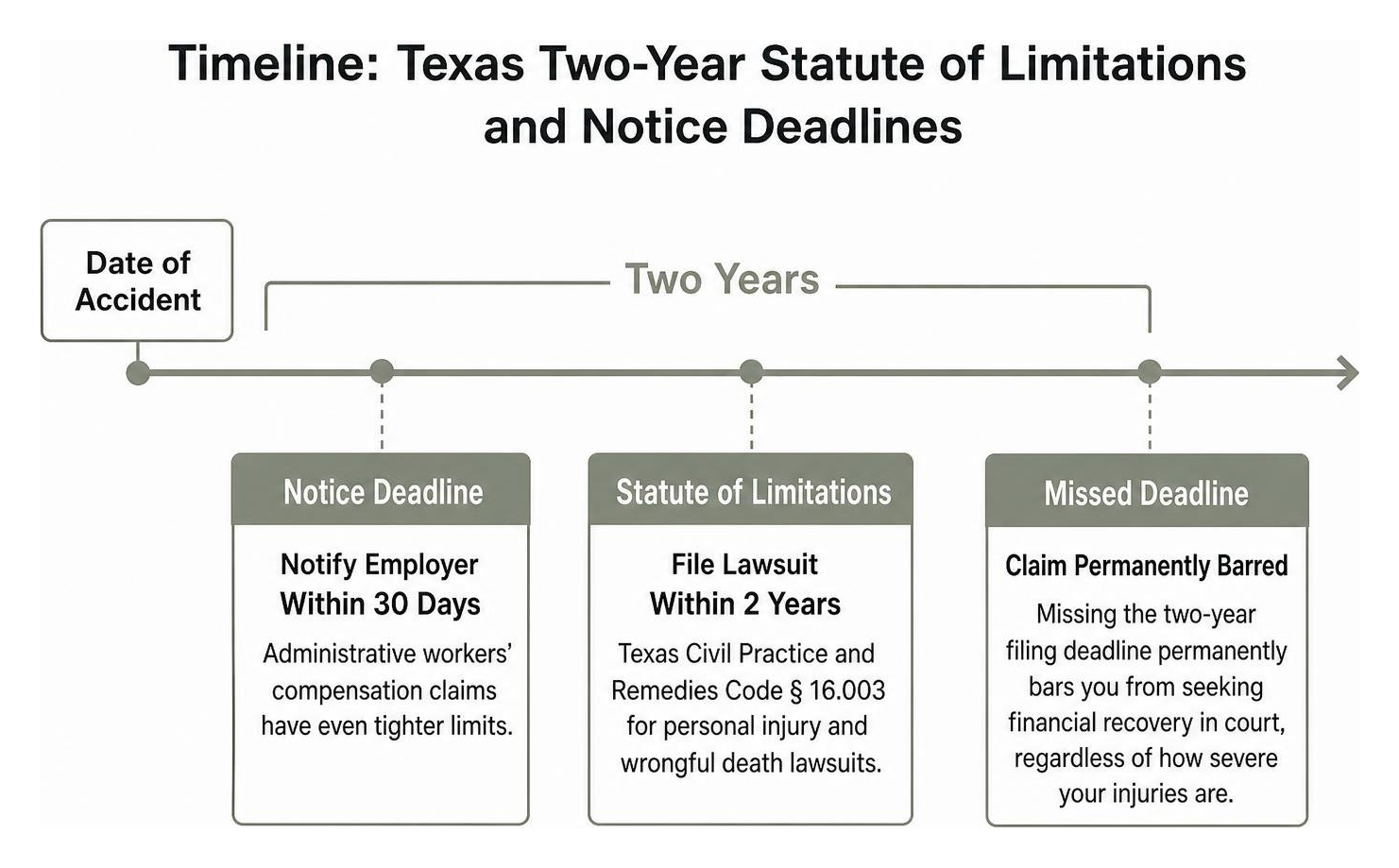
Under Texas Civil Practice and Remedies Code § 16.003, the Texas statute of limitations for personal injury and wrongful death lawsuits is two years from the date of the accident.
Missing this strict two-year filing deadline permanently bars you from seeking financial recovery in court, regardless of how severe your injuries are. Administrative workers’ compensation claims have even tighter limits:
- You must report your injury to your employer within 30 days.
- You must file your formal DWC Form-041 with the Texas Department of Insurance, Division of Workers’ Compensation (DWC) within one year of the accident.
Navigating Comparative Fault and Commercial Transit Coverage
In Texas third-party injury claims and motor vehicle accidents during work travel, state law applies a 51% modified comparative-fault bar (Texas Civil Practice and Remedies Code Chapter 33). Under this proportionate responsibility rule:
- You can recover damages as long as your percentage of responsibility is 50% or less.
- Your total financial award is reduced by your exact percentage of fault (for example, if you are awarded $100,000 but found 20% at fault, you receive $80,000).
- If you are found 51% or more responsible, you are completely barred from recovering any damages.
Insurance defense adjusters frequently use this rule to blame workers for their own accidents. For transit-related workplace accidents along busy corridors like I-45, I-10, and Beltway 8, claims may also involve Personal Injury Protection (PIP) coverage. PIP is a no-fault auto insurance coverage that pays immediate medical bills and a portion of lost income regardless of who caused the collision.
Understanding how these rules intersect is equally critical in complex industrial sectors, including maritime operations and oilfield injury claims.
Frequently Asked Questions About Houston Workplace Injury Claims
Can I sue my employer in Texas if they have workers’ compensation insurance?
If your employer carries state-regulated workers’ comp insurance, the exclusive remedy doctrine generally prevents you from suing them for ordinary negligence. However, you can sue a subscriber employer if they caused a worker’s death through intentional acts or gross negligence. Additionally, you retain the legal right to file a third-party personal injury lawsuit against negligent equipment manufacturers, subcontractors, or property owners.
What is the deadline to file a workplace injury lawsuit in Houston courts?
You have two years from the date of the accident to file a formal personal injury lawsuit in the Harris County Civil Courts at Law or District Courts. If you are filing an administrative claim through the Texas Division of Workers’ Compensation, you must notify your employer within 30 days and submit your formal state claim within one year.
How much does it cost to consult with an on-the-job accident attorney?
Initial case reviews are provided at no cost. Reputable personal injury attorneys work on a contingency-fee basis, meaning you pay nothing out of pocket. Legal fees and case expenses are paid solely from the financial recovery secured through settlement or verdict.
Taking Action to Protect Your Future After a Work Injury
A serious on-the-job injury can disrupt your livelihood, leaving you with mounting medical expenses, physical pain, and career uncertainty. Because Texas workplace safety and insurance laws differ significantly from other states, you should never rely solely on an employer or insurance adjuster to explain your legal rights.
At Westloop Law Firm, we stand up for injured workers across Houston, Harris County, and surrounding communities. Our combined background in personal injury litigation and probate law allows us to provide comprehensive advocacy for injured employees and families pursuing wrongful death claims after fatal industrial accidents. When you need a dedicated personal injury lawyer in Houston, we are here to investigate your accident, identify all liable parties, and fight for the full financial recovery you deserve. Contact our team today to schedule your free, confidential case evaluation.