 Skip to content
Finding a Medical Injury Law Firm in Houston
A medical injury law firm Houston can help you determine whether a harmful medical outcome may be a valid malpractice claim under Texas law. Not every complication or failed treatment is negligence. A claim generally requires evidence that a health care provider failed to meet the accepted standard of care and that failure caused a preventable injury.
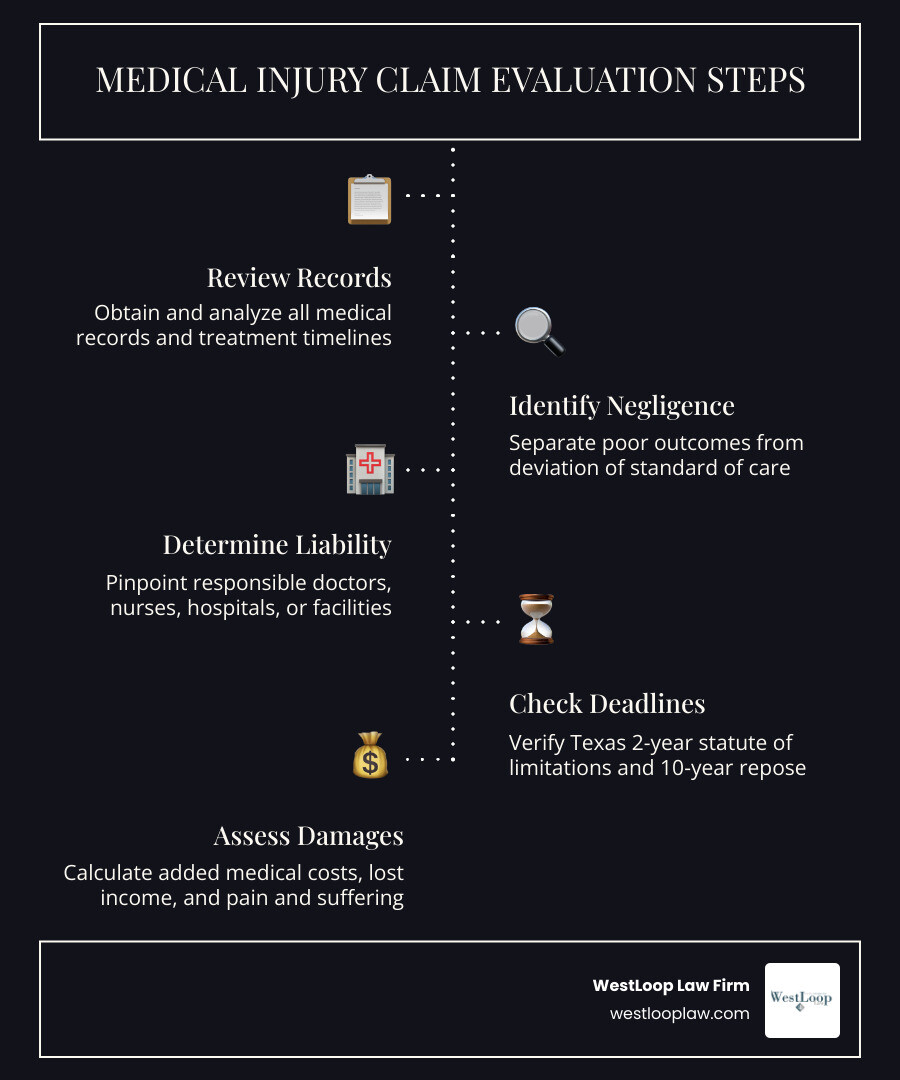
For a quick starting point, look for a firm that can help you:
- Review medical records and the timeline of treatment.
- Separate a poor outcome from possible medical negligence.
- Identify the doctors, nurses, facilities, or hospitals involved.
- Determine whether Texas filing deadlines and legal requirements apply.
- Assess damages such as added medical care, lost income, and pain and suffering.
Houston’s large network of hospitals and medical centers means patients receive complex care every day. When something goes wrong, the facts can be difficult to untangle. Texas also has strict rules for medical malpractice cases, including early preliminary report requirements and limits on certain damages. That makes a careful case review important before filing a lawsuit.
WestLoop Law Firm can help injured Texans understand the questions that matter: What happened? Could it have been avoided with reasonable care? And is there evidence to support a legal claim?
Medical injury law firm Houston vocab explained:
- Houston personal injury lawyer
- Houston car accident injury attorneys
- Houston product liability attorney
How a Medical Injury Law Firm in Houston Evaluates Malpractice vs Bad Outcomes
When medical care results in an unexpected injury or worsening condition, patients naturally feel frustrated and distressed. However, under Texas law, an unsatisfactory medical outcome does not automatically mean medical malpractice occurred. Healthcare procedures carry inherent risks, and even the most cautious medical care can sometimes fail to produce a full recovery.
To build a valid claim, a legal cause of action requires clear proof of medical negligence. This means demonstrating that a healthcare professional deviated from the accepted standard of care—the degree of care and skill that a reasonably prudent healthcare provider in the same field would have exercised under similar circumstances. A medical injury law firm Houston focuses on identifying whether a provider’s errors directly led to harm that could have been prevented.
Determining Malpractice in Texas Medical Centers
The sprawling Texas Medical Center, situated near Fannin Street and Holcombe Boulevard, is home to world-renowned institutions such as Houston Methodist Hospital, Memorial Hermann-Texas Medical Center, Ben Taub Hospital, and St. Luke’s Health. While these facilities deliver advanced medical care, the sheer volume of patients and high-stakes treatments increases the potential for medical mistakes.
Determining malpractice in these complex clinical environments involves analyzing both individual provider actions and institutional protocols. Hospital negligence may stem from inadequate staffing, improper staff training, malfunctioning equipment, or systemic communication breakdowns between departments. Physician liability, on the other hand, usually involves personal clinical choices, such as misreading diagnostic imaging, prescribing harmful drug combinations, or executing surgical mistakes.
To learn more about how legal standards apply across healthcare settings in Harris County, visit our Houston Medical Malpractice Law Firm Guide.
Role of a Medical Injury Law Firm Houston in Assessing Viability
Evaluating the legal strength of a potential medical malpractice claim requires a systematic process. At WestLoop Law Firm, we perform comprehensive case evaluation procedures to ensure every client receives a thorough review.
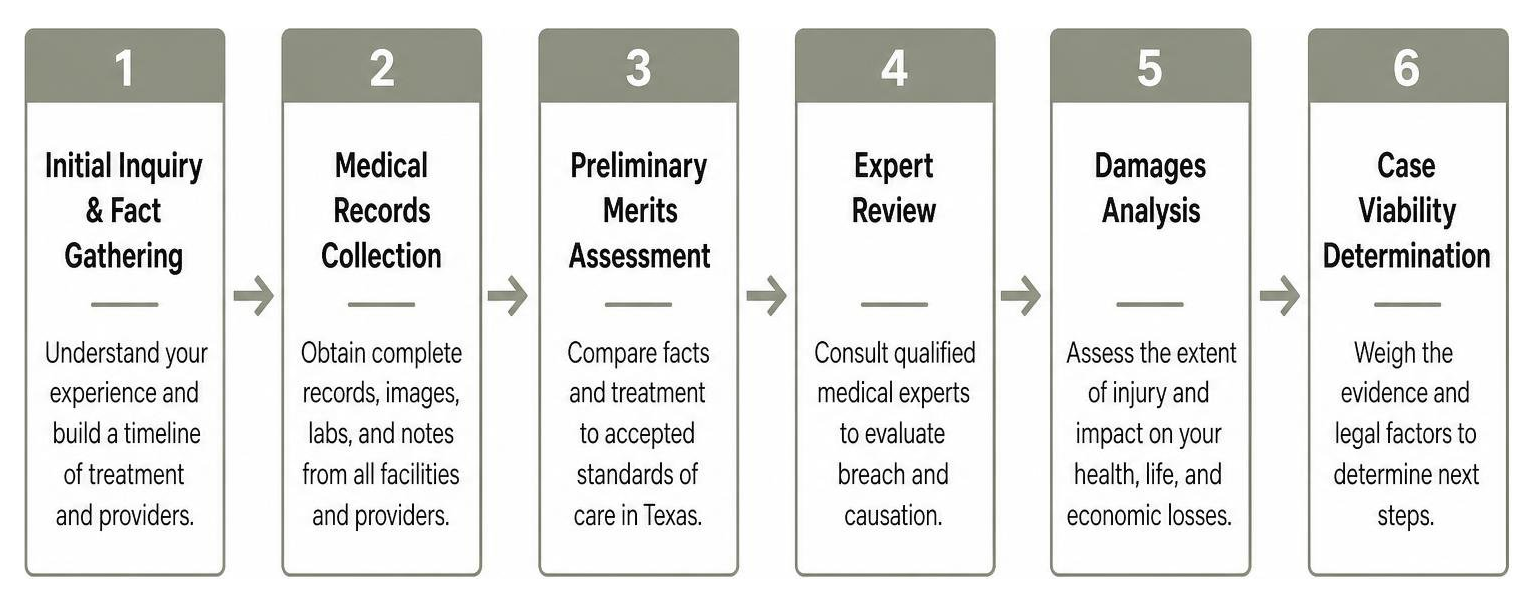
Our process typically follows key phases to assess case viability:
- Initial Inquiry and Fact Gathering: We sit down with you to construct a complete timeline of your medical treatment, identifying all involved doctors, nurses, clinics, and hospitals across Houston.
- Comprehensive Medical Records Review: We collect complete chart notes, surgical logs, lab results, and nursing notes from local health centers along Interstate 45, Loop 610, or the Energy Corridor.
- Preliminary Merits Assessment: We compare the medical timeline against accepted Texas clinical guidelines to determine if the provider deviated from acceptable standards.
- Physician Review: Under Texas law, a qualified practicing doctor must review the facts and provide an opinion confirming that medical errors occurred and directly caused your harm.
To understand how top legal advocates evaluate these complex elements, check out our resource on Best Medical Negligence Lawyers.
Common Medical Injuries and Challenges Under Texas Malpractice Laws
Medical injuries can happen in any medical discipline, transforming routine treatments into life-altering crises. In Houston, thousands of medical claims are investigated each year across major hospital networks along the Southwest Freeway and North Freeway.
Types of Medical Errors Across Houston Hospitals
Medical errors manifest in diverse clinical scenarios. Some of the most frequent types of injuries that result in formal claims include:
- Surgical Errors: Mistakes made inside the operating room, such as operating on the wrong surgical site, leaving foreign objects like sponges or scalpels inside a patient, or damaging internal organs during laparoscopic procedures.
- Medication Errors: Administering incorrect drug dosages, ignoring known patient allergies, or miscalculating intravenous infusions in emergency rooms like those at Ben Taub Hospital.
- Birth Trauma: Delayed decisions to perform emergency C-sections, improper use of forceps or vacuum extractors, or failing to monitor fetal distress, which can lead to permanent cerebral palsy or brachial plexus injuries.
- Diagnostic Delays and Misdiagnosis: Failing to interpret radiologic scans accurately, ignoring lab indicators, or dismissing patient symptoms, which allows conditions like stroke, heart attacks, or aggressive cancers to progress untreated.
If you or a family member experienced serious injury inside a hospital, read our dedicated guide on hiring a Hospital Malpractice Attorney Houston.
Navigating Texas Medical Malpractice Statutes and Damage Caps
Texas has some of the most restrictive medical malpractice laws in the nation. Enacted under Civil Practice and Remedies Code Chapter 74, these statutory provisions create specific hurdles for injured patients seeking financial recovery.
One of the primary provisions is the two-year statute of limitations. In Texas, you generally have exactly two years from the date the negligent act occurred—or from the completion of the continuous medical treatment—to file a lawsuit. In rare cases where an injury could not reasonably have been discovered immediately, a narrow discovery rule may apply, but Texas also enforces a strict 10-year statute of repose that acts as an absolute bar to recovery regardless of discovery.
Furthermore, Texas law imposes strict caps on non-economic damages (compensation for pain, suffering, emotional distress, and loss of enjoyment of life):
| Damage Type | Statutory Limit in Texas | Details |
|---|---|---|
| Non-Economic (Physician/Individual) | $250,000 | Capped per individual healthcare provider defendant. |
| Non-Economic (Single Hospital Facility) | $250,000 | Capped per individual hospital or institutional facility. |
| Non-Economic (Multiple Facilities) | $500,000 | Overall maximum cap across all institutional facilities combined. |
| Economic Damages | Uncapped | Includes past/future medical bills, lost wages, and lost earning capacity. |
Because non-economic damages are strictly capped at $250,000 per defendant and $500,000 total across institutions, a strong legal strategy relies heavily on meticulously documenting economic losses, which are completely uncapped under Texas law.
For an in-depth breakdown of these statutory challenges, review our dedicated guide on working with a Texas Medical Malpractice Lawyer.
Key Steps to Take After Suspecting a Medical Injury
Taking prompt, methodical actions after you suspect a medical mistake occurred can make a significant difference in protecting both your health and your legal rights.
Immediate Actions After Suffering a Medical Injury
If you suspect medical negligence during care received anywhere in the Houston area, consider taking the following essential steps:
- Seek Corrective Medical Treatment: Your immediate priority is your health. Seek secondary evaluation from an independent doctor—preferably at a different health system, such as moving from a community clinic to Memorial Hermann or Houston Methodist along Katy Freeway—to stabilize your health and document your physical condition.
- Preserve Complete Medical Records: Request full, unedited copies of all medical records, lab reports, imaging files, and discharge summaries immediately. Under HIPAA and Texas law, you have the right to inspect and obtain your records.
- Maintain a Detailed Injury Journal: Keep a daily log of physical pain levels, emotional struggles, missed work days, daily limitations, and conversations with doctors or healthcare staff.
- Avoid Making Public Statements: Refrain from discussing your medical condition, care, or potential legal actions on social media platforms or with hospital insurance risk managers before securing legal representation.
Partnering with a Medical Injury Law Firm Houston for Qualified Witness Evaluation
Under Texas Civil Practice and Remedies Code Chapter 74, a plaintiff in a medical malpractice lawsuit must serve a comprehensive report written by a qualified medical professional on each defendant within 120 days of the defendant filing their answer. This report must explicitly define:
- The standard of care applicable to the treatment.
- The precise manner in which the provider failed to meet that standard.
- The direct causal connection between the provider’s breach and the patient’s resulting harm.
Failing to serve a compliant report within the strict statutory deadline results in mandatory dismissal of the case with prejudice and an order forcing the plaintiff to pay the defense attorneys’ fees.
Because securing qualified medical witnesses and preparing these reports can cost tens of thousands of dollars, our team at WestLoop Law Firm handles upfront litigation expenses and arranges thorough reviews with respected medical authorities to safeguard your claim.
Explore our full walkthrough on securing powerful case representation in the Houston Medical Malpractice Lawyer Guide.
Compensation Expectations and Legal Costs in Houston Malpractice Cases
In Texas, medical malpractice cases involve median payouts of approximately $250,000, with a substantial portion of successful resolutions originating in Houston due to the concentration of medical facilities along routes like US-59 and I-10. Historically, approximately 1 in 3 formal malpractice claims in Texas result in financial recovery for the plaintiff.
When calculating the total financial recovery in a medical injury lawsuit, claims are broken down into economic and non-economic damages:
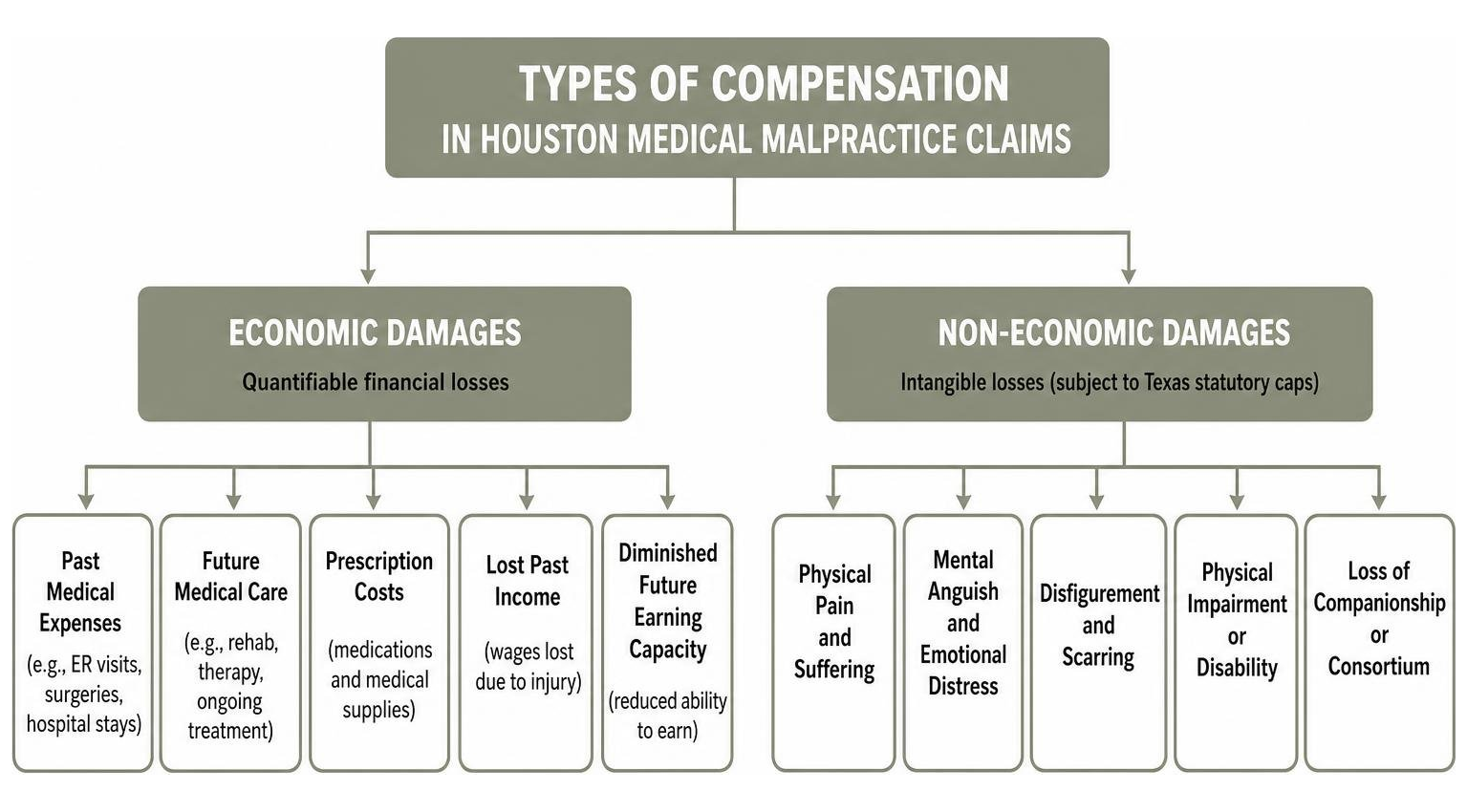
- Economic Damages: Compensation for quantifiable financial losses, including past emergency bills, future rehabilitation costs, dedicated home care, prescription costs, lost past income, and diminished future earning potential.
- Non-Economic Damages: Subject to statutory caps, these compensate for physical pain, mental anguish, disfigurement, physical impairment, and loss of companionship.
Hiring a medical injury law firm Houston shouldn’t create added financial stress during an already challenging period. We handle all personal injury and medical malpractice claims on a contingency fee arrangement. This means:
- You pay zero out-of-pocket legal fees upfront.
- Our firm covers all necessary case expenses, including medical record retrieval fees, filing costs, court reporters, and medical witness retainers (which frequently range between $50,000 and $100,000 per case).
- We only receive compensation if we successfully recover a monetary settlement or jury verdict on your behalf.
To read a detailed breakdown of how medical claims are resolved in Texas, check out our Medical Injury Claims Ultimate Guide.
Frequently Asked Questions About Houston Medical Injury Claims
How long do I have to file a medical malpractice lawsuit in Texas?
In Texas, the standard statute of limitations for filing a medical malpractice claim is two years from the exact date the alleged medical error occurred. If the harm occurred as part of a continuous course of treatment, the two-year timeline begins on the date that specific course of treatment concludes.
Texas also enforces a strict 10-year statute of repose. This acts as an absolute deadline, meaning that regardless of when an injury was discovered, no lawsuit can be brought more than 10 years after the date of the medical error. Because gathering records and acquiring required medical reports takes time, contacting a lawyer as soon as you suspect harm is vital.
What are the damage caps for medical injury lawsuits in Houston?
Texas law places statutory caps on non-economic damages in medical malpractice cases under Chapter 74 of the Civil Practice and Remedies Code. For claims against individual physicians or health care practitioners, non-economic damages (such as pain, suffering, and mental anguish) are capped at $250,000 per claimant.
When claims involve hospital facilities or health care institutions, non-economic damages are capped at $250,000 per facility, with a maximum limit of $500,000 total across all institutional defendants. Therefore, the absolute combined maximum cap for non-economic damages across all individual and institutional defendants in Texas is $750,000. However, economic damages—including medical bills, rehabilitation expenses, lost wages, and loss of future earning capacity—remain completely uncapped under Texas law.
How are cases handled when multiple healthcare providers are involved?
Medical care in major Houston institutions often involves extensive care teams, including primary surgeons, consulting physicians, anesthesiologists, physician assistants, and hospital nursing staff. When medical negligence involves multiple providers, a lawsuit can name each responsible individual and entity as co-defendants.
Under Texas modified comparative fault rules, liability is apportioned among defendants based on their percentage of fault. Additionally, under principles of vicarious liability or respondeat superior, hospitals can often be held liable for the negligent acts of their direct employees, such as employed nurses or resident physicians. Managing claims against multiple defendants requires coordinated legal strategy and precise preliminary reports for each individual specialty involved.
Taking Action with WestLoop Law Firm After a Medical Injury
If you or someone close to you has experienced severe harm, permanent disability, or worsened health conditions following medical care in Houston, you do not have to handle the complex recovery process on your own. Determining whether your medical injury stemmed from clear healthcare errors requires prompt legal review, detailed medical analysis, and strict adherence to Texas Chapter 74 requirements.
At WestLoop Law Firm, we combine compassionate client representation with aggressive advocacy to stand up to large hospital networks, insurance companies, and defense teams across Harris County. We handle personal injury and probate matters with the utmost care, giving you peace of mind while we fight to secure the maximum compensation you deserve for your economic losses, ongoing care needs, and physical recovery.
Contact us today to schedule your comprehensive, confidential claim evaluation. Let our dedicated team evaluate your treatment history, review your options, and help you take decisive action toward financial recovery. Learn more by visiting our guide on working with a Houston Personal Injury Lawyer.