 Skip to content
What You Need to Know About Trucking Black Box Data After a Houston Crash
Trucking black box data is the electronic information recorded by onboard computer systems inside commercial trucks — and it can be the most powerful evidence in your accident case.
Here is a quick overview of what it covers:
| What It Is | What It Records | Why It Matters |
|---|---|---|
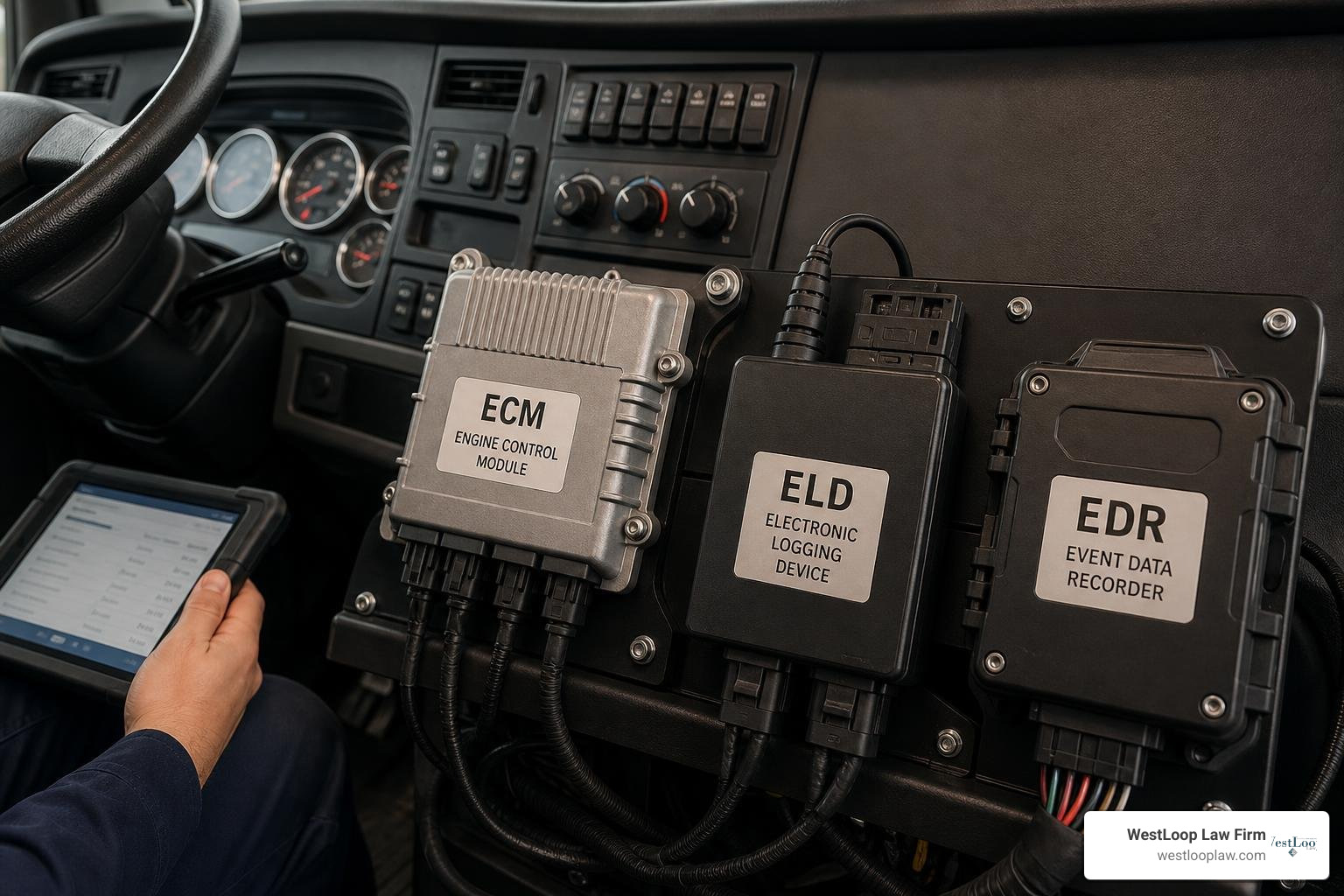
| Electronic Control Module (ECM) | Speed, RPM, throttle, braking, fault codes | Shows truck behavior before and during a crash |
| Electronic Logging Device (ELD) | Driving hours, rest periods, engine activity | Proves hours-of-service violations |
| Event Data Recorder (EDR) | Delta-V (crash force), seatbelt status, airbag deployment | Reconstructs the exact moment of impact |
These systems work together to create an objective, digital record of what the truck was doing in the seconds — and days — before a collision.
When a large commercial truck crashes on a Houston highway like I-10, I-45, or the Loop 610, the aftermath moves fast. The trucking company’s response team may already be at the scene while you are still being treated at Ben Taub Hospital or Memorial Hermann. They know what the black box recorded. And in some cases, they have every reason to make sure you never see it.
That data is also fragile. Many systems overwrite information in as little as 7 to 30 days. Once it is gone, it is often gone for good.
Understanding what truck black box data is, what it captures, and how to protect it can make or break a serious injury claim in Houston.
Trucking black box data word list:
Understanding Trucking Black Box Data and Its Components in Houston Crashes
When we talk about a “black box” in a semi-truck, we are not talking about a single orange flight recorder like you find on commercial airplanes. Instead, we are referring to an interconnected web of onboard computers that monitor, regulate, and log the truck’s mechanical and operational performance.
In Houston’s heavy commercial corridors, such as near the Port of Houston or along the East Loop, thousands of big rigs operate daily. When an accident occurs, the digital footprint left by these computers serves as an unbiased “silent witness” to the events. To build a strong claim, we must look at how an Auto Accident Attorney Explains Role of Evidence and break down the three primary devices that make up a commercial vehicle’s data suite: the ECM, the ELD, and the EDR.
Electronic Control Modules (ECM)
The Electronic Control Module (ECM) is essentially the brain of the truck’s engine. Originally introduced by manufacturers to counter invalid engine warranty claims and track performance, the ECM continuously monitors engine diagnostics, fuel systems, and emissions.
For our purposes after a crash, the ECM is invaluable because it logs system fault codes and operational history. If a truck experienced a critical mechanical failure on the Katy Freeway, or if the engine was running hot because of poor maintenance, the ECM is where that diagnostic history is stored.
Electronic Logging Devices (ELD)
To combat driver exhaustion, federal regulations require most interstate commercial drivers to use an Electronic Logging Device (ELD). The ELD connects directly to the truck’s engine to automatically record driving time, engine hours, and vehicle movement.
By tracking when the truck is in motion, the ELD creates a tamper-resistant record of a driver’s Hours of Service (HOS). Under Federal Motor Carrier Safety Administration ELD rules, motor carriers must retain these ELD logs and supporting documents for at least six months.
Event Data Recorders (EDR)
The Event Data Recorder (EDR) is the component most similar to a traditional passenger vehicle’s black box. While General Motors began integrating early versions of this technology in about 40% of its Model Year 1999 passenger vehicles, modern heavy truck EDRs are highly sophisticated.
The EDR is programmed to capture a continuous loop of physical data, which is permanently written to non-volatile memory only when triggered by a “crash event” (such as rapid deceleration or a sudden change in velocity, known as delta-V). These triggers are often linked to airbag deployment or sudden hard braking. In passenger vehicles, minimum standards for these devices are outlined under 49 CFR Part 563, but in heavy commercial trucks, the EDR is often integrated directly into the engine or cabin control modules, recording detailed physics data in the milliseconds surrounding an impact.
What Specific Data Points Are Recorded During a Houston Crash?
When an 18-wheeler collides with a passenger car on the Southwest Freeway or near the Texas Medical Center, the forces involved are extreme. Commercial trucks can weigh up to 80,000 pounds, whereas the average passenger car weighs around 4,000 pounds. Because of this massive weight discrepancy, understanding the exact physics of the crash is essential.
The data captured by the truck’s internal computers provides an objective, step-by-step timeline of the seconds leading up to, during, and immediately after the impact.
| Data Category | Electronic Control Module (ECM) | Electronic Logging Device (ELD) | Event Data Recorder (EDR) |
|---|---|---|---|
| Vehicle Speed | Yes (recent rolling history) | No (calculates average speed over distance) | Yes (high-resolution pre-crash seconds) |
| Brake & Throttle Status | Yes (switch status and throttle %) | No | Yes (exact timing and pressure) |
| Hours of Service (HOS) | No | Yes (mandatory logging) | No |
| Engine Diagnostics / Faults | Yes (detailed diagnostic codes) | No | No |
| Crash Physics (Delta-V) | No | No | Yes (change in velocity over milliseconds) |
| Seatbelt & Airbag Status | No | No | Yes |
Speed and Braking Metrics in Trucking Black Box Data
When we investigate a collision, we look closely at speed and braking metrics. The data points retrieved from the EDR and ECM can tell us:
- Pre-Crash Speed: The exact speed of the truck in the 5 to 10 seconds before the crash, showing if the driver was speeding on a wet Loop 610.
- Brake Application: Whether the driver applied the brakes, how hard they pressed them, and the exact millisecond the brakes were engaged.
- Throttle Percentage: How far the driver was pressing the accelerator. For example, if the throttle was at 100% and there was 0% braking right up until impact, it indicates the driver did not react at all.
- Clutch and Cruise Control Status: Whether cruise control was active, which can help explain a delayed reaction time.
These metrics are vital for reconstructing the crash, as explained in our Houston Truck Accident Lawyers Ultimate Guide.
How Trucking Black Box Data Exposes Driver Fatigue and Violations on Houston Roads
Fatigue is one of the most common causes of commercial vehicle accidents. When truck drivers push past their legal driving limits to meet tight deadlines, their reaction times drop.
By cross-referencing ELD records with the physical data from the ECM and EDR, we can uncover safety violations:
- Hours of Service Discrepancies: We can compare the ELD logs (which show when the driver claimed to be sleeping or off-duty) with the ECM engine activity. If the ECM shows the engine was running and the truck was moving when the driver’s log says they were in the sleeper berth, we have proof of falsified records.
- Steering Inactivity: The EDR can record steering wheel angles. A complete lack of steering input followed by a sudden, violent correction or no correction at all right before a crash often indicates that the driver fell asleep or was severely distracted.
- Hard Braking History: A pattern of frequent hard braking events recorded by the ECM in the hours leading up to a crash can show aggressive driving or a driver struggling to stay awake in heavy traffic.
Securing this data is a key step outlined in our 18-Wheeler Accident Lawyer Complete Guide.
Why Electronic Evidence is Fragile and At Risk of Loss After a Houston Accident
Every day in the United States, approximately 18,000 tow-away crashes occur. Many of these involve heavy commercial vehicles. When a damaged semi-truck is towed from a crash site on I-10 to a salvage yard, the clock starts ticking.
Unlike passenger vehicle systems that may preserve crash data indefinitely, many commercial truck ECMs are designed to operate on a continuous loop. This means that as the truck is operated, new data constantly overwrites the oldest data.
In many trucks, normal operation can overwrite critical crash data in as little as 30 to 45 days—and in some high-use fleets, this window can be as short as 14 to 30 days. Furthermore, simply turning on the ignition, towing the truck with the drive wheels on the ground, or conducting post-crash mechanical diagnostic tests can trigger new engine events that overwrite the crash data. This fragile nature of digital evidence is a major hurdle when trying to How to Navigate a Houston Big Rig Crash Claim.
The Threat of Spoliation of Evidence
In legal terms, “spoliation” is the intentional or negligent destruction, alteration, or failure to preserve evidence that is relevant to a legal proceeding.
In the trucking industry, major carriers employ rapid response teams. These insurance adjusters, corporate lawyers, and preferred reconstruction technicians are often dispatched to a crash scene within hours. While their official role is to investigate, their practical goal is to protect the trucking company’s bottom line.
If the truck is quickly repaired, sold for salvage, or if the ECM is cleared during diagnostics before a victim’s legal team can inspect it, key evidence is lost. This is one of the 4 Mistakes Truck Accident Claims Houston victims make: waiting too long to protect their rights while the carrier moves to clear the data.
Protecting Data with a Preservation Letter
To prevent the loss of this vital information, we must act immediately. The first step is drafting and sending a formal evidence preservation letter (also known as a spoliation letter).
This letter is a formal legal notice sent via certified mail to the trucking company, the driver, the truck’s registered owner, and their insurance carrier. It explicitly demands that they:
- Halt all repairs, alterations, or maintenance on the tractor and trailer.
- Preserve all electronic data, including native files from the ECM, EDR, ELD, and any onboard cabin cameras.
- Keep the vehicle in its post-crash state and prevent any diagnostic tools from being plugged into the truck’s computer ports.
Under Texas law, if a trucking company receives this letter and subsequently destroys or overwrites the data, they can face severe legal penalties in court, including a “spoliation instruction.” This is where the judge instructs the jury to assume that the destroyed evidence would have proven the trucking company was at fault.
Legal Steps to Secure and Analyze Commercial Vehicle Data in Houston
Because commercial trucks and their onboard data are considered the private property of the trucking company, carriers are rarely willing to hand over this information voluntarily. If a victim asks for the black box data, the company will almost always refuse.
To overcome this resistance, we must take immediate legal action through the Houston courts. This process is detailed in our Trucking Accident Attorney Houston Guide.
Overcoming Trucking Company Resistance
If a trucking company ignores our preservation letter or indicates they intend to put the truck back into service, we can petition a local Harris County judge for a Temporary Restraining Order (TRO). A TRO legally bars the trucking company from touching, moving, or altering the truck or its electronic systems until an independent inspection can take place.
Once a formal lawsuit is filed, we can issue a Subpoena Duces Tecum or formal discovery requests. These legal commands compel the trucking company to produce the native data files. This step is crucial because, as discussed in Houston Trucking Negligence and Why Your Lawyer Needs to Know the Hiring History, trucking companies will often try to hide behind proprietary software claims or offer simple, human-readable printed summaries that omit the raw, millisecond-level metadata.
Reconstructing the Houston Crash Sequence
Once we secure legal access to the truck, we coordinate a formal inspection. This download must be handled by a qualified forensic reconstructionist who uses specific hardware and software to extract the raw data directly from the physical module.
To ensure the data is admissible in court, we follow a strict chain of custody:
- Visual Documentation: Photographing the physical state of the modules, serial numbers, and connector ports.
- Native File Extraction: Downloading the files in their native format rather than relying on PDF printouts, which can be edited or incomplete.
- Corroborating Evidence: We don’t look at the black box in a vacuum. We layer this data with GPS telematics, forward-facing dashcam footage, maintenance records, and physical evidence from the scene (like skid marks and vehicle debris patterns).
This comprehensive approach is supported by Texas-specific insights on the importance of black box data in Texas commercial truck accidents.
Frequently Asked Questions About Houston Truck Accidents and Black Boxes
Navigating the aftermath of a serious truck wreck on Houston roads like Loop 610 or the Eastex Freeway can be overwhelming. Here are answers to some of the most common questions we receive regarding truck accident investigations and electronic evidence.
How long does black box data last before it is overwritten?
The duration depends on the manufacturer of the engine and the specific model of the ECM. While some modern systems can retain data for up to 30 to 45 days of normal operation, many systems operate on a tight loop where older events are replaced as soon as new events occur.
In some cases, if the truck is driven even a short distance after the crash—such as being moved by a towing company or driven around a salvage yard—the crash data can be completely overwritten within minutes. This is why immediate action is necessary to preserve the data before it is lost forever.
Can a trucking company legally refuse to hand over the data?
Yes, initially. Because the truck is the private property of the motor carrier, they do not have to hand over the data simply because you ask for it.
To obtain the data, you must use legal compulsion. This means sending a formal preservation demand, filing a lawsuit, and utilizing court-ordered subpoenas to force them to grant access to the vehicle’s computer systems.
What happens if the truck is destroyed or the data is missing?
If the truck was destroyed by fire or the ECM was physically crushed beyond repair, we pivot to secondary electronic and physical evidence. This includes:
- GPS Telematics: Fleet management systems (like Omnitracs or Samsara) that constantly upload location and speed data to cloud servers.
- Dispatch Logs: Digital communication records between the driver and the trucking company’s home office.
- Spoliation Sanctions: If the trucking company intentionally destroyed the truck or cleared the modules after receiving a preservation letter, we can ask the court to penalize them, which can include a default judgment on liability.
Conclusion
When a collision with an 18-wheeler turns your life upside down, the physical and financial recovery can feel like an uphill battle. While you are recovering at Ben Taub Hospital or adjusting to life after a severe injury, the trucking company and their insurance providers are already working to protect their interests.
You do not have to face them alone. At Westloop Law Firm, we dedicate our practice to personal injury and probate law, bringing a deep understanding of both fields to help Houston families secure the compensation they deserve. We know how to move quickly to preserve trucking black box data, stop evidence destruction, and build a clear, evidence-backed case to hold negligent trucking companies accountable.
If you or a loved one has been injured in a commercial truck crash on Houston roads, time is not on your side. Contact Westloop Law Firm today for a free, no-obligation consultation, and let us start securing the digital evidence needed to protect your future. For more information on your legal options, explore our Houston Truck Accident Lawyers Ultimate Guide.