 Skip to content
Can I Still Get Paid if I Was Partly at Fault for a Crash in Houston?
Yes. Under Texas law, you can recover compensation if you are 50% or less at fault. Your compensation is reduced by your share of fault. If you are more than 50% at fault, you generally cannot recover damages from the other parties.
What to do first:
- Get medical care immediately and ensure local law enforcement is dispatched to report the crash.
- Photograph all involved vehicles, skid marks, road debris, and traffic conditions, and obtain witness contact details if you can do so safely.
- Avoid apologizing or guessing about fault at the scene or to insurance adjusters.
- Save thorough records of your injuries, medical treatments, hospital bills, vehicle repair estimates, and missed work.
- Consult an attorney before providing recorded statements to any insurance carrier.
Fault is not always clear after a collision on busy roadways like I-10, I-45, Beltway 8, or Loop 610. A qualified Houston car accident lawyer can review the physical evidence and crash report before you accept an insurer’s assessment.
Helpful local resources for injured motorists:
- Speak directly with a dedicated Houston car accident lawyer about your claim.
- Review our comprehensive guide on what to do after an accident in Houston to protect your rights.
- Connect with an experienced auto accident attorney in Houston, TX to contest unfair fault allocations.
Yes, you can still receive financial recovery even if your own driving actions contributed partially to the wreck. Texas operates under a proportionate responsibility legal framework established in Texas Civil Practice and Remedies Code Chapter 33. Under this statutory framework, as long as your assigned percentage of responsibility does not exceed 50 percent, you maintain the legal right to pursue and obtain compensation from other negligent parties who contributed to the incident.
This system ensures that financial responsibility is divided among everyone involved based on their individual contribution to the collision. If an insurance company tries to assign excessive blame to your actions, understanding how comparative negligence principles apply in Houston helps you protect your rightful financial recovery.
Can I Still Get Paid if I Was Partly at Fault for a Crash in Houston Under the 51% Bar Rule?
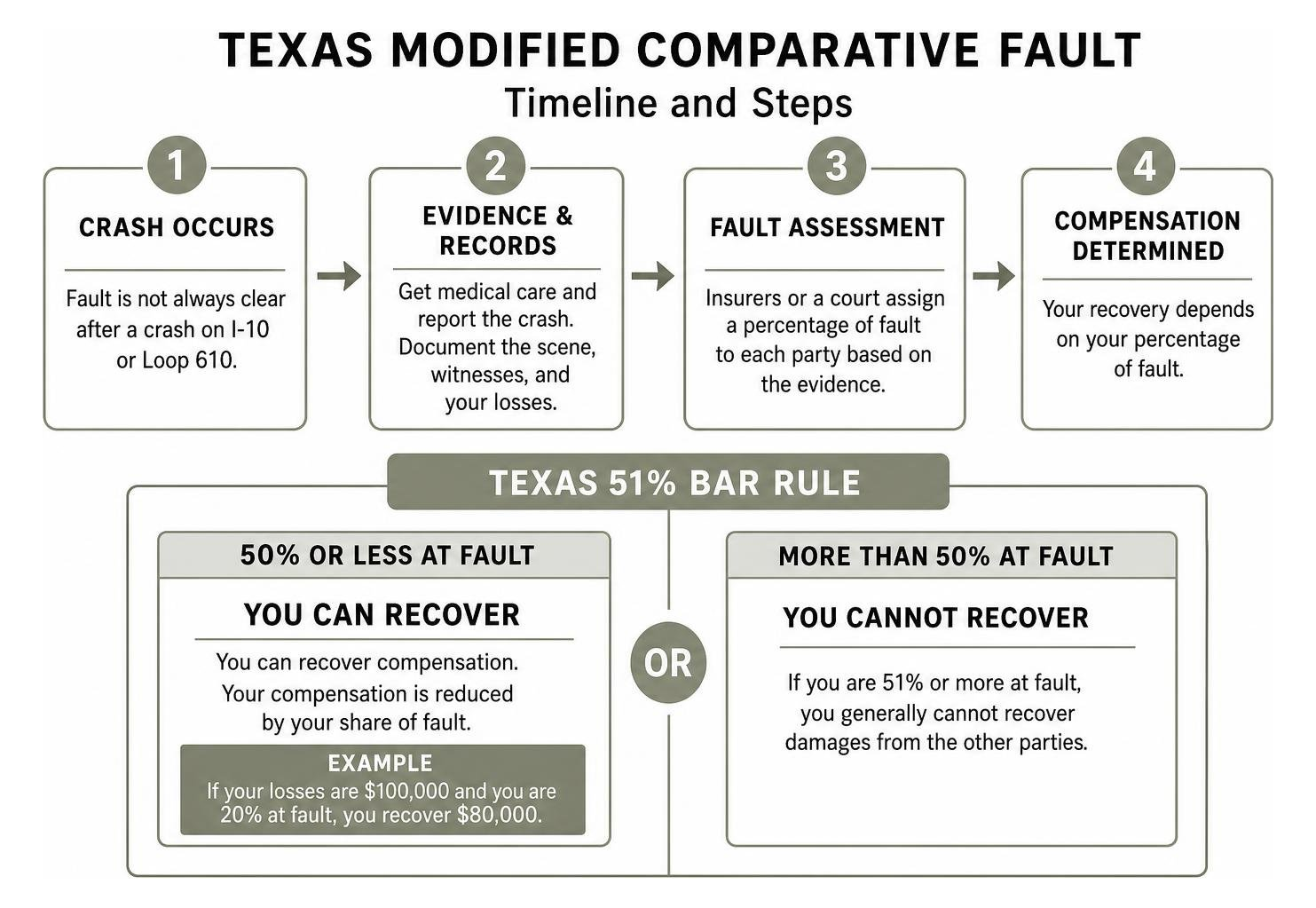
Under the Texas 51 percent modified comparative fault rule, an injured party can recover financial damages as long as their share of fault is 50 percent or lower. The moment an insurance adjuster, judge, or jury determines that you bear 51 percent or more of the overall responsibility, Texas law bars you from collecting any damages whatsoever from other drivers or entities.
When you share 50 percent or less of the fault, your financial recovery is diminished in direct proportion to your assigned percentage of blame. For example, if your total damages across medical bills, lost wages, and pain and suffering equal $100,000, and investigators determine you were 20 percent responsible because of a minor speed infraction, your recovery is reduced by 20 percent ($20,000). You would walk away with a final recovery of $80,000. In local proceedings before the Harris County Civil Courts at Law, establishing these precise percentages often serves as the central battlefield of a contested car crash claim.
| Percentage of Fault Assigned | Total Claim Value | Deduction Amount | Final Payout Received |
|---|---|---|---|
| 0% at fault | $100,000 | $0 | $100,000 |
| 10% at fault | $100,000 | $10,000 | $90,000 |
| 20% at fault | $100,000 | $20,000 | $80,000 |
| 50% at fault | $100,000 | $50,000 | $50,000 |
| 51% at fault or higher | $100,000 | Barred from recovery | $0 |
Types of Damages Recoverable When Fault Is Shared
When liability is divided among multiple parties, you still maintain the legal standing to pursue both economic and non-economic damages for your crash-related losses. Economic damages address objective, quantifiable financial losses resulting from the wreck, whereas non-economic damages compensate for subjective, personal hardships endured throughout your physical recovery.
Common damages recoverable in Texas shared-fault injury claims include:
- Past and future medical treatment, including emergency intake at Memorial Hermann Hospital, Ben Taub Hospital, or Houston Methodist
- Ongoing physical therapy, rehabilitation sessions, surgical procedures, and prescription medication costs
- Lost wages incurred during recovery and time missed from work
- Diminished future earning capacity if disabling injuries prevent you from resuming your prior career path
- Costs for vehicle repairs, structural bodywork, or total replacement of personal property
- Physical pain, emotional trauma, disfigurement, impairment, and mental anguish
Calculating the true financial value of your claim requires evaluating comprehensive medical records, employment documentation, and future prognosis reports. You can review how injury claims are valued across Houston to understand how these critical factors shape your overall financial recovery.
How Is Fault Determined After a Car Crash in Houston?
Determining fault after a motor vehicle collision requires a thorough investigation into physical evidence, state traffic laws, vehicle positioning, and real-time driver behaviors. Insurance claims representatives, law enforcement investigators, collision reconstruction analysts, and Harris County civil juries evaluate every available piece of evidence to allocate specific percentages of responsibility to each involved motorist.
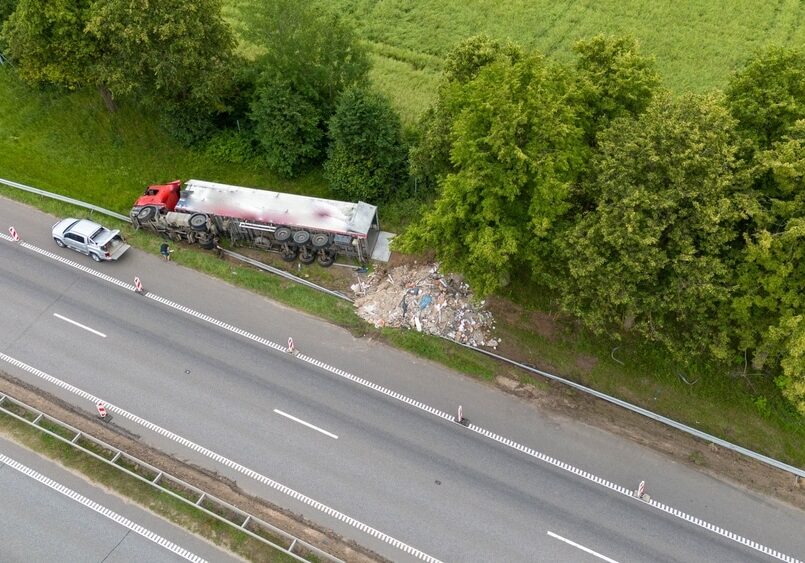
Annual traffic figures from TxDOT crash records data demonstrate that thousands of serious collisions occur across the Houston metropolitan area each year. Many of these wrecks involve complex chain-reaction collisions and contested merge maneuvers across multi-lane thoroughfares where determining exact liability becomes deeply disputed.
The Role of Police Reports and Traffic Laws on Houston Freeways
When officers from the Houston Police Department, Harris County Sheriff’s Office, or Texas Department of Public Safety respond to an incident along major arteries like I-10 Katy Freeway, Loop 610, Beltway 8, or I-45 North Freeway, they prepare an official Texas Peace Officer’s Crash Report (Form CR-3). This formal document captures officer observations, recorded driver statements, road and weather conditions, and perceived contributing factors such as driver inattention, following too closely, or improper lane changes.
While a police report carries significant weight during insurance settlement negotiations, it does not represent the ultimate legal authority in civil litigation. Officers often arrive after the crash has occurred and base their initial assessments on incomplete statements. If an officer’s report implies you were partly at fault, you can examine what happens when a police report alleges partial fault and work to challenge those conclusions using objective physical data, witness depositions, and traffic camera footage.
Insurance Adjuster Assessment vs. Jury Verdicts
Insurance adjusters are tasked with protecting their carrier’s profitability. To minimize payouts or avoid financial liability entirely, adjusters frequently invoke comparative fault defenses, attempting to push your proportion of responsibility above the 50 percent threshold.
In contrast, juries seated in the Harris County District Court or Harris County Civil Courts at Law must weigh admissible evidence under formal Texas evidentiary rules. When insurance carriers refuse to provide an equitable settlement because of inflated fault assessments, presenting your case before a civil jury enables a neutral panel of citizens to determine the true allocation of fault.
What Steps Should You Take Immediately After a Crash in Houston?
Taking prompt, decisive actions following a car collision protects both your physical well-being and your legal interests. Seeking immediate medical evaluation at local facilities like Houston Methodist or Memorial Hermann creates an unbroken chain of medical documentation linking your physical injuries directly to the incident. Simultaneously, securing photographs of vehicle resting positions, skid marks, road signs, and gathering contact details from impartial witnesses preserves indispensable factual evidence before it is lost or cleared by road crews.
For a thorough walkthrough of critical protocols, review our step-by-step resource outlining what steps to take after an auto collision to safeguard your injury claim.
If your Texas auto policy includes Personal Injury Protection (PIP) coverage, you can access these immediate benefits to pay for medical care and lost income regardless of who caused the collision. In Texas, insurance companies are required by law to offer PIP coverage unless you rejected it in writing. Utilizing your PIP benefits provides vital short-term financial support while multi-party fault investigations and negotiations proceed.
Preserving Evidence and Meeting Legal Deadlines
Under the Texas personal injury statute of limitations codified in Texas Civil Practice and Remedies Code § 16.003, you have exactly two years from the date of the collision to file a formal lawsuit in court. Failing to file your claim within this strict two-year statutory timeframe permanently forfeits your right to recover damages through the Texas judicial system.
Preserving critical crash evidence early is just as urgent as meeting statutory deadlines. Sending formal spoliation letters promptly requires opposing motorists, trucking companies, or commercial fleet operators to preserve electronic logging device records, onboard dashcam footage, and maintenance logs. You can review detailed information regarding the Texas personal injury statute of limitations to keep your legal rights fully intact.
Frequently Asked Questions About Houston Car Accident Fault
Can I Still Get Paid if I Was Partly at Fault for a Crash in Houston if I Was 20% Responsible?
Yes. Under the Texas proportionate responsibility framework, being assigned 20 percent of the blame allows you to collect 80 percent of your overall damages. For example, if your total medical bills, lost wages, vehicle damage, and non-economic suffering total $50,000, your final financial recovery will be $40,000 once your 20 percent share ($10,000) is deducted from the total award.
Can an injured passenger recover damages if their driver was partly at fault?
Yes. Passengers in Texas rarely contribute to causing an auto accident and have an established right to pursue compensation for their injuries. If the driver of the vehicle you were riding in shared fault with another driver on a Houston roadway, you can pursue injury claims against both motorists’ insurance policies up to the applicable policy limits to recover your total losses.
How do commercial truck accidents differ when fault is shared?
Commercial truck wrecks along major Houston transportation corridors like I-10 or Beltway 8 involve complex state and federal regulations set by the Federal Motor Carrier Safety Administration (FMCSA). Establishing corporate violations—such as hours-of-service infractions, negligent driver hiring, or overloaded cargo trailers—often shifts significant liability back onto the trucking motor carrier and refutes claims that a passenger vehicle driver caused the wreck.
Does Texas law allow recovery if fault is evenly split at 50-50?
Yes. Texas law expressly allows recovery when fault is divided exactly 50-50. Because your share does not exceed 50 percent, you are entitled to recover 50 percent of your total damages from the other responsible driver.
Protect Your Legal Rights with WestLoop Law Firm
Confronting an insurance company that attempts to shift blame onto you after a motor vehicle collision demands an assertive and strategic legal approach. At WestLoop Law Firm, our team utilizes comprehensive trial preparation and deep courtroom knowledge to help injured individuals across Houston stand up against aggressive comparative fault defenses and secure the financial compensation they deserve.
If you have concerns about shared liability, an unfavorable police report, or a delayed insurance claim following an accident on Houston highways, our team is ready to evaluate your legal options. Contact a dedicated Houston car accident lawyer at WestLoop Law Firm today to protect your legal rights and demand fair compensation.