 Skip to content
Doctor Malpractice Lawyers Near Me: 2026 Guide to Justice
When Medical Care Causes Harm: Your Path to Local Legal Help
Doctor malpractice lawyers near me are legal professionals who focus on representing patients harmed by medical negligence in your local area. Here’s how to connect with one quickly:
Finding Local Medical Malpractice Lawyers:
- Search certified referral services approved by your state bar association
- Check lawyer directories like Martindale, Best Lawyers, or Lawyers.com for local attorneys with a focus in this area
- Look for board-certified attorneys in professional liability
- Verify their experience with cases similar to yours
- Schedule free consultations to discuss your case (most work on contingency)
Medical errors are more common than most people realize. In Canada, one in 13 hospital patients experiences an adverse event during their stay, and 40 percent of these incidents are preventable. While these statistics highlight a broader issue, the reality is that such incidents can happen anywhere, including right here in Houston. Whether it’s a misdiagnosis, surgical mistake, or medication error, the consequences can be devastating—physically, emotionally, and financially.
When you’re dealing with mounting medical bills, lost wages, and the pain of an injury that shouldn’t have happened, finding the right legal advocate feels urgent. You need someone who understands the local court system, has access to qualified medical professionals in your area, and can meet with you face-to-face during this difficult time.
The challenge? Medical malpractice cases are complex and vigorously defended. Healthcare providers and their insurance companies have significant resources and experienced legal teams ready to fight your claim. That’s why finding an experienced local attorney who focuses on medical malpractice—not just general personal injury—makes all the difference.
This guide will help you understand what constitutes medical malpractice, steer the legal process, and most importantly, find a qualified doctor malpractice lawyer in your area who can fight for the justice and compensation you deserve.
Understanding Medical Malpractice: Do You Have a Case?
If you’re reading this, chances are something went wrong during your medical care, and you’re wondering whether you have a case. It’s a question we hear constantly at WestLoop Law Firm, and it’s completely understandable to feel confused about what qualifies as medical malpractice.
Here’s what you need to know: not every bad outcome is malpractice. Even the best doctors can’t guarantee perfect results. Sometimes treatments fail despite everyone doing everything right. Medical negligence becomes medical malpractice only when a healthcare provider’s care falls below accepted standards and directly causes you harm.
Think of it this way—the standard of care is what a reasonably skilled healthcare professional would do in similar circumstances. When a doctor, nurse, or other provider fails to meet that standard, and you get hurt because of it, that’s when you might have a case.
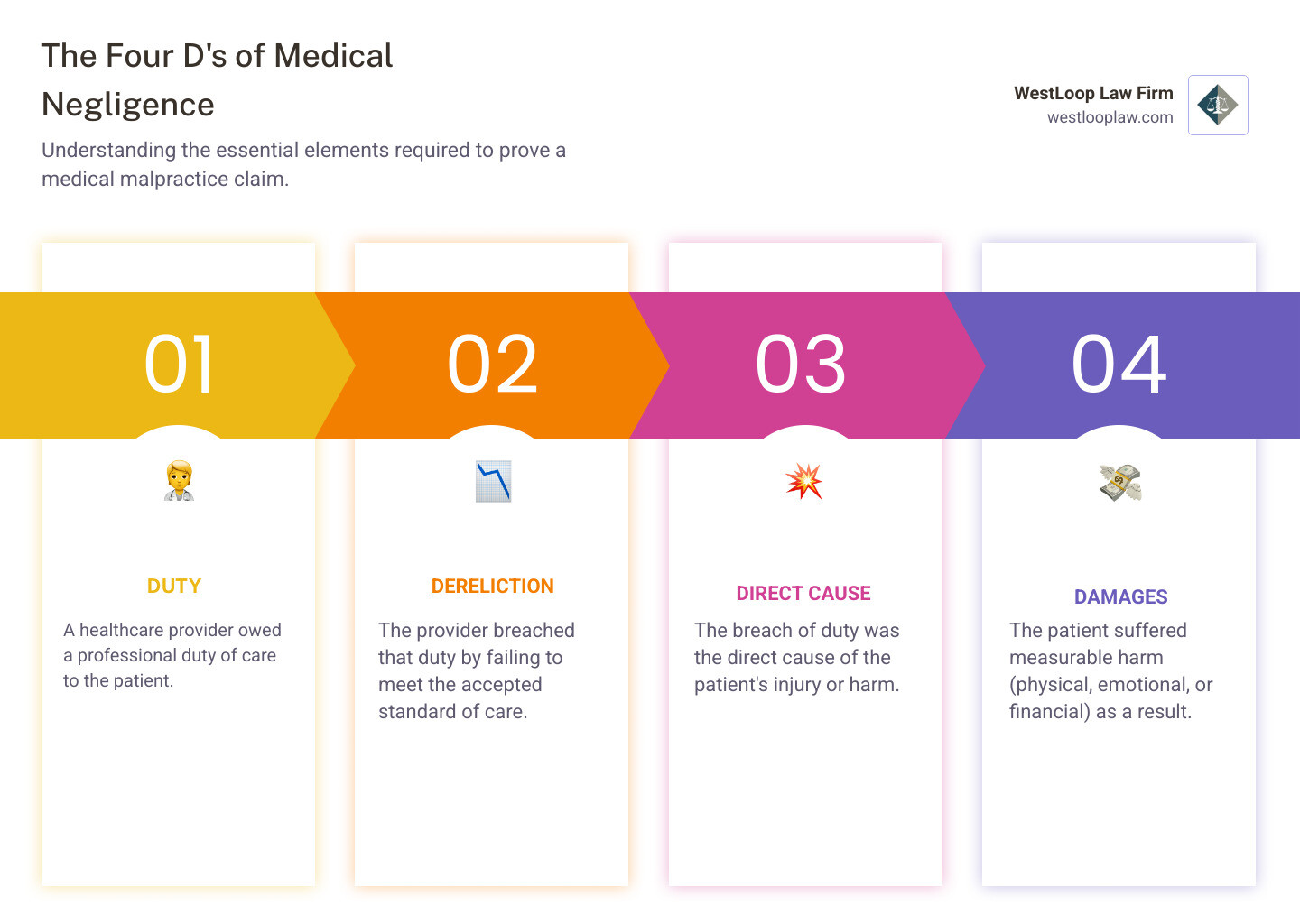
To build a successful medical malpractice claim in Houston, we need to prove four essential elements. You might have seen these referred to as the “Four D’s” in the infographic above:
Duty means the healthcare provider had a responsibility to care for you. This usually happens the moment a doctor-patient relationship begins—when they agree to treat you.
Dereliction (or breach of duty) means the provider failed to meet the accepted standard of care. They did something wrong, or they failed to do something they should have done.
Direct cause (causation) is where many cases get tricky. We have to prove that the provider’s mistake directly caused your injury. It’s not enough that they made an error—that error must be the reason you got hurt.
Damages means you suffered real, measurable harm. This could be physical injuries, emotional trauma, medical bills, lost wages, or ongoing pain and suffering.
All four elements must be present. If any one is missing, you likely don’t have a viable malpractice case. Understanding the distinction between general negligence and actionable malpractice can be complex, which is why we’ve written a detailed guide on medical malpractice vs. negligence: what’s the difference in Houston, TX.
What Constitutes a Breach in the Standard of Care?
The standard of care is the foundation of every medical malpractice case. It’s not about perfection—it’s about competence. Did your doctor act the way a reasonably skilled doctor would have in the same situation?
Let’s use a real example. Say you’re having an angioplasty, and the catheter tears the lining of your artery. That’s a known risk of the procedure. The tear itself might not be malpractice. But what happens next matters enormously. If your doctor fails to recognize the tear, doesn’t treat it properly, or ignores warning signs, that failure to manage a known complication could absolutely be a breach of the standard of care.
Here’s what makes these cases challenging: we almost always need the opinion of other medical professionals to prove a breach occurred. These medical professionals review your medical records and explain what a competent practitioner should have done differently. Their testimony helps the court understand whether your provider’s act or omission fell below acceptable standards.
The standard isn’t about what the best doctor would do—it’s about what a reasonable practitioner would do. That’s an important distinction, and it’s one reason why searching for doctor malpractice lawyers near me who understand these nuances is so critical to your case.
For a deeper dive into what legally qualifies as malpractice in Houston, check out our article on what is medical malpractice in Houston, TX.
Common Types of Medical Errors and Negligence
Medical errors come in many forms, and we’ve seen them all at WestLoop Law Firm. Some happen in split seconds during surgery. Others unfold slowly over weeks or months of missed warning signs. Here are the types of medical negligence we encounter most often:
Misdiagnosis or delayed diagnosis can be devastating. When a doctor misses cancer, mistakes a heart attack for indigestion, or dismisses serious symptoms, patients lose precious time for treatment. A small malignant lump misidentified as benign can grow unchecked while you think you’re fine. By the time the real diagnosis comes, the disease may have progressed beyond effective treatment. If you’ve experienced this, our wrong diagnosis lawyer Houston page offers specific guidance.
Surgical errors range from shocking mistakes like operating on the wrong body part to more subtle failures like improper technique that causes nerve damage. We’ve represented clients who had surgical instruments left inside them after procedures. We’ve seen infections from improperly sterilized equipment. Even performing the right surgery poorly can constitute malpractice. Learn more about these cases at our Houston surgical error lawyer page.
Birth injuries are particularly heartbreaking because they often affect both mother and baby. Failing to perform a timely C-section, misusing forceps or vacuum extractors, not recognizing fetal distress, or mismanaging complications can cause permanent disabilities like cerebral palsy or Erb’s palsy.
Anesthesia mistakes have immediate and sometimes fatal consequences. Too much anesthesia can cause brain damage or death. Too little means waking up during surgery. Failing to monitor oxygen levels, improper intubation, or not reviewing a patient’s medical history for drug allergies can all be catastrophic.
Medication errors happen more often than you’d think. The wrong drug, wrong dosage, failure to check for dangerous drug interactions, or pharmacy mistakes in filling prescriptions can cause serious harm or death. Sometimes doctors fail to warn patients about side effects they should be monitoring.
Hospital-acquired infections shouldn’t happen in a clean, well-run facility. When healthcare workers don’t follow proper hygiene protocols, fail to sterilize equipment, or ignore infection control procedures, patients can develop serious conditions like sepsis, MRSA, or surgical site infections.
Anesthesia mistakes, psychiatric evaluation errors (like failing to assess suicide risk properly), and various forms of general negligence by nurses, radiologists, lab technicians, or other healthcare professionals can all lead to serious harm.
The common thread? Someone failed to do what they should have done, and you paid the price.
Who Can Be Held Liable?
When medical care goes wrong, figuring out who’s responsible isn’t always straightforward. Medical care involves many people, and negligence can happen at any point in your treatment. At WestLoop Law Firm, we investigate every potential defendant to make sure no one who harmed you escapes accountability.
Doctors and surgeons are the most obvious defendants. This includes your general practitioner, specialists like cardiologists or neurologists, OB/GYNs, anesthesiologists, radiologists, psychiatrists, and any surgeon who treated you. If they made the mistake, they can be held liable.
Nurses provide hands-on patient care and can be liable for their own negligence. Medication errors, failure to monitor patients properly, improper wound care, or ignoring critical changes in your condition can all constitute nursing malpractice.
Hospitals and clinics can be held responsible even if they didn’t directly harm you. If they hired incompetent staff without proper vetting, maintained unsafe or unsanitary conditions, understaffed their facility, or failed to enforce proper policies and procedures, the institution itself may be liable. Our hospital negligence lawyer Houston page covers this topic in detail.
Pharmacists who dispense the wrong medication, provide incorrect instructions, or fail to catch dangerous drug interactions can be sued for malpractice.
Dentists can commit malpractice during procedures, through misdiagnosis of oral conditions, or by providing improper treatment that causes lasting harm.
Other healthcare professionals who can be held liable include anesthesiologists, home health care workers, respiratory therapists, lab and imaging technicians, chiropractors, paramedics, managed care organizations, and nursing homes.
The key is identifying everyone whose negligence contributed to your injury. Sometimes multiple parties share responsibility, and you deserve compensation from all of them. That’s why when you’re searching for doctor malpractice lawyers near me, you want attorneys who know how to investigate thoroughly and hold every negligent party accountable.
The Legal Journey: What to Expect in a Malpractice Claim
We understand that if you’re reading this, you’re likely already dealing with physical pain, emotional stress, and mounting medical bills. The last thing you need is the added burden of navigating a complex legal system. But here’s what we want you to know: you won’t have to face this alone.
Medical malpractice litigation is unlike most other legal cases. Healthcare providers and their insurance companies have deep pockets and experienced legal teams ready to fight claims aggressively. Think about it—these organizations have spent years building defense strategies and relationships with qualified medical witnesses. In Canada, for example, the Canadian Medical Protective Association (CMPA) defends doctors with substantial assets and a vast network of medical professionals. While we don’t have an exact equivalent here in the U.S., healthcare systems and insurers in Houston are equally well-resourced and committed to protecting their interests.
This reality means that pursuing a medical malpractice claim requires significant time, resources, and in-depth knowledge. The litigation costs can be substantial, often including expenses for medical record reviews, fees for medical witnesses, court costs, and extensive findy procedures. These cases rarely settle quickly—healthcare providers know that many patients give up when faced with lengthy, expensive litigation.
Qualified medical witnesses are absolutely essential to your case’s success. You can’t win a medical malpractice claim without testimony from other medical professionals who can explain what should have happened versus what actually occurred. These medical professionals review your medical records in detail, explain the accepted standard of care to a jury, identify exactly where the defendant’s care fell short, and establish the direct link between that substandard care and your injuries. Their credibility and professional standing often make or break a case.
At WestLoop Law Firm, we have the resources and relationships to secure top-tier medical professionals who can effectively support your claim. We handle all the upfront costs of litigation, so you can focus on your recovery while we build the strongest possible case on your behalf.

The Critical Timeline: Understanding the Statute of Limitations
Here’s something that keeps us up at night: we’ve seen too many people with legitimate medical malpractice claims lose their right to compensation simply because they waited too long to take action. The statute of limitations is a strict legal deadline, and once it passes, the courthouse doors close—no matter how strong your case might be.
In Texas, you generally have two years to file a medical malpractice lawsuit. This countdown typically starts on the date the malpractice occurred or the date you finded (or reasonably should have finded) your injury. This “findy rule” exists because some injuries don’t show up immediately. For instance, a surgical error might not become apparent until months or even years later when symptoms finally develop.
But here’s the catch: there are exceptions and nuances to this rule, particularly when children are involved or in cases involving foreign objects left in the body during surgery. Some situations may have shorter deadlines, while others might extend slightly longer. The law can be complicated, and misunderstanding these timeframes could cost you your case.
We can’t stress this enough: waiting is one of the biggest mistakes you can make. Building a strong medical malpractice case takes time. We need to gather and review extensive medical records, consult with medical professionals, investigate what happened, and prepare detailed legal filings. All of this happens before we even file your lawsuit. If you wait until the deadline is approaching, we may not have enough time to build the compelling case you deserve.
If you suspect you’ve been harmed by medical negligence, reach out to doctor malpractice lawyers near me as soon as possible. For a comprehensive understanding of how these deadlines work in Texas, we encourage you to review our detailed guide on the Texas Statute of Limitations.
Calculating Damages: What Compensation Can You Recover?
When we take on your case, our goal is straightforward: secure full and fair compensation for every way this medical negligence has affected your life. Medical malpractice damages typically fall into two main categories that work together to make you whole again.
Economic damages are the tangible, calculable costs that medical negligence has imposed on your life. These include all your past and future medical expenses—from emergency room visits and surgeries to ongoing rehabilitation and therapy. If you’ve had to modify your home for accessibility or hire home health care, those costs count too. Lost wages from time off work are included, as is your reduced earning capacity if you can’t return to your previous job or work the same hours. We work with financial professionals to calculate what you’ve lost and what you’ll continue to lose over your lifetime.
Non-economic damages address the human cost—the ways medical negligence has diminished your quality of life. This includes compensation for your physical pain and suffering, the emotional distress and mental anguish you’ve endured, the loss of enjoyment of life’s activities you once loved, and the strain on your relationships with family and friends. These damages recognize that some losses can’t be measured in dollars and cents, but they’re very real and deserve compensation.
| Type of Damage | Description |
|---|---|
| Economic Damages | Medical expenses, lost wages, future earning capacity, rehabilitation costs, home modifications, ongoing care needs |
| Non-Economic Damages | Pain and suffering, emotional distress, loss of enjoyment of life, loss of consortium, mental anguish |
Texas does have damage caps in certain medical malpractice cases, particularly for non-economic damages against healthcare institutions. These caps can significantly affect your potential recovery, which is why working with experienced doctor malpractice lawyers near me who understand how to maximize compensation within these legal limits is crucial.
Every case is unique, and the compensation you can recover depends on the specific facts of your situation. During our free consultation, we’ll evaluate your case and provide an honest assessment of what compensation you might reasonably expect. For a more detailed breakdown of potential compensation, visit our comprehensive Lawyer for Medical Malpractice Compensation Guide.
We know that no amount of money can undo what happened to you. But fair compensation can ease financial burdens, provide access to the best medical care, and offer some measure of justice. At WestLoop Law Firm, we work on a contingency fee basis—you pay nothing unless we win your case. This means we take on the financial risk of litigation so you can pursue justice without worrying about upfront legal costs.
If you believe medical negligence has harmed you or someone you love, please reach out to us. We offer a free consultation to discuss your situation and evaluate your potential claim. Our team has the experience, resources, and determination to take on even the most complex medical malpractice cases. Learn more about how we can help with cases involving medical mistakes. We’re here to fight for you every step of the way.