 Skip to content
Failure to diagnose cancer: 5 Devastating Errors
Why a Failure to Diagnose Cancer Can Change Everything
A failure to diagnose cancer is a medical error where a healthcare provider misses or delays identifying cancer in a patient with symptoms or risk factors. This can have devastating consequences, allowing cancer to progress to advanced stages where treatment is less effective and survival rates drop significantly.
Key Facts About Cancer Diagnostic Failures:
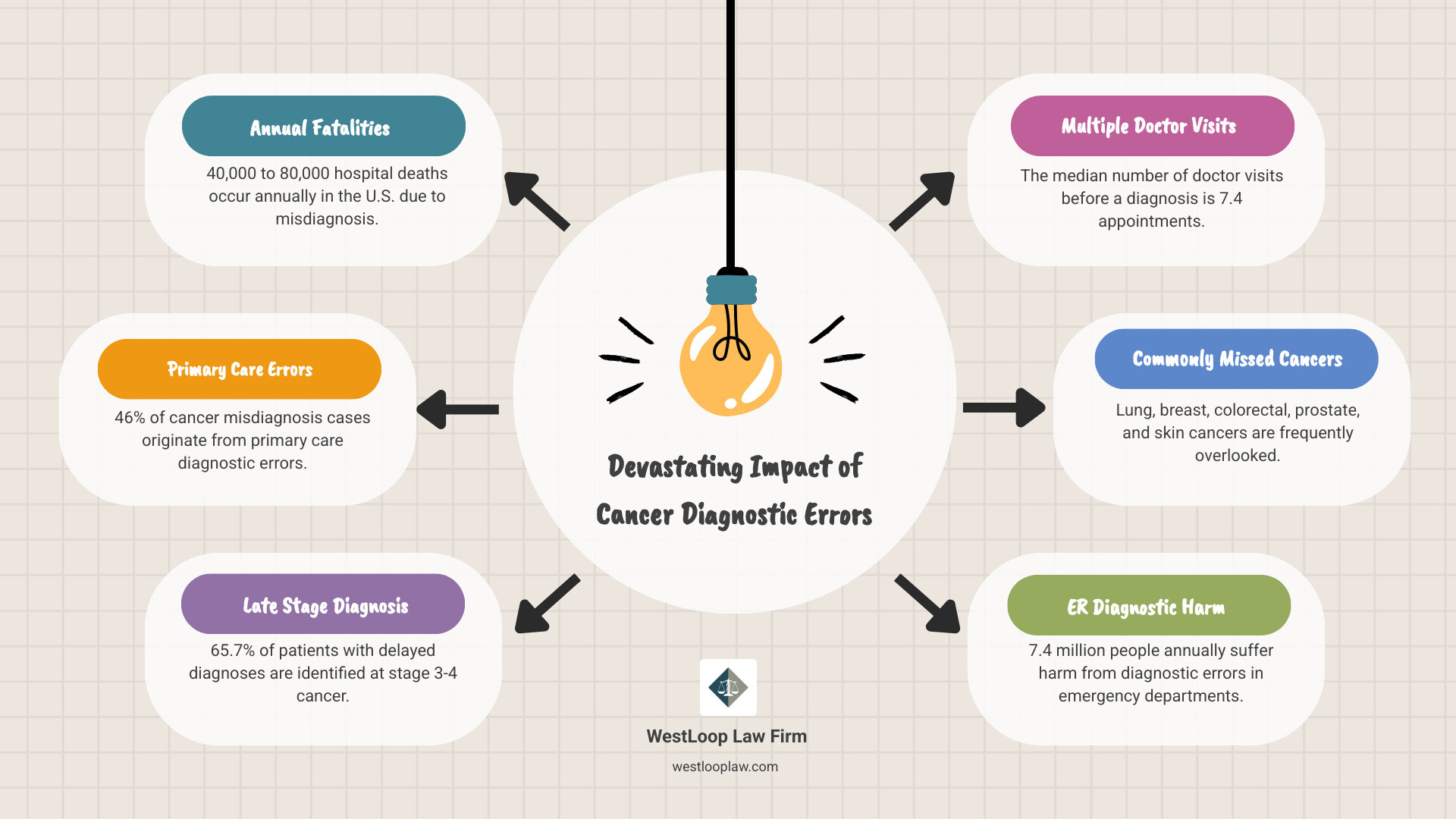
- 40,000 to 80,000 hospital deaths occur annually in the U.S. due to misdiagnosis
- 46% of cancer misdiagnosis cases stem from primary care diagnostic errors
- 65.7% of patients in delayed diagnosis claims are diagnosed at stage 3-4 cancer
- The median number of doctor visits before diagnosis is 7.4 appointments
- Common missed cancers include lung, breast, colorectal, prostate, and skin cancers
When you trust a doctor, you expect them to catch serious conditions like cancer early, when treatment is most effective. However, diagnostic errors are a major problem in American healthcare. As cancer progresses, the difference between a stage 1 and stage 4 diagnosis can be the difference between life and death.
If a doctor fails to order proper tests, misreads results, or ignores your symptoms, it may be medical negligence. In Texas, you have legal rights when a healthcare provider’s failure to diagnose cancer causes you harm.
Statistics show that diagnostic errors contribute to tens of thousands of deaths each year. Understanding what constitutes a failure to diagnose, who is responsible, and your legal options is the first step toward justice.
Understanding Diagnostic Failures in Cancer Care

When a healthcare provider misses cancer that should have been caught, it can be a violation of the standard of care that doctors are legally required to meet. These diagnostic failures often represent medical negligence that compromises patient safety. To learn more about the disease, the National Cancer Institute provides comprehensive information about what cancer is.
What Constitutes a Failure to Diagnose Cancer?
Legally, a failure to diagnose cancer occurs when a medical professional fails to identify cancer in a patient with clear signs that warranted further investigation. The question is whether they met the accepted standard of care—the level of competence a reasonable physician would provide under similar circumstances.
- Delayed diagnosis is when cancer is eventually found, but only after an avoidable delay that allowed the disease to progress and become harder to treat.
- Complete failure to identify is when a provider never diagnoses the cancer, despite multiple visits and clear symptoms. The diagnosis may come from another doctor or a medical emergency, after precious time has been lost.
- Ignoring clear signs happens when a doctor dismisses abnormal test results or persistent symptoms without conducting a thorough investigation.
If another competent doctor would have diagnosed the cancer earlier in the same situation, you may have a medical malpractice claim. Our team can help you understand wrong diagnosis claims and your legal options.
Failure to Diagnose vs. Misdiagnosis
While often used interchangeably, these terms have distinct legal meanings.
| Feature | Failure to Diagnose Cancer | Misdiagnosis of Cancer |
|---|---|---|
| Core Issue | No diagnosis is given, or diagnosis is significantly delayed. | An incorrect diagnosis is given. |
| Result | Cancer goes undetected and untreated for a period. | Patient is treated for the wrong condition, or cancer is mistaken for something else. |
| Example Scenario | Doctor fails to order a biopsy despite a suspicious lump. | Doctor diagnoses a cancerous lump as a benign cyst. |
| Impact | Cancer progresses, potentially becoming untreatable. | Patient may undergo unnecessary treatments or miss crucial cancer treatment. |
A failure to diagnose means the cancer was missed entirely. A misdiagnosis means the doctor provided the wrong diagnosis. A false positive (diagnosing cancer when there is none) leads to unnecessary trauma and treatment. A false negative (diagnosing cancer as a harmless condition) allows the disease to spread unchecked. Both are forms of medical negligence that can have devastating consequences.
Common Cancers That Are Frequently Missed
Some cancers are prone to being missed because their symptoms can be vague or mimic less serious conditions.
- Breast cancer errors occur when suspicious lumps are dismissed or mammograms are misread, allowing the cancer to advance.
- Colorectal cancer is often mistaken for IBS or hemorrhoids. Failure to investigate persistent bowel changes can allow the cancer to spread.
- Lung cancer can be attributed to chronic conditions like bronchitis or COPD, especially in smokers. Small tumors may be missed on chest X-rays.
- Prostate cancer symptoms can be dismissed as normal aging. Without proper PSA testing and follow-up, it can spread beyond the prostate gland.
- Lymphoma presents with general symptoms like fatigue and swollen lymph nodes, which are often not investigated further if they persist.
- Skin cancer, especially melanoma, can be overlooked when a dangerous mole is dismissed as a harmless spot. Early detection is critical.
Studies reveal how often doctors misdiagnose these five cancers, highlighting the critical need for thorough investigation of persistent symptoms.
Common Causes and Consequences of a Failure to Diagnose Cancer
A failure to diagnose cancer allows the disease to progress from a localized, treatable stage to an advanced, metastatic one. This worsens the prognosis, limits treatment options, increases medical costs, and inflicts immense emotional distress on patients and their families.
Why Do Diagnostic Errors Happen?
Diagnostic errors are complex, with 46% of cancer misdiagnosis cases originating from primary care diagnostic errors. Common reasons include:
- Failure to Order Proper Testing: Not ordering necessary blood work, imaging, or biopsies despite symptoms or risk factors.
- Delay in Testing or Sending Results: Administrative or systemic delays in conducting tests or communicating results.
- Lost or Misread Test Results and Scans: Lab results or radiology images being misplaced, overlooked, or misinterpreted.
- Failure to Recognize and Follow-Up on Common Symptoms: Dismissing persistent symptoms as minor ailments without considering cancer.
- Failure to Obtain Proper Patient Information and/or History: Overlooking a patient’s risk factors or family history.
- Poor Communication: Breakdowns in communication between different healthcare providers.
- Over-reliance on Remote Consultations: Lacking a comprehensive physical examination needed to identify subtle signs of cancer.
While not always malicious, these errors can constitute medical negligence when they fall below the accepted standard of care.
The Life-Altering Consequences of a Delayed Diagnosis
The implications of a missed cancer diagnosis are profound and often irreversible. When cancer is not detected early, it has time to grow and spread, leading to:
- Cancer Metastasis: The spread of cancer from the original tumor to other parts of the body, making it significantly harder to treat and often incurable.
- More Aggressive Treatments: Later-stage diagnoses require more invasive treatments like extensive surgery, higher doses of chemotherapy, and intense radiation, which have severe side effects.
- Reduced Survival Rates: Survival rates for many cancers drop dramatically as the stage progresses. For example, the survival rate for stage 0 lung cancer can be as high as 90%, but it plummets to less than 10% at stage IV.
- Increased Physical and Emotional Pain: Patients endure prolonged suffering from the disease, harsh treatments, and the emotional toll of an advanced diagnosis.
- Lost Wages and Increased Medical Bills: Intensive treatment leads to more time away from work and higher medical expenses.
- Wrongful Death: In the most tragic cases, a delayed diagnosis leads to a premature and avoidable death.
A significant delay in diagnosis can profoundly impact a patient’s life, as shown in cases where missed follow-ups led to a much later-stage diagnosis, altering the patient’s final months.
The Legal Standard: Proving Medical Malpractice

If a failure to diagnose cancer has harmed you or a loved one, the law provides a path to justice through a medical malpractice claim. These cases require proving that a preventable error caused real damage to your health and life. At WestLoop Law Firm, we help clients understand what must be proven and how to navigate a medical malpractice claim effectively.
Establishing Negligence and the Standard of Care
Not every delayed diagnosis is malpractice. The key is whether your provider met the standard of care—the level of skill a reasonably competent medical professional would have provided in the same situation. If another doctor would have recognized the warning signs, then failing to do so may be negligence.
To prove medical malpractice, you must establish four elements:
- A doctor-patient relationship existed, creating a duty of care.
- The provider breached the standard of care through a negligent act or omission.
- This breach directly caused your injury or worsened your condition.
- You suffered actual damages (physical, emotional, or financial).
Proving a breach of the standard of care requires medical testimony from other doctors in the same field of practice. Our investigative techniques page provides more insight into this process.
Who Can Be Held Liable?
Multiple parties can be responsible for a diagnostic error:
- Primary care physicians who dismiss symptoms or fail to refer to another physician.
- Physicians with focused training (e.g., oncologists, dermatologists) who fail to recognize cancer within their area of practice.
- Radiologists who misinterpret scans or fail to report critical findings.
- Pathologists who misread a biopsy or confuse cancerous cells with benign ones.
- Hospitals and medical facilities for systemic failures like understaffing, faulty equipment, or poor communication protocols. Our hospital negligence lawyers handle these cases.
- Laboratory technicians and nurses who process results incorrectly or fail to communicate worsening symptoms.
Identifying all responsible parties is critical for a successful claim.
Understanding the Statute of Limitations in Texas
Texas law sets a strict deadline, or statute of limitations, for filing a lawsuit. Missing this deadline means you lose your right to seek justice.
For most medical malpractice claims, you have two years from the date the negligence occurred to file. If you did not realize you were harmed right away, limited exceptions may affect when the filing period begins, particularly where an injury could not reasonably have been finded earlier.
Texas also has a statute of repose, which is an absolute deadline of ten years from the date of the negligent act, regardless of when the harm is finded. These deadlines are unforgiving, so it is crucial to consult an attorney as soon as you suspect a failure to diagnose cancer. Understanding your legal rights in a malpractice case begins with acting before these time limits expire.
Your Path to Justice: Taking Action After a Diagnostic Error
When a failure to diagnose cancer disrupts your life, you have rights and there are concrete steps you can take. While no amount of money can reverse the harm, a successful legal claim can provide financial relief for medical bills and lost income. It also holds negligent providers accountable.
Building a strong case requires careful preparation and skilled legal guidance. The process may seem daunting, but you don’t have to face it alone. We’re here to help you understand your legal rights and fight for the compensation you deserve.
Steps to Take if You Suspect a Failure to Diagnose Cancer
If you believe a diagnostic error has occurred, time is of the essence. Here are the immediate steps you should take:
- Seek a second opinion. Trust your instincts. If you have doubts about your diagnosis (or lack thereof), consult another medical professional. This is your right as a patient and is often how errors are found.
- Gather all your medical records. These documents are the foundation of a malpractice claim. Collect doctor’s notes, lab results, imaging reports, and all correspondence.
- Document everything. Create a detailed timeline of your symptoms, appointments, and conversations with providers. Note when symptoms started, what you were told, and when you finally received the correct diagnosis.
- Contact a medical malpractice lawyer. An experienced attorney can evaluate your situation, determine if you have a viable claim, and guide you through the legal process. Strict time limits apply in Texas, so acting quickly is crucial.
What Damages Can Be Claimed in a Lawsuit?
A successful lawsuit can recover damages for both financial losses and personal suffering.
-
Economic damages cover quantifiable financial losses. This includes past and future medical bills, lost wages, and loss of future earning capacity if your ability to work has been permanently affected.
-
Non-economic damages compensate for intangible losses. This includes pain and suffering for the physical and emotional distress caused by the delayed diagnosis and harsher treatments. It also covers mental anguish, loss of enjoyment of life, and compensation for disfigurement or impairment.
In cases where a diagnostic failure leads to death, surviving family members may pursue wrongful death damages to cover funeral expenses and the loss of financial and emotional support.
Our goal is to provide financial relief while you face an uncertain future. Our guide to medical malpractice compensation offers more detail on what you may be able to claim.
How to Advocate for a Timely and Accurate Diagnosis
While medical professionals have the primary responsibility for diagnosis, you play an important role as an active participant in your care. Being proactive and communicating clearly can help ensure cancer is caught early.
Being Your Own Best Advocate
Partner with your healthcare team to improve your chances of a timely and accurate diagnosis. Here’s how you can advocate for yourself:
-
Ask questions. You have a right to understand your care. Ask why a test is being ordered or why a symptom is being dismissed. If you don’t understand something, keep asking until you do.
-
Provide a thorough medical history. Share your complete family cancer history, lifestyle habits, and any medications or supplements you take. These details are important clues for your doctor.
-
Seek second opinions. If your symptoms persist, you receive a serious diagnosis, or something doesn’t feel right, consulting another doctor is smart healthcare. A fresh set of eyes often catches what was missed.
-
Don’t ignore persistent symptoms. Your body knows when something is wrong. If you have unexplained weight loss, chronic fatigue, or any new and concerning symptom, ensure it is thoroughly investigated.
-
Keep personal health records. Maintain your own file with test results, reports, and a timeline of your health journey. These records are invaluable if you need to switch doctors or pursue a legal claim.
-
Stay informed about your health. Understanding your risk factors and the warning signs of common cancers helps you have more productive conversations with your doctor and gives you the confidence to speak up.
A good doctor will welcome your questions. If you feel dismissed or unheard, that is a red flag. Trust your instincts—it could save your life.
Secure the Justice You Deserve
When a failure to diagnose cancer occurs, it’s a devastating breach of trust. The consequences are life-altering: more aggressive treatments, a worsened prognosis, financial strain, and the knowledge that earlier detection could have changed everything.
You don’t have to face this alone.
At WestLoop Law Firm, we are dedicated to helping people in Houston, Texas, who have been harmed by medical negligence. We know a lawsuit can’t turn back time, but holding negligent providers accountable can provide a sense of justice and prevent similar errors from happening to others.
Our legal team combines experience in personal injury and probate law, allowing us to handle every aspect of your case, including complex wrongful death claims. We work with leading medical professionals to prove that your provider fell below the accepted standard of care.
Your story matters. The path forward begins with a conversation. We will listen to what happened, review your records, and provide an honest assessment of your case. This initial consultation is free, with no obligation.
Time is critical. Texas law imposes strict deadlines for filing medical malpractice claims. Waiting too long can mean losing your right to seek compensation entirely. The sooner we can handle the legal complexities, the sooner you can focus on your health and family.
If a failure to diagnose cancer has changed your life or taken someone you love, we are here to fight for the justice and compensation you deserve. Contact our medical mistakes lawyers for a free consultation today. Let us carry this burden for you.