 Skip to content
What to Do When You Have a Houston Property Damage Claim
A Houston property damage claim can feel overwhelming — whether your roof was torn off by a hurricane on the Gulf Coast, your home flooded near Brays Bayou, or your car was wrecked on I-10 near Westheimer Road.
Here’s a quick overview of the key steps:
- Document all damage immediately with timestamped photos and videos
- Notify your insurance company as soon as possible to avoid missing policy deadlines
- File within the right time limits — Texas gives you two years from the date of damage to file a lawsuit
- If the City of Houston is involved, submit a written notice to the Mayor and City Council within 90 days under Article IX, Section 11 of the City Charter
- Don’t accept the first offer — initial insurance settlements are almost always lower than what you’re owed
- Consider legal help if your claim is denied, delayed, or undervalued
Houston sits in one of the most storm-battered regions in the country. Harris County ranks near the top nationally for storm-related property losses. Hailstorms, hurricanes, flooding, and fires can all strike with little warning — and when they do, insurance companies don’t always make recovery easy.
Most property owners don’t realize how many ways a claim can go wrong. Insurers may blame pre-existing damage, cite policy exclusions, or simply offer far less than repairs actually cost. Knowing your rights before you file makes a real difference.
This guide walks you through every stage of the process — from the first photo you take after a storm to what happens if your insurer refuses to pay fairly.
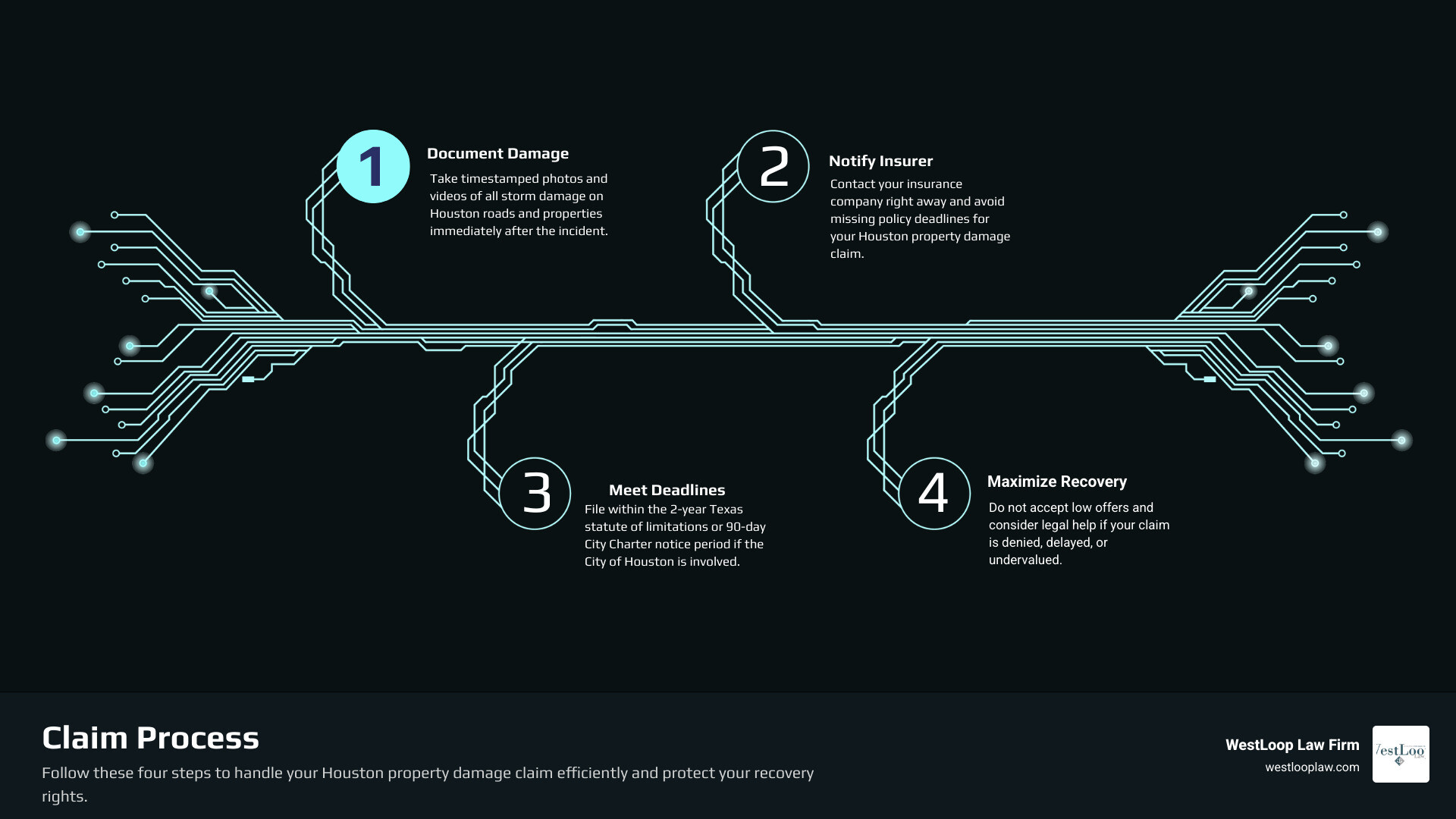
Simple guide to Houston property damage claim:
Immediate Steps and City Rules for a Houston Property Damage Claim
When disaster strikes your Houston property, the clock starts ticking immediately. Whether a severe thunderstorm ripped shingles off your home on Westheimer Road or a sudden collision smashed your vehicle near the busy intersection of I-10 and Loop 610, taking the right steps in the first 24 to 48 hours is vital to securing a fair payout.
First and foremost, prioritize your safety. Before walking through your home or checking on your vehicle, ensure there are no active hazards like downed power lines, structural collapses, or gas leaks. If you or anyone else has suffered physical injuries, seek immediate medical care at a local emergency room, such as Memorial Hermann Hospital, before worrying about physical property.
Once safety is established, your primary job is to prevent further loss. Standard insurance policies require property owners to take reasonable steps to mitigate damage. This means putting a tarp over a compromised roof, boarding up broken windows, or turning off the main water valve to stop a burst pipe. If you fail to take these steps, your insurer may deny coverage for any additional damage that occurs afterward. Keep all receipts for temporary repair materials, as these costs are typically reimbursable under your policy.
Documenting Damage on Houston Roads and Properties
To build a solid foundation for your Houston property damage claim, you must collect clear, undeniable evidence. Do not touch or clean up anything until you have recorded the scene exactly as it is.
When documenting your property, follow this systematic approach:
- Take high-resolution photos and videos: Capture wide angles of the entire scene, followed by close-up shots of specific damaged areas.
- Use scale markers: If hail strikes your property, place a coin or a measuring tape next to the hailstone or the dent to show its actual size.
- Gather official records: If your vehicle is damaged in a wreck, ensure you have the necessary documents for car accidents Houston TX to protect your rights, including the police accident report and contact information for all parties involved.
- Keep a written inventory: Create a detailed spreadsheet listing damaged items, their estimated age, purchase price, and replacement cost.
- Get independent repair estimates: Do not rely solely on the insurance adjuster’s evaluation. Request detailed quotes from multiple licensed local contractors to establish the true cost of repairs.
Filing a Claim Against the City of Houston
Sometimes, the damage to your property is caused directly by municipal operations or city-owned vehicles. If a city utility truck hits your parked car or a public works crew damages your property, you face a completely different set of rules. Filing a claim against a government entity is vastly different from filing a standard insurance claim.
Under the City of Houston Charter, Article IX, Section 11, the city has strict protections. To hold the city liable, you must provide a formal, written “Notice of Claim” to the Mayor and City Council within 90 days of the incident. If you miss this tight window, the city is legally exempt from liability, and your claim will be permanently barred.
To file this claim successfully, you must submit a notarized letter containing the following details:
- The exact date, time, and specific location where the damage occurred (e.g., near the Houston Permitting Center on Washington Avenue).
- A clear, detailed description of how the incident happened.
- The specific damage or injuries sustained.
- The amount of financial compensation you are seeking.
- At least three independent repair estimates, along with photographs of the damage, a copy of your vehicle title (if applicable), and any relevant police reports.
You can learn more about the formal submission requirements on the City of Houston Legal Department – Filing a Claim portal. That Texas law heavily shields government bodies, meaning the city will thoroughly evaluate and often contest these claims.
Navigating Insurance Laws for a Houston Property Damage Claim
Navigating Texas insurance laws requires a clear understanding of your legal rights and the minimum coverages established by the state. When dealing with vehicle accidents, Texas operates under an “at-fault” system. This means the person who caused the accident is financially responsible for the resulting damage.
| Metric / Requirement | Texas Standard / Rule |
|---|---|
| Minimum Vehicle Property Damage Liability | $25,000 per accident |
| Minimum Vehicle Bodily Injury Liability | $30,000 per person / $60,000 per accident |
| Statute of Limitations (Property Damage) | 2 years from the date of loss |
| City of Houston Administrative Claim Deadline | 90 days from the date of incident |
| Standard Wind/Hail Policy Deductibles | Typically 2% of home’s insured value |
Under Texas law, drivers are required to carry a minimum of $25,000 in property damage liability coverage. However, with rising vehicle and labor costs in 2026, a standard collision can easily exceed this minimum. If you are hit by an underinsured driver, you may need to rely on your own collision coverage or uninsured motorist policy to cover the difference.
Texas also uses a modified comparative negligence rule. Under this system, your compensation can be reduced by your percentage of fault. If you are found to be more than 50% responsible for the accident, you cannot recover any damages from the other party. Understanding how liability is split is essential, and you can read more about understanding comparative negligence in Houston TX to see how this rule might affect your recovery.
For property owners dealing with storm and weather-related losses, the Texas Department of Insurance – Storm Damage Resources provides helpful guidelines on policyholder rights and state-mandated insurer deadlines.
Wind, Hail, and Hurricane Issues in a Houston Property Damage Claim
Living in Houston means preparing for extreme weather. Hurricanes, severe windstorms, and sudden hailstorms cause millions of dollars in local property damage every year.
Standard Texas homeowners policies usually cover wind and hail damage, but they come with unique structural limitations:
- Percentage Deductibles: Unlike standard flat-fee deductibles (such as $500 or $1,000), most Texas wind and hail policies utilize a percentage-based deductible. This is typically set at 2% of your home’s total insured value. If your home is insured for $300,000, you must pay $6,000 out of pocket before your insurance coverage kicks in. Some policies carry deductibles as high as 5%.
- Windstorm Associations: If you live closer to the coast or in a designated catastrophe area, standard insurers may exclude windstorm coverage entirely. In these cases, property owners must purchase separate coverage through the Texas Windstorm Insurance Association (TWIA). You can review these special requirements through the Texas Department of Insurance – Windstorm Coverage resource.
- Cosmetic vs. Functional Damage: Insurers frequently try to deny roof claims by classifying hail dents or shingle granule loss as “cosmetic” rather than “functional.” Under Texas case law, if the damage compromises the long-term integrity of the roof or makes it more susceptible to leaks, it must be covered as functional damage.
Floodplain Management and Substantial Damage in Houston
Perhaps the most misunderstood aspect of property ownership in Houston is flood insurance. Standard homeowners insurance policies do not cover flood damage. To protect your property from rising waters, you must carry a separate policy through the National Flood Insurance Program (NFIP) or a private flood insurer.
If your home is located within a designated floodplain and suffers severe flood damage, you must navigate the City of Houston’s strict floodplain management rules. When a home in a floodplain is damaged by rising waters, the City of Houston Floodplain Management Office must perform a “Substantial Damage Determination.”
Under local ordinances and FEMA guidelines, if the total cost to repair the structure to its pre-loss condition equals or exceeds 50% of the structure’s market value (excluding land value, as determined by the Harris County Appraisal District – HCAD), the property is deemed “substantially damaged.”
Once a home receives this determination, you cannot simply perform basic repairs. To obtain a repair permit, you must bring the entire structure into compliance with current floodplain management codes. This often requires elevating the home above the base flood elevation, which can add tens of thousands of dollars to your recovery costs. To request an evaluation or submit repair estimates, property owners must complete and submit the official Substantial Damage Determination Request Form to the city’s permitting office.
Overcoming Denials and Maximizing Your Recovery
It is a frustrating reality: insurance companies are for-profit businesses. Their primary goal is to minimize payouts to protect their bottom line. When you submit a Houston property damage claim, the insurer will assign an adjuster whose job is to find reasons to reduce, delay, or deny your payment.
If you receive a low offer or a denial letter, do not panic. These initial decisions are rarely final. To protect your investment, you must understand the tactics insurers use and how to fight back. Learning how to maximize compensation for your car accident claim or home insurance claim can help you level the playing field.
Some property owners choose to hire public adjusters to help negotiate their claims. Public adjusters are licensed professionals who represent policyholders rather than insurance companies. While they can assist in documenting damage, they charge a percentage of your final settlement (often up to 10%). Before hiring one, you should review the guidelines provided by the Texas Department of Insurance – Working with a Public Adjuster to ensure you understand their fees and limitations.
Common Insurance Denial Tactics
To protect your claim, you must be able to spot common insurer tactics before they derail your recovery:
- Attributing Damage to Exclusions: Insurers love to claim that your water damage was caused by a slow, gradual leak (which is excluded) rather than a sudden, accidental pipe burst (which is covered).
- Alleging Lack of Maintenance: If your roof leaks during a storm, the insurer may argue that the leak occurred because your roof was old and poorly maintained, rather than because of wind or hail.
- Offering Lowball Estimates: The insurer’s adjuster may use outdated software or national averages to estimate repair costs, failing to account for the actual, higher cost of skilled labor and materials in the Houston area.
- Unreasonable Delays: Insurers may repeatedly ask for the same documents, delay scheduling inspections, or take weeks to return calls, hoping you will grow desperate and accept a lower settlement just to get the process over with.
When to Hire an Attorney for Your Houston Property Damage Claim
While minor claims can often be resolved directly with your insurer, there comes a point where professional legal representation is necessary.
As a general rule, we recommend using a $25,000 discrepancy threshold. If the gap between what your contractor says repairs will cost and what the insurance company is offering is $25,000 or more, attempting to handle the dispute on your own is highly risky.
When you hire us at Westloop Law Firm, the dynamic changes instantly. Insurance companies behave differently when they know a law firm is prepared to take them to court. We can assist you by:
- Reviewing your policy to identify hidden coverages and challenge unfair exclusions.
- Hiring independent structural engineers, roofers, and estimators to build an indisputable record of your losses.
- Filing formal demand letters that outline bad faith insurance practices under the Texas Insurance Code.
- Taking your case to court if the insurer refuses to offer a fair and just settlement.
If your property damage arose from a motor vehicle collision, navigating the legal landscape can be especially tricky. For example, the Sugar Land commute is a legal minefield where multi-vehicle wrecks frequently complicate property damage and injury claims. Having an experienced legal team on your side ensures you don’t get stuck paying for someone else’s negligence.
For more details on finding the right legal representation, check out our guide on the best property damage attorneys in Houston.
Frequently Asked Questions about Houston Property Damage Claims
What is the deadline to file a Houston property damage claim?
In Texas, the statute of limitations for filing a lawsuit over property damage is two years from the date the damage occurred. This deadline applies to both real property (like your home or land) and personal property (like your vehicle).
However, you should not wait this long to take action. Most insurance policies have strict “prompt reporting” clauses that require you to notify them of a loss within a few days or weeks. Failing to report the damage promptly can result in your claim being denied before you ever have the chance to file a lawsuit.
Does standard homeowners insurance cover flood damage in Houston?
No, standard homeowners insurance policies specifically exclude flood damage. To protect your home from rising water, storm surges, or overflowing bayous, you must purchase a separate flood insurance policy. Most flood policies in Houston are written through the National Flood Insurance Program (NFIP), which is managed by FEMA, though private flood insurance options are also available.
Can the City of Houston be held liable for pothole or sewer damage?
Generally, no. Under Texas law, municipal governments enjoy broad sovereign immunity. The state has specifically exempted the City of Houston from liability for property damage caused by the condition of its streets (such as potholes) or by defective or clogged city sewer lines.
While you can still submit a Notice of Claim to the city within 90 days, these claims are almost always denied under state law exemptions unless you can prove extreme, direct negligence that falls outside of these standard immunities.
Conclusion
Recovering from property damage in Houston is a journey that requires patience, organization, and a clear understanding of your legal rights. Whether you are dealing with a stubborn insurance adjuster who refuses to pay for storm repairs, or trying to sort out liability after a major car wreck, you do not have to go through this process alone.
At Westloop Law Firm, we combine our legal knowledge with a dedicated focus on helping Houstonians recover the compensation they deserve. We understand the tactics insurance companies use to undervalue claims, and we are prepared to stand up to them on your behalf.
If you are facing a denied, delayed, or undervalued claim, get in touch with us today. Contact a car accident lawyer in Houston or reach out to our property damage recovery team to schedule your free consultation and take the first step toward putting your property—and your life—back together.