 Skip to content
What to Do After a Truck Highway Pileup in Houston
After a truck highway pileup in Houston, get medical care, preserve evidence, and avoid giving a recorded statement or accepting fault before you understand what happened. Multi-vehicle truck crashes may involve more than one responsible party, including a truck driver, trucking company, cargo loader, maintenance provider, or another motorist.
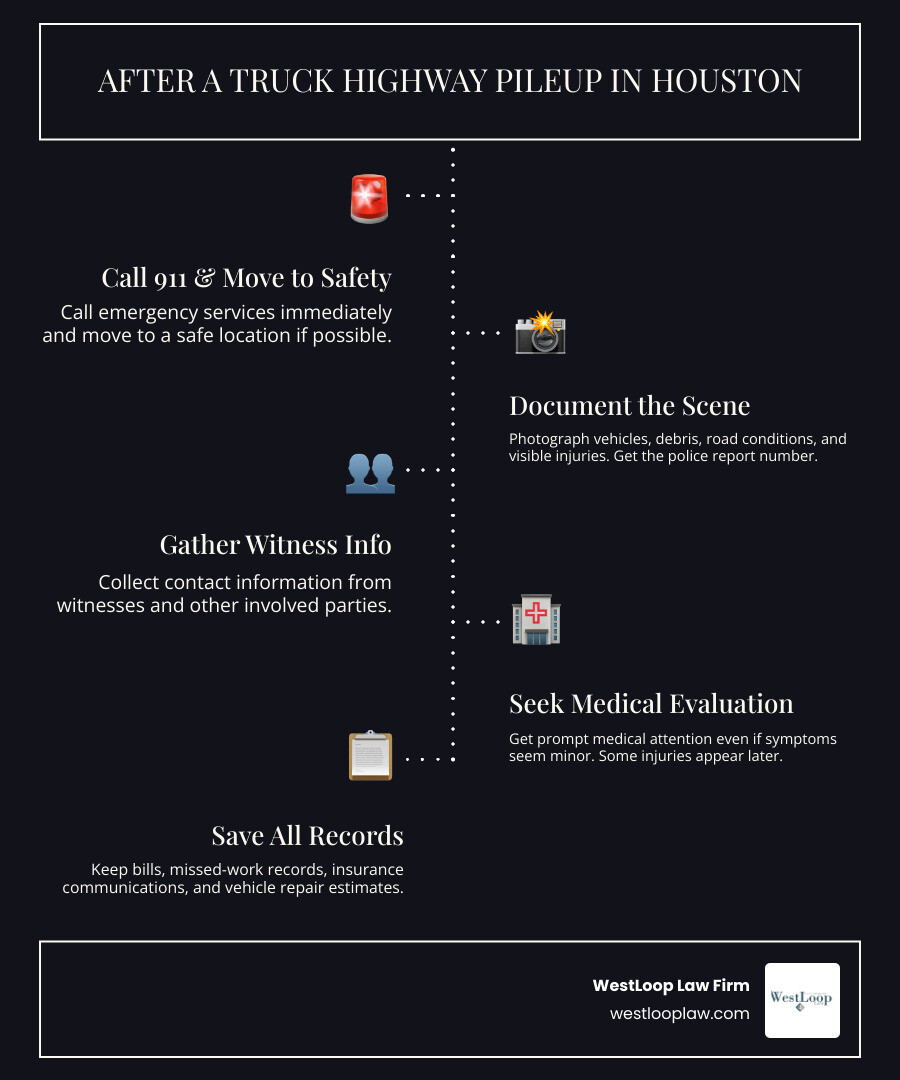
Take these early steps:
- Call 911 and move to a safe place if you can do so safely.
- Photograph vehicles, debris, road conditions, and visible injuries.
- Get the police report number and witness contact information.
- Seek prompt medical evaluation, even if symptoms seem minor.
- Save bills, missed-work records, and insurance communications.
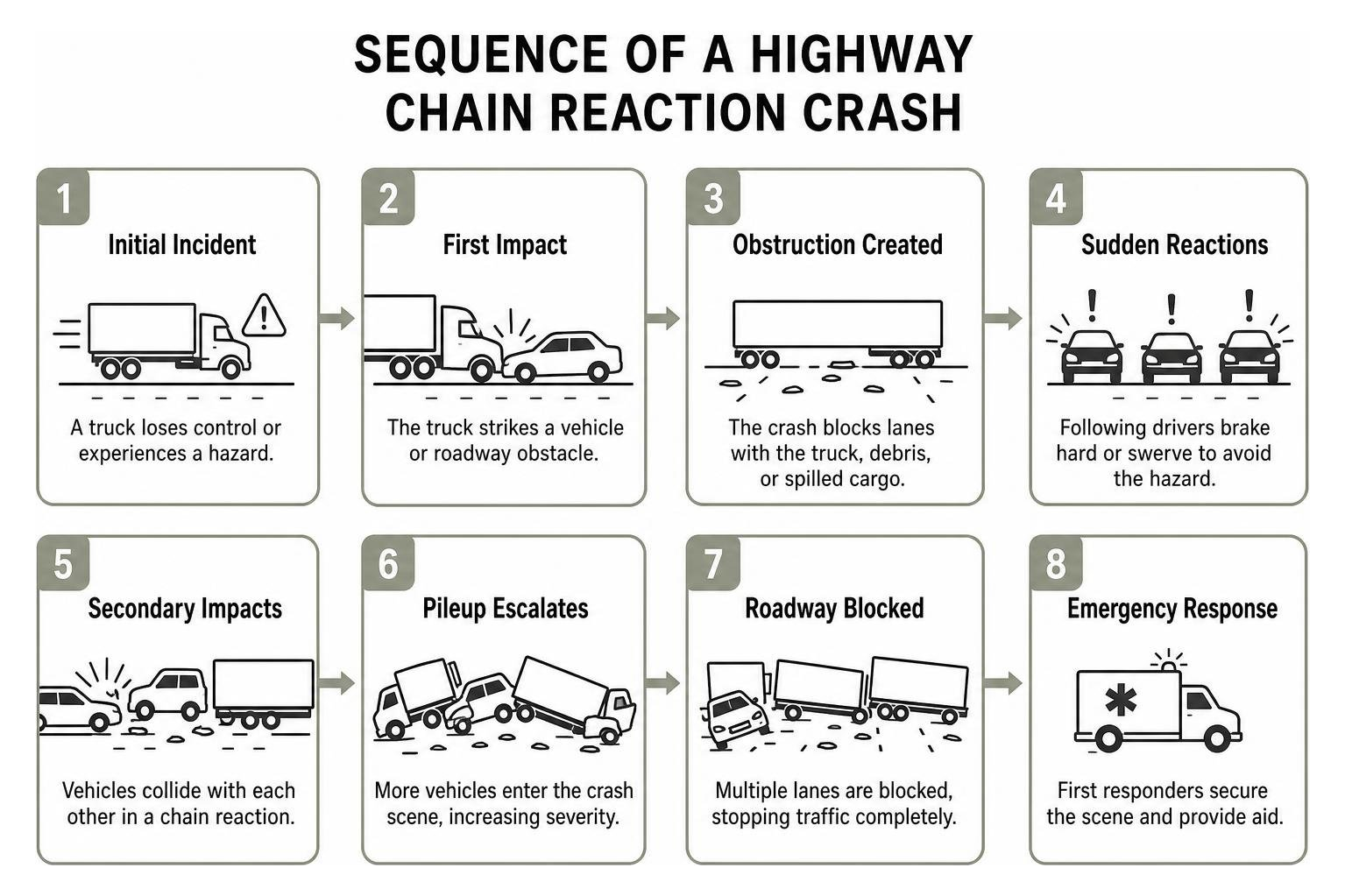
Houston-area crashes involving overturned 18-wheelers, spilled cargo, fuel, and blocked freeway lanes show how quickly a truck collision can become a chain-reaction event. On corridors such as I-10, I-610, SH-225, I-69, and the Grand Parkway, determining fault often requires evidence beyond the crash scene, including truck data, driver logs, maintenance records, and cargo-securement information.
Westloop Law Firm can help injured motorists understand their legal options and protect evidence while the facts are still available.
Learn more about your rights after a highway collision:
Causes and Common Scenarios of Multi-Vehicle Commercial Wrecks

When an eighty-thousand-pound commercial vehicle loses control at highway speeds, physics takes over immediately. The momentum of a fully loaded tractor-trailer cannot be neutralized instantly. A sudden lane change, blown tire, or split-second distraction frequently initiates a devastating chain reaction that ensnares passenger vehicles traveling in adjacent lanes.
Several recurring scenarios contribute to major highway crashes across Houston:
- Shifting and Spilled Cargo: Improperly secured freight can destabilize an 18-wheeler during standard maneuvers, causing a rollover. When heavy items spill across travel lanes, following drivers face immediate obstructions. For instance, 18-wheeler loses load, pipes spread across SH-225 at I-610 exit ramp, images show – ABC13 Houston illustrates how scattered industrial freight instantly disables entire freeway connectors.
- Bulk Material and Environmental Spills: Heavy haulers carrying sand, gravel, or liquid cement create immediate hazards when involved in collisions. When a truck hauling gravel overturns in crash, shutting down westbound lanes of I-610 at I-45, the resulting physical debris and ruptured diesel tanks turn high-speed freeways into slippery obstacle courses.
- Hazmat Contamination and Tanker Rollovers: Commercial trucks transporting hazardous chemicals or petroleum introduce severe toxicity and fire hazards. An overturned 18-wheeler closes multiple lanes on Eastex Freeway at Kelley Street, requiring dedicated hazmat emergency units, extensive containment barriers, and total freeway shutdowns that ripple across Houston traffic grids.
- Jackknifing and Barrier Vaults: High-speed sudden braking can cause a trailer to skid outward perpendicular to the cab. In dramatic circumstances, collisions force commercial rigs upward or over concrete guardrails, as reported in a Houston Chronicle report where a tractor-trailer ended up suspended above lower roadways.
- Construction Vehicle Rollovers: The continuous infrastructure development around Houston brings heavy concrete mixers and dump trucks onto fast-moving outer loops. A wreck on 99 Grand Parkway shuts down road near Cypress Rosehill underscores how high centers of gravity make heavy construction trucks vulnerable to rollovers that block lanes for hours.
Dangerous Corridors Prone to a Truck Highway Pileup Houston Wreck
Houston hosts some of the busiest freight transit routes in the nation. Heavy commercial traffic blends daily with high commuter volumes, creating severe crash risks along several well-known corridors:
- Interstate 10 (Katy Freeway & East Freeway): Spanning the entire metroplex, I-10 accommodates tens of thousands of long-haul carriers daily. Recent incidents, such as when lanes reopened after overturned truck shuts down all eastbound lanes of I-10 East Freeway EB at Cedar Lane – ABC13 Houston, demonstrate how crashes halt transit across the eastern energy corridor. Further east, a big rig rollover crash causes deadly pileup along I-10 where … TxDOT adjusted travel conditions highlights the extreme vulnerability of high-speed rural-to-urban transitional zones. Additional reports from big rig rollover crash causes deadly pileup along I-10 … confirm how quickly multi-vehicle pileups escalate on this interstate.
- Interstate 610 (The Loop): Encircling inner Houston, the North, South, and East Loops feature complex interchanges and tight exit ramps where heavy trucks frequently negotiate short merging lanes.
- State Highway 99 (Grand Parkway): This sprawling outer loop carries rapid freight moving around Houston, where high legal speed limits leave minimal stopping margins when traffic ahead decelerates abruptly.
- State Highway 225 & Interstate 69 (Eastex Freeway): Serving the industrial port complexes, these routes experience continuous streams of chemical tankers, flatbeds, and heavy commercial machinery.
Understanding Liability in a Truck Highway Pileup Houston Collision
Determining fault after a multi-vehicle highway pileup requires careful legal and factual analysis. Texas follows a modified comparative fault system under Chapter 33 of the Texas Civil Practice and Remedies Code, known as proportionate responsibility. Under this rule, an injured driver can recover damages as long as their share of responsibility does not exceed 50 percent.
Because commercial truck crashes typically involve multiple impacts, insurance companies aggressively attempt to shift blame among different drivers to reduce their payout obligations.
| Potentially Liable Party | Basis of Legal Responsibility | Critical Evidence Utilized |
|---|---|---|
| Commercial Truck Driver | Hours of Service violations, distracted driving, excessive speed for road conditions, improper lane changes. | Electronic Logging Device (ELD) records, cell phone logs, dashcam video, toxicology panels. |
| Motor Carrier / Trucking Company | Vicarious liability, negligent hiring, improper training, demanding unsafe delivery schedules. | Carrier safety audits, driver qualification files, dispatch communication records, internal safety policies. |
| Cargo Loading Facility / Shipper | Improper weight distribution, failure to secure heavy cargo, exceeding gross vehicle weight ratings. | Bills of lading, warehouse load manifests, cargo securement inspections, post-crash cargo placement photos. |
| Third-Party Maintenance Provider | Defective brake repairs, failure to replace worn steering components, improper tire mounting. | Maintenance logs, work orders, mechanic certifications, mechanical component failure reports. |
| Other Motorists in the Pileup | Sudden deceleration without cause, tailgating, unsafe lane changes cutting off commercial rigs. | Traffic camera feeds, witness accounts, event data recorders (black boxes) from passenger cars. |
Multiple At-Fault Parties in Commercial Chain-Reaction Crashes
Unlike a routine two-car accident, a commercial wreck in Houston often involves corporate entities located across different states. Under the legal doctrine of respondeat superior, trucking companies are held legally answerable for the negligent acts of their drivers committed within the course and scope of employment.
Additionally, independent cargo contractors and logistics brokers can share legal liability if improper securement leads to dynamic load shifts that cause a driver to overturn. Federal regulations enforced by the Federal Motor Carrier Safety Administration (FMCSA) mandate strict compliance regarding braking performance, tire condition, driver rest cycles, and load strapping. When maintenance providers cut corners or motor carriers pressure drivers to ignore mandatory rest breaks, they expose themselves to direct liability for resulting pileups.

At Westloop Law Firm, we evaluate every link in the logistics chain to ensure all responsible insurance policies are identified.
Step-by-Step Guide: How to Pursue Compensation After a Highway Crash
Navigating the aftermath of a catastrophic highway pileup requires quick, decisive action. Corporate trucking insurers often deploy rapid-response teams within hours of an incident to protect their bottom line.
To protect your legal rights and personal health, follow these essential steps:
- Obtain Comprehensive Medical Attention: Even if you walk away from the crash scene, undergo a thorough physical evaluation immediately. The intense adrenaline surge following a multi-vehicle wreck frequently conceals underlying soft-tissue tears, internal bleeding, and concussions.
- Contact Law Enforcement and Obtain Incident Numbers: Ensure the Houston Police Department, Harris County Sheriff’s Office, or Texas Department of Public Safety files a formal crash report. Record the reporting officer’s name, badge number, and incident report identifier.
- Refrain from Giving Recorded Statements to Insurance Adjusters: Adjusters representing commercial carriers are trained to ask leading questions designed to elicit statements that minimize carrier liability. Speak with legal counsel before giving recorded interviews or signing blanket medical authorization forms.
- Organize Financial and Medical Documentation: Maintain an organized file containing all medical bills, prescription receipts, property repair evaluations, explanation of benefits statements, and records of lost income.
- Secure Dedicated Legal Representation: Retain an attorney who understands commercial motor vehicle safety standards and has the resources to conduct independent crash investigations.
Preserving Critical Evidence After a Truck Highway Pileup Houston Incident
Commercial trucking litigation depends heavily on technical data that can be overwritten or lost if not secured immediately. Most modern commercial tractors contain Engine Control Modules (ECMs) and Event Data Recorders (EDRs) that capture speed, brake application, throttle position, and steering inputs in the seconds leading up to a crash.

To prevent this data from being destroyed during vehicle repairs or routine digital overwrites, we issue formal spoliation letters to the motor carrier, their insurance providers, and maintenance facilities. This legal directive requires them to preserve:
- ECM and EDR black box downloads
- Electronic Logging Device (ELD) hours-of-service records
- In-cab front and driver-facing video camera recordings
- Dispatch text messages, GPS tracking logs, and cellular phone records
- Pre-trip and post-trip driver inspection reports (DVIRs)
- Annual vehicle safety inspection certificates and maintenance work orders
- Driver qualification files, medical examiner certificates, and drug screening results
Documenting Personal Injuries and Property Damages
Due to the immense weight disparity between passenger cars and fully loaded tractor-trailers, injuries sustained in Houston highway pileups are often severe. Victims frequently require emergency transport by LifeFlight to regional trauma centers in the Texas Medical Center.
Our firm works closely with treating physicians, life-care planners, and economic analysts to accurately quantify the full extent of your physical and financial losses:
- Traumatic Brain Injuries (TBI): Ranging from severe concussions to permanent cognitive impairment requiring long-term therapy.
- Spinal Cord Injuries: Including disc herniations, fractured vertebrae, and partial or complete paralysis.
- Severe Orthopedic Trauma: Multiple bone fractures, crushed limbs, and joint disruptions requiring surgical intervention and hardware placement.
- Burn and Inhalation Injuries: Resulting from ruptured diesel fuel tanks, hazardous chemical exposure, or post-collision vehicle fires.
- Psychological Trauma: Post-Traumatic Stress Disorder (PTSD), severe driving anxiety, and chronic sleep disturbances following high-impact pileups.
Frequently Asked Questions About Houston Multi-Vehicle Truck Wrecks
What makes determining fault complex in a multi-vehicle truck crash?
Determining fault in a multi-vehicle highway pileup is complex because crashes involve multiple successive impacts, conflicting driver accounts, and shared responsibilities across commercial supply chains. Investigating these claims requires analyzing electronic black box data, vehicle crush patterns, dashcam footage, and roadway gouge marks to reconstruct the exact order of collisions and measure each party’s percentage of responsibility under Texas law.
How long do injured motorists have to file a truck collision claim in Texas?
Under Texas Civil Practice and Remedies Code Section 16.003, injured motorists generally have two years from the date of the collision to file a personal injury lawsuit. However, waiting until the deadline approaches can severely weaken a claim. Critical physical evidence, such as black box logs and maintenance records, can be legally overwritten or discarded if formal evidence preservation letters are not served on the commercial carrier shortly after the crash.
What compensation is recoverable after an 18-wheeler pileup?
Victims of commercial truck crashes in Houston can pursue both economic and non-economic damages. Recoverable compensation includes past and future medical bills, emergency transport expenses, surgical costs, lost wages, diminished future earning capacity, physical pain and suffering, mental anguish, physical impairment, and property repair or replacement costs. In cases involving gross negligence, exemplary or punitive damages may also be sought.
Securing Your Financial Recovery After a Houston Highway Pileup
The physical, emotional, and financial toll of a commercial truck pileup can alter the course of your life in an instant. Dealing with medical treatments while facing aggressive corporate insurance adjusters is an unnecessary burden when you need to focus on healing.
At Westloop Law Firm, we stand up for injured individuals and families throughout the greater Houston area. Our combined personal injury and probate legal capabilities allow us to address complex catastrophic injury cases and wrongful death matters with compassionate care and vigorous courtroom advocacy. We handle the heavy legal lifting, securing vital black box data, coordinating accident reconstruction, and pursuing the maximum compensation you deserve.
If you or a loved one has suffered injuries in a major highway crash, explore our Houston truck accident lawyers guide to learn more about your rights, or connect with our team today to schedule an initial consultation.