 Skip to content
What You Need to Know About a Motorcycle Crash Claim in Houston
Filing a motorcycle crash claim in Houston can feel overwhelming — especially when you’re dealing with injuries, missed work, and a flood of calls from insurance adjusters.
Here’s a quick overview of the process so you know where you stand:
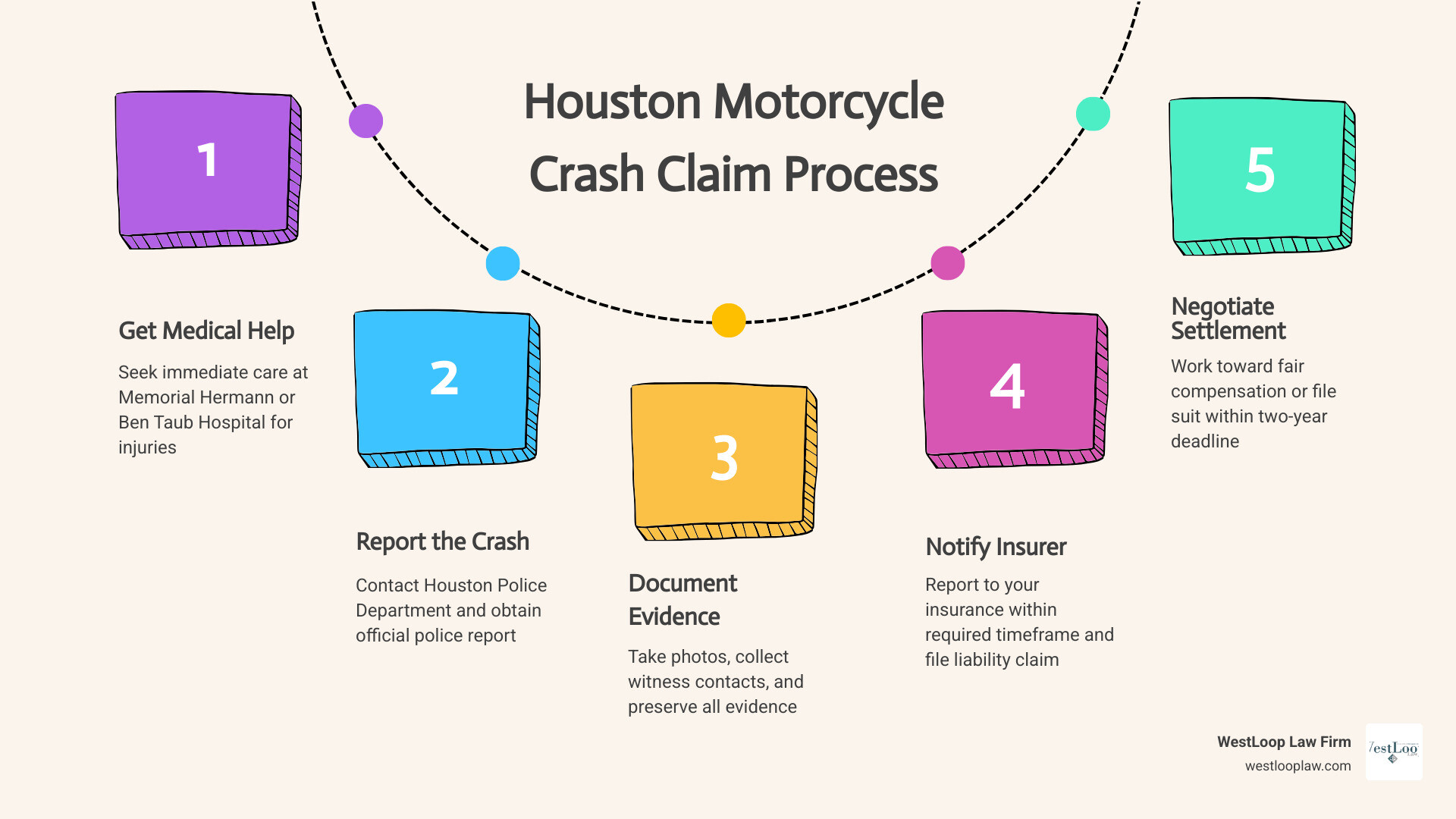
How a Houston Motorcycle Crash Claim Works — At a Glance
- Get medical attention immediately — at Memorial Hermann or Ben Taub Hospital if needed
- Report the crash to Houston Police Department and get the official report
- Document everything — photos, witness contacts, gear damage
- Notify your insurance company within your policy’s required timeframe
- File a liability claim against the at-fault driver’s insurer (Texas is a fault-based state)
- Negotiate a settlement — or file a lawsuit if a fair offer isn’t made
- Know your deadline — Texas gives you two years from the crash date to file a personal injury lawsuit
Motorcycle riders face serious risks every time they ride. Nationally, motorcyclists are roughly 28 times more likely to die in a crash than people riding in passenger cars. In 2023 alone, 6,335 motorcyclists were killed on U.S. roads — the highest number ever recorded.
Houston’s busiest corridors — the I-45, the 610 Loop, and surface roads through heavy urban traffic — are among the most dangerous stretches for riders in Texas.
When a crash happens, the financial pressure hits fast. Medical bills pile up. Income stops. And insurance companies start working to minimize what they pay you.
This guide walks you through every step of the motorcycle crash claim process in Houston — from the scene of the accident to the final settlement.
Motorcycle crash claim vocab explained:
- Most common injury from motorcycle accident
- Motorcyclist personal accident
- Attorney for motorcycle accidents
Immediate Steps to Take After a Houston Motorcycle Accident
The moments following a crash on a busy Houston freeway like I-45 or the 610 Loop are chaotic. However, the actions you take in the minutes and days after a wreck can directly determine the success of your motorcycle crash claim.
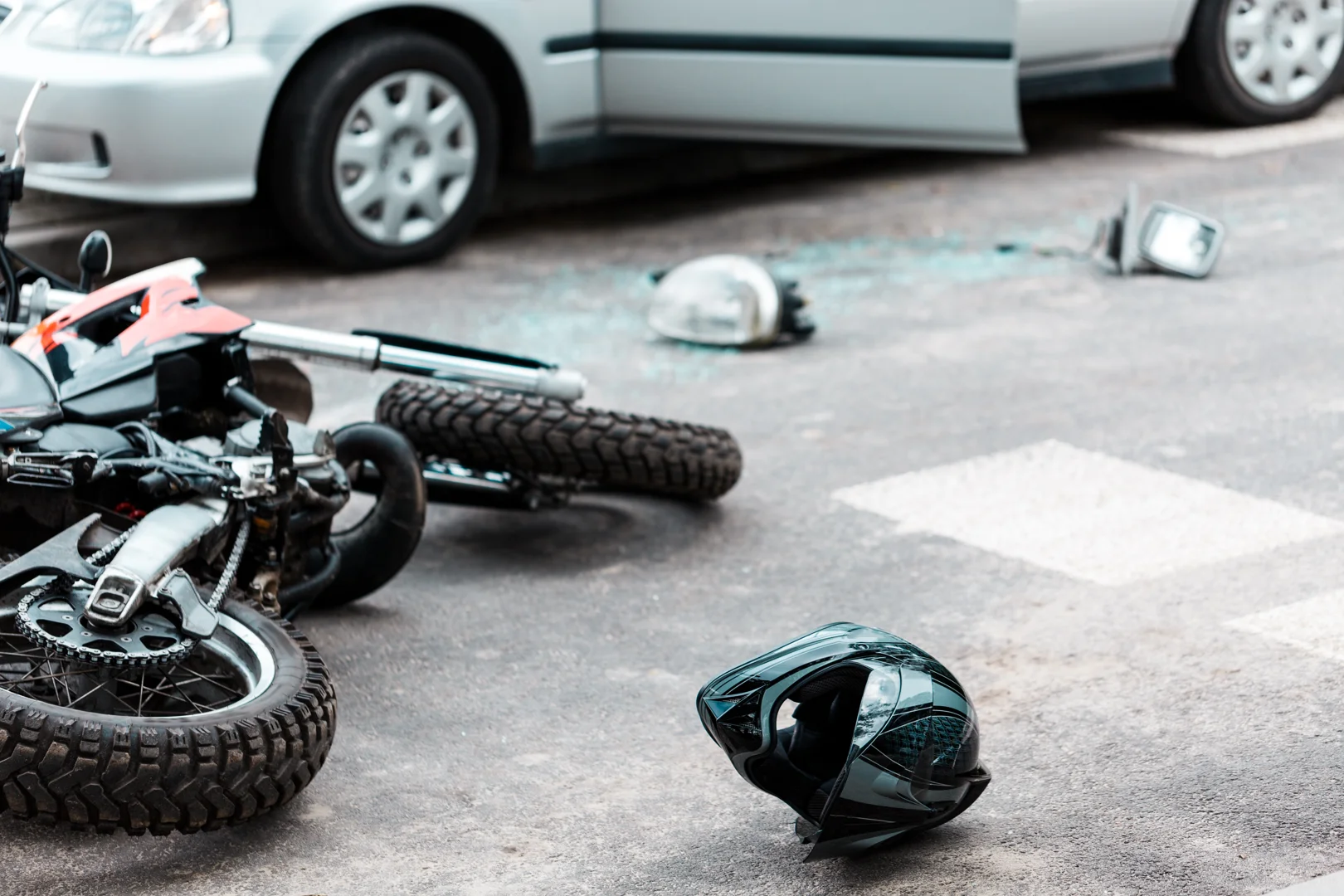
1. Seek Immediate Medical Attention
Your health is the absolute priority. Even if you believe your injuries are minor, you should be evaluated by a medical professional. Adrenaline can mask severe internal injuries, traumatic brain injuries (TBIs), or internal bleeding.
Houston is home to world-class trauma centers, including Memorial Hermann Hospital and Ben Taub Hospital. Getting checked out immediately not only protects your physical well-being but also establishes an official medical record linking your injuries directly to the crash. If you delay medical care, insurance adjusters will inevitably argue that your injuries were either pre-existing or caused by an unrelated event.
2. Contact Law Enforcement
Call 911 so the Houston Police Department or the Harris County Sheriff’s Office can dispatch officers to the scene. An officer will document the crash, interview witnesses, and draft an official police report. This report is a foundational piece of evidence. It often contains the officer’s preliminary assessment of fault and details about traffic violations committed by the other driver.
3. Preserve Crucial Evidence
If you are physically able to do so safely, gather as much evidence at the scene as possible. Take wide-angle and close-up photos of the vehicles, the positioning of your motorcycle, skid marks, road hazards, and your visible injuries. Collect contact information from any eyewitnesses who stopped to help.
Additionally, preserve your physical riding gear. Your helmet, jacket, and gloves can provide physical proof of the impact’s severity. More info on gathering evidence can help you understand how to build an airtight case from day one.
4. What to Avoid: Admitting Fault and Social Media
Never apologize or say things like “I didn’t see you coming either” at the scene. Insurance adjusters will twist polite gestures or casual remarks into admissions of liability.
Furthermore, avoid posting anything about the crash on social media. Do not share photos of your recovery, status updates about the accident, or complaints about the other driver. Insurance defense teams routinely monitor public profiles to find photos or statements they can use to claim your injuries are not as severe as you state.
Understanding Insurance Rules and Your Motorcycle Crash Claim
Insurance laws vary wildly across the United States. To successfully navigate your recovery, it helps to understand how different states structure their insurance systems.
Texas operates under a traditional fault-based (tort) system, which stands in stark contrast to no-fault states like Michigan.
| Insurance Feature | Texas (Fault-Based System) | Michigan (No-Fault System) |
|---|---|---|
| Primary Source of Recovery | The at-fault driver’s liability insurance. | Personal Injury Protection (PIP) benefits. |
| Establishing Fault | Required. You must prove the other driver was negligent to recover compensation. | Not required for medical benefits (PIP), but required to sue for pain and suffering. |
| Motorcycle PIP Coverage | Optional (Medical Payments or PIP can be purchased, but not mandatory). | Motorcycles are generally excluded from standard auto PIP; riders must access other policies. |
| Right to Sue for Pain & Suffering | Unrestricted, provided you are less than 51% at fault. | Restricted; injuries must meet a “serious impairment of body function” threshold. |
| Uninsured Motorist (UM/UIM) | Highly recommended due to high rates of uninsured drivers. | Recommended, but claims systems rely heavily on no-fault structures first. |
In Houston, because we operate under a fault-based system, you must prove the other driver caused the crash to recover damages from their insurance policy. Texas requires drivers to carry a minimum of $30,000 in bodily injury liability coverage per person and $60,000 per accident. However, because motorcycle injuries are often catastrophic, these minimum limits are rarely enough to cover extensive medical bills.
This is why carrying Uninsured/Underinsured Motorist (UM/UIM) coverage is so critical for Texas riders. If an uninsured driver strikes you, or if their policy limits are exhausted, your own UM/UIM policy steps in to cover the remaining damages. Why you shouldn’t ride alone explains how having the right legal and insurance safety nets protects your financial future.
Michigan No-Fault Laws and Motorcycle PIP Benefits
For riders who are moving from or researching different state laws, Michigan’s auto insurance system is famously complex. Unlike Texas, Michigan utilizes a No-Fault system where injured parties typically turn to their own Personal Injury Protection (PIP) coverage for medical expenses, regardless of who caused the crash.
However, under Michigan law, a motorcycle is not defined as a “motor vehicle.” Therefore, motorcyclists are not required to carry standard No-Fault PIP insurance, nor can they purchase it directly for their bikes.
Instead, a motorcyclist in Michigan is only required to purchase minimal liability coverage to protect against damage or injury caused to others. If a rider chooses to ride without a helmet in Michigan, they must carry at least $20,000 in first-party medical benefits.
If a motorcyclist is injured in an accident involving an actual motor vehicle (like a car or truck), the No-Fault system still applies, allowing the rider to receive unlimited medical benefits. These catastrophic medical claims are backed by the Michigan Catastrophic Claims Association (MCCA), which reimburses insurance companies for claims that exceed a specific retention limit (currently $555,000).
How to File a No-Fault Motorcycle Crash Claim
If you ever find yourself dealing with a claim in a No-Fault jurisdiction like Michigan, the process of securing PIP benefits follows a strict “order of priority” established by state law:
- The insurer of the owner of the motor vehicle involved in the accident.
- The insurer of the operator of the motor vehicle involved in the accident.
- The motor vehicle insurer of the motorcycle operator (if they own a separate car with PIP coverage).
- The motor vehicle insurer of the owner of the motorcycle (if different).
- The Michigan Assigned Claims Plan (MACP), which acts as a state-administered safety net if no other coverage exists.
In these systems, an initial PIP claim must be filed within one year of the accident date. Failure to meet this strict deadline completely bars your right to recover medical benefits.
Determining Fault and Damages in a Texas Motorcycle Accident
Back home in Houston, your motorcycle crash claim is decided by Texas comparative negligence rules. Specifically, Texas follows the 51% bar rule (proportionate responsibility).
Under this law, you can recover compensation as long as you are 50% or less at fault for the wreck. However, your final payout will be reduced by your percentage of blame. For example, if a jury determines your total damages are $100,000, but finds you 20% responsible because you were traveling slightly over the speed limit on the 610 Loop, your final recovery will be $80,000. If your fault is found to be 51% or higher, you are completely barred from recovering any compensation.
The Challenge of Rider Bias
Motorcyclists often face a steep uphill battle due to unfair stereotypes. Insurance adjusters and jurors frequently harbor biases, assuming that anyone who rides a motorcycle is inherently reckless, speed-obsessed, or dangerous. This bias is a primary reason why 610 Loop riders get paid less when they attempt to handle claims on their own. Overcoming this bias requires presenting clear, undeniable physical evidence and professional accident reconstruction.
The Texas Statute of Limitations
Do not wait to take action. In Texas, the statute of limitations for filing a personal injury lawsuit after a motorcycle accident is two years from the date of the crash. If you do not settle your claim or file a formal lawsuit before this window closes, you lose your legal right to seek compensation forever.
Recoverable Damages in a Motorcycle Crash Claim
When you file a motorcycle crash claim in Houston, you have the right to pursue compensation for both your financial losses (economic damages) and the personal toll the crash has taken on your life (non-economic damages).
Economic Damages
These represent your direct, out-of-pocket financial losses. They include:
- Medical Bills: Emergency room care, surgeries, physical therapy, prescription medications, and estimated future medical care.
- Lost Income: Money lost while recovering. For severe injuries that limit your career longevity, this includes recovering lost wages and your loss of future earning capacity.
- Property Damage: The cost to repair or replace your motorcycle, riding gear, and helmet.
Non-Economic Damages
These address the intangible, subjective losses that do not come with a receipt:
- Pain and Suffering: Physical discomfort and ongoing chronic pain.
- Emotional Distress: Anxiety, depression, PTSD, and sleep disturbances following a traumatic wreck.
- Loss of Enjoyment of Life: The inability to participate in hobbies, recreational activities, or the simple pleasure of riding.
Diminished Value Claims
Even after a professional shop fully repairs your motorcycle, its market value drops simply because it now has a collision history on its record. You have the right to file a recovering diminished value claim against the at-fault driver’s insurance to recover this loss in resale value.
Frequently Asked Questions About Houston Motorcycle Accidents
How long does it take to settle a motorcycle accident case in Houston?
The timeline to resolve a motorcycle crash claim varies significantly based on the details of the case. A minor injury claim with clear liability might settle within four to nine months.
However, if you suffered severe injuries requiring surgery or extensive rehabilitation, the process will take longer—often 12 to 24 months. It is critical to wait until you reach Maximum Medical Improvement (MMI)—the point where your doctors believe your condition has stabilized—before settling. If you settle too early, you cannot go back and ask for more money if you need additional surgeries later. For a deeper look at this timeline, read our settlement insights.
Do I need a lawyer for a motorcycle accident in Harris County?
Technically, you are not legally required to hire an attorney. However, trying to handle a serious injury claim alone is highly risky. Insurance adjusters are trained to minimize payouts. They may offer you a quick, lowball settlement before you understand the full scope of your medical needs, or they may use your recorded statements to shift the blame onto you.
Studies consistently show that accident victims represented by experienced attorneys recover significantly more than those who go it alone—even after legal fees are paid. Discover the reasons to hire a lawyer to see how legal representation levels the playing field against major insurance corporations.
What if I was partially at fault for my Houston motorcycle crash?
You can still recover compensation as long as your share of the blame does not exceed 50%. Under Texas’s proportionate responsibility laws, your final compensation will be reduced by your percentage of fault.
Because insurance companies aggressively try to shift the blame to riders to reduce their payouts, having dedicated representation is vital to protect your rights. If you are facing arguments that you were speeding, lane splitting, or riding unsafely, getting Harris County legal help is the best way to keep the focus where it belongs: on the negligent driver who hit you.
Conclusion
A serious motorcycle crash can disrupt your life in an instant. Between physical recovery, emotional stress, and financial strain, you should not have to fight insurance companies alone.
At Westloop Law Firm, we provide dedicated legal advocacy for injured riders across Houston and Harris County. We combine deep knowledge of personal injury and probate law, ensuring that if a crash tragically results in a wrongful death, we can seamlessly manage both the injury claim and the probate process for surviving family members.
We work on a contingency fee basis, meaning you pay nothing upfront, and we only get paid if we recover compensation for you. Let us handle the insurance adjusters while you focus on getting back on your feet.
Contact our Houston attorneys today to schedule a free, no-obligation consultation to discuss your case.