 Skip to content
Why You Need a Negligence Lawyer After an Injury
A negligence lawyer represents individuals harmed by someone else’s carelessness. If you’ve been injured in an accident, during medical care, or on another’s property, a lawyer can help you recover compensation for medical bills, lost wages, and pain and suffering.
You should consult a negligence lawyer if:
- You were injured by someone’s careless actions.
- A preventable medical error caused you harm.
- Your injury led to significant financial loss or ongoing pain.
- The at-fault party or their insurer denies responsibility.
- You are unsure about the validity or value of your claim.
Negligence has far-reaching consequences. For example, medical errors are the third leading cause of death in the U.S., and thousands more are affected by car accidents, slip and falls, and workplace incidents each year.
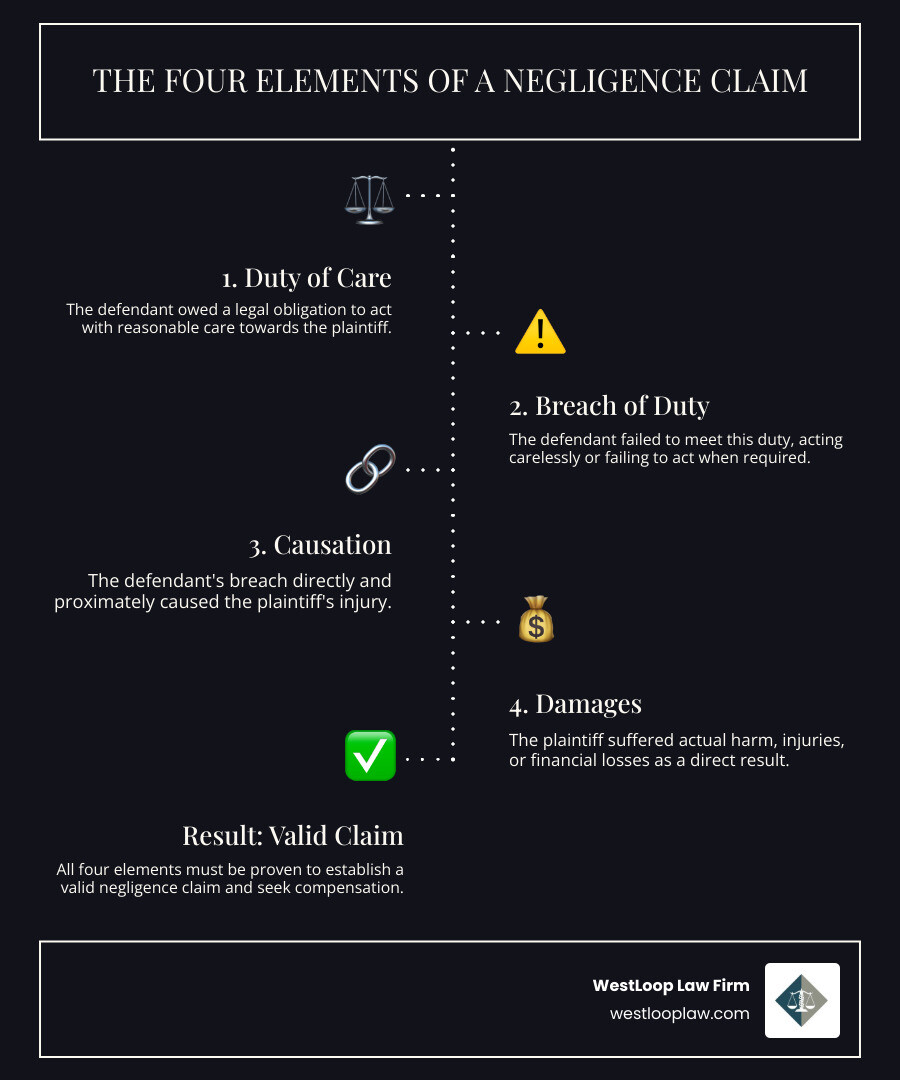
Proving negligence requires demonstrating four elements: a duty of care was owed, that duty was breached, the breach caused your injury, and you suffered actual damages. A negligence lawyer is essential for this process. They investigate the incident, gather evidence, negotiate with insurance companies, and represent you in court if needed. In Texas, you generally have only two years to file a claim, so it’s crucial to act quickly. A skilled lawyer can manage the complexities of your case while you focus on healing.
Understanding Legal Negligence and Your Rights
Negligence is the foundation of most personal injury lawsuits. It is the failure to use the care that a reasonably prudent person would in similar circumstances, resulting in harm to another. Unlike intentional acts, negligence involves carelessness rather than a deliberate intent to cause injury. When proving liability in Houston personal injury cases, we are typically establishing that an individual or entity (a ‘tortfeasor’) committed a civil wrong (‘tort’) that caused harm.
The Four Elements Needed to Prove Negligence
To win a negligence claim, our negligence lawyers must prove four key elements:
- Duty of Care: The defendant had a legal obligation to act with a certain level of care toward you. For example, drivers must operate vehicles safely, and doctors must meet accepted medical standards.
- Breach of Duty: The defendant failed to meet that standard of care. A driver texting and causing a crash or a surgeon leaving an instrument in a patient are clear breaches.
- Causation: The defendant’s breach must have directly caused your injuries. This means the injury would not have happened “but for” the defendant’s act, and the harm was a foreseeable result of their carelessness.
- Damages: You suffered actual harm and losses, such as physical injuries, medical bills, and lost wages. Without demonstrable damages, there is no valid claim.
Who Can Be Held Liable for Negligence?
Identifying the at-fault party can be complex. Our negligence lawyers are skilled at untangling liability.
- Individual Liability: A single person’s careless actions cause harm, like a drunk driver.
- Employer Liability (Respondeat Superior): An employer may be liable for an employee’s negligence if it occurred within the scope of their job.
- Property Owner Liability: Owners must maintain safe premises. They can be liable for injuries from hazards they knew or should have known about.
- Multiple Liable Parties: Often, several parties contribute to an accident. A crash could involve a negligent driver, a faulty auto part, and a poorly maintained road. We identify all potential tortfeasors to maximize your compensation.
Types of Damages and Compensation in a Negligence Claim
After an injury caused by someone’s negligence, the law allows you to seek financial compensation to help restore what you’ve lost. A negligence lawyer works to recover all deserved damages, which fall into two main categories.
Economic damages cover your calculable financial losses. This includes all past and future medical expenses, from hospital stays and surgeries to physical therapy and prescriptions. It also covers lost wages for time missed from work and your loss of future earnings if your ability to work has been permanently affected. Property damage, such as a totaled car, and other out-of-pocket costs are also included.
Non-economic damages compensate for the intangible, quality-of-life losses. Pain and suffering accounts for the physical discomfort you’ve endured and may continue to face. Emotional distress addresses the psychological impact, such as anxiety, depression, or PTSD. You can also be compensated for loss of enjoyment of life if you can no longer participate in hobbies or activities you once loved, as well as for permanent disfigurement or scarring.
In cases of extreme recklessness, Texas law may permit punitive damages. These are intended to punish the wrongdoer and deter similar conduct, rather than to compensate the victim.
For families who have lost a loved one, wrongful death claims can recover costs for funerals, lost financial support, and the mental anguish and loss of companionship. Our Houston wrongful death attorneys handle these sensitive cases with the utmost care.
Calculating the full value of a claim is complex. Insurance companies will try to minimize their payout, often ignoring future costs and non-economic harm. A skilled negligence lawyer documents every loss to fight for compensation that truly reflects the total impact on your life. The damages you can recover depend on the severity of your injuries, their effect on your life and work, and the strength of the evidence.
Medical Malpractice: A Specific Form of Negligence

Medical malpractice is a specific type of negligence that occurs when a healthcare professional’s carelessness causes harm. It happens when a provider deviates from the accepted medical standard of care, breaking the trust placed in them. Not every bad outcome is malpractice, but preventable mistakes that cause injury can be grounds for a legal claim. Shockingly, medical errors are the third leading cause of death in the U.S.
A valid medical malpractice claim requires a doctor-patient relationship, which establishes a legal duty of care. Our negligence lawyers investigate whether the provider’s actions fell below professional standards. Sometimes, hospital liability is also a factor due to staffing errors or flawed policies.
Common Examples of Medical Malpractice
Medical errors can be life-altering. Some common examples include:
- Misdiagnosis or Delayed Diagnosis: Failure to identify a serious condition like cancer or heart disease in a timely manner, preventing crucial treatment.
- Surgical Errors: Operating on the wrong body part, leaving instruments inside a patient, or causing preventable nerve damage.
- Birth Injuries: Negligence during labor and delivery causing conditions like cerebral palsy or Erb’s palsy.
- Anesthesia Errors: Administering the wrong dosage or failing to monitor a patient’s vital signs, which can lead to brain damage or death.
- Medication Errors: Prescribing or administering the wrong drug or dosage, or overlooking dangerous drug interactions.
- Lack of Informed Consent: Failing to inform a patient of the risks of a procedure, leading to a complication the patient would have otherwise avoided.
For more examples of medical malpractice, our team can help determine if your situation qualifies.
Proving a Medical Malpractice Claim
Proving medical malpractice is challenging. It requires more than showing a bad result; we must prove a provider’s negligence caused specific harm. Testimony from qualified professionals is essential. Texas law requires a report from a qualified medical professional who can explain how the standard of care was breached and how that breach caused your injury.
Our approach to proving negligence in Houston medical malpractice cases involves a thorough medical records review to find inconsistencies and errors. We work with these professionals to establish the deviation from the standard of care and link the breach to your injury. Holding negligent providers accountable not only secures compensation for victims but also promotes better patient safety for everyone.
The Role of a Negligence Lawyer in Your Case
When you’re injured by someone’s negligence, an experienced negligence lawyer is your dedicated advocate. Our firm focuses on personal injury law in Houston, and we handle all aspects of your case so you can focus on recovery.
How a Negligence Lawyer Builds Your Case
Building a strong case involves several key steps:
- Free Consultation: We start by discussing your case for free to assess its viability and answer your questions.
- Case Investigation: Our team gathers all evidence, including police reports, photos, and witness statements.
- Collecting Medical Records: We obtain all records and bills to document your injuries and costs.
- Interviewing Witnesses: We locate and interview witnesses who can support your claim.
- Hiring Professional Witnesses: For complex cases, we engage medical, economic, or accident reconstruction professionals.
- Determining Liable Parties: We identify every individual or entity responsible for your injuries.
- Filing the Lawsuit: We formally file a lawsuit against the negligent parties.
- Handling Insurance Company Communications: We manage all negotiations with insurers, protecting you from tactics designed to devalue your claim. We work on a contingency fee basis, so you pay nothing unless we win.
What to Expect from the Legal Process with a Negligence Lawyer
The legal process can be long, but we keep you informed at every stage.
- Negotiation and Settlement: Most personal injury cases are resolved through settlement. According to a 2024 Forbes article, this is true even for most medical malpractice cases. Our goal is to secure a fair settlement without a lengthy trial.
- Litigation and Trial Process: If a fair settlement isn’t possible, we are fully prepared to take your case to court. This process includes findy, depositions, and trial before a judge and jury.
- Client Communication: We believe in clear, consistent communication, explaining legal complexities in plain language and keeping you updated on your case’s progress.
Understanding Fault: How Comparative Negligence Affects Your Claim
Many clients worry they can’t file a claim if they were partly to blame for an accident. In Texas, this isn’t necessarily true, but it can affect your compensation.
Texas follows a modified comparative negligence rule. This legal doctrine acknowledges that multiple parties can share responsibility for an accident. A court will assign a percentage of fault to each party involved. For example, if you were awarded $100,000 in damages but found to be 15% at fault, your compensation would be reduced by 15%, leaving you with $85,000.
The most critical part of this rule is the 51% bar. If you are found to be 51% or more responsible for the accident, you are barred from recovering any damages at all. You must be 50% or less at fault to receive compensation.
Insurance companies use this rule to their advantage, often trying to shift blame onto you to reduce or deny your claim. This is why having an experienced negligence lawyer is so important. Our team at WestLoop Law Firm understands how to counter these tactics by thoroughly investigating your case and accurately presenting the facts. We fight to ensure fault is assigned fairly and to protect your right to full compensation. Don’t assume you have no case if you share some blame; let us provide an honest assessment of how comparative negligence in Houston, TX might affect your claim.
Frequently Asked Questions about Negligence Claims
We’ve helped many Houston residents steer injury claims and have compiled answers to the most common questions.
How much can I sue a hospital or doctor for negligence?
The value of a case is unique to its circumstances. In Texas medical malpractice cases, there are no caps on economic damages, meaning you can recover the full amount of your medical bills and lost income. However, non-economic damages (for pain and suffering) are capped. The final value depends on the severity of your injury, the total financial and non-financial losses, and the strength of your evidence. We can provide a realistic assessment of your claim’s potential worth during a free consultation.
What is the statute of limitations for a negligence claim in Texas?
Timing is critical. In Texas, you generally have two years from the date of your injury to file a lawsuit for most negligence and medical malpractice claims. This deadline is known as the Texas statute of limitations. While there are limited exceptions, missing this deadline will likely bar you from ever recovering compensation. It is safest to contact a negligence lawyer as soon as you suspect you have a case.
What should I do if I suspect I have a negligence case?
Taking the right steps immediately after an injury can protect your right to compensation.
- Get Medical Attention: Your health is the priority. Seeing a doctor creates an essential medical record of your injuries.
- Document Everything: Keep all medical bills, accident reports, and receipts. Take photos of your injuries and the accident scene. Get contact information from any witnesses.
- Keep a Journal: Note your symptoms, pain levels, and how the injury impacts your daily life. This helps demonstrate your non-economic damages later.
- Be Cautious with Insurers: Do not give recorded statements or sign any documents from an insurance adjuster without legal advice. Their goal is to minimize the payout.
- Contact Us: The sooner you get an experienced attorney involved, the better. We offer a free case evaluation to explain your options and start protecting your rights. Understanding why you need a Houston personal injury lawyer on your side is the first step.
Conclusion
When someone’s carelessness causes you harm, the consequences can be devastating, from mounting medical bills to chronic pain and emotional distress. Pursuing a negligence claim is a complex legal process that requires proving a duty of care was breached and directly caused your damages. You should not have to face this challenge alone while trying to heal.
At WestLoop Law Firm, our negligence lawyers have experience in personal injury and medical malpractice law. We understand the nuances of Texas law and the tactics insurance companies use. Our combined experience in personal injury and probate law provides comprehensive support, especially in catastrophic injury or wrongful death cases.
As your dedicated advocate, we will investigate your case, identify all responsible parties, and fight for the full compensation you deserve. We work on a contingency fee basis, so you pay no upfront legal costs.
Time is limited to file a claim in Texas. The sooner we begin, the stronger your case will be.
You don’t have to steer this journey alone. Our team is here to provide the compassionate, skilled representation you need.
Contact our Houston Medical Malpractice Lawyers for a free consultation today to protect your rights and pursue the justice you deserve.