 Skip to content
When Family Disputes Meet Legal Reality
Probate litigation occurs when legal disputes arise during the administration of a deceased person’s estate. These conflicts typically involve challenges to a will’s validity, disagreements over asset distribution, or issues with an executor’s management of the estate.
Quick Answer: What is Probate Litigation?
- Legal disputes that happen during the probate process
- Common issues include will contests, executor misconduct, and beneficiary disagreements
- Court supervision is required to resolve these conflicts
- Most cases settle before going to trial
- Can last years and cost tens of thousands in legal fees
When a loved one passes away, the legal process is expected to be straightforward, but disputes can arise. What starts as grief can quickly turn into family conflict when someone questions the will, believes the executor is mishandling assets, or feels they’ve been unfairly left out.
“Probate disputes can complicate the already emotional process of managing a loved one’s final affairs after their death,” as legal professionals note.
The reality is stark: probate litigation can drain an estate of substantial funds and tear families apart for years. Understanding this process—and knowing your options—can help you steer these difficult waters more effectively.
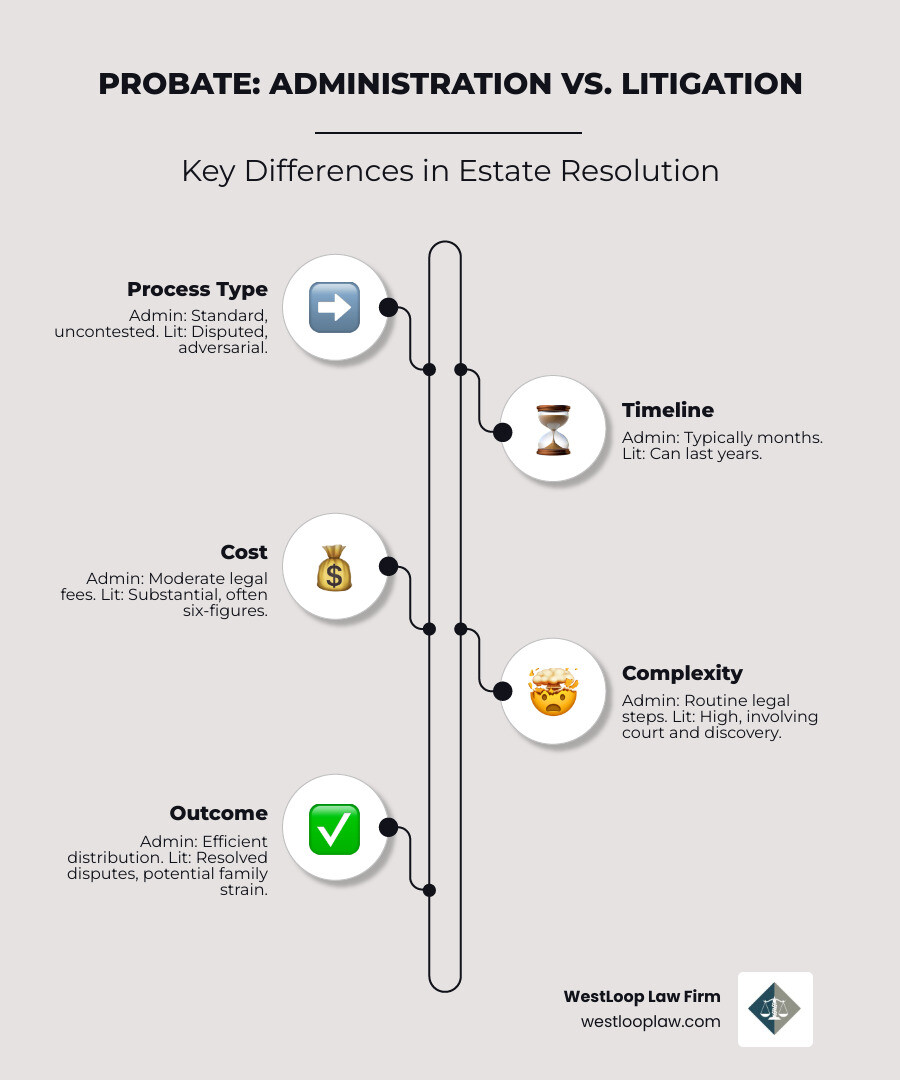
Basic probate litigation vocab:
What is Probate Litigation and Who is Involved?
Imagine a family argument over an inheritance escalating to the point where lawyers get involved. Welcome to probate litigation—the legal battlefield where family disputes meet courtroom reality.
When someone passes away, their estate goes through probate, a court-supervised process to validate the will, pay debts, and distribute assets. Most of the time, this runs smoothly. But when interested parties disagree on how the estate should be handled, probate litigation begins. It is any legal dispute that erupts during the probate process, requiring court intervention to resolve conflicts.

Probate litigation involves court disputes where various parties file complaints to protect their rights. These “interested parties” can include beneficiaries named in the will, heirs who would inherit without a will, creditors seeking payment, and executors managing the estate. For a broader understanding of legal disputes, you can explore What is Litigation?.
The Scope of Conflict: Probate Litigation vs. Estate Litigation
People often use “probate litigation” and “estate litigation” interchangeably, but they are different. Probate litigation is a focused term for disputes that happen during the probate process, such as will contests or executor misconduct allegations.
Estate litigation is a broader term covering conflicts that can happen before, during, or after probate. This includes trust disputes (which often bypass probate), asset ownership disagreements, and guardianship disputes. The key difference is the timing and connection to the court-supervised probate process. For more on trust-related disputes, see More info about Trust Litigation.
The Key Players: Probate Lawyer vs. Probate Litigation Attorney
Just as a family doctor differs from a surgeon, a probate lawyer and a probate litigation attorney have distinct roles.
A probate lawyer is an administrative guide, helping executors steer the paperwork of probate court. They focus on filing documents, gathering assets, paying debts, and distributing property.
A probate litigation attorney is a courtroom advocate who steps in when disputes erupt. Their work involves investigating claims, representing clients in court, and negotiating settlements. You call them when a will is contested or you suspect executor misconduct.
| Feature | Probate Lawyer | Probate Litigation Attorney |
|---|---|---|
| Primary Role | Estate administration guidance | Dispute resolution and advocacy |
| Work Style | Administrative and advisory | Adversarial and investigative |
| Main Tasks | Document filing, asset management, distribution | Lawsuit filing, courtroom representation, settlement negotiation |
| When You Need Them | Smooth estate settlement | Conflicts, challenges, or misconduct allegations |
At WestLoop Law Firm, we are equipped to handle both the administrative side of probate and the complex litigation that can arise. Whether you need steady guidance or fierce advocacy, we’re here to help.
Common Grounds for Contesting a Will and Other Disputes
Probate litigation often erupts from deep-seated family tensions that surface after a death, turning grief into conflict. Most disputes fall into two main categories: challenges to the will itself or problems with how the estate is being managed.

Understanding these common conflicts can help you recognize warning signs early.
Challenging the Will Itself
Sometimes a will doesn’t seem right, leading to a will contest—a formal legal challenge questioning if the will truly reflects the deceased’s wishes. Common grounds include:
-
Lack of testamentary capacity: This means the person making the will lacked the mental ability to understand what they were doing. In Texas, a person must understand they are creating a will, know their property, recognize their family, and comprehend how the will distributes their assets.
-
Undue influence: This occurs when someone pressures or manipulates a vulnerable person into changing their will, overcoming the person’s free will.
-
Fraud and forgery: Fraud involves lying to someone to get them to change their will, while forgery is faking a signature or creating a fake will.
-
Improper execution: This challenges whether the will was created according to legal requirements. Texas law requires most wills to be written, signed, and witnessed by at least two people in the signer’s presence. What makes a will valid in Texas outlines these rules. For more information, see More info about Contesting a Will.
Issues with the Executor or Administrator
Even with a valid will, litigation can arise if the executor (or administrator) mishandles their responsibilities. Executors have a fiduciary duty to the estate, meaning they must put the estate’s interests above their own.
When they fail, beneficiaries may file claims for:
-
Executor misconduct: This can involve using estate money for personal expenses or ignoring responsibilities.
-
Asset mismanagement: An executor might let property deteriorate, fail to collect debts owed to the estate, or make poor investment decisions.
-
Self-dealing: This is using the position for personal gain, such as selling estate property to oneself at a low price or hiring their own business for estate services.
-
Failure to account: Executors must provide regular financial reports. When reports are late, incomplete, or confusing, it raises suspicion.
All these issues fall under breach of fiduciary duty. Texas law holds executors to high standards of honesty and competence, as detailed in the Executor responsibilities under Texas law. While many disputes can be resolved without court, litigation may be the only way to protect the estate when an executor has clearly violated their duties.
Navigating the Contested Probate Litigation Process
When disputes arise, an estate can shift from routine administration to contested probate litigation. This involves a series of structured legal steps designed to resolve the conflict under court supervision.
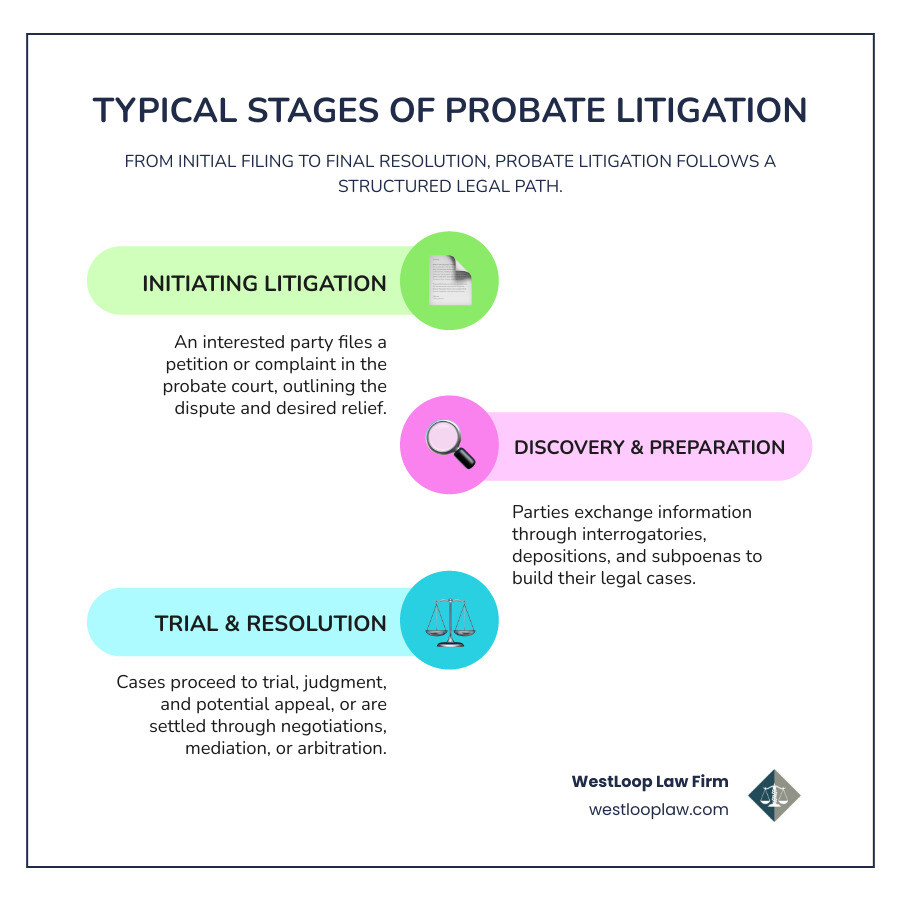
The Stages of a Lawsuit
The journey through probate litigation follows a predictable path:
-
Initiating Litigation: An “interested party” files a petition or complaint with the probate court, outlining the dispute and the relief sought.
-
Findy Process: Lawyers gather evidence through tools like written questions (interrogatories), sworn testimonies (depositions), and formal requests for documents (subpoenas).
-
Pre-Trial Motions: Parties may file motions with the court to compel cooperation, ask for a ruling without a trial (summary judgment), or exclude evidence.
-
Trial: If the case isn’t resolved, it proceeds to trial, where both sides present evidence and arguments to a judge or jury.
-
Judgment and Appeal Process: The court issues a judgment. If a party believes a legal error occurred, they may appeal to a higher court to review the decision.
Finding a Resolution Without a Trial
The vast majority of probate litigation cases never go to trial. Most are resolved through alternative methods to save time, money, and emotional strain.
-
Settlement Negotiations: Parties can engage in direct negotiations at any point to reach a mutually agreeable resolution.
-
Mediation: A neutral third-party mediator facilitates communication to help the parties reach a voluntary settlement. We often recommend Mediation because it can preserve relationships and offer flexible outcomes.
-
Arbitration: A neutral arbitrator hears arguments and makes a binding decision. It is often faster and less formal than a trial.
These methods, known as Alternative Dispute Resolution, offer significant advantages, including lower costs, faster resolution, and privacy. Statistics show that most estate litigation cases settle before trial, as the legal fees often make a trial impractical, especially for smaller estates.
A Closer Look: How State Laws Impact Probate Litigation
While we primarily serve clients in Houston, Texas, it’s helpful to understand that probate litigation laws vary dramatically from state to state. The basic rules are similar, but each state has its own deadlines, requirements, and legal precedents that can shape the entire experience.

Using a state like Illinois as an example illustrates why local knowledge is so critical. State-specific laws can create a different legal landscape than what we have in Texas.
Key Differences Across States
If you are dealing with a contested probate matter, here are some rules that can differ by jurisdiction:
-
Valid Will Requirements: While most states require a will to be written, signed, and witnessed, the specific details can vary. For instance, the number of witnesses or whether they can be beneficiaries might differ.
-
Statute of Limitations: This is one of the strictest rules. States impose a firm deadline for contesting a will after it’s admitted to probate. In some states, this can be as short as a few months. Missing this deadline can bar your claim, no matter how strong it is.
-
No-Contest Clauses: These clauses, which disinherit a beneficiary for challenging the will, are treated differently everywhere. Some states enforce them strictly, while others, like Illinois, may not enforce them if the challenger had a good reason (“probable cause”) for their lawsuit. Compare this to the rules on what makes a will valid in Texas.
The Practical Reality of a Contested Case
Regardless of the state, the practical reality of probate litigation is that very few cases go to trial. The emotional and financial costs are often too high, leading most families to settle. This is especially true for smaller estates, where legal fees can quickly consume the assets in dispute.
Navigating these complex and state-specific rules makes experienced legal representation essential. While you can represent yourself (“pro se”), you are still expected to follow all procedural rules and deadlines. This example shows why having local counsel who understands your jurisdiction—like we provide at WestLoop Law Firm for our Houston clients—is crucial for success.
The Financial Realities: Managing the Cost of Conflict
Probate litigation can be devastatingly expensive. The costs—attorney fees, court filings, and expert witnesses—can quickly eat away at the very estate everyone is fighting over. We’ve seen cases where families spend more on legal battles than the disputed assets were worth.
The emotional toll on family relationships often proves even more costly, turning temporary disagreements into permanent rifts.
Why Litigation is So Expensive
Understanding the sources of these costs can help you make better decisions. The expense comes from several realities of the court system:
-
Information Gathering: Courts require extensive evidence, meaning lawyers spend hours on depositions, document review, and written questions. Each step adds to the bill.
-
Rigid Court Procedures: The legal system moves slowly by design to ensure fairness. This means multiple court appearances and detailed filings, all requiring legal expertise.
-
Lengthy Process: Legal fees for experienced probate litigation attorneys are significant. Complex cases can stretch for years, with costs accumulating monthly.
Effective Techniques to Control Litigation Costs
Despite these challenges, smart strategies can help protect your family’s estate from being consumed by legal fees.
-
Focus on financial stakes, not emotional ones. Litigation is a poor tool for resolving family history or hurt feelings. Keeping your eye on the monetary disputes will streamline the process.
-
Make realistic settlement offers. Being willing to compromise is a sign of strength, not weakness. It protects what matters most and can lead to a faster, more cost-effective resolution.
-
Use mediation whenever possible. Mediation is a less formal, less expensive setting to resolve disputes. Most cases settle before trial, and mediation often provides the framework for those settlements.
-
Limit findy to essential information. An experienced attorney knows how to focus on the most critical evidence without getting lost in costly and unnecessary fishing expeditions.
-
Invest in proactive Estate Planning to prevent disputes. The best way to control litigation costs is to prevent disputes from happening in the first place with clear, well-drafted documents.
At WestLoop Law Firm, we help families steer these challenges while protecting both their financial interests and family relationships. The goal isn’t just to win—it’s to preserve what matters most.
Frequently Asked Questions about Probate Litigation
Probate litigation can feel overwhelming, especially when families are grieving. Here are straight answers to some of the most common questions we receive.
How long does probate litigation take?
There’s no simple answer, as the timeline depends on several factors:
- Case Complexity: An estate with a single bank account will resolve faster than one with multiple businesses and properties.
- Nature of the Dispute: A straightforward capacity challenge may take months, while a complex fraud case could last for years.
- Court Schedules: Heavy caseloads can cause delays.
- Willingness to Settle: Parties who are open to negotiation can resolve disputes much faster than those who are not.
While an uncontested probate might finish in under a year, contested litigation often takes much longer. Patience is essential.
Who can initiate probate litigation?
The law allows any “interested party” to file a claim. This generally means anyone with a direct financial stake in the estate’s outcome. This includes:
- Beneficiaries named in the will.
- Heirs who would inherit if there were no valid will.
- Creditors owed money by the deceased.
- The executor or administrator, who may need to file suit to recover assets or defend the estate.
People who were disinherited or received less than expected may also have standing if they can show a legitimate basis for their claim.
Can a no-contest clause in a will prevent a lawsuit?
A no-contest clause (or in terrorem clause) threatens to disinherit any beneficiary who challenges the will and loses. These clauses are designed to deter frivolous lawsuits.
However, they are not always absolute. Many states will not enforce a no-contest clause if the challenger had “probable cause” or a “good faith” reason for the lawsuit, such as a genuine belief that the will was the product of undue influence or fraud.
Enforcement varies significantly by state. Some jurisdictions enforce these clauses strictly, while others are more protective of challengers with legitimate concerns. Because the stakes are so high, you should never try to interpret a no-contest clause on your own. An experienced probate litigation attorney can evaluate your case and explain the real risks involved. For more information, see our page on will contests.
Conclusion
Dealing with probate litigation is never easy. It can be a long, expensive, and emotionally draining process. However, sometimes these disputes are necessary to protect your rights or to honor a loved one’s true wishes.
As we’ve discussed, litigation can arise from will contests, executor misconduct, or beneficiary disputes. The good news is that most cases are resolved through negotiation or mediation, saving families money and helping to preserve relationships.
Still, the financial reality is that legal fees can be substantial. Focusing on the financial stakes rather than old family grudges is key to achieving a better outcome.
The best defense against probate litigation is a good offense—meaning clear, well-drafted estate planning documents that leave little room for doubt. A clear plan can prevent many disputes from ever starting.
At WestLoop Law Firm, we’ve guided countless Houston families through these challenging waters. Our experience in both probate administration and probate litigation means we can help whether you need to settle an estate smoothly or fight for your rights in court.
If you are questioning a will, concerned about an executor’s actions, or want to create an estate plan that prevents future conflict, we are here to help. With the right guidance, you can protect your interests while preserving what matters most.
Contact a Houston probate lawyer for guidance today to discuss your situation and learn how we can help you steer this complex process with confidence.