 Skip to content
Navigating estate administration in Texas begins with understanding the Texas Estates Code, which replaced the old Texas Probate Code in 2014. The statutory framework provides standard procedures to ensure a decedent’s debts are addressed fairly and their remaining assets transfer lawfully to named beneficiaries or statutory legal heirs. For comprehensive legal guidelines across the state, you can review the General Information – Probate Law – Guides at Texas State Law Library .
In Houston, probate cases are heard in statutory probate courts housed inside the Civil Courthouse at 201 Caroline Street in Downtown Houston. Whether a loved one lived near Memorial Park, worked in the Texas Medical Center, or resided along Interstate 10, their formal estate settlement will generally be handled through these dedicated Harris County courtrooms. Court supervision provides structural protection for family members, beneficiaries, and legitimate creditors alike.
Probate Property vs Nonprobate Property
When evaluating an estate, the first operational step in our Houston probate process guide is separating probate property from nonprobate property. Probate property includes any asset held solely in the deceased person’s name without a valid beneficiary designation or survivorship clause. Common examples include individually owned residential homes, bank accounts without payable-on-death riders, personal vehicles, and business interests. To understand how real property moves through court oversight, examine our guide on real estate in probate.
Nonprobate property passes directly to a surviving co-owner or named party outside of judicial administration. Key categories of nonprobate assets include:
- Life insurance policy payouts with named individuals as designated beneficiaries
- Retirement accounts, such as 401(k) plans and IRAs, featuring valid beneficiary forms
- Bank deposits with Payable-on-Death (POD) or Transfer-on-Death (TOD) setups
- Real property held in joint tenancy with explicit rights of survivorship
- Assets held within a validly created revocable living trust
Attorney Requirements in Harris County Statutory Probate Courts
A common point of confusion for Houston families is whether an executor can handle probate court without legal representation. In Harris County statutory probate courts, judges strictly enforce administrative rules prohibiting non-attorneys from appearing pro se when managing a formal probate estate.
The legal rationale is straightforward: an executor or administrator does not merely represent themselves. Instead, they act as a fiduciary representing the interests of third parties, including estate beneficiaries, heirs, and unpaid creditors. Representing third-party legal interests in court without a valid law license constitutes the unauthorized practice of law under Texas rules. Hiring a qualified Houston probate attorney ensures that all court filings, published notices, and accounting entries comply strictly with Harris County local procedures.
Key Methods and Steps in the Houston Probate Process

Texas offers several distinct probate methods based on whether the decedent left a valid written will, the estate’s debt load, and the overall cooperation of surviving family members. Selecting the correct procedural path avoids unnecessary legal costs and court delays.
Independent Administration and Letters Testamentary
Independent administration is the most effective and efficient form of estate settlement in Texas. When a valid will specifies independent administration—or when all heirs agree to request it—the appointed executor can fulfill their statutory duties with minimal court intervention.
Once the Harris County Probate Court signs the authorizing order and the executor files their formal oath, the clerk issues Letters Testamentary. This official document gives the executor legal standing to manage assets, write checks from estate accounts, settle debts, and transfer property. Financial institutions located across Houston, from Downtown to the Energy Corridor, rely on recently issued Letters Testamentary before providing access to accounts. To read a deep dive on these duties, consult our probate estate attorney complete guide.
When independent administration is not feasible due to active heir disputes or legal challenges, the court orders dependent administration. Under dependent administration, the court directly supervises every single transaction, requiring judicial approval before selling property, paying claims, or distributing assets.
Alternative Probate Methods in Texas
When formal administration is unnecessary, Texas law allows for streamlined alternative options:
- Muniment of Title: Available when a valid written will exists, the estate owes no outstanding debts (other than debt secured by real estate liens), and no ongoing administration is needed. The court admits the will to probate solely to transfer title to real estate and property, bypassing the need to appoint an executor or issue Letters Testamentary.
- Small Estate Affidavit: Used when a person dies without a will (intestate) leaving probate assets below specific statutory limits, excluding the primary homestead and exempt personal property. The affidavit must be signed by all distributed heirs and two disinterested witnesses, then approved by a probate judge.
- Application to Determine Heirship: Required when someone dies intestate and assets cannot be transferred through a Small Estate Affidavit. The judge appoints an Attorney Ad Litem to represent unknown or minor heirs, conducts an evidentiary hearing, and declares the lawful statutory heirs.
| Probate Method | Requires a Valid Will? | Requires Appointed Executor? | Best Suited For |
|---|---|---|---|
| Independent Administration | Yes (or heir consent) | Yes | Estates requiring active management, debt clearing, or asset sales. |
| Dependent Administration | Optional | Yes | High-conflict estates or situations requiring strict court oversight. |
| Muniment of Title | Yes | No | Estates with no unpaid debts where the only goal is transferring real estate or titles. |
| Small Estate Affidavit | No | No | Small intestate estates with limited non-homestead property. |
| Determination of Heirship | No | Yes (often paired with administration) | Intestate estates needing formal judicial declaration of lawful heirs. |
Essential Filings, Fees, and Timelines in Harris County
Probate practice in Houston requires careful attention to statutory timelines and local administrative mandates. Since January 2014, attorneys in Harris County are required to submit all probate pleadings electronically through EFileTexas.gov.
However, an important legal exception applies to original physical wills: while a scanned copy is submitted electronically with the initial petition, the physical original will must be delivered to the Harris County Clerk’s Office at 201 Caroline Street within three business days of the electronic filing. The clerk’s office maintains a low e-filing rejection rate across statutory probate courts, with most rejections stemming from incorrect case captions, missing coversheet details, or administrative deposit errors.
Step-by-Step Houston Probate Process Guide for Estate Executors
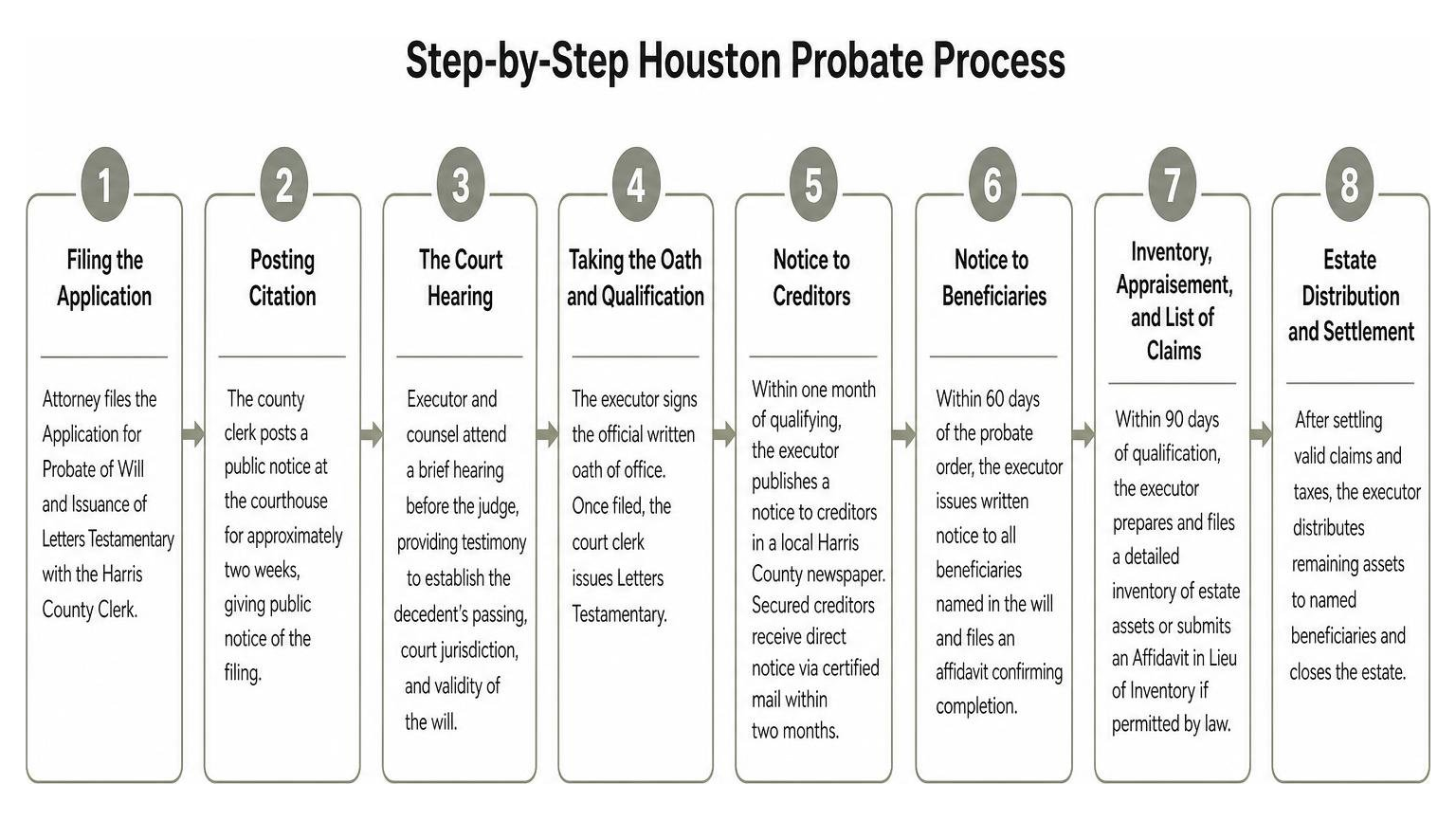
To complete a standard independent probate administration in Houston, executors follow a structured step-by-step sequence:
- Filing the Application: Your attorney files the Application for Probate of Will and Issuance of Letters Testamentary with the Harris County Clerk.
- Posting Citation: The county clerk posts a public notice at the courthouse for approximately two weeks, giving public notice of the filing.
- The Court Hearing: The executor and legal counsel attend a brief hearing before the assigned statutory probate judge, providing testimony to establish the decedent’s passing, court jurisdiction, and the validity of the submitted will.
- Taking the Oath and Qualification: The executor signs the official written oath of office. Once filed, the court clerk officially issues Letters Testamentary.
- Notice to Creditors: Within one month of qualifying, the executor must publish a notice to creditors in a locally distributed Harris County newspaper. Secured creditors holding mortgages or vehicle liens must receive direct notice via certified mail within two months.
- Notice to Beneficiaries: Within 60 days of the probate order, the executor must issue written notice to all beneficiaries named in the will and file an affidavit confirming completion.
- Inventory, Appraisement, and List of Claims: Within 90 days of qualification, the executor prepares and files a detailed inventory of estate probate assets or submits an Affidavit in Lieu of Inventory if permitted by law.
- Estate Distribution and Settlement: After settling valid claims and taxes, the executor distributes remaining assets to named beneficiaries and closes the estate.
When conflicts arise over will validity, breach of fiduciary duty, or heir rights, our probate litigation attorney team steps in to protect beneficiary interests in court.
Harris County Filing Fees and Court Costs Breakdown
Initiating a new probate action requires paying statutory court filing fees to the Harris County Clerk. These mandatory costs cover docketing, citation posting, and state electronic filing fees. Additionally, cases involving heirship determinations or court-ordered guardianships require an upfront Attorney Ad Litem deposit to cover independent counsel fees appointed by the court.
When requesting certified copies of Letters Testamentary or court orders, the clerk assesses standard per-page copying and certification fees. Filers who pay court fees electronically using major credit cards without being present at the clerk’s counter incur a standard payment processing surcharge.
Guardianship Proceedings and Alternatives in Harris County
Guardianship is a legal process where a statutory probate court grants an individual legal authority to make decisions for an incapacitated adult or a minor child. Because guardianship removes basic constitutional rights, Texas law treats it as a remedy of last resort. Detailed court guidelines can be reviewed in the official PROBATE COURTS handbook.
Duties of Guardian of Estate vs Guardian of Person
Harris County Statutory Probate Courts Nos. 1 through 5 divide guardianship responsibilities into two distinct legal roles:
- Guardian of the Person: Responsible for the ward’s physical care, living arrangement, medical treatments, and daily welfare. They must submit an Annual Report detailing the ward’s health, living conditions, and care activities.
- Guardian of the Estate: Responsible for protecting and managing the ward’s financial assets. They must post a corporate fiduciary bond within 20 days of court appointment and file an Inventory, Appraisement, and List of Claims within 30 days of qualifying.
The Guardian of the Estate faces strict ongoing accountability:
- Estate liquid funds must be held in accounts insured by the FDIC or NCUA, keeping deposits under the maximum insured limit per financial institution.
- An Annual Account must be filed every year within 60 days following the anniversary of qualification, detailing every dollar received, spent, or invested.
- Letters of Guardianship expire annually (specifically 1 year plus 120 days after issuance) and are renewed only after the judge approves the required annual account or report.
If you suspect financial mismanagement or wish to contest an improper application, consulting an estate litigation lawyer in Texas is essential.
Lesser Restrictive Alternatives to Texas Guardianships
Before establishing a formal guardianship, Texas judges require proof that less restrictive alternatives were considered and deemed insufficient. Common legal alternatives include:
- Durable Financial Powers of Attorney
- Medical Powers of Attorney and Directive to Physicians
- Revocable Living Trusts, designed using tailored Houston estate planning trust structures
- Joint bank account setups or representative payee arrangements
- Formal community supports and adult protective services
Working with an experienced estate planning lawyer Houston TX allows families to establish these proactive documents well before cognitive decline or illness occurs, eliminating the need for invasive courtroom proceedings.
Frequently Asked Questions About Houston Probate
How Long Do You Have to Probate a Will in Harris County?
In Texas, an Application to Probate a Will must generally be filed within four years of the decedent’s date of death. If four years pass without probate filing, the will becomes unenforceable, and the estate is treated under statutory intestate laws as if no will ever existed. In limited situations, an applicant can probate a late will solely as a Muniment of Title if they prove to the judge that they were not at fault for missing the deadline.
What Is Included in the Houston Probate Process Guide for Uncontested Estates?
An uncontested estate proceeding follows a streamlined path:
- Filing the original will and probate application.
- Waiting out the public citation posting period.
- Attending a single uncontested hearing at 201 Caroline Street.
- Securing Letters Testamentary and publishing notices to creditors.
- Filing the required asset inventory or statutory affidavit.
- Distributing estate assets to beneficiaries.
If you are looking for an estate and trust attorney near me in the Greater Houston region, working with our firm simplifies every procedural step.
How Do I Obtain Letters Testamentary in Houston?
You cannot obtain Letters Testamentary simply by presenting a signed will to a bank. Letters Testamentary are legal certificates issued solely by the Harris County Clerk after a statutory probate judge hears testimony, approves the application, signs an order admitting the will to probate, and receives the executor’s signed oath. Banks across Houston typically require Letters Testamentary issued or certified within the preceding 60 days before releasing financial accounts.
Strategic Guidance for Your Houston Estate Matters
At WestLoop Law Firm, we guide executors, trustees, and family members through every phase of estate administration, probate hearings, and guardianship filings in Harris County. Whether you need help probating a loved one’s will, managing court deadlines along Loop 610, or setting up a comprehensive estate planning Houston strategy to protect your legacy, our team provides clear legal counsel focused on your family’s peace of mind.
From simple estates near the Galleria to complex contested matters expanding into surrounding communities, such as The Woodlands Probate Family Law When Estate challenges arise, we stand ready to assist. Visit our Houston Estate Planning Law resources today to schedule a consultation and secure your legal representation.