 Skip to content
Houston defective product lawyer: 3 Essential Steps
When Everyday Products Turn Dangerous: Your Rights in Houston
A Houston defective product lawyer helps consumers injured by dangerous products hold manufacturers, distributors, and retailers accountable. Under Texas’s strict liability standards, you can pursue compensation for medical bills, lost wages, and pain and suffering, even if the company wasn’t negligent. This means manufacturers are responsible for injuries their defective products cause.
What a Houston defective product lawyer can do for you:
- Investigate your case – Gather evidence, consult engineers and medical professionals, and determine which type of defect caused your injury
- Identify liable parties – Hold manufacturers, wholesalers, retailers, and component makers responsible
- Handle corporate legal teams – Steer complex litigation against well-funded defendants
- Maximize your compensation – Recover medical expenses, lost income, pain and suffering, and potentially punitive damages
- Work on contingency – No upfront costs; you only pay if you win your case
Every year, close to 40 million Americans suffer injuries related to consumer products, and more than 35,000 people die. In Houston, defective automotive parts, dangerous pharmaceuticals, faulty medical devices, and unsafe household products injure thousands of residents who trusted these items to be safe.
Whether you were hurt by a defective tire on I-10, a dangerous drug prescribed by your doctor, or a malfunctioning household appliance in your home, Texas law gives you the right to seek justice. The challenge is proving your case against corporations with deep pockets and aggressive legal teams.
That’s where legal representation becomes critical. Product liability cases involve complex investigations, testimony from qualified professionals, and detailed knowledge of manufacturing processes. You need an advocate who understands how to build a strong case and fight for fair compensation.
Learn more about Houston defective product lawyer:
Understanding Product Liability Law in Texas
Product liability law holds manufacturers, distributors, and retailers responsible for injuries their products cause. It’s built on the principle that consumers expect products to be safe when used as intended. When a dangerous product breaks that trust, the law provides a way for injured people to seek justice and compensation.
The product’s journey to you is called the “chain of distribution.” Every entity in this chain, from the designer to the retailer, has a responsibility to ensure the product’s safety. If a defect causes injury, any party in the chain can potentially be held responsible.
Texas law strongly protects consumers. Under Chapter 82 of the Texas Civil Practice and Remedies Code, our state recognizes three primary types of defects for liability claims, ensuring responsible parties are held accountable for injuries caused by product flaws, regardless of intent.
Strict liability is a cornerstone of Texas product liability. It means a manufacturer or seller can be liable for injuries from a defective product even if they weren’t negligent. We only need to prove the product was defective and that the defect caused your injury. This principle encourages manufacturers to make safe products, holding them liable for harm during foreseeable use if the product was unaltered.
Who Can Be Held Responsible for a Defective Product?
When a defective product causes harm, pinpointing who is at fault can be complex. However, product liability law allows us to hold various parties accountable throughout the product’s journey from concept to consumer. These typically include:
- Manufacturers: This is often the primary target. The actual company that designed and produced the product, or even just a component part, can be held liable. This includes the company that assembled the final product.
- Wholesalers/Distributors: These are the intermediaries who get the product from the manufacturer to the retailer. If they were aware of a defect or played a role in the defect occurring (e.g., improper storage leading to damage), they could be held responsible.
- Retailers: The store where you purchased the product can also be held liable. Even if they didn’t create the defect, they are part of the chain that made the dangerous product available to you.
- Component Part Makers: Many products are made up of parts from different companies. If a specific component (like a faulty brake system in a car or a defective battery in a medical device) is the source of the defect, the manufacturer of that component can be held responsible.
- Assembling Manufacturers: In cases where one company manufactures parts and another assembles them into a final product, the assembling company can be liable if the defect arises during the assembly process.
Our goal as your Houston defective product lawyer is to identify every potentially liable party to ensure you receive the full compensation you deserve.
Key Elements of a Successful Claim
To pursue a successful product liability claim in Houston, we typically need to establish a few key elements:
- Proving the product was defective: We must show the product had a design, manufacturing, or marketing defect that made it unreasonably dangerous. This often requires detailed investigation, sometimes involving engineers or other qualified professionals.
- Showing the defect caused your injury: We must establish a direct link (causation) between the product’s defect and your harm. For example, we would connect a defective tire blowout to your crash injuries.
- Documenting your damages: We need comprehensive evidence of the losses you incurred due to the injury. This includes all medical records from local medical facilities, as well as lost wage statements, receipts for out-of-pocket expenses, and documentation of pain and suffering.
The Three Main Types of Product Defects
Defects can emerge at any stage, causing serious injuries. Common products in liability claims include automotive parts (like airbags and brake systems), medical devices (such as hip implants), household appliances (like pressure cookers), children’s toys, and power tools. For example, power tool accidents injure nearly a million people annually, causing 200 deaths and showing the widespread risk.

Design Defects: Flaws in the Blueprint
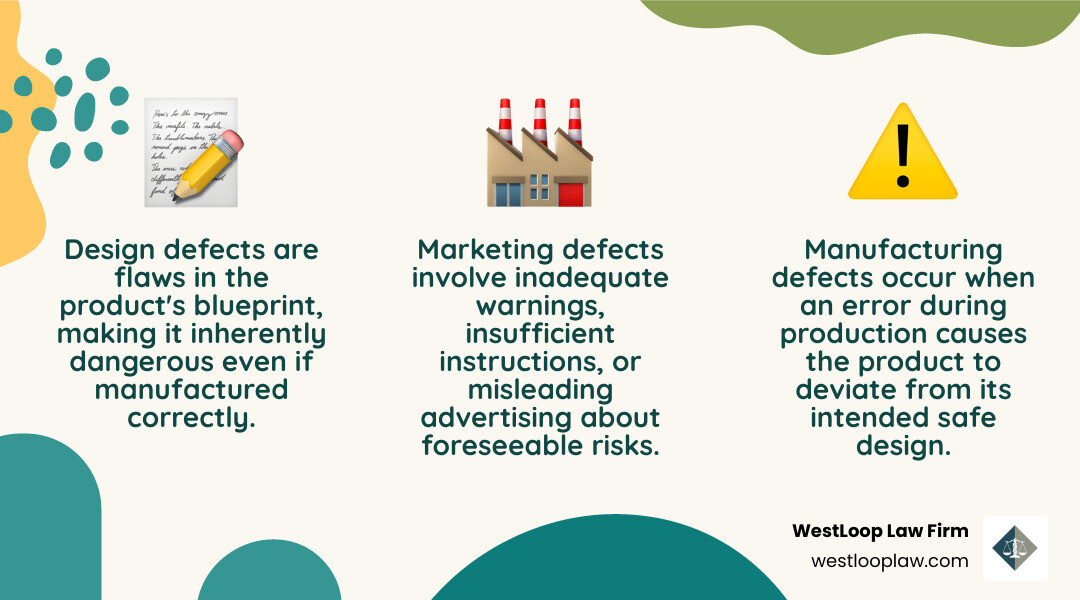
A design defect occurs when a product is inherently dangerous due to a flaw in its original blueprint, even if it was manufactured perfectly. In such cases, the entire product line is dangerous. To prove a design defect in Texas, we must show that:
- The product’s design made it unreasonably dangerous.
- The defect caused your injury.
- There was a safer alternative design that was economically and technologically feasible at the time the product was manufactured.
Examples include unstable vehicle designs that make SUVs prone to rollovers, machinery lacking essential safety guards, or products made with flammable materials when safer alternatives existed. The Roundup weedkiller, which contains a chemical known to cause cancer, is a significant example of a design defect.
Manufacturing Defects: Errors on the Assembly Line
Manufacturing defects happen when a product deviates from its intended design during the production process, making it dangerous. This means the design itself might be safe, but an error during manufacturing made a specific product, or a batch of products, unsafe.
Think of pharmaceutical drugs contaminated during production, electronic devices wired incorrectly, or a ladder produced with smaller screws than specified, compromising its safety. The error could be unique to a single item or affect an entire batch if the manufacturing process itself was flawed. Proving a manufacturing defect often involves intricate investigations into the production line and quality control measures.
Marketing Defects: Failure to Warn
Marketing defects, also known as “failure to warn” defects, occur when a product is dangerous because of inadequate instructions or insufficient warnings about its potential hazards. Manufacturers have a legal duty to warn consumers of potential risks if they foresee reasonable uses of their products can cause danger.
This includes:
- Inadequate instructions: The product’s directions are unclear or incomplete, leading to misuse and injury.
- Insufficient warnings: The product lacks clear labels about potential dangers, such as choking hazards for children’s toys, severe side effects of medication, or the extreme temperatures of hot beverages.
- Foreseeable risks of misuse: Manufacturers must warn against reasonably foreseeable misuses of their products, not just intended uses.
- Lack of allergy information: Food products failing to disclose common allergens.
- Misleading advertising: Marketing that creates a false sense of security about a product’s safety.
Data from the U.S. Consumer Product Safety Commission (CPSC) underscores the importance of clear warnings. While the CPSC notes injuries are often “related to” products, inadequate warnings can establish a direct cause. We use data from agencies like the U.S. Consumer Product Safety Commission to support these claims.
Navigating Your Houston Defective Product Claim

Navigating a defective product claim in Houston is complex, but you don’t have to do it alone. With a Houston defective product lawyer, we will guide you through every step, from gathering evidence to meeting legal deadlines, to fight for the full damages you deserve.
Understanding the Texas Statute of Limitations
The statute of limitations is a critical deadline for filing a lawsuit. In Texas, you generally have two years from the date of injury for a defective product claim. Missing this deadline means you could lose your right to seek compensation.
However, product liability cases can have additional complexities. Texas also has a 15-year statute of repose for product liability claims, meaning a claim generally cannot be brought more than 15 years after the product was first sold. There are exceptions, particularly if the manufacturer offered a written warranty for a longer period, which would extend the deadline to match the warranty.
Furthermore, Texas law includes a “discovery rule.” This exception can extend the statute of limitations if your injury or its cause was not immediately apparent. For instance, if you developed an illness years later from a defective medical device, the two-year clock might start when you discovered the connection between the product and your illness, not from the date of implantation.
Given these nuances, acting quickly is paramount. Consulting a Houston defective product lawyer as soon as possible after an injury is essential to ensure all deadlines are met and your rights are protected.
What Damages Can You Recover?
When a defective product causes you harm, you may be entitled to recover a wide range of damages. Our goal is to ensure you receive full and fair compensation for all your losses, both economic and non-economic. These can include:
- Medical Expenses: This covers all past and future medical costs related to your injury, including emergency room visits, hospital stays, surgeries, doctor appointments, prescription medications, physical therapy, rehabilitation, and assistive devices.
- Lost Wages: If your injury prevented you from working, you can seek compensation for the income you’ve already lost.
- Loss of Earning Capacity: If your injury permanently affects your ability to work or earn at the same level as before, we can pursue damages for your diminished future earning potential.
- Pain and Suffering: This compensates you for the physical pain and discomfort caused by your injury.
- Mental Anguish: This covers the emotional distress, anxiety, depression, and psychological impact the injury has had on your life.
- Property Damage: If the defective product also damaged your personal property (e.g., a defective appliance causing a fire that damaged your home), these costs can also be recovered.
- Punitive Damages: In cases where a manufacturer’s conduct was particularly egregious, reckless, or malicious, Texas courts may award punitive damages. These are not intended to compensate you for losses but to punish the wrongdoer and deter similar conduct in the future.
Express vs. Implied Warranties
Warranties play a significant role in product liability, providing consumers with certain guarantees about the products they purchase. There are two main types:
| Feature | Express Warranty | Implied Warranty |
|---|---|---|
| Definition | A specific, explicit promise made by the seller or manufacturer about the product’s quality, condition, or performance. | An unspoken, unwritten guarantee imposed by law, ensuring a product meets certain minimum standards. |
| How it’s Made | Can be written (e.g., product manual, advertising), verbal (e.g., salesperson’s promise), or demonstrated (e.g., sample or model). | Automatically applies to most sales of goods unless specifically disclaimed (though disclaimers have legal limits). |
| Key Types | – Promise about product quality or performance. | – Implied Warranty of Merchantability: Guarantees the product is fit for its ordinary purpose and is of acceptable quality for similar goods. |
| – Description of the goods. | – Implied Warranty of Fitness for a Particular Purpose: Applies when the buyer relies on the seller’s skill or judgment to select goods suitable for a specific purpose, and the seller knows of this reliance and the particular purpose. The goods must then be fit for that purpose. | |
| Example | “This blender comes with a 5-year warranty against motor failure.” or “This car gets 30 MPG city.” | A new toaster should, without explicit promise, be able to toast bread safely and effectively. |
Breach of warranty can be a basis for a product liability claim, especially when a product fails to meet these promised or implied standards and causes injury.
Why You Need an Experienced Houston Defective product lawyer
Seeking justice after an injury from a defective product is challenging. You will face large corporations and their insurance companies, whose goal is to minimize your compensation. A dedicated Houston defective product lawyer is essential to level the playing field.
Product liability litigation is complex, requiring knowledge of legal procedures and manufacturing. Opposing attorneys for manufacturers and retailers will use aggressive tactics to protect their clients. Without strong legal representation, you risk being undervalued. We understand these tactics and are prepared to counter them.
How a Lawyer Investigates Your Case
A thorough investigation is the bedrock of any strong product liability claim. Our approach involves several critical steps:
- Gathering Evidence: This includes securing the defective product itself (crucial for analysis), preserving its packaging, collecting all medical records, police reports, eyewitness statements, and any other documentation related to your injury and the product’s use.
- Hiring Engineers and Medical Professionals: We frequently collaborate with independent engineers, product designers, accident reconstructionists, and qualified medical professionals. These individuals can analyze the product for defects, determine how the defect caused your injury, and provide testimony on the extent of your harm and prognosis. For instance, an engineer might identify a design flaw in a vehicle’s steering mechanism, or a medical professional might link a specific drug to an adverse health outcome.
- Accident Reconstruction: In cases involving accidents, such as those caused by defective automotive parts, accident reconstructionists can recreate the incident to demonstrate how the product’s defect led to the crash and your injuries.
- Deposing Witnesses: We interview and depose individuals who have relevant information, including company employees, designers, quality control personnel, and other witnesses to your injury.
- Analyzing Product Design and Manufacturing Process: This often involves scrutinizing technical specifications, safety testing reports, internal memos, and manufacturing records to uncover where the defect originated and whether the company was aware of potential dangers.
This meticulous approach ensures we build the strongest possible case, leaving no stone unturned in our pursuit of justice for you.
The Role of Product Recalls in Your Claim
Product recalls, issued by government agencies like the Food & Drug Administration (FDA) and CPSC or voluntarily by companies, are a key safeguard against dangerous products.
While a recall doesn’t automatically mean you have a successful product liability case, it can be powerful evidence. A recall indicates that the manufacturer or a regulatory body has acknowledged a defect or safety concern with the product. As your Houston defective product lawyer, we can use recall information to:
- Demonstrate a known defect: A recall notice serves as official recognition that the product was indeed flawed or dangerous.
- Establish manufacturer knowledge: It can suggest that the manufacturer was aware of the problem, potentially strengthening claims of negligence or failure to warn.
- Support causation: If your injury aligns with the reason for the recall, it helps link the product’s defect to your harm.
A recall is not required to file a claim. Many dangerous products cause injuries before a recall is ever issued, or a defect might be specific to your product without affecting the entire line. We investigate each case independently, using recall information when available, but always prepared to prove a defect even without one.
Class Action vs. Mass Tort Lawsuits
When a single defective product harms many people, the legal system provides mechanisms to handle these numerous claims efficiently. The two primary types are class action lawsuits and mass tort cases, and understanding the difference is key:
-
Class Action Lawsuits:
- One Lawsuit, Many Plaintiffs: A single lawsuit is filed on behalf of a large group of people (the “class”) who have suffered similar injuries from the same product.
- Commonality: All members of the class typically share common questions of law and fact, meaning their injuries and the cause of those injuries are very similar.
- Shared Outcome: The lawsuit proceeds as one, and any settlement or verdict is usually divided among the class members, often equally or based on a predetermined formula. Individual damages are often less specific.
- Opt-Out: Class members usually have the option to “opt out” and pursue their own individual lawsuit if they wish.
-
Mass Tort Cases:
- Many Individual Lawsuits: Unlike a class action, a mass tort involves many individual lawsuits filed by different plaintiffs against the same defendant(s) for injuries caused by the same product.
- Individualized Damages: While the product and the defendant are the same, the injuries, damages, and specific circumstances of each plaintiff can vary significantly. Each plaintiff’s case is treated individually for compensation purposes.
- Consolidated for Efficiency: These individual cases are often consolidated for pre-trial proceedings (discovery, motions) in a process called Multidistrict Litigation (MDL) to streamline the legal process, but they retain their individual identity for trial or settlement.
- Greater Control: Plaintiffs in mass torts typically retain more control over their individual cases and settlement decisions.
For products with widespread harm, such as dangerous drugs or medical devices, our Houston defective product lawyer team can assess whether your case might fit into a mass tort or if an individual lawsuit is more appropriate, always aiming for the best outcome for your unique situation.
Frequently Asked Questions about Houston Product Liability Cases
What is the first thing I should do if I’m injured by a defective product?
First and foremost, seek immediate medical attention. Then, preserve the product and its packaging without altering them—this is crucial evidence. Take photos and videos of the product, your injuries, and the scene. Write down what happened. Finally, do not speak to the manufacturer’s insurance company before consulting a Houston defective product lawyer, as they do not have your best interests in mind.
How much does it cost to hire a lawyer for my case?
We handle product liability cases on a contingency fee basis. This means you pay no upfront costs. Our fee is a percentage of the compensation we recover for you. If we don’t win your case, you pay nothing. This allows you to pursue justice without financial stress.
Can I still have a case if the product was a gift or I bought it secondhand?
Yes. In Texas, you don’t have to be the original purchaser to file a claim. ‘Privity of contract’ does not apply to most product liability cases. Anyone foreseeably injured by a defective product can file a claim, including recipients of gifts, secondhand buyers, or even bystanders. The focus is on the defective product and the injury it caused.
Holding Negligent Companies Accountable
Companies have a responsibility to ensure their products are safe. When a defective product in Houston betrays that trust, the consequences can be devastating, causing life-altering injuries and financial hardship.
Taking legal action is about more than compensation; it’s about holding companies accountable. Your case can help prevent future injuries by prompting manufacturers to improve safety. It’s a powerful way to advocate for consumer safety in our Houston community.
Our team at WestLoop Law Firm is dedicated to helping individuals and families in Houston steer the complexities of product liability law. We are committed to carefully investigating your claim, building a compelling case, and fighting vigorously on your behalf. We understand the physical, emotional, and financial toll a defective product injury can take, and we are here to offer the legal guidance and support you need.
If you or a loved one has been injured by a dangerous or defective product, don’t hesitate to explore your legal options. Contact us today for a free consultation to discuss your specific situation and understand how we can help you pursue the justice and compensation you deserve.