 Skip to content
Houston drunk driving accident attorney: 1st Step to Justice
The Sobering Reality of Drunk Driving in Houston
A houston drunk driving accident attorney helps victims pursue compensation from impaired drivers and potentially liable third parties like bars or social hosts. If you’ve been injured by a drunk driver in Houston, here’s what you need to know:
What a Houston Drunk Driving Accident Attorney Does:
- Investigates the crash and gathers evidence of intoxication
- Identifies all liable parties (driver, bars, employers, social hosts)
- Negotiates with insurance companies for maximum compensation
- Files lawsuits within Texas’s two-year statute of limitations
- Pursues both economic damages (medical bills, lost wages) and non-economic damages (pain and suffering)
- Works on a contingency fee basis (no upfront costs, only paid if you win)
Drunk driving remains a devastating problem across Texas, and Houston sits at the center of this crisis. The numbers are staggering and heartbreaking.
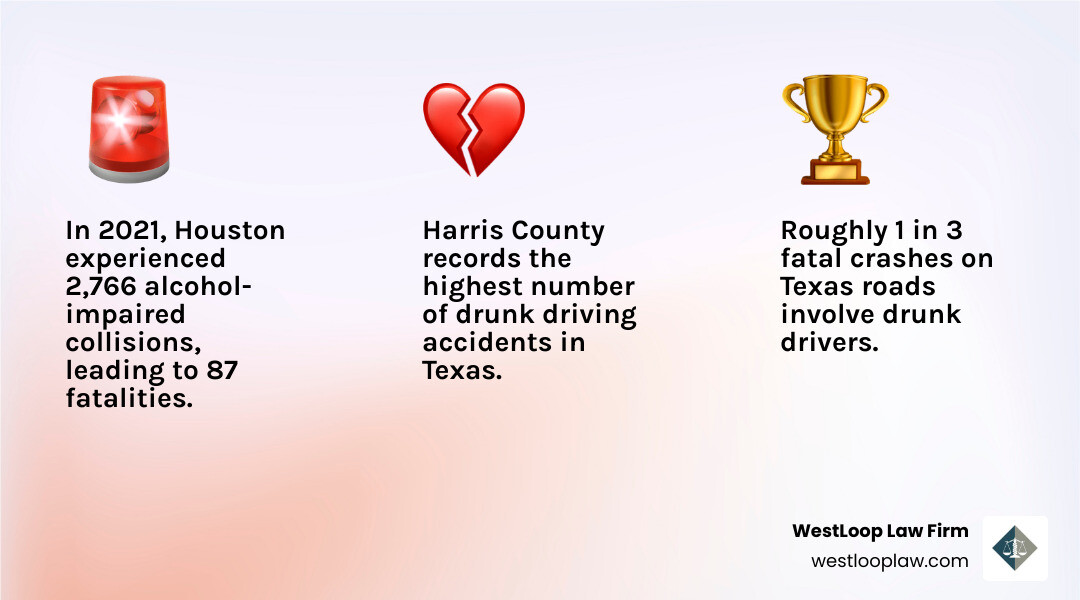
In 2021 alone, there were 2,766 alcohol-impaired collisions in Houston. These weren’t just statistics on a report—they were real crashes that killed 87 people, seriously injured 176 others, and left 477 with minor injuries.
Nearly 185 crashes happen every single day in Houston. Drunk drivers are involved in roughly one out of every three fatal crashes on Texas roads. That means every time you drive through the Galleria area, along I-45, or through the neighborhoods near Memorial Hermann Hospital, you’re sharing the road with potential drunk drivers.
Harris County has the highest number of drunk driving accidents in the entire state. Statewide, over 18,400 alcohol-impaired collisions occurred in 2021, killing 579 people. In 2020, drunk driving accidents represented 25% of all car wreck fatalities in Texas—958 lives lost.
If a drunk driver hit you or someone you love, you’re facing more than just physical injuries. Medical bills pile up fast. Lost wages from missing work add financial stress. Pain, anxiety, and trauma don’t show up on X-rays but hurt just as much.
You have rights. Texas law allows you to pursue compensation from the drunk driver and potentially from bars that over-served them or hosts who provided alcohol to minors. But the legal process is complex, and insurance companies will try to minimize what they pay you.
The two-year statute of limitations in Texas means time matters. Evidence disappears. Witnesses forget details. Security footage gets deleted.
Quick houston drunk driving accident attorney definitions:
First Steps After a Houston Drunk Driving Collision
Being involved in any car accident is terrifying, but finding the other driver is intoxicated adds another layer of shock and anger. Your immediate actions are crucial, not just for your safety, but also for any future legal claim.

Here’s what you should do:
-
Call 911 Immediately: This is non-negotiable. Don’t hesitate. Call the police and report the accident. It’s essential to get law enforcement to the scene for several reasons:
- Medical Assistance: If you or anyone else is injured, paramedics can be dispatched.
- Official Police Report: An officer will create an official report, documenting the crash details, witness statements, and, crucially, their observations of the other driver. This report will be a vital piece of evidence.
- Initiate Criminal Case: If the officer suspects intoxication, they can perform the Houston Police Department’s Standardized Field Sobriety Testing and potentially arrest the drunk driver. The criminal case is separate from your civil claim but can provide powerful evidence.
-
Seek Immediate Medical Attention: Even if you feel “fine” or only have minor aches, get checked out by a doctor or go to the nearest emergency room. Some severe injuries, like whiplash or concussions, might not show symptoms until hours or days later. Delaying medical care can not only harm your health but also give insurance companies an excuse to question the severity or cause of your injuries. Your medical records are critical evidence for your claim.
-
Document the Scene (Safely!): If it’s safe to do so, use your phone to take pictures and videos.
- Vehicle Damage: Capture all angles of damage to both vehicles.
- Injuries: Photograph any visible injuries you or your passengers sustained.
- Road Conditions: Show skid marks, debris, traffic signs, and any environmental factors.
- The Other Driver: If you notice signs of intoxication (slurred speech, unsteady gait, open containers), try to capture it, but maintain a safe distance.
- License Plates: Get clear photos of all license plates involved.
-
Gather Witness Information: If anyone saw the accident, ask for their name and contact information. Their unbiased testimony can be invaluable, especially if the drunk driver denies fault or intoxication.
-
Do Not Admit Fault: Even if you think you might have contributed in some small way, do not apologize or admit fault. Anything you say can be used against you later by insurance adjusters trying to minimize their payout. Stick to the facts.
-
Report to Your Insurance: Notify your own insurance company about the accident. However, do not speak with the drunk driver’s insurance company or sign any documents from them until you’ve consulted with a houston drunk driving accident attorney. Insurance adjusters for the at-fault driver are not on your side; their job is to pay out as little as possible.
Here is a list of crucial evidence to collect at the scene:
- Contact information for all drivers (name, phone, insurance policy number).
- Contact information for any witnesses.
- Photos and videos of vehicle damage, injuries, and the accident scene.
- The police report number and the investigating officer’s name and badge number.
- Any unusual observations about the other driver (smell of alcohol, slurred speech, erratic behavior).
- Location details (street names, cross-streets, landmarks).
Who is Liable and What Compensation Can You Recover?
When a drunk driver causes an accident, their actions are clearly negligent. However, determining who is financially responsible and what compensation you can recover can be more complex than it first appears. It’s not always just the drunk driver on the hook.

Multiple Liable Parties
While the intoxicated driver is primarily responsible for their reckless actions, other parties might also share liability in Texas:
- The Drunk Driver: This is the most obvious party. Their gross negligence in getting behind the wheel while impaired makes them directly liable for your injuries and damages.
- Establishments (Dram Shop Liability): Under the Texas Department of Transportation (TxDOT) regulations and the Texas Dram Shop Act, a bar, restaurant, or other establishment that serves alcohol can be held liable. We’ll dive deeper into this below.
- Social Hosts: If an individual knowingly serves alcohol to a minor who then causes a drunk driving accident, that social host could be held responsible.
- Employers: If the drunk driver was operating a vehicle within the scope of their employment (e.g., driving a company car or to a work event) and became intoxicated, their employer might be held vicariously liable.
Types of Damages You Can Recover
The compensation you can recover in a drunk driving accident claim falls into several categories:
-
Economic Damages: These are quantifiable financial losses.
- Medical Bills: Past and future medical expenses, including emergency room visits, hospital stays, surgeries, rehabilitation, therapy, and medication.
- Lost Wages: Income you’ve lost due to being unable to work, as well as future lost earning capacity if your injuries prevent you from returning to your previous job or working at all.
- Property Damage: Costs to repair or replace your vehicle and any other personal property damaged in the accident.
- Out-of-Pocket Expenses: Costs for transportation to medical appointments, home modifications, or domestic help.
-
Non-Economic Damages: These are subjective, non-monetary losses that are harder to quantify but significantly impact your quality of life.
- Pain and Suffering: Physical pain and emotional distress caused by the accident and your injuries.
- Mental Anguish: Psychological trauma, anxiety, depression, and post-traumatic stress disorder (PTSD) that often accompany severe accidents.
- Loss of Enjoyment of Life: Compensation for your inability to participate in hobbies, activities, or daily routines you once enjoyed.
- Physical Impairment: Compensation for any permanent physical limitations or disfigurement.
-
Punitive Damages (Exemplary Damages): These are damages awarded not to compensate the victim, but to punish the at-fault party for exceptionally reckless or malicious behavior and to deter others from similar conduct. In Texas, drunk driving accidents often qualify for punitive damages because driving while intoxicated is considered gross negligence. This can significantly increase the total compensation awarded.
Calculating Pain and Suffering
How do attorneys calculate non-economic damages like pain and suffering? It’s not an exact science, but we use various methods, often involving a “multiplier.” This method typically involves:
- Adding Up Economic Damages: We first calculate the total of all your economic damages (medical bills, lost wages, etc.).
- Applying a Multiplier: This sum is then multiplied by a number, usually between 1.5 and 5, depending on the severity and permanence of your injuries, the impact on your life, and the egregiousness of the drunk driver’s actions. For a drunk driving case where the driver’s actions were particularly reckless, a higher multiplier might be justified.
This calculation helps us arrive at a fair value for your non-economic losses, ensuring you receive comprehensive compensation for all you’ve endured.
Understanding Texas Dram Shop and Social Host Liability
Texas has specific laws designed to hold establishments and individuals accountable when they contribute to drunk driving. This is a crucial aspect of seeking full compensation after an accident.
-
Bar or Restaurant Liability (Texas Dram Shop Act): The Texas Dram Shop Act allows victims of drunk driving accidents to sue the establishment that served the alcohol. For an establishment (like a bar or restaurant) to be held liable, two conditions generally must be met:
- The establishment served alcohol to a person who was visibly intoxicated to the extent that they presented a clear danger to themselves and others.
- The intoxication of that person was a proximate cause of the damages suffered by the victim.
This means if a bartender continues to serve drinks to someone who is slurring their words, stumbling, or exhibiting other clear signs of severe intoxication, and that person then gets in a car and causes an accident, the bar could be held partially responsible. Proving this requires gathering evidence like witness testimony from the bar, credit card receipts showing how many drinks were purchased, and potentially surveillance footage from the establishment.
-
Social Host Liability: While the Dram Shop Act primarily applies to commercial establishments, social hosts (individuals hosting private parties) can also face liability in Texas, particularly if they serve alcohol to minors. If a social host knowingly provides alcohol to someone under 21, and that minor then causes a drunk driving accident, the social host can be held liable for the resulting damages.
Common Injuries and Recoverable Damages in a DWI Wreck
Drunk driving accidents are often more severe than other types of collisions because intoxicated drivers may not brake, swerve, or react to impending danger. This can lead to high-speed, high-impact crashes with devastating consequences. Some common injuries we see include:
- Traumatic Brain Injuries (TBI): Ranging from concussions to severe brain damage, TBIs can cause long-term cognitive, emotional, and physical impairments.
- Spinal Cord Injuries: These can result in paralysis, loss of sensation, and chronic pain, often requiring lifelong care.
- Broken Bones: Fractures can be complex, requiring surgery, pins, and extensive rehabilitation.
- Internal Organ Damage: Injuries to organs like the liver, spleen, or kidneys can be life-threatening and require immediate surgical intervention.
- Lacerations and Abrasions: Severe cuts can lead to significant scarring and disfigurement.
- Whiplash and Soft Tissue Damage: While sometimes dismissed, these injuries can cause chronic pain and mobility issues.
- Post-Traumatic Stress Disorder (PTSD) and Emotional Trauma: The psychological impact of a drunk driving accident can be profound, leading to anxiety, depression, and fear of driving.
Recoverable damages for these injuries include all the economic and non-economic losses discussed earlier, such as medical bills, lost wages, property damage, and compensation for pain and suffering. We work diligently to ensure all aspects of your suffering are accounted for.
How a Houston Drunk Driving Accident Attorney Builds Your Case
Navigating the legal aftermath of a drunk driving accident can feel overwhelming, especially when you’re trying to heal. That’s where a houston drunk driving accident attorney steps in. We act as your guide and advocate, handling the complexities so you can focus on your recovery.
Case Investigation and Evidence Gathering
Our first step is always a thorough investigation. Even if the drunk driver’s guilt seems obvious, building a strong civil case requires meticulous evidence collection. We don’t just rely on the police report; we conduct our own independent investigation. This includes:
- Police Reports: We obtain and scrutinize the official accident report, including officer observations, witness statements, and any charges filed.
- BAC Test Results: Blood Alcohol Concentration (BAC) test results are crucial. In Texas, a person is legally intoxicated when their BAC is 0.08 percent or higher. We use this to establish the driver’s impairment.
- Witness Testimony: We interview witnesses, including those at the scene of the accident and potentially those who saw the driver before the crash (e.g., at a bar).
- Accident Reconstruction: For complex cases, we may work with accident reconstructionists to analyze the physics of the crash, impact speeds, and vehicle movements to prove the drunk driver’s actions caused the collision.
- Traffic Camera Footage: We seek out any available traffic camera or nearby surveillance footage that might have captured the accident or the driver’s erratic behavior leading up to it.
- Bar Receipts and Surveillance: If we suspect Dram Shop liability, we investigate where the drunk driver was drinking, obtain receipts, and seek surveillance footage from the establishment to prove they over-served a visibly intoxicated patron.
- Prior DWI Convictions: A history of previous DWI convictions can be relevant, especially when seeking punitive damages, as it demonstrates a pattern of reckless behavior.
Insurance Negotiations
Dealing with insurance companies is often one of the most frustrating parts of a personal injury claim. The at-fault driver’s insurance company will likely try to:
- Minimize Your Injuries: They might argue your injuries aren’t as severe as you claim or that they pre-existed the accident.
- Offer Lowball Settlements: They’ll often present a quick, low offer hoping you’ll accept before fully understanding the true value of your claim.
- Blame You: They might try to shift blame, even partially, to you to reduce their payout under Texas’s modified comparative fault law.
As your houston drunk driving accident attorney, we handle all communication with the insurance companies. We negotiate aggressively on your behalf, presenting a carefully documented demand for compensation that reflects the full extent of your damages. Our goal is to secure the maximum compensation you deserve without the need for a lengthy trial.
Filing a Lawsuit
If insurance negotiations don’t yield a fair settlement, we are fully prepared to file a personal injury lawsuit and take your case to court. This involves:
- Drafting and Filing Pleadings: We prepare all necessary legal documents to initiate the lawsuit in the appropriate Houston or Harris County court.
- Findy: This phase involves exchanging information with the opposing side, including depositions, interrogatories, and requests for documents.
- Mediation or Arbitration: Many cases resolve through alternative dispute resolution methods before trial.
- Trial: If necessary, we will represent you vigorously in court, presenting your case to a judge and jury.
Protecting Your Rights: Criminal vs. Civil Liability
It’s important to understand the difference between criminal and civil liability in drunk driving cases.
- Criminal Liability: This is the state prosecuting the drunk driver for breaking the law (e.g., DWI, Intoxication Assault, Intoxication Manslaughter). The burden of proof is “beyond a reasonable doubt,” and the penalties are fines, jail time, and license suspension.
- Civil Liability: This is your personal injury claim against the drunk driver (and potentially other parties) to recover compensation for your damages. The burden of proof is “preponderance of the evidence” (meaning it’s more likely than not that the driver caused your injuries). The outcome of the criminal case does not dictate the outcome of your civil claim; you can still pursue compensation even if the drunk driver is not convicted in criminal court.
We track the criminal case closely, as evidence gathered by prosecutors can be beneficial for your civil claim. However, we build your civil case independently to ensure your right to compensation is protected, regardless of the criminal court’s decision.
Navigating the Two-Year Statute of Limitations in Texas
Time is a critical factor in any personal injury claim, especially after a drunk driving accident.
- Filing Deadline: In Texas, the statute of limitations for filing a personal injury lawsuit, including those stemming from drunk driving accidents, is generally two years from the date of the accident. This means you typically have two years to either settle your claim or file a lawsuit in court.
- Importance of Acting Quickly: Waiting too long can jeopardize your ability to recover compensation. Evidence can disappear, witnesses’ memories fade, and critical documentation may become harder to obtain. Furthermore, your injuries might require ongoing medical care, and understanding the full extent of your damages takes time.
- Exceptions to the Rule: While rare, there can be exceptions to the two-year rule, such as cases involving minors (where the clock might not start until they turn 18) or situations where the injury wasn’t immediately findable. However, these exceptions are complex and shouldn’t be relied upon without legal counsel.
The sooner you contact a houston drunk driving accident attorney, the better we can preserve evidence, investigate the accident, and build a strong case on your behalf, ensuring you don’t miss crucial deadlines.
Frequently Asked Questions about Houston Drunk Driving Accident Claims
We understand you likely have many questions after such a traumatic event. Here are answers to some common inquiries we receive:
Can I get compensation if the drunk driver was not convicted of a DWI?
Yes, absolutely. This is a common misconception. Your civil personal injury claim is entirely separate from the criminal case against the drunk driver. The standards of proof are different:
- Criminal Court: Prosecutors must prove guilt “beyond a reasonable doubt.”
- Civil Court: You, as the victim, only need to prove that it’s “more likely than not” (preponderance of the evidence) that the drunk driver caused your injuries due to their negligence.
Even if the criminal court drops charges, the driver is acquitted, or the police never charge them, we can still build a strong civil case using evidence like police reports, witness statements, and medical records to prove their intoxication and fault. We don’t rely on the criminal justice system to secure your compensation.
What are the legal consequences for drunk driving in Texas?
The legal consequences for drunk driving in Texas are severe and are primarily handled by the criminal court system. According to the Texas Department of Transportation, a person is legally intoxicated when their blood alcohol concentration (BAC) is 0.08 percent or higher. However, you can still be charged if your impairment affects your ability to drive safely, even with a lower BAC.
Penalties escalate with repeat offenses or if there are aggravating factors (like a child passenger or serious injury/death):
- First DUI Offense (BAC > 0.08): Typically a Class B Misdemeanor, with fines up to $2,000, jail time between 72 hours and 180 days, and license suspension up to one year.
- First DUI Offense (BAC > 0.15): This can be a Class A Misdemeanor, with fines up to $4,000 and jail time between 72 hours and one year.
- Second DUI Offense: A Class A Misdemeanor, fines up to $4,000, jail time from one month to one year, and license suspension up to two years.
- Third DUI Offense: This becomes a Third-Degree Felony, carrying fines up to $10,000, two to ten years in prison, and license suspension up to two years.
- Intoxication Assault: If the drunk driver causes serious bodily injury, it’s a Third-Degree Felony, with fines up to $10,000 and two to ten years in prison.
- Intoxication Manslaughter: If the drunk driver causes a fatality, it’s a Second-Degree Felony, with fines up to $10,000 and two to twenty years in prison. Texas also has “Bentley’s Law” which, as of September 2023, can require convicted intoxication manslaughter offenders to pay child support to surviving minors of the victim.
These criminal penalties are separate from the civil liability a drunk driver faces for causing your injuries and damages.
How much does it cost to hire a Houston drunk driving accident attorney?
We believe that everyone deserves justice, regardless of their financial situation. That’s why we work on a contingency fee basis for personal injury cases. This means:
- No Upfront Costs: You don’t pay us anything out-of-pocket to start your case.
- We Only Get Paid If You Win: Our fee is a percentage of the compensation we recover for you, either through a settlement or a court award.
- Free Case Evaluation: We offer a free, no-obligation consultation to discuss your case, answer your questions, and explain your legal options.
This arrangement allows you to pursue justice without added financial stress, knowing that our interests are aligned with yours: securing the maximum possible compensation.
Secure the Justice You Deserve
Being a victim of a drunk driving accident is a life-altering experience. The physical pain, emotional trauma, and financial burdens can feel impossible. You shouldn’t have to face aggressive insurance adjusters or complex legal procedures while trying to heal.
At WestLoop Law Firm, we are committed to helping victims of drunk driving accidents in Houston. We understand the unique challenges these cases present, from proving multiple layers of liability to fighting for comprehensive compensation, including punitive damages. Our background in personal injury law allows us to approach each case with a thorough understanding of the legal landscape and a compassionate focus on your well-being. We combine our knowledge of the law to secure the justice and compensation you deserve.
Don’t let a drunk driver’s recklessness define your future. Let us handle the legal battle so you can concentrate on your recovery. The clock is ticking on the statute of limitations, so prompt action is essential to protect your rights and preserve critical evidence.
Contact a personal injury lawyer in Houston for a free consultation today. We’re here to listen, to guide you, and to fight for the justice you deserve.