 Skip to content
What to Do When Nursing Home Negligence Leads to the Unthinkable
When Nursing Home Neglect Becomes Fatal: What Houston Families Need to Know
Nursing home neglect resulting in death is one of the most devastating outcomes a family can face — and it happens more often than most people realize.
Here is what you need to know right away:
- What it is: Nursing home neglect resulting in death occurs when a facility fails to provide basic care — food, water, hygiene, medical attention, or supervision — and that failure directly causes a resident to die.
- Who can act: Surviving spouses, children, and other close family members in Texas can file a wrongful death lawsuit against the nursing home.
- Time limit: Texas has a strict statute of limitations, so families must act quickly or risk losing their legal rights.
- What you can recover: Compensation may cover medical bills, funeral costs, pain and suffering, and loss of companionship.
- First step: Contact a Houston nursing home abuse lawyer immediately to preserve evidence before it disappears.
You trusted the facility. You visited. You called. You believed your loved one was in good hands.
Then came the call no family should ever receive.
Nursing home deaths from neglect do not always look dramatic. They often build slowly — a skipped medication here, an untreated bedsore there, a fall that no one reported on time. By the time a family realizes something went wrong, the evidence is already fading.
In 2024 alone, New York State received nearly 15,000 nursing home complaints and incidents in a single year. Investigations in Michigan found that nearly three dozen residents died of suspected neglect or abuse over just four years. These are not isolated cases. This is a pattern.
For-profit nursing homes — which make up a large share of facilities across Houston and the rest of Texas — face financial pressure to keep staffing costs low. That pressure can put vulnerable residents at serious risk.
If your family is living through this right now, you are not alone. And you have legal rights worth understanding.
Understanding Nursing Home Neglect Resulting in Death
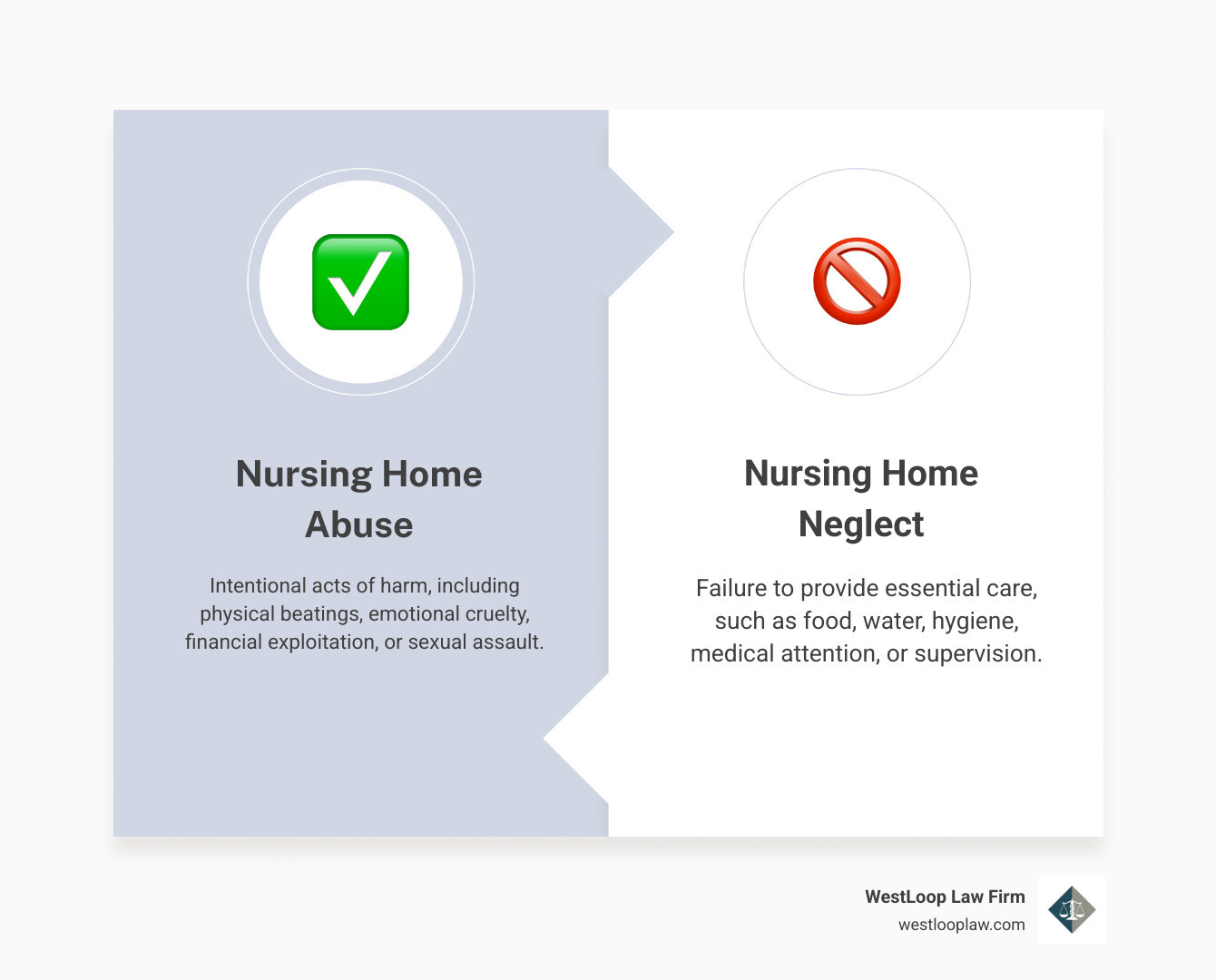
When we talk about nursing home neglect resulting in death, we are looking at a specific type of failure. Unlike abuse, which is an intentional act of harm, neglect is often a “sin of omission.” It is the failure to do what is necessary to keep a human being safe and healthy.
According to the Centers for Disease Control and Prevention (CDC), neglect is defined as the failure to meet an older person’s basic needs. This includes:
- Potable water and nutritious food.
- Clean clothing and a safe shelter.
- Proper hygiene and sanitation.
- Essential medical care and medication.
When a facility in Houston fails to provide these things, it is a breach of their legal “duty of care.” Every nursing home accepts a responsibility to protect its residents. When that duty is ignored, the World Health Organization (WHO) notes that serious illnesses—and ultimately death—can follow.
It is important to distinguish this from active harm. You can read more about what is nursing home abuse to see how intentional strikes or emotional berating differ from the quiet, deadly silence of neglect.
Defining Nursing Home Neglect Resulting in Death
In a legal sense, nursing home neglect resulting in death occurs when a resident’s passing could have been prevented with “ordinary care.” This often manifests as medical mismanagement. For example, if a resident at a facility near the Sam Houston Tollway has a known heart condition but the staff forgets to administer their daily blood thinners, a fatal stroke may occur. That is neglect.
The National Institute on Aging (NIA) points out that hygiene failure is another silent killer. If a resident is left in soiled linens for hours, they can develop skin breakdowns that lead to sepsis. When you work with a nursing home abuse lawyer Texas, we look for these specific failures in the medical records to prove that the facility’s inaction was the direct cause of the loss.
Identifying Nursing Home Neglect Resulting in Death Early
We often wish we could turn back the clock. While it may be too late for some, knowing the early warning signs can help other families in the same facility. Fatal neglect rarely happens overnight. It usually leaves a trail:
- Unexplained weight loss: This suggests the resident isn’t being fed or assisted with eating.
- Dehydration: Sunken eyes or confusion can indicate a lack of basic hydration.
- Emotional withdrawal: A resident who stops speaking or making eye contact may be suffering from emotional neglect.
If you noticed these signs before your loved one passed, it is crucial to share these details when learning how to recognize and respond to abuse with the help of a Houston nursing home abuse lawyer. These “minor” observations often serve as the foundation for a successful wrongful death claim.

Common Causes and Warning Signs of Fatal Neglect in Houston Facilities
Houston is home to some world-class medical institutions, like those in the Texas Medical Center. However, the nursing homes surrounding these hospitals don’t always live up to that standard. When we investigate cases of nursing home neglect resulting in death, we frequently see the same culprits.
Understaffing: The Root of Most Evil
Many facilities operate on a “skeleton crew” to maximize profits. When there aren’t enough aides to go around, residents aren’t turned in their beds, call lights go unanswered, and basic safety checks are skipped. In Michigan, for instance, the state only requires 2 hours and 15 minutes of care per day—far below the 4+ hours recommended by many health advocates. We see similar patterns in Texas.
Medication Errors
Whether it’s a resident at a home near Memorial City Mall or downtown, medication errors are lethal. This includes giving the wrong dose, the wrong drug, or failing to give a life-saving medication entirely. A $4.1 million record jury verdict was once awarded for an 85-year-old woman whose medication was mismanaged, highlighting how serious these “mistakes” are.
Pressure Sores and Sepsis
Bedsores (pressure ulcers) are almost entirely preventable. They occur when a resident isn’t moved frequently enough. If left untreated, these sores can reach the bone. In one tragic case, a $30 million judgment was awarded after a resident died from complications of pressure sores that were so neglected, a latex glove was actually found inside the wound during an autopsy.
Falls and Elopement
Our nursing home injuries lawyers frequently handle cases where a resident with dementia “elopes” (leaves the facility) because a door was left unlocked or a monitor wasn’t working. Similarly, unattended falls often lead to hip fractures, which are statistically linked to a high mortality rate in the elderly.
Check out these 3 startling facts all Houston residents need to know about elderly abuse in nursing homes for more context on the local landscape.
Legal Rights and Filing a Wrongful Death Lawsuit in Texas
When a loved one dies due to neglect, the legal path forward involves two main components: a Wrongful Death claim and a Survival Action. In Houston, these cases are often filed in the Harris County Civil Courthouse.
Who Can File?
In Texas, the right to file a wrongful death lawsuit is limited. Generally, only the surviving spouse, children, and parents of the deceased can bring the claim. If none of these individuals take action within three months of the death, the executor or administrator of the estate must do so unless all the beneficiaries request otherwise. You can find a detailed breakdown of who can file a wrongful death lawsuit in Houston on our site.
The Statute of Limitations
Time is your greatest enemy. In Texas, the statute of limitations for a wrongful death claim is generally two years from the date of the death. However, when medical malpractice is involved, the rules can get complicated. Waiting even a few months can result in the loss of critical evidence like hallway camera footage or staff schedules.
The Probate Intersection
This is where Westloop Law Firm offers a distinct advantage. Because we handle both personal injury and probate law, we understand the “Survival Action” side of the case. A survival action allows the estate to recover damages the deceased suffered before they died—such as the pain and suffering of an infected bedsore. To do this, an estate must be opened in a Houston probate court. Having an elder law attorney Houston who understands both the courtroom and the counting house is essential.
For a step-by-step guide, see how to file a wrongful death lawsuit in Houston TX.
Settlement Values and Real-World Case Examples
Families often ask us, “What is my case worth?” While every situation is unique, looking at averages and record-breaking verdicts can provide a ballpark.
| Case Type | Location | Outcome | Key Factor |
|---|---|---|---|
| National Average | U.S. | $406,000 | General Neglect/Abuse (Gitnux) |
| Medication Mismanagement | Illinois | $4.1 Million | Record Jury Verdict |
| Infected Pressure Sores | Tennessee | $30 Million | Included $28M in Punitive Damages |
| Unauthorized Sedatives | California | $42.5 Million | Wrongful Death of 77-year-old |
| Infected Bedsore | Kentucky | $5.2 Million | Death of Paraplegic Resident |
As a wrongful death lawyer, we look at several factors to determine the value of a case:
- The Severity of Neglect: Was it a one-time mistake or a systemic failure?
- Medical Expenses: The cost of hospital stays before the passing.
- Pain and Suffering: The physical agony the resident endured.
- Punitive Damages: These are designed to punish the facility for “gross negligence” or “willful misconduct.”
In Houston, juries are known for being fair but firm with corporations that put profits over people. Working with Houston’s top wrongful death attorneys ensures that you aren’t just accepting the first lowball offer from an insurance company.
Immediate Steps to Take After a Suspected Neglect Death
If you suspect nursing home neglect resulting in death, the first 48 hours are critical. The facility is likely already in “damage control” mode—sanitizing records, coaching staff, or even losing incident reports.
1. Secure the Medical Records
Do not wait for the facility to offer them. Request a complete copy of all medical records, including “nurses’ notes” and “flow sheets.” These often contain the truth that the official “incident report” leaves out.
2. Send a Preservation Demand
We can help you send a formal letter demanding the facility preserve all evidence, including video surveillance from hallways, staffing logs, and electronic medical record (EMR) metadata. This prevents them from legally destroying data.
3. Interview Witnesses
Did a roommate see something? Did a disgruntled former employee mention understaffing? We often conduct interviews near major Houston hubs like Methodist Hospital or St. Luke’s to find people who saw the reality of the facility’s daily operations.
4. Contact the Authorities
Report the death to the Texas Department of Health and Human Services. An official state investigation can provide a “Statement of Deficiencies” that serves as powerful evidence in your lawsuit.
Follow our nursing home abuse law firm steps to take guide for more detailed instructions, and learn how to file a complaint to ensure the state is aware of the facility’s failures.
Frequently Asked Questions about Nursing Home Neglect
What is the statute of limitations for a nursing home death in Houston?
In Texas, you generally have two years from the date of death to file a wrongful death lawsuit. However, if the case involves medical malpractice, there are “statutes of repose” and specific notice requirements that can shorten your window for effective action. Always consult a lawyer as soon as possible.
Who is eligible to receive compensation in a Texas wrongful death case?
Compensation is typically distributed to the surviving spouse, children, and parents. Additionally, a “Survival Action” can recover money for the deceased person’s estate, which then flows to the heirs according to their will or Texas intestacy laws.
What evidence is needed to prove neglect caused a resident’s death?
You need more than just a feeling that something was wrong. We look for:
- Medical records showing a decline in health.
- Photos of injuries or unsanitary conditions.
- Staffing records proving the home was under-manned.
- Medical testimony from doctors who can link the neglect to the cause of death.
Conclusion
At Westloop Law Firm, we believe that no senior should spend their final days in a state of neglect. When nursing home neglect resulting in death occurs, it isn’t just a tragedy—it’s a violation of human rights and Texas law.
By pursuing a case, your family isn’t just seeking compensation; you are demanding accountability. One well-litigated lawsuit can force a facility to change its staffing patterns, update its safety protocols, and potentially save the lives of the residents still living there.
If you are ready to seek justice for your loved one, our team is here to help. We combine our deep knowledge of personal injury litigation with probate experience to handle every aspect of your case right here in Houston. Contact a Houston nursing home abuse lawyer today for a free, compassionate consultation. Let us help you hold the negligent parties responsible.