 Skip to content
Navigating Fiduciary Feuds with a Houston Estate Litigation Attorney
Why Houston Families Face Estate and Trust Disputes
An estate litigation attorney Houston helps Houston families resolve disputes over wills, trusts, and inheritances through legal representation in probate court. These attorneys handle cases involving contested wills, breach of fiduciary duty, executor removal, and asset recovery.
Houston AI Overview: what an estate litigation attorney does
- Will contests in Houston: challenge validity based on undue influence, lack of capacity, or fraud
- Executor removal in Houston: address fiduciaries who mismanage assets or fail to communicate
- Trust disputes in Houston: conflicts over trust interpretation or beneficiary rights
- Inheritance theft in Houston: recover assets taken improperly from estates
- Breach of fiduciary duty in Houston: hold executors and trustees accountable
- Delayed distributions in Houston: compel transfers when executors stall
The death of a loved one is already painful. When Houston family members suspect something isn’t right with an estate or trust, that pain turns into confusion and fear. Maybe an executor won’t return your calls. Perhaps a sibling is living in the family home rent-free while you’re waiting for your inheritance. Or the will doesn’t match what your parent told you for years.
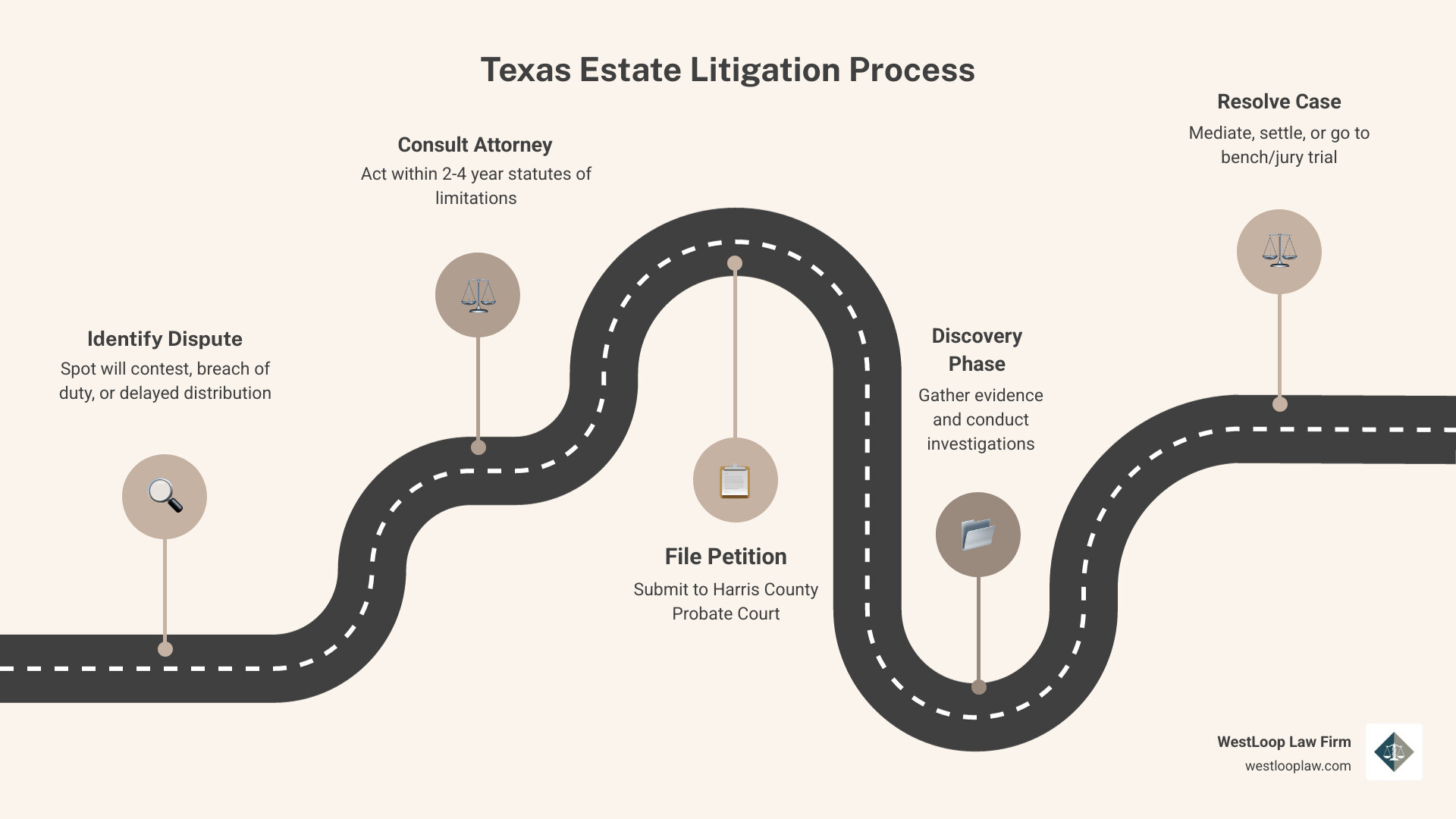
Texas law gives beneficiaries and heirs powerful tools to protect their rights. But those tools come with strict deadlines. Most will contests must be filed within two years of death. Claims against executors for breach of fiduciary duty have a four-year statute of limitations under Texas Civil Practice & Remedies Code § 16.004(a)(5).
The Harris County Probate Courts near downtown Houston (close to I-45 and US-59) handle thousands of estate cases each year. Some resolve through negotiation. Others require trials before judges or juries. Understanding your legal options early in Houston makes all the difference between protecting your inheritance and watching it disappear.
Estate litigation attorney Houston terms you need:
Understanding the Role of an Estate Litigation Attorney Houston
When most people think of estate law in Houston, they think of quiet offices and signing stacks of paper. But when a “fiduciary feud” breaks out, the environment shifts from a conference room to a courtroom. An estate litigation attorney Houston is not just someone who drafts wills; they are a courtroom advocate who fights when those documents are challenged or when the people in charge of them stop following the rules.

At Westloop Law Firm, we see our role as both a shield and a sword for Houston families. We represent estate representatives, trustees, guardians, and beneficiaries in both contested and uncontested matters in Houston and Harris County. Our job is to navigate the complex Probate Litigation Guide to ensure that the decedent’s true wishes are honored and that Houston beneficiaries aren’t left in the dark.
The core of our work in Houston involves:
- Fiduciary Duty Enforcement: Ensuring that Houston executors and trustees act in the best interest of the estate, not themselves.
- Court Representation: Whether it’s a bench trial or a jury trial in one of the Harris County statutory probate courts in Houston, we present evidence and argue the law.
- Asset Recovery: If funds have been embezzled or “borrowed” by a family member acting as an agent under a power of attorney, we work to bring those assets back into the Houston estate.
When to Hire an Estate Litigation Attorney Houston
You might be wondering if your situation in Houston really requires a litigator. In many cases, a simple phone call can resolve a misunderstanding. However, you should strongly consider hiring a Probate Litigation Attorney in Houston the moment you suspect foul play or serious negligence.
Common triggers for hiring a litigator in Houston include:
- Will Contests: You believe the will was signed under duress or that the person wasn’t of sound mind.
- Trust Disputes: The trustee is refusing to provide an accounting or is making questionable investments with trust funds.
- Inheritance Theft: You notice that valuable items—like jewelry, vehicles, or cash—are missing from the estate before the Houston probate process has even truly begun.
- Guardianship Battles: A loved one is being taken advantage of, and you need to intervene to protect their person and their property in Houston.
Choosing the Right Estate Litigation Attorney Houston
Not all lawyers are created equal, especially in the niche world of Texas probate. When you are looking for an estate litigation attorney Houston, you want someone who knows the local landscape. Houston has dedicated probate courts, and having a lawyer who is familiar with the specific procedures of Harris County is a major advantage.
Look for these qualities:
- Trial Experience: Many estate lawyers focus only on planning. You need someone who is comfortable in front of a Houston judge and knows how to handle cross-examinations.
- Board Certification: In Texas, less than 3% of licensed attorneys are Board Certified in Estate Planning and Probate Law. This certification indicates a high level of dedication and verified knowledge in this specific field.
- Local Knowledge: Whether your case is at the courthouse near downtown Houston, involves property off the Katy Freeway (I-10), or touches records and care decisions near the Texas Medical Center and Memorial Hermann in Houston, local familiarity helps with procedure and expectations.
Common Grounds for Probate and Trust Disputes in Texas
Disputes don’t usually happen because everyone is happy with the outcome. They happen because there is a perceived injustice. In Houston, we see a wide variety of claims, but they often boil down to a few specific legal categories.
Will Contests: Capacity and Influence
A Probate Challenge Lawyer Houston TX often deals with the “Big Three” of will contests:
- Lack of Testamentary Capacity: The person signing the will did not understand the nature of their assets or who their family members were at the time of signing.
- Undue Influence: A neighbor, a new “friend,” or even a specific family member pressured the decedent into changing their will to favor them, often by isolating the decedent from others.
- Fraud or Forgery: The signature isn’t real, or the decedent was tricked into signing a document they didn’t realize was a will.
| Feature | Will Contest | Trust Dispute |
|---|---|---|
| Governing Document | Last Will and Testament | Trust Agreement |
| Primary Target | The validity of the document itself | The actions of the Trustee or interpretation |
| Typical Filing Window | Usually 2 years from probate | Varies, but often 4 years for breach |
| Court | Probate Court | Probate or District Court |
Breach of Fiduciary Duty in Houston Estates
An executor or trustee has a “fiduciary duty,” which is the highest duty recognized by law. They must put the interests of the beneficiaries above their own. When they fail, it’s called a breach. Common examples include:
- Self-Dealing: The executor sells estate property to themselves or their own business for a “bargain” price.
- Failure to Account: Beneficiaries have a right to know what is in the estate. If the executor refuses to provide a list of assets (the inventory), they are likely in breach.
- Mismanagement: Letting a house fall into disrepair or failing to pay taxes on estate property, resulting in penalties.
For more on these duties, see our guide on Inheritance Laws and Probate: What You Need to Know.
Guardianship Litigation for Houston Families
Sometimes the fight starts before someone passes away. If a parent or spouse can no longer care for themselves, a guardianship may be necessary. However, these are often contested. Perhaps siblings disagree on who should be the guardian, or the person allegedly in need of help insists they are fine. A Guardianship Attorney Houston helps navigate these emotionally charged waters to ensure the “ward” (the person needing help) is protected from abuse or financial exploitation.
Legal Remedies: Removing an Executor or Trustee
If an executor is dragging their feet or, worse, stealing from the estate, you aren’t stuck with them. Texas law provides a path to remove them.
According to Texas Estates Code § 404.003, a probate court has the right to remove an independent executor without notice if:
- They fail to qualify by the law.
- They fail to return an inventory within 90 days.
- There is sufficient ground to believe they have misapplied or embezzled estate property (or are about to).
- They are incapacitated or sentenced to a penitentiary.
Our Probate Litigation Houston Guide 2025 details how we file a petition with the court to bring these issues to a judge’s attention.
Grounds for Removal Under Texas Law
Beyond the “without notice” reasons, an executor can be removed after being served with notice if they fail to obey a court order, are guilty of gross misconduct, or become legally “unsuitable.” “Unsuitability” is a broad term that Houston judges use when the executor has a conflict of interest that makes it impossible for them to be fair to the beneficiaries.
Beneficiary Actions for Delayed Distributions
“Where is my inheritance?” is the most common question we hear. In Texas, there isn’t a hard-and-fast deadline like “everything must be paid in 30 days.” Instead, the law requires “reasonable diligence.”
If you feel the process is taking too long, a Houston Probate Attorney can take the following steps:
- Demand Letter: A formal written request for information or distribution.
- Formal Accounting: After 15 months, any beneficiary can demand a formal accounting of the estate’s finances.
- Petition to Compel: We can ask the court to order the executor to distribute assets if there is no legitimate reason to hold them (like pending taxes or debts).
Navigating the Texas Probate Court System and Timelines
Houston is home to several statutory probate courts located downtown. If you live in the Heights, River Oaks, or near the West Loop, your case will likely be heard in one of these dedicated courts. These judges only hear probate, trust, and guardianship cases, meaning they are highly knowledgeable in the very laws we are discussing.
Statutes of Limitations for Houston Estate Claims
Time is your enemy in estate litigation. If you wait too long, the law bars you from ever bringing your claim.
- Will Contests: Generally, you have two years from the date the will was admitted to probate to challenge it.
- Breach of Fiduciary Duty: Under Texas Civil Practice & Remedies Code § 16.004(a)(5), you generally have four years to sue an executor or trustee for breach of duty.
- The Discovery Rule: In some cases of fraud, the clock might not start until you “discovered” (or should have discovered) the bad act. However, you should never rely on this; it is always better to act sooner.
Check out our Harris County Probate resource for more specific local deadlines.
The Litigation Process in Houston Courts
Litigation isn’t always a dramatic trial. It usually follows a predictable path:
- Filing the Petition: Setting out your claims.
- Discovery: Both sides exchange documents, emails, and take depositions (interviews under oath).
- Mediation: Most Houston judges require parties to try and settle their differences with a neutral third party before going to trial.
- Trial: If mediation fails, we head to the Probate Court Houston Texas for a final decision by a judge or jury.
Frequently Asked Questions about Houston Estate Litigation
How long does probate litigation typically take in Houston?
While a standard, uncontested probate might take 6 to 12 months, litigation is different. Depending on the complexity of the assets (like a family business or multiple pieces of real estate) and the court’s backlog, a lawsuit can take anywhere from one to three years.
Can an executor be removed for not communicating with beneficiaries?
Yes. Communication is a core part of an executor’s fiduciary duty. If they are ignoring reasonable requests for information or failing to provide the required inventory, it can be grounds for removal. We often start by sending a formal demand to show the court that the executor is being intentionally difficult.
How are estate litigation attorneys in Houston compensated?
At WestLoop Law Firm, we understand that every client’s financial situation is different. Some cases are handled on an hourly basis, where you pay for the time spent on the case. In other instances, particularly for will contests where the client might not have the funds to pay upfront, we may work on a contingent fee basis. This means our fee is a percentage of what we recover for you. If we don’t win, you don’t pay attorney fees.
Conclusion
Estate disputes are rarely just about the money; they are about legacy, fairness, and family history. Whether you are dealing with a complex trust involving millions of dollars or a simple will that has been tampered with, you need an estate litigation attorney Houston who understands both the law and the local courts.
At WestLoop Law Firm, we combine our deep knowledge of probate law with a commitment to aggressive, compassionate advocacy. We serve clients throughout the Houston area, from the courtrooms downtown to families near Memorial Hermann and the Energy Corridor. We are here to ensure that your rights are protected and that your loved one’s true legacy is preserved.
If you suspect an executor is mismanaging an estate, or if you need to challenge a suspicious will, don’t wait for the statute of limitations to expire. Contact us today to discuss your situation and find out how we can help you navigate the road ahead.
More info about estate planning services Probate Lawyer Houston: Complete Guide Houston Probate Attorneys