 Skip to content
Common Motorcycle Injuries and How to Recover
How Dangerous Are Houston’s Roads for Motorcycle Riders?
The most common injury from motorcycle accident crashes falls into several categories — and Houston riders face all of them on roads like the I-10 Katy Freeway every day.
Here’s a quick breakdown of the most frequent injuries motorcyclists sustain:
| Injury Type | How Common |
|---|---|
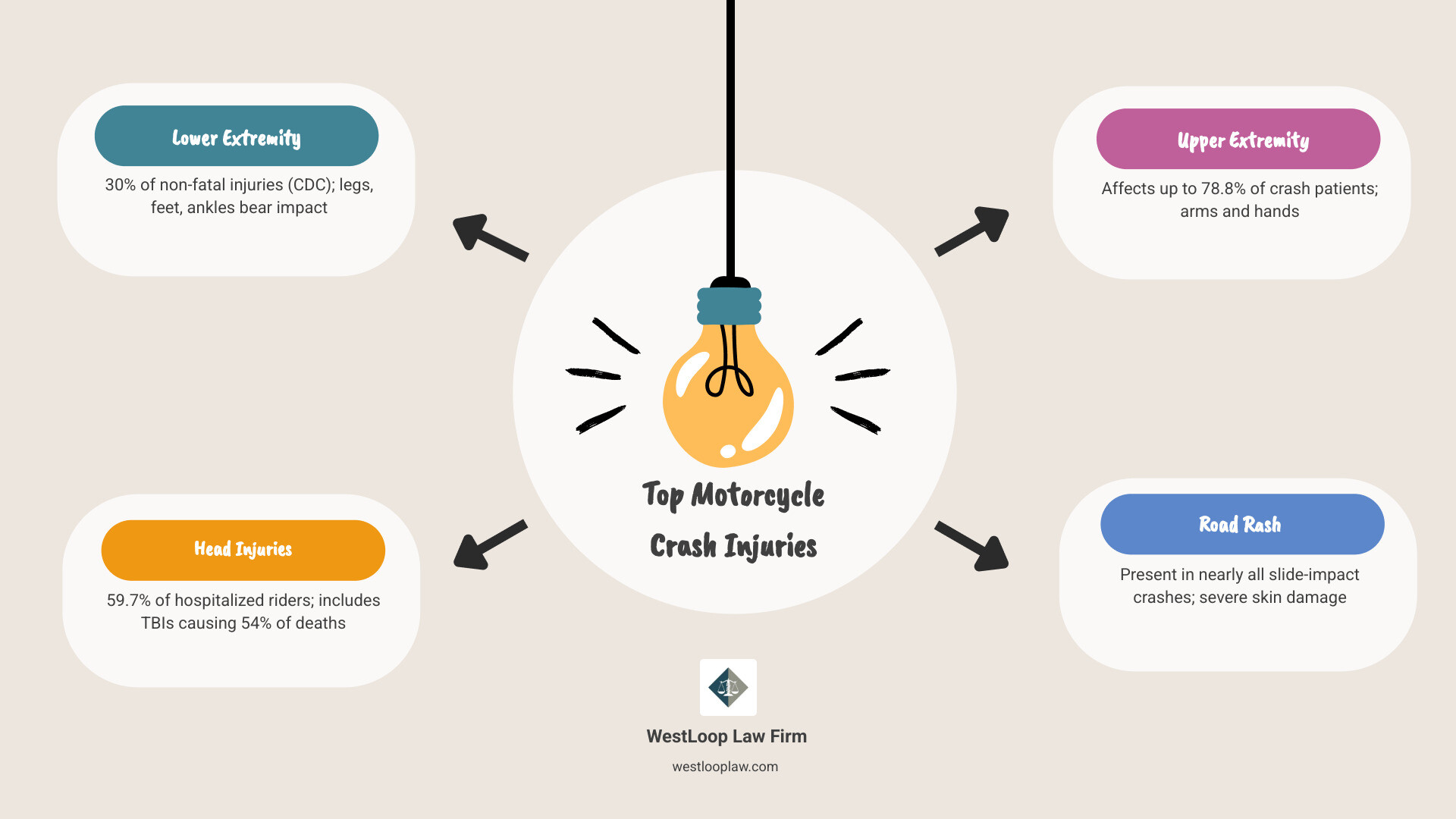
| Lower extremity (legs, feet, ankles) | 30% of all non-fatal injuries (CDC) |
| Head injuries | 59.7% of hospitalized riders |
| Upper extremity (arms, hands) | Affects up to 78.8% of crash patients |
| Traumatic brain injury (TBI) | Causes 54% of rider deaths |
| Road rash | Present in nearly all slide-impact crashes |
| Spinal cord injuries | Leading cause of permanent disability |
Motorcycles make up just 3% of registered vehicles in the U.S. — but account for 15% of all traffic fatalities. In 2023 alone, 6,335 motorcyclists were killed nationwide. Riders are 28 times more likely to die per mile traveled than passenger car occupants.
Unlike a car, a motorcycle offers no roll cage, no airbags, and no metal shell between you and the pavement. On Houston highways like the 610 Loop or US-59, where traffic is dense and speeds are high, that exposure can turn a single collision into a life-changing event.
This article breaks down the most common injuries riders sustain — what they are, why they happen, and what your options are if you’ve been hurt on a Houston road.
The Most Common Injury from Motorcycle Accident: Lower Extremity Trauma
When we look at the raw data for non-fatal crashes, the legs, feet, and ankles take the brunt of the impact. According to NHTSA research on lower-extremity injuries, these account for approximately 47% of all significant injuries treated at trauma centers.
While they aren’t always the most life-threatening, they are often the most debilitating. A rider might survive a crash with their life intact but face months or years of physical therapy to walk again. In the busy environment of Houston motorcycle accidents, these injuries often occur when a rider is forced to lay the bike down or is struck from the side by a driver who didn’t check their blind spot.

Leg and Foot Fractures
The human leg is not designed to withstand the weight of a 500-pound Harley-Davidson or the blunt force of a bumper on the West Sam Houston Tollway. The most frequent breaks involve the tibia (shin bone) and fibula (the smaller bone in the lower leg). In fact, tibia/fibula fractures represent about 95% of all lower-leg injuries in motorcycle crashes.
Other common fractures include:
- Femur Fractures: The thigh bone is the strongest in the body, but a high-speed impact can snap it, leading to significant internal bleeding and a long recovery.
- Pelvic Fractures: These often occur in frontal collisions where the rider is thrown forward against the fuel tank.
- Ankle Displacement: The complex structure of the ankle is easily crushed or twisted, often requiring surgical hardware like pins and plates to stabilize.
| Impact Point | Most Common Fracture Type |
|---|---|
| Frontal Collision | Pelvis, Femur |
| Side Impact | Tibia, Fibula, Malleolar (Ankle) |
| Laying the Bike Down | Metatarsal (Foot), Tibia |
Pinned Injuries and Crushing
One unique danger for motorcyclists is the risk of being pinned. In a multi-vehicle collision on the 610 Loop, a motorcycle can easily fall over, trapping the rider’s leg between the heavy bike and the scorching asphalt. This results in crushing injuries that damage more than just bone.
Soft tissue damage—including muscles, tendons, and ligaments—can be even harder to heal than a clean break. If you are dealing with these complex physical hurdles, a motorcycle crash injury attorney can help you navigate the medical documentation needed to prove the full extent of your damages.
Severe Head and Brain Trauma
While leg injuries are the most frequent non-fatal issue, head injuries are the leading cause of death. Research shows that head trauma affects nearly 60% of admitted patients and a staggering 85% of fatalities. Even in Houston, where we have world-class facilities like Memorial Hermann Hospital’s trauma center, a severe brain injury can be permanent.
Traumatic Brain Injuries: A Most Common Injury from Motorcycle Accident
A traumatic brain injury (TBI) occurs when a sudden jolt or blow to the head causes the brain to bounce or twist inside the skull. This creates chemical changes and can even stretch or damage brain cells. According to research on TBI symptoms, even a “mild” concussion can have lasting effects.
Symptoms to watch for include:
- Loss of consciousness (even for a few seconds)
- Confusion or “brain fog”
- Dizziness and loss of coordination
- Changes in personality or mood swings
- Dilated pupils or slurred speech
For those who survive, the road back is long. Cognitive impairment can make it impossible to return to work or maintain the same quality of life. Our Houston brain injury lawyer tips emphasize that you should never settle a claim until the full long-term impact of a TBI is understood by medical professionals.
Helmet Effectiveness and Safety Standards
The single most effective way to prevent a fatal most common injury from motorcycle accident is to wear a helmet. The NHTSA helmet safety guide helps riders identify gear that actually provides protection versus “novelty” helmets that offer zero safety.
Helmets reduce the risk of head injury by 69% and the risk of death by 37% to 42%. Modern standards like the ECE 22.06 are now testing for rotational forces—the twisting motion that often causes brain bleeds during a slide. If you’ve been injured, a motorcycle injury lawyer will often look at your safety gear as part of the evidence in your case to show you took every precaution possible.
Spinal Cord Damage and Internal Injuries
The spine is the highway of the central nervous system, and in a motorcycle crash, that highway is incredibly vulnerable. Unlike car drivers, who have seatbelts and seats to absorb energy, a rider’s back often takes a direct hit from the ground or another vehicle.
Internal Bleeding: A Hidden Most Common Injury from Motorcycle Accident
One of the scariest things about motorcycle crashes is that you can be “walking and talking” while dying on the inside. Blunt force trauma—hitting the handlebars or being struck by a car—can cause internal organs like the liver, spleen, or kidneys to rupture.
Research on internal trauma notes that internal bleeding doesn’t always show up immediately. It can lead to organ failure or hemorrhagic shock hours after the accident. Because these injuries are so critical, we provide a Houston brain damage attorney ultimate guide that also touches on how systemic trauma affects overall recovery.
Biker’s Arm and Nerve Damage
“Biker’s Arm” is a term used to describe a specific type of nerve damage called a brachial plexus injury. When a rider is thrown from their bike, the natural instinct is to put their arms out to break the fall. The force of the impact can tear the nerves in the upper extremity, leading to:
- Partial or full paralysis of the arm
- Muscle atrophy (wasting away)
- Severe, chronic pain
- Loss of fine motor skills in the hand
The role of motorcycle accident attorneys Houston is to ensure that these types of life-altering nerve injuries are compensated correctly, as they often require expensive surgeries and lifelong care.
Road Rash and Soft Tissue Damage
Road rash is often dismissed as a “scrape,” but that’s a dangerous oversimplification. When skin meets pavement at 60 MPH, the friction generates enough heat to cause what are essentially heavy-duty burns.
Categorizing Road Rash Severity
Medical professionals categorize road rash similarly to thermal burns. In many Houston accidents, especially those occurring on rougher surfaces like feeder roads, the damage can be extensive.
- First-Degree: Redness and irritation, similar to a bad sunburn.
- Second-Degree: The outer layer of skin is torn, but the inner layers remain. This carries a high risk of infection.
- Third-Degree: The skin is completely rubbed away, exposing fat, muscle, or even bone. This often requires skin grafts and can lead to permanent scarring and nerve exposure.
Complications from road rash include “pavement ague” (traumatic tattooing from debris), severe infections, and permanent loss of sensation. If you’ve suffered significant scarring, a Houston burn injury lawyer can help you seek damages for both the physical pain and the emotional toll of disfigurement.
Whiplash and Neck Trauma
While whiplash is usually associated with car rear-endings, it is also a most common injury from motorcycle accident scenarios. The weight of a helmet, while necessary for safety, adds mass to the head. When a rider is suddenly jerked, the cervical spine (neck) can suffer ligament tears and disc herniations.
Research on whiplash explains that these injuries can cause chronic headaches and limited range of motion. If you’re feeling neck stiffness after a crash on the Southwest Freeway, contacting a motorcycle accident lawyer Houston Texas early on ensures your medical evaluations are documented from day one.
Frequently Asked Questions about Motorcycle Injuries in Houston
What is the most common non-fatal injury in a motorcycle crash?
Statistically, lower extremity injuries are the most frequent. This includes fractures to the tibia and fibula, as well as crushing injuries to the feet and ankles. About 30% of all non-fatal motorcycle injuries involve the legs and feet.
How do helmets affect the risk of a traumatic brain injury?
Helmets are incredibly effective. They reduce the risk of a TBI by 69%. While they cannot prevent every injury in high-speed collisions, they are the difference between a concussion and a fatal skull fracture in the majority of crashes.
Can I recover compensation for road rash in Houston?
Yes. Road rash is a serious medical condition that often requires advanced treatment, wound care, and sometimes plastic surgery. If another driver’s negligence caused your accident, you can seek compensation for medical bills, pain and suffering, and any permanent scarring.
Conclusion
Riding in Houston is a thrill, but the risks are real. From the heavy traffic at the I-10 and I-45 interchange to the high-speed stretches of the Grand Parkway, motorcyclists are at a constant disadvantage. If you find yourself at Ben Taub Hospital or another local trauma center after a crash, your focus should be on healing.
At Westloop Law Firm, we understand the specific challenges Houston riders face. We combine our deep knowledge of personal injury law with a commitment to the local biking community. If you are struggling with the aftermath of the most common injury from motorcycle accident crashes, we are here to help you navigate the legal system.
Whether you need guidance on how to claim motorcycle accident injuries or you need a team of attorneys in Houston to take your case to trial, we have the resources to fight for the compensation you deserve. Don’t let an insurance company minimize your pain—reach out to us today to start your recovery journey.