 Skip to content
What a Houston Will Probate Lawyer Actually Does (And Why It Matters)
A houston will probate lawyer helps families manage one of the most stressful legal processes they will ever face — settling a loved one’s estate after they pass away.
Here’s a quick answer if you’re short on time:
- A Houston will probate lawyer validates the deceased’s will in court
- They guide the executor through every step of estate administration
- They notify creditors, manage assets, and resolve disputes between heirs
- They file all required paperwork with Harris County Probate Court
- They can also help reduce how much of the estate goes through probate at all
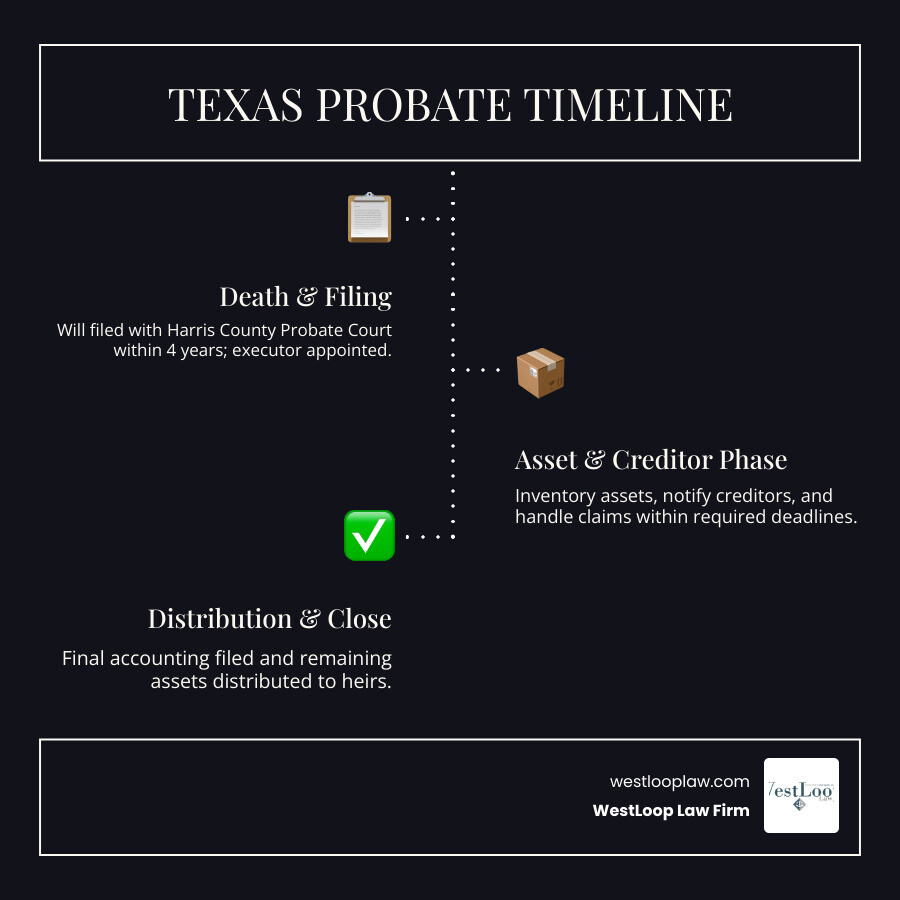
Probate is the legal process by which a court distributes a person’s assets after they die. In Texas, most estates — whether or not there is a will — must go through some form of this process. For Houston residents, that means dealing with Harris County Probate Court, strict deadlines, creditor claims, and sometimes, family conflict.
One client described handling probate after losing a parent as feeling “like a second full-time job.” That’s not an exaggeration. Between inventorying assets, filing court documents, notifying creditors, and managing family expectations, the process is heavy — especially while grieving.
The good news? You don’t have to do it alone.
Houston will probate lawyer vocab to learn:
Understanding the Texas Probate Process in Harris County
To understand why having a skilled legal advocate by your side is so critical, it helps to look at how the probate system works in Houston. If your loved one passed away while living in Houston, Pasadena, Katy, or anywhere else within Harris County, their estate will be handled by the Harris County Probate Courts.
Unlike many states where probate is handled by general district courts, Harris County has dedicated probate courts located in downtown Houston. These courts handle thousands of estate matters each year, ranging from straightforward will validations to highly complex, multi-million-dollar estate battles. Because of this high volume, the judges and court staff expect filings to be legally precise and submitted in a timely manner.
When we guide families through this process, the journey begins by filing an application for probate in the county where the deceased lived. For local families, this means submitting the original will and a death certificate to the county clerk. If you are looking for a deep dive into how these local courts operate, you can check out our Probate Court Houston Texas Complete Guide to get a better sense of what to expect when stepping into the downtown courthouse.
How a Houston Will Probate Lawyer Validates a Will
One of the very first and most critical hurdles in the probate process is proving to the court that the will presented is indeed the true, valid, and final legal testament of the deceased. This is known as validating the will.
A houston will probate lawyer is instrumental during this phase. To validate a will in Texas, we must prove several key elements:
- Proper Execution: The will must meet all Texas legal requirements, including being in writing, signed by the testator (the person who made the will), and witnessed by at least two people over the age of 14 who signed in the testator’s presence.
- Testamentary Capacity: We must show that the deceased was of sound mind when they signed the document—meaning they understood they were making a will, knew the general nature of their property, and recognized their natural heirs.
- Lack of Revocation: We must establish that the deceased did not later revoke or replace this will with a newer version.
If the will contains a “self-proving affidavit” (a notarized document attached to the back of the will where the witnesses swear to its validity), the process is significantly smoother. If it does not, we may need to locate the original witnesses or find individuals who can verify the deceased’s signature under oath.
Once the court is satisfied that the will is valid, the judge will formally appoint the executor named in the will. This individual is then issued “Letters Testamentary,” which serve as their official legal passport to manage bank accounts, sell real estate, and handle the deceased’s affairs. For a step-by-step breakdown of how these initial filings work, read our Probate Filing Houston Complete Guide.
Independent vs. Dependent Administration in Texas
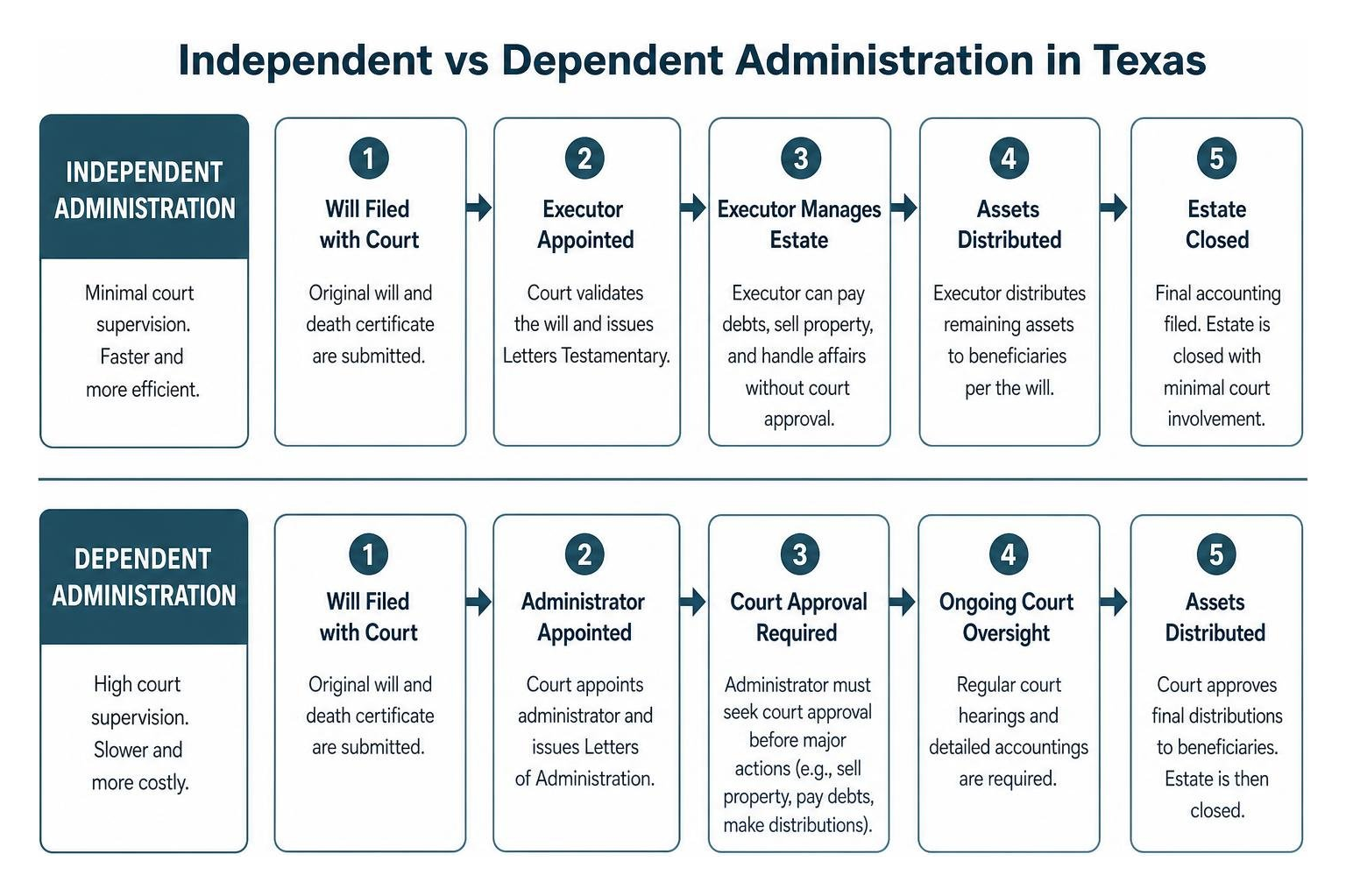
Texas is famous for having one of the most streamlined and user-friendly probate systems in the country—provided your loved one’s will was drafted correctly. In Texas, probate administration generally falls into one of two categories:
- Independent Administration: This is the preferred method. If the will explicitly requests an independent administration (or if all beneficiaries agree to it), the executor can manage the estate with minimal court supervision. Once the court approves the will and appoints the executor, the executor can pay debts, sell property, and distribute assets without having to ask the judge for permission at every turn. This saves families an immense amount of time, stress, and legal fees.
- Dependent Administration: If the will does not allow for independent administration, or if there is no will and the heirs cannot agree, the court will order a dependent administration. In this scenario, the court acts as a strict supervisor. The administrator must get court approval before selling a house, paying a creditor, or distributing a single dollar. This requires frequent court hearings, detailed financial reporting, and significantly higher legal costs.
Understanding the nuances between these two pathways is essential for protecting your family’s inheritance. To explore the legal framework that governs these processes, you can review our guide to Probate Laws Houston.
Key Duties of a Houston Will Probate Lawyer

Many people assume that a probate attorney simply fills out a few forms and stands next to them in court for five minutes. In reality, a dedicated houston will probate lawyer serves as an indispensable guide, project manager, and legal shield throughout the entire estate administration journey.
When you work with us, our primary responsibility is to lift the administrative burden off your shoulders so you can focus on healing. We handle everything from the initial court filings to the final distribution of assets, ensuring that you fulfill your fiduciary duties as an executor without exposing yourself to personal legal liability. For a comprehensive look at how we support families through this transition, please refer to our Probate Lawyer Houston Complete Guide.
Managing Estate Assets and Resolving Creditor Claims
Once an executor is appointed, they are legally responsible for locating, securing, and valuing all the assets owned by the deceased. This can include everything from a family home near the Texas Medical Center to bank accounts, vehicles, and personal belongings.
A probate attorney helps you handle these steps by:
- Preparing an Inventory: We assist you in drafting the formal “Inventory, Appraisement, and List of Claims,” which must be filed with the court within 90 days of your appointment (unless an Affidavit in Lieu of Inventory is permitted).
- Notifying Creditors: Under Texas law, executors must publish a notice to general creditors in a locally circulated newspaper within 30 days of receiving their Letters Testamentary. We handle this publication and send direct, certified letters to secured creditors (such as mortgage companies or car lenders).
- Resolving Outstanding Debts: Before assets can be distributed to beneficiaries, legitimate debts must be paid. We help you evaluate creditor claims, negotiate settlements if the estate has limited funds, and ensure that invalid claims are legally rejected. This protects the estate from being depleted by predatory or unsubantiated claims.
Handling these financial details incorrectly can lead to personal lawsuits against the executor. Working with a skilled legal team ensures that you remain fully compliant with Harris County Probate requirements.
Resolving Disputes with a Houston Will Probate Lawyer
Even with the clearest will, estate administration can sometimes bring family tensions to the surface. Old sibling rivalries, disagreements over who gets sentimental personal items, or suspicions surrounding a late-in-life will change can quickly boil over into legal battles.
If an heir or potential beneficiary decides to challenge the validity of a will—claiming lack of mental capacity, fraud, or “undue influence” by a caregiver—the probate process shifts from administrative to adversarial. This is where having a litigation-tested houston will probate lawyer becomes critical.
We represent executors defending the will, as well as family members who believe a will is invalid or that an executor is mismanaging estate funds. Whether resolving disputes through quiet mediation or representing clients in a contested court trial, we work tirelessly to protect your rights and honor your loved one’s true wishes. For those facing these stressful situations, we recommend reading our Probate Litigation Guide and consulting with a dedicated Probate Litigation Attorney to understand your legal options.
How to Minimize Probate Assets in Texas
One of the most valuable services an estate planning and probate attorney can provide is helping you structure your assets before you pass away so that your loved ones can bypass the probate court altogether. Even if you are currently dealing with the probate of a loved one’s estate, understanding how to minimize probate assets for your own future estate is a powerful way to protect your family’s legacy.
By converting “probate assets” into “non-probate assets,” you can ensure that your property transfers directly to your beneficiaries immediately upon your death, without the need for court intervention, filing fees, or public disclosure. To learn more about how to set up these protections, explore our Probate Estate Attorney Complete Guide.
Exempt vs. Non-Probate Assets in Houston
In Texas, not every asset is subject to the probate process. When evaluating an estate, we divide assets into three distinct categories: probate assets, exempt assets, and non-probate assets.
- Probate Assets: Assets owned solely by the deceased that do not have a designated beneficiary or a survivorship right. These must go through court probate to transfer ownership (e.g., a home owned solely by the deceased, or a bank account with no co-owner or beneficiary).
- Exempt Assets: Texas law provides strong protections for surviving spouses and minor children. Certain “exempt property” can be set aside free from the claims of general creditors. This includes the primary homestead, home furnishings, clothing, up to two firearms, tools used for trade, farming vehicles, and one vehicle per family member.
- Non-Probate Assets: Assets that transfer automatically to a named beneficiary or joint owner by contract, completely bypassing the probate process.
To help you visualize how different assets are treated under Texas law, we have put together this comparison table:
| Asset Type | Goes Through Probate? | How Ownership Transfers | Examples |
|---|---|---|---|
| Solely Owned Real Estate | Yes | Through court-approved will or intestacy | A house near Memorial City Mall owned only by the deceased |
| Joint Tenancy with Right of Survivorship | No | Automatically transfers to the surviving joint owner | Joint bank accounts, real estate with a survivorship deed |
| Accounts with Beneficiary Designations | No | Directly to named beneficiaries upon death | 401(k)s, IRAs, life insurance policies, Transfer-on-Death (TOD) accounts |
| Assets Held in a Living Trust | No | Managed and distributed by the successor trustee | Real estate, business interests, or investments held in trust |
| Exempt Personal Property | Limited | Set aside for surviving spouse/children via court order | Family heirlooms, home furniture, personal vehicles |
By utilizing strategic estate planning tools like revocable living trusts, Transfer-on-Death deeds for real estate, and updated beneficiary designations on financial accounts, you can significantly reduce the size of your probate estate. This not only saves your family thousands of dollars in court costs but also provides them with immediate access to financial resources when they need them most.
Frequently Asked Questions About Houston Probate
Dealing with the legal process after a loss can feel overwhelming, and it is natural to have questions. Here are clear, straightforward answers to some of the most common questions families ask us. For more detailed answers, you can read our guide on 10 FAQs From a Probate Lawyer in Houston Texas.
How long does the probate process take in Harris County?
The timeline for probate in Houston depends heavily on the complexity of the estate and whether the probate is uncontested or contested:
- Uncontested Probate with a Will: If there is a valid will and no family disputes, an independent administration in Harris County typically takes between 6 to 12 months to fully complete. This includes the time needed to file the application, attend the court hearing, notify creditors, inventory assets, and distribute the property.
- Contested Probate or No Will: If there is no will (requiring an heirship determination) or if family members are actively disputing the estate, the process can easily drag on for 1 to 2 years or longer. Court delays, extensive asset searches, and litigation can significantly extend this timeline.
What happens if someone dies without a will in Houston?
When a Houston resident passes away without a valid will, they are said to have died “intestate.” In these cases, the state of Texas has a pre-written “will” for them, known as the laws of intestate succession.
Instead of the deceased choosing who inherits their property, Texas law dictates exactly how assets are split among the surviving spouse, children, parents, and siblings. To distribute these assets, the family must go through a formal court process called an Heirship Determination. The court will appoint an independent attorney (an attorney ad litem) to investigate the family history and confirm the identity of the legal heirs, which adds extra time and expense to the probate process.
Can you avoid probate court in Texas?
Yes, with proactive planning, you can avoid probate court entirely or minimize it significantly. The most effective ways to avoid probate in Houston include:
- Creating and funding a Revocable Living Trust
- Setting up Pay-on-Death (POD) or Transfer-on-Death (TOD) designations on bank and investment accounts
- Utilizing a Transfer-on-Death Deed for your Texas real estate
- Ensuring all shared property is held with Right of Survivorship language
For smaller estates with no real estate and limited assets (under $75,000, excluding the homestead and exempt property), families may also bypass full probate by utilizing a simplified Small Estate Affidavit or a process known as Muniment of Title.
Secure Your Family Legacy with Westloop Law Firm
Losing a loved one is a deeply emotional experience, and trying to handle complex court filings, creditor negotiations, and asset distributions while grieving is a heavy burden. At Westloop Law Firm, we believe that handling the legal system after a loss shouldn’t feel like a second full-time job.
We offer compassionate guidance and dedicated legal representation to families throughout the Houston area. Whether you need help validating a simple will, resolving a complex estate dispute, or designing a comprehensive plan to protect your assets for the next generation, we are here to stand by your side.
Let us handle the legal heavy lifting so you can focus on what truly matters—your family. Contact Westloop Law Firm today to schedule a consultation and learn how our estate planning services can bring you and your loved ones lasting peace of mind.