 Skip to content
Understanding the Power Revocation Houston Process
The power revocation houston process is something many Texans don’t think about until it’s urgent — and by then, the stakes are high.
Here’s a quick answer if you need it now:
How to Revoke a Power of Attorney in Houston (Quick Overview)
- Draft a written Notice of Revocation — include full legal names, the original POA date, and a clear statement revoking authority
- Sign it before a notary public — verbal notice is not legally valid in Texas
- Deliver actual notice — send copies via certified mail to your former agent and every bank, hospital, or institution that held the original
- Record the revocation with the Harris County Clerk — required if the original POA was used for real estate transactions
Life changes. Relationships shift. Trust breaks down. And sometimes the person you once chose to manage your finances or medical decisions is no longer the right fit.
In July 2026, this is more relevant than ever. FBI data shows an 11% rise in fraud cases targeting people over 60 between 2022 and 2023. Many of those cases involved agents acting under powers of attorney that were never properly revoked.
What surprises most Houston residents is this: simply tearing up the document isn’t enough. If your bank on West Loop South still has the original on file and never received notice, your former agent may still legally act on your behalf.
That’s a serious problem — and it’s one that’s entirely avoidable.
This guide walks you through 3 clear changes you need to make to ensure your revocation is legally airtight and recognized by every institution that matters.
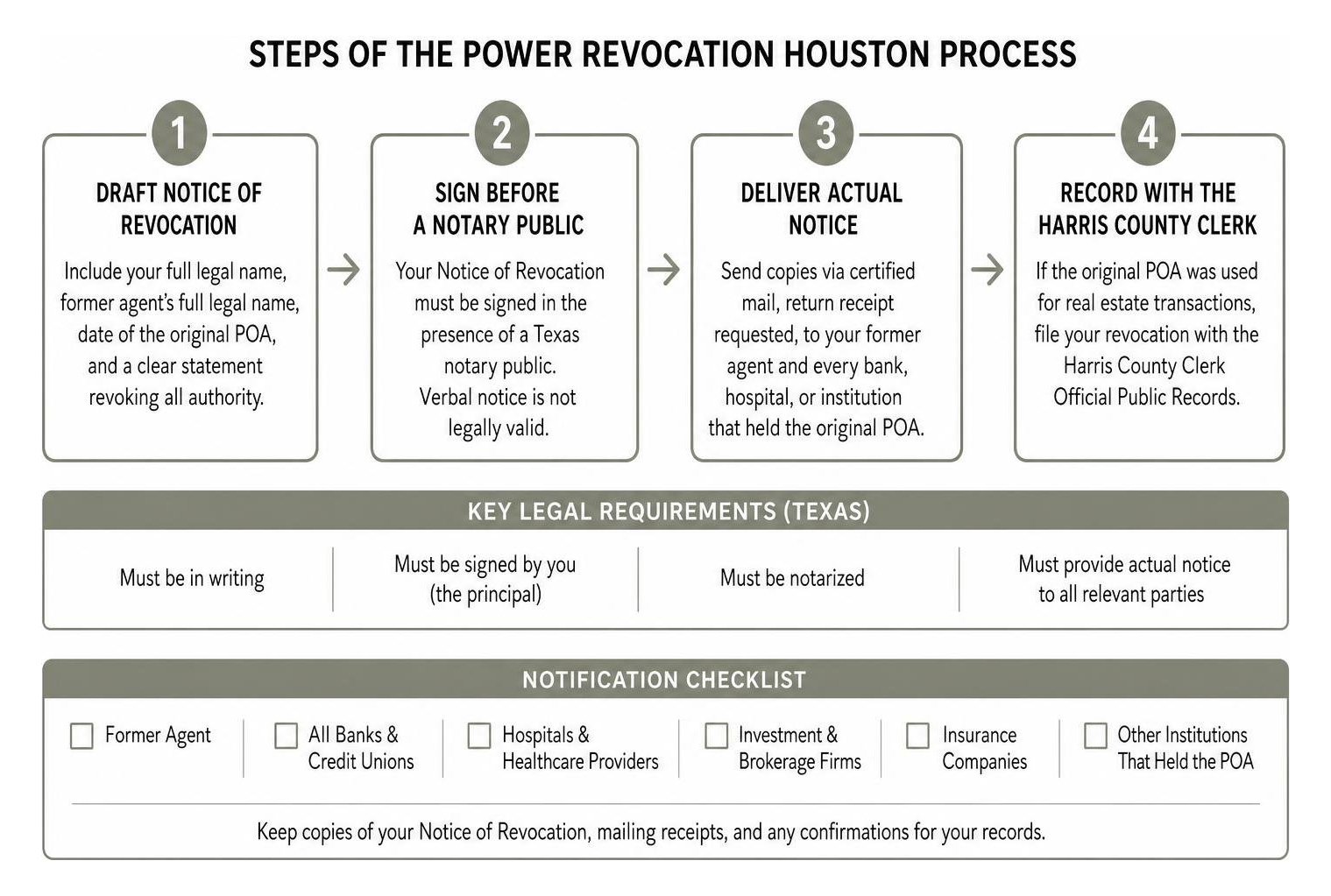
Essential power revocation houston process terms:
To successfully take back the decision-making authority you previously gave away, you must understand the rules established under Texas law. A durable power of attorney (DPOA) is a powerful legal instrument governed by Texas Estates Code Title 2. Because it grants broad powers over your bank accounts, healthcare decisions, and real property, the law requires a precise process to undo it.
Under the Texas Estates Code, the principal (the person who created the POA) retains the absolute right to revoke or change the document at any time, provided they possess the required mental capacity. Mental capacity means you are of sound mind and fully understand the nature and consequences of the revocation when you sign it. If a medical professional has already declared you incapacitated, you can no longer legally sign a revocation.
For Houstonians, the local heart of this legal administration is the Harris County Clerk’s Office, located on Caroline Street in Downtown Houston. Whether you are dealing with a general, limited, or medical power of attorney, the administrative steps you take locally determine whether the revocation holds up under legal scrutiny.
For a broader understanding of how these documents are formed and structured in our state, you can refer to the Guides: Powers of Attorney: General Information provided by the Texas State Law Library, or check out our comprehensive resource, The Ultimate Guide to Power of Attorney in Houston.
Legal Requirements for a Valid Power Revocation Houston Process
For a revocation to be legally recognized in Texas, it must meet several strict statutory requirements:
- It Must Be in Writing: Verbal cancellations do not count. You cannot simply call your former agent on the phone and tell them they are fired.
- Clear and Unambiguous Language: The document must explicitly state your intent to revoke the specific power of attorney, noting the original date of execution and the name of the agent.
- Signed and Notarized: You must sign the document in the presence of a licensed notary public. This acts as formal verification of your identity and your voluntary execution of the change.
- Mental Competency: You must have the legal capacity to understand the action you are taking at the exact moment of signing.
If you are looking for a baseline starting point to draft this document, you can review the SAMPLE REVOCATION OF POWER OF ATTORNEY hosted by TexasLawHelp.
Why Verbal Notice Fails in the Power Revocation Houston Process
One of the most dangerous mistakes a principal can make is relying on a verbal agreement or an informal text message to cancel a POA. Under Texas Estates Code Chapter 751, third parties (such as financial institutions, lenders, and medical centers) are legally protected if they rely on a presented power of attorney in good faith, unless they have received “actual notice” of its revocation.
This means if you tell your former agent “you are no longer my representative,” but that agent goes to a bank on West Loop South and presents the original, unrevoked POA document, the bank is legally allowed to honor their signature. The bank cannot be held liable for transactions made by the agent because the bank did not receive a formal, written revocation.
Furthermore, under Texas Estates Code 751.206, businesses have strict statutory guidelines regarding when they must accept or reject a POA. If they have not been formally served with a written, notarized revocation, they are legally bound to respect the active POA on file. Relying on verbal communication leaves your assets completely exposed.
The 3 Easy Changes to Revoke Your Power of Attorney
If you need to change or cancel your current arrangement, you can achieve complete legal security by executing three systematic changes.
To protect your property, investments, and medical choices, follow these three steps to successfully navigate the power revocation houston process. For more details on managing your affairs, you can read about Power of Attorney: Managing Financial and Medical Affairs.
Change 1: Execute a Formal Written Notice of Revocation
The first change is transitioning from an informal decision to a formal legal document. You must draft a “Notice of Revocation of Power of Attorney.” This document must contain:
- Your full legal name and physical address.
- The full legal name of the agent (and any successor agents) you are removing.
- The exact date the original power of attorney was executed.
- A clear, absolute statement declaring that the original document and all authority granted under it are revoked immediately.
Once drafted, you must sign this document in front of a notary public. In Houston, you can easily find a notary public at local banks, shipping stores, or real estate offices. This step is non-negotiable; without a notary seal, the document cannot be recorded with Harris County and will not be accepted by major financial or medical institutions.
Change 2: Deliver Actual Notice to Your Former Agent and Key Institutions
The second change is moving from private execution to active distribution. A revocation is only as good as its delivery. You must provide “actual notice” to your former agent and every third party that has a copy of the original POA on file.
To do this:
- Send to the Former Agent: Mail a copy of the notarized revocation to your former agent’s last known address. Always use Certified Mail with Return Receipt Requested. This provides you with an undeniable, court-admissible paper trail proving they received the notice.
- Notify Financial Institutions: Hand-deliver or mail the notarized revocation to every bank, credit union, and investment firm where you hold accounts. If you bank near the Galleria or along West Loop South, visit those branches personally, speak with a manager, and ensure they upload the revocation to your profile.
- Notify Healthcare Providers: If you are revoking a Medical Power of Attorney, send copies to your primary care physicians and local hospital networks, such as Memorial Hermann Hospital or Houston Methodist in the Texas Medical Center.
Under Texas Estates Code Section 751.110, third parties are fully protected from liability until they receive this actual notice, making this distribution step the most critical part of the entire process.
Change 3: Record the Revocation with the Harris County Clerk
The third change is making your revocation a matter of public record. If your original power of attorney was ever recorded in the public deed records—which is highly common and often legally required for real estate transactions—you must record the revocation in the exact same office.
In Houston, this is handled by the Harris County Clerk’s Office located at 201 Caroline Street. Recording the revocation in the deed records puts the entire world on constructive notice that your former agent no longer has the authority to sell, mortgage, or transfer your real property. If an agent tries to sell a home or commercial building in Houston after the revocation has been recorded, the title company will flag the recorded revocation, instantly blocking the unauthorized transaction.
Crucial Legal Scenarios: Divorce, Lost Documents, and Incapacity
While the standard power revocation houston process is straightforward, certain life events introduce complex legal hurdles that require swift, strategic action.
To learn more about how healthcare decisions and end-of-life planning intersect with these documents, read our guide on Living Will and Healthcare Power of Attorney.
Does Divorce Automatically Revoke a POA in Texas?
A common point of confusion for many Houstonians going through a divorce is whether their ex-spouse automatically loses power of attorney privileges.
Under current Texas law, if you name your spouse as your agent under a durable power of attorney, their authority is automatically terminated on the date a court grants your final divorce decree or annulment, unless the POA document explicitly states otherwise.
However, there is a dangerous gap here: this automatic termination does not take effect until the divorce is finalized. During the months your divorce is pending in a Harris County family court, your spouse retains full legal authority to access your bank accounts or make medical decisions for you unless you actively revoke their authority in writing.
We highly recommend executing a formal written revocation at the very beginning of divorce proceedings rather than waiting for the final decree.
How to Handle a Lost Original Document or a Noncompliant Agent
What happens if you want to cancel a POA but cannot locate the original physical document, or if a disgruntled former agent refuses to return it?
First, you do not need the original document to revoke it. A newly drafted, notarized “Notice of Revocation” is the legally controlling instrument. It completely overrides the lost original.
If your former agent refuses to stop acting on your behalf or refuses to return your financial records, keys, or assets, you must act immediately:
- Send a Formal Demand Letter: Have a lawyer draft and send a formal letter demanding they cease and desist all actions.
- Notify Authorities: If they continue to access your accounts, file a report for unauthorized financial transactions or elder fraud. Globally, POA abuse is a rising issue; in the United Kingdom, the Court of Protection saw a 55% increase in applications to remove or censure attorneys in a single year due to agent misconduct.
- Seek Court Intervention: Your attorney can file for a temporary restraining order (TRO) or temporary injunction in a Houston court to legally freeze the agent’s ability to act while the dispute is resolved.
What Happens If the Principal Loses Mental Capacity?
If a principal loses their mental capacity due to dementia, a severe stroke, or a cognitive accident before revoking an old POA, they can no longer legally sign a revocation document.
In this scenario, concerned family members cannot simply sign a revocation on the principal’s behalf. Instead, they must petition one of the Harris County Probate Courts to establish a formal legal guardianship.
If the court appoints a guardian, that guardian can then ask the probate judge to formally terminate the existing power of attorney and strip the untrustworthy agent of their power. Because this process involves court hearings and medical evaluations, having a trusted Estate Planning Lawyer in Houston is essential to navigate the path forward.
Frequently Asked Questions About Revoking a POA in Houston
Are banks legally required to accept a revocation notice in Texas?
Yes. Once a bank receives actual, written notice of a notarized revocation, they are legally obligated to stop recognizing the former agent’s authority. Under Texas law, financial institutions have strict timelines to process power of attorney documents. Once they are officially served with a revocation, they must update their systems immediately to protect your accounts from unauthorized access.
What is the most common mistake people make when revoking a POA?
The most common mistake is assuming that a verbal conversation or destroying the original physical document is enough. Because digital copies often exist and third parties can rely on them in good faith, failing to send formal, written, notarized notice to all relevant banks, hospitals, and land registries leaves the door wide open for unauthorized transactions.
Can I revoke a power of attorney myself without a lawyer?
Yes, you can legally draft and execute a revocation yourself. However, doing so without professional guidance carries significant risks. If your document lacks the correct legal descriptions, fails to meet the exact standards of the Texas Estates Code, or is not delivered to the correct parties via certified mail, it may fail to protect your assets when you need it most.
Reclaim Complete Control of Your Future Today
Taking back control of your financial and medical decisions should not be left to chance. Whether you are navigating a divorce, updating your long-term estate plan, or dealing with an agent who is no longer trustworthy, executing the power revocation houston process correctly is the only way to protect your hard-earned assets and personal autonomy.
At Westloop Law Firm, we assist Houston families with clear, compassionate, and legally sound estate planning and probate solutions. We can help you draft an airtight revocation, ensure it is properly recorded with the Harris County Clerk, and establish a secure plan for your future.
Do not wait for an unauthorized transaction to occur before taking action. Contact our office today to schedule a consultation with an experienced Estate Planning Lawyer in Houston and secure your peace of mind.