 Skip to content
Starting the Formal Probate Process in Houston
Formal probate Houston court proceedings begin when someone files the right application in a Harris County Probate Court to validate a will, appoint an executor, or determine who may handle an estate.
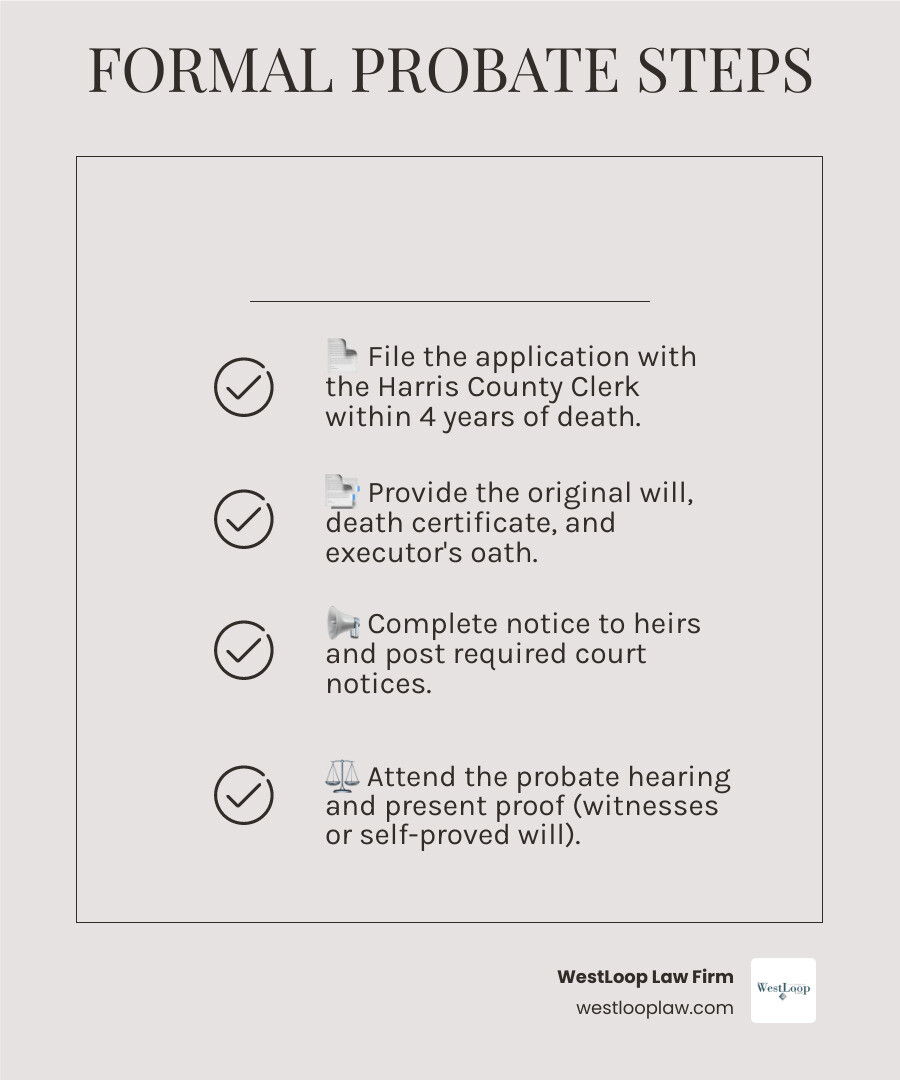
For a quick overview, the process usually involves:
- Filing an application with the Harris County Clerk.
- Providing the will, death information, and required court documents.
- Completing notice and posting requirements.
- Attending a probate hearing and presenting required proof.
- Qualifying the executor or administrator, when an administration is needed.
A probate case may be straightforward, but small details can change the path. For example, a will may be used only to transfer property through a muniment of title, or it may require a full independent administration so someone can collect assets, pay debts, and act for the estate.
Texas generally requires a will-probate application within four years of death. Harris County also has local filing, hearing, witness, and electronic-filing practices that can affect how smoothly a case moves forward. This guide explains what to expect before filing in Houston, including the key choices that shape the formal probate process.
Terms related to formal probate houston court:
Navigating the Formal Probate Houston Court System
Understanding how the Houston statutory probate system operates is an important first step. Harris County features dedicated statutory probate courts designed specifically to manage decedent estates, guardianships, and trust matters. When you file a case in Houston, your matter will be assigned to one of these statutory probate courts located at the Harris County Civil Courthouse on 201 Caroline Street in downtown Houston.
These courts have jurisdiction over estate administration, interpretation of wills, trust litigation, personal injury or wrongful death actions tied to an estate, and fiduciary liability disputes. The judicial bench includes experienced judges who govern their courtrooms using both the Texas Estates Code and local court rules. For an overview of how the local statutory judges manage their dockets, you can review our guide on harris county probate court judges.
At Westloop Law Firm, we guide Houston families through every phase of this court system. Choosing the correct proceeding early saves time and reduces administrative burdens. The table below highlights key operational differences between two common estate options in Houston:
| Feature | Muniment of Title | Independent Administration |
|---|---|---|
| Primary Purpose | Serves as legal evidence to transfer title to estate assets | Grants full authority to manage assets, settle debts, and distribute property |
| Letters Testamentary Issued? | No | Yes |
| Unpaid Estate Debts Allowed? | No (except debts secured by real estate liens) | Yes |
| Notice to Creditors Required? | No published notice to general creditors required | Yes, mandatory published notice and direct notice to secured creditors |
| Ongoing Estate Inventory Required? | No | Yes (or an Affidavit in Lieu of Inventory) |
Filing Deadlines, Fees, and E-Filing Protocols
Initiating a formal probate Houston court matter requires strict compliance with statutory deadlines and county electronic filing rules. Under the Texas Estates Code, an application to probate a will must ordinarily be filed within four years of the decedent’s date of death. If an application is delayed beyond four years, additional notice procedures and court findings are required before a will can be admitted.
All formal filings in Houston must be submitted electronically through EFileTexas.gov or an approved Electronic Filing Service Provider. Standard statutory court costs apply, including base court filing charges, state electronic filing fees, and county administrative envelope fees. When e-filing an application to probate a will, Texas law provides a specific rule for original documents: an electronic copy of the original will must be attached to your e-filed application, and the physical original will must be delivered to the Harris County Clerk within three business days of the electronic filing.
For official updates on clerk hours, certified copy orders, and fee structure details, you can visit the Harris County Clerk’s Office Probate Courts portal. To gain a deeper understanding of initial application steps, explore our probate filing houston complete guide.
Filing Requirements in Formal Probate Houston Court
To properly commence a formal probate proceeding in Houston, the applicant must file a comprehensive set of initial pleadings. Missing or incomplete forms can lead to e-filing rejections or hearing delays.
Key required documents include:
- Application for Probate: A formal petition detailing the decedent’s death, jurisdiction, marital history, beneficiaries, and requested relief.
- Original Will and Codicils: Delivered to the clerk within the three-day window following e-filing.
- Proof of Death and Other Testimony: Written testimony prepared for the hearing establishing the facts of death, domicile, and will execution.
- Oath of Executor or Administrator: Signed by the appointee to swear faithful performance of legal duties.
- Personal Representative Information Sheet: Required local administrative form providing contact details for court records.
For step-by-step guidance on gathering these initial records, review our probate court houston texas complete guide.
Key Probate Options: Muniment of Title vs. Independent Administration
When initiating a formal probate Houston court proceeding, selecting the right legal pathway depends on the estate’s debts, assets, and family dynamics. Texas provides two primary methods for probating a valid will: admission as a muniment of title or opening an independent administration.
Muniment of title is a streamlined probate option unique to Texas. It is appropriate when the decedent left a valid will, owned property in Texas, and had no unpaid estate debts, other than debts secured by liens on real estate. Under muniment of title, the court admits the will to probate, but no executor is appointed and no Letters Testamentary are issued. The court order admitting the will acts as a legal transfer of property ownership directly to the named beneficiaries.
When an estate has active debts, multiple bank accounts, or complex property holdings requiring active management, independent administration is standard. Under Texas Estates Code §401.003, if a will does not name an independent executor, all named beneficiaries can collectively agree to request an independent administration. If heirs or beneficiaries disagree, or if minor children are involved alongside separate property, the court may trigger a dependent administration, requiring strict judicial supervision for every transaction.
For local court guidelines and forms, consult the official Probate Court No. 4 Information and Forms directory. You can also explore our probate lawyer houston complete guide to evaluate which option fits your family’s situation.
Appointing Successor Executors and Handling Executor Availability
It is common for the primary executor named in a will to be unable or unwilling to serve due to illness, pre-decease, or personal preference. When this occurs in Houston probate courts, clear procedures govern who may step forward.

The process for addressing executor availability involves standard legal steps:
- Reviewing Will Designations: The court first looks to any alternate or successor executors explicitly named in the decedent’s original will.
- Obtaining Formal Declinations: If a primary named executor decides not to act, they must sign a notarized declination to serve, which is filed with the court clerk.
- Filing an Application for Successor Appointment: The alternate named executor files an application requesting appointment and issuance of Letters Testamentary.
- Re-Posting Notice Requirements: If an application is amended to substitute an applicant or change the requested letters, updated public citation and posting may be required under local court rules.
- Handling Surviving Co-Administrators: Under Texas Estates Code §240, if multiple co-executors or co-administrators are serving and one passes away or resigns, the remaining surviving co-administrator may continue to act, though updating court letters requires filing an appropriate motion.
Court Hearing Rules and Attorney Ad Litem Requirements
Once the application and public posting period are complete, the case is set for a prove-up hearing before a statutory probate judge. In Houston courts, uncontested hearings are conducted either in person at the 201 Caroline courthouse or remotely via video conferencing tools like Zoom.

When participating in remote Zoom dockets, local courts enforce strict standards. For example, judges require attorneys and key witnesses to be physically present in the attorney’s office together during virtual hearings unless an out-of-state witness exception applies. Participants must join on time, maintain video capability, and identify their case number upon entering the virtual courtroom.
In proceedings involving unknown heirs, minor beneficiaries, incapacitated parties, or wills probated after the four-year statutory deadline, the court will appoint an Attorney Ad Litem. The applicant must post a mandatory ad litem deposit fee with the court registry to cover the court-appointed lawyer’s work. Ad litem fees are governed by local fee standards and court approval. For detailed information on court appearances, read our probate attorney houston complete guide.
Uncontested Hearings in Formal Probate Houston Court
The witness requirements for prove-up hearings depend on the type of will offered to the court:
- Self-Proved Wills: A self-proved will includes an attached self-proving affidavit signed by the testator, two witnesses, and a notary public. In these cases, live witness testimony regarding execution is unnecessary; the named applicant or attorney can establish necessary jurisdictional facts.
- Non-Self-Proved Wills: If a written will lacks a proper self-proving affidavit, the applicant must present live testimony or sworn depositions from one or more subscribing witnesses who signed the original document.
- Holographic Wills: A will written entirely in the testator’s handwriting requires testimony from two disinterested witnesses who can positively identify the decedent’s handwriting and signature.
For specific docket schedules and instructions, visit Probate Court No. 4.
Heirship Dockets and Mandatory Order Language
When an individual dies without a valid will in Houston, an application to declare heirship must be filed alongside an administration request. Heirship proceedings require an Attorney Ad Litem to represent unknown or missing heirs.
At the uncontested heirship hearing, local rules require live testimony from two disinterested witnesses—individuals who have personal knowledge of the decedent’s family history but will not inherit anything from the estate. The court evaluates this testimony to issue a Judgment Declaring Heirship.
Draft court orders in Houston heirship matters must contain specific statutory provisions, including explicit language addressing whether the decedent applied for or received Medicaid benefits on or after March 1, 2005, clear declarations regarding unpaid estate debts, and specific findings confirming the court’s jurisdiction over property rights.
Special Proceedings: Guardianships and Registry Fund Withdrawals
Beyond estate administration, statutory probate courts in Houston handle guardianships for incapacitated adults and minors, as well as court registry accounts.
To initiate a guardianship in Houston, an applicant must file a detailed petition supported by a Physician’s Certificate of Medical Examination completed by a licensed doctor within 120 days of filing. Proposed guardians must complete background checks and register with the Judicial Branch Certification Commission (JBCC) before appointment.
Another frequent administrative task in Houston probate courts involves withdrawing minor registry funds. When funds are deposited into the court registry for a minor following a legal settlement or inheritance, those funds remain secured until the individual reaches adulthood.
Upon turning 18, the individual can file an Application to Withdraw Funds From Court Registry with the probate court. For access to guardianship checklists and withdrawal guidelines, refer to Probate Court No. 4 Information and Forms and our guide on probate family law in harris county.
Frequently Asked Questions About Houston Probate
Can You Probate a Will in Houston Without an Attorney?
While individuals may represent themselves in court (pro se) in certain basic matters, local statutory rules in Harris County generally require a licensed attorney for probate proceedings where the applicant acts as a fiduciary. Because an executor or administrator represents the rights of estate beneficiaries and creditors, court rules state that non-attorneys cannot represent third-party interests.
The primary exception occurs when a will is probated strictly as a muniment of title and all beneficiaries join as co-applicants, ensuring no third-party fiduciary duties are created.
What Happens If a Will Is Filed After the Four-Year Deadline in Harris County?
Filing an application to probate a will more than four years after the decedent’s death requires meeting a higher legal burden. The applicant must establish by clear evidence that they were not “at fault” or default for failing to present the will within the statutory four-year window.
Additionally, the applicant must issue personal service or certified mail notice to all of the decedent’s heirs at law who would inherit if no will existed. If an heir’s whereabouts are unknown, the court appoints an Attorney Ad Litem to represent their interests before the court determines whether the delayed will may be admitted.
How Do You Withdraw Registry Funds When a Minor Turns 18 in Probate Court No. 4?
Withdrawing funds from the court registry in Probate Court No. 4 requires completing specific administrative steps once the beneficiary reaches age 18:
- Obtain the official application form from Court No. 4’s resource index.
- Complete the Application to Withdraw Funds From Court Registry When Minor Turns 18, detailing the cause number, original deposit details, and proof of age.
- Attach certified copies of the applicant’s birth certificate and official government-issued photo identification.
- Submit the verified application to the court clerk.
- Upon judicial approval, present the signed court order to the clerk’s accounting department to process the disbursement check.
Securing Guidance for Your Formal Probate Houston Court Matter
Navigating a formal probate Houston court case involves balancing strict Texas Estates Code requirements with Harris County local rules, e-filing guidelines, and hearing schedules. Whether you need to probate a simple will, navigate an uncontested heirship docket, or resolve estate administration disputes, having legal support helps prevent delays and protects estate assets.
At Westloop Law Firm, we assist families, executors, and beneficiaries across Houston through every phase of court proceedings. We provide attentive representation tailored to your family’s needs. To learn more about how we can guide you through the probate system, visit our estate planning law houston resources or explore the main portal at WestLoop Law Firm.