 Skip to content
What “Probate Near Me” Means for Houston Families in 2026
If you’re searching for probate near me in Houston, here’s what you need to know right away:
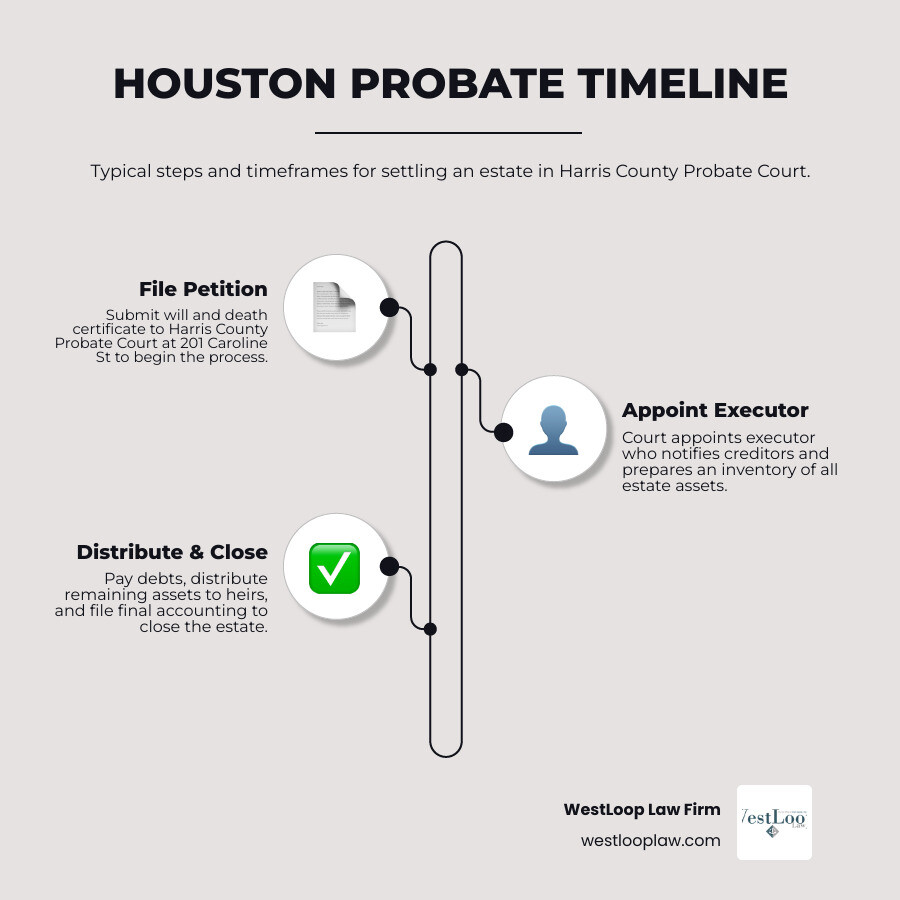
Quick Answer: How to Start Probate in Houston
| Step | What to Do |
|---|---|
| 1 | Locate the original will and death certificate |
| 2 | File a petition with Harris County Probate Court (downtown Houston, near I-610) |
| 3 | Get appointed as executor or administrator |
| 4 | Notify creditors and inventory estate assets |
| 5 | Pay debts, then distribute assets to heirs |
| 6 | Close the estate with the court |
Harris County Probate Courts are located at 201 Caroline St, Houston, TX 77002 — near the Texas Medical Center corridor and accessible from the West Loop (I-610).
Losing someone close to you is hard enough. Then comes the paperwork, the court dates, and the legal terms you’ve never heard before.
Probate is the court-supervised process of settling a deceased person’s estate. That means paying debts, transferring property, and distributing what’s left to heirs. In Houston, this happens through the Harris County Probate Courts — and it typically takes 6 to 12 months to complete.
Not every estate needs full probate. Some assets pass directly to loved ones through beneficiary designations or joint ownership. But when probate is required, having local legal guidance makes a real difference.
At Westloop Law Firm, we help Houston families navigate probate from start to finish — with clear answers, no unnecessary delays, and representation that knows Harris County’s courts.
Related content about probate near me:
Understanding the Probate Process in Houston and Beyond
When we talk about probate in Houston, we are dealing with the rules established by the Texas Estates Code. Texas has a reputation for having a relatively streamlined probate process compared to other states, but it still requires careful navigation of the local court system. In Harris County, probate matters are handled by dedicated statutory probate courts located in downtown Houston on Caroline Street.
To understand why Houstonians appreciate the Texas system, it helps to look at how other states handle these matters. For example, in Florida, the law frequently requires formal administration for estates, which can become highly administrative and slow. Florida also has strict rules about who can serve as a personal representative, often requiring an out-of-state executor to be a close relative.
Up north in Westmoreland County, Pennsylvania, the probate process involves the Register of Wills. Pennsylvania estates must navigate a state inheritance tax that ranges from 0% for surviving spouses up to 15% for non-relatives, with a small discount if paid early.
In contrast, Texas does not have a state-level inheritance or estate tax in June 2026. This financial relief makes the Texas process less burdensome, but the legal steps remain precise. Knowing the local Probate Laws Houston is the first step to ensuring an estate is settled correctly without running into costly delays.
If you are looking for court locations or forms, you can access the Harris County Clerk’s Office Probate Courts portal to review local dockets and settings. Navigating the Probate Court Houston Texas requires adhering to strict local rules, which is why most families prefer to work with a local attorney who regularly stands before the Harris County judges.
When is Probate Required for an Estate?
Probate is generally required when a person dies owning assets solely in their name. If your loved one owned a home near the West Loop (I-610), a family business in the Heights, or bank accounts at a local Houston branch without a designated beneficiary, those assets are considered “probate assets.”
Without court intervention, banks will not allow you to access the deceased person’s accounts, and the Texas Land Title Association will not recognize a transfer of real estate. The court must formally recognize the will and authorize a representative to act.
To help local families understand this timeline, we look closely at how assets are titled. If a home near the Texas Medical Center or Memorial Hermann Hospital was titled jointly with rights of survivorship, it might bypass the court entirely. However, if it was owned solely by the deceased, you must go through the formal Probate Laws in Houston Process for Residents to transfer the deed to the rightful heirs.
Different Types of Probate Administration
Texas offers several paths to settle an estate, depending on the complexity and size of the assets:
- Independent Administration: This is the most common and preferred method in Houston. Once the court appoints the executor, that person can administer the estate with minimal court supervision. They can pay debts, sell real estate, and distribute property without asking the judge for permission at every turn.
- Dependent Administration: If there is high family conflict or the deceased left significant debts, the court may require dependent administration. This means the administrator must seek court approval for almost every action, including paying bills or selling a vehicle. It is much more time-consuming and expensive.
- Muniment of Title: This is a uniquely simple Texas procedure. If the deceased had a valid will, owed no debts (other than a home mortgage), and the only real need is to transfer title to property (like a house near Memorial Drive), the will can be admitted as a “muniment of title.” The court recognizes the will as the actual deed transfer document without appointing an executor.
By comparison, Florida uses “summary administration” for estates valued under $75,000 (which rises to $150,000 in July 2026) or when the decedent has been deceased for more than two years. While Texas has its own small estate affidavits, choosing the right path in Houston requires analyzing the estate’s liabilities and assets. Our Probate Filing Houston Complete Guide provides a deeper dive into selecting the right filing type for your family’s situation.
Navigating the Court System: Finding Probate Near Me Services in Houston
When you begin searching for a probate near me lawyer, you are looking for someone who knows the physical and procedural landscape of the Harris County court system. The probate courts are housed in the Harris County Civil Courthouse downtown.
The judges who preside over these courts have specific expectations for filings, scheduling, and hearings. Knowing the preferences of the Harris County Probate Court Judges can mean the difference between a quick, ten-minute hearing and a multi-month delay because a form was filled out incorrectly.
For those living near the Texas Medical Center, West Loop, or outer suburbs like Katy and Kingwood, traveling downtown can be a hassle. That is why we focus on making the administrative side as simple as possible. Understanding how Harris County Probate operates ensures we can file documents electronically and prepare you for what to expect during your court appearance. If you are ready to explore your options, you can connect with us directly through Westloop Law Firm in Houston.
Why You Need a Qualified Probate Near Me Lawyer
While some legal matters can be handled independently, Texas courts generally require an executor or administrator to be represented by a licensed attorney. Because an executor represents the interests of others (the beneficiaries and creditors) rather than just themselves, doing so without a lawyer is considered the unauthorized practice of law in Texas.
Beyond the legal requirement, a local attorney helps you avoid costly administrative errors. Missing a creditor notification deadline or distributing funds before resolving tax liabilities can leave an executor personally liable. Working with a dedicated Probate Lawyer Houston ensures that every step is completed in compliance with the Texas Estates Code, keeping you safe from personal liability. If you are trying to find representation close to home, searching for a Probate Attorney Near Me is the fastest way to secure local representation.
Steps to Retain a Probate Near Me Law Firm
Finding the right legal team shouldn’t add to your stress. Here is how we recommend starting the process:
- Gather Key Information: Before your first call, locate the original will (if there is one), a copy of the death certificate, and a general list of the deceased’s assets and debts.
- Schedule an Initial Consultation: This is your opportunity to share the details of the estate and ask questions about the timeline and process.
- Discuss the Fee Structure: Ensure the firm explains how they bill—whether through flat fees for uncontested matters or hourly rates for complex estates.
- Confirm Local Familiarity: Ensure your attorney regularly practices in the specific county where the deceased resided.
If you are looking for local support, finding the Best Probate Attorney Near Me involves choosing a firm that combines deep legal knowledge with a compassionate, human approach. At Westloop Law Firm, we pride ourselves on guiding families through these tough times with clarity and respect.
Duties of an Executor and Handling Estate Complications
Being named an executor is an honor, but it is also a job. In Houston, an executor is a fiduciary, meaning they owe the highest duty of loyalty and care to the estate’s beneficiaries and creditors.
The typical duties include:
- Filing the will and petition for probate.
- Publishing a notice to creditors in a local Houston newspaper.
- Sending direct notices to secured creditors.
- Filing an Inventory, Appraisement, and List of Claims with the court within 90 days of qualifying.
- Paying valid claims and taxes.
- Distributing the remaining assets according to the will.
If the executor lives outside of Texas, they can still serve, but they must appoint a resident agent for service of process. This ensures the court and local creditors have a physical address in Texas to send official correspondence. For a comprehensive breakdown of these responsibilities, see our Probate Attorney Houston Complete Guide and our Probate Estate Attorney Complete Guide.
Resolving Will Contests and Probate Litigation
Sometimes, the probate process isn’t smooth. Family dynamics, long-held grievances, or sudden changes to a will can lead to disputes.
When a family member believes a will is invalid, they may file a contest. Common grounds for challenging a will in Houston include:
- Lack of Capacity: Proving the deceased did not understand what they were signing or the extent of their assets (often involving medical records from hospitals like Houston Methodist or Memorial Hermann).
- Undue Influence: Showing that someone pressured or coerced the deceased into changing their will.
- Execution Defects: Proving the will was not signed or witnessed according to Texas law.
If someone dies without a will (intestate), Texas law dictates who inherits. This often requires an “Application to Determine Heirship,” which involves the court appointing an independent attorney (an attorney ad litem) to investigate the family tree and confirm the rightful heirs.
If your family is facing a dispute, our Probate Litigation Houston Guide 2025 offers valuable guidance on how these court battles are handled. When disputes cannot be resolved amicably, a Probate Challenge Lawyer Houston TX can represent your interests in court to protect the true intent of your loved one.
How to Avoid Probate with Strategic Estate Planning
The best way to handle probate is to plan ahead so your family can avoid it altogether. By utilizing strategic planning tools, you can ensure your assets transfer directly to your beneficiaries without court involvement.
- Revocable Living Trusts: A trust holds title to your assets while you are alive, and a successor trustee manages and distributes those assets privately when you pass away, completely bypassing the court.
- Beneficiary Designations: Financial accounts, life insurance policies, and retirement accounts can be set up with Transfer on Death (TOD) or Payable on Death (POD) designations.
- Lady Bird Deeds (Enhanced Life Estate Deeds): This is a popular tool in Texas that allows you to retain ownership of your home during your lifetime and automatically transfer it to your heirs upon your death, avoiding probate and protecting the property from Medicaid estate recovery.
To learn more about setting up these protective measures, consulting a Probate and Estate Attorney is an excellent way to secure your family’s future and provide peace of mind.
Frequently Asked Questions about Houston Probate
How long does the probate process take in Harris County?
On average, an uncontested independent probate administration in Houston takes 6 to 12 months. The timeline can be affected by court backlogs, the speed of real estate sales (especially in competitive neighborhoods near the West Loop or the Heights), and how quickly financial institutions release funds.
If there are disputes, tax complications, or multiple creditors, the process can drag on for several years. For a detailed breakdown of what to expect month-by-month, read our Probate Court Houston Texas Complete Guide.
What are the typical costs and fees associated with probate?
Probate costs generally include court filing fees, fees for publishing creditor notices, and attorney fees. Attorney fees can be billed hourly or as a flat fee, depending on the complexity of the estate.
When comparing states, Texas is generally more affordable than states with inheritance taxes. For instance, in Pennsylvania, families must pay state inheritance taxes ranging up to 15% within nine months of death. In Texas, we do not have a state inheritance tax, which keeps more money in the hands of the beneficiaries. To find out more about budgeting for this process, review our guide on how to hire the Best Probate Attorney Houston.
Can an out-of-state executor manage a Houston estate?
Yes, Texas law allows out-of-state executors to manage an estate here. However, you must appoint a resident agent who lives in Texas to accept legal notices on behalf of the estate.
Additionally, many Harris County courts now allow remote video appearances for simple, uncontested hearings, meaning you may not even have to travel to Houston to be sworn in. For more details on managing an estate from afar, check out our Probate Lawyer Houston Complete Guide.
Conclusion
Losing a loved one is a profound life transition. Navigating the legal requirements of the Harris County probate courts shouldn’t add unnecessary pain to your grief. Whether you are dealing with a straightforward independent administration or facing a complex family dispute, having supportive, local representation makes all the difference.
At Westloop Law Firm, we combine our deep familiarity with Houston probate law with a compassionate, down-to-earth approach. We are here to answer your questions, handle the court filings, and protect your family’s legacy so you can focus on healing.
If you need assistance with an estate or want to put a plan in place to protect your assets, contact us today to schedule a consultation. Let us help you navigate the road ahead with confidence. Explore your planning options today at Estate Planning Law Houston.