 Skip to content
Why Safety Guard Failures Matter in a Houston Underride Crash
After an underride truck accident, Houston victims and families should seek medical care, call police, save photos and witness details, and avoid giving a recorded statement to an insurer before they understand the facts. A prompt investigation can help preserve the trailer, its rear guard, maintenance records, and truck data that may show why the crash happened.
An underride collision occurs when a passenger vehicle slides beneath the rear or side of a tractor-trailer. Instead of the vehicle’s front safety systems taking the impact, the trailer can strike the windshield or roofline. That makes severe head, neck, spinal cord, and fatal injuries far more likely than in many other truck crashes.
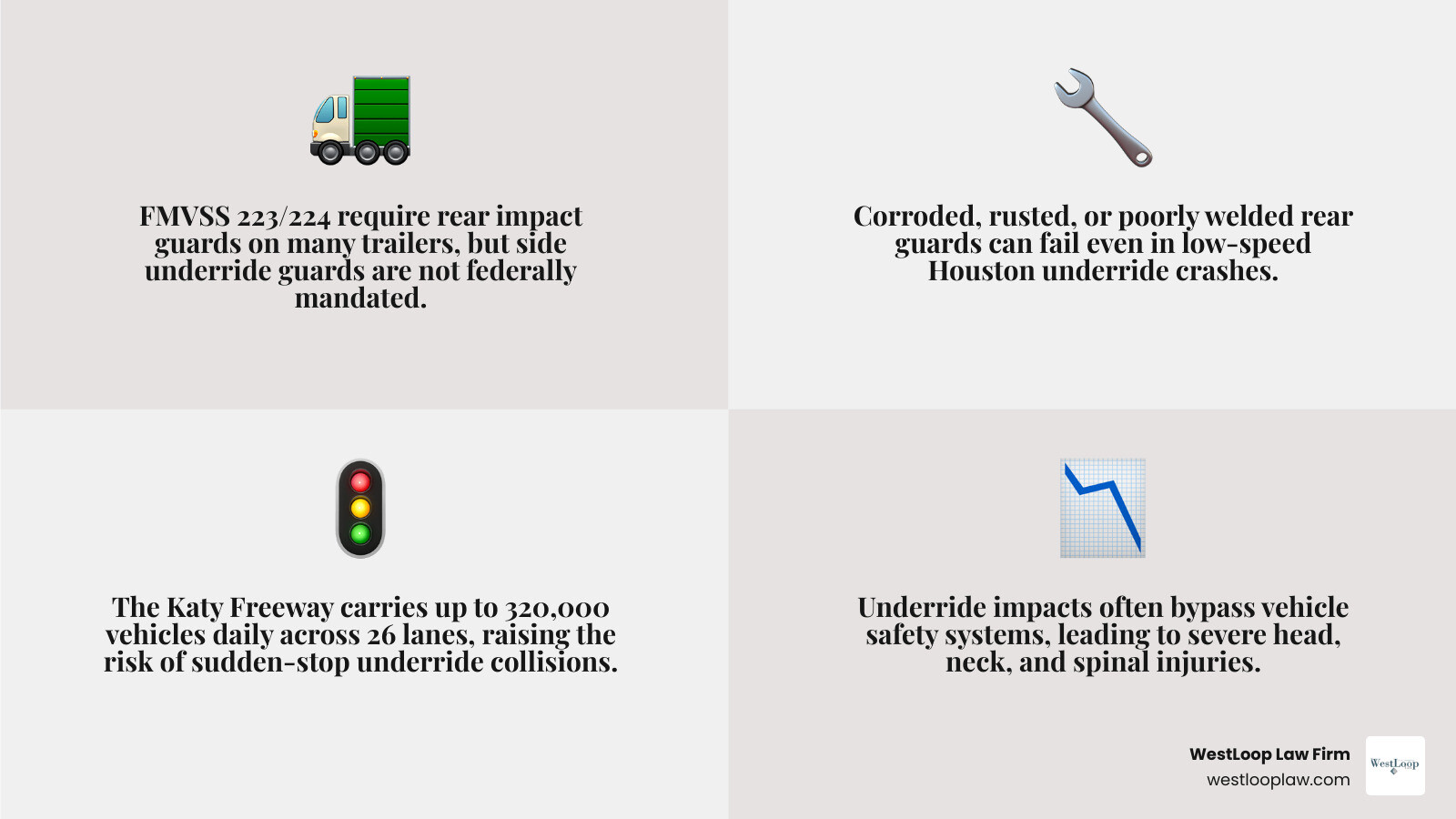
Houston’s crowded freeway system adds risk. The Katy Freeway carries roughly 220,000 to 320,000 vehicles a day and reaches up to 26 lanes in some areas. Sudden braking, lane changes, poor visibility, stopped trucks, and failed or damaged guards can turn a momentary loss of control into a catastrophic collision.
Federal rules require many trailers to have rear impact guards under Federal Motor Vehicle Safety Standards 223 and 224. But side guards are generally not required by federal law. When a rear guard is missing, corroded, poorly maintained, or fails in a crash, responsibility may extend beyond the driver to the carrier, maintenance provider, or trailer manufacturer.
Evaluating full 18 wheeler collision damages is a critical part of pursuing a Houston big rig lawsuit alongside a dedicated truck injury attorney in Houston.
Why Underride Collisions Happen on High-Volume Houston Corridors
Houston is home to some of the busiest and widest highways in the world. When you combine massive commercial freight movement with relentless commuter traffic, the probability of severe wrecks rises dramatically. Harris County logs more than 6,100 commercial vehicle crashes each year. In 2024 alone, the county recorded 579 traffic fatalities across 546 fatal crashes, leading the state of Texas in roadway deaths.

High-density corridors like Interstate 10, Interstate 45, Highway 290, and Loop 610 present specific challenges that foster underride scenarios:
- Complex Multi-Lane Merging: Navigating up to 26 lanes on segments of the Katy Freeway requires constant lane changes. Passenger cars can easily get caught in a truck driver’s extensive blind spots.
- Sudden Deceleration and Stop-and-Go Traffic: Traffic bottlenecks near the West Loop or downtown interchanges cause abrupt slowdowns. When a tractor-trailer slows down rapidly without working brake lights, or when a commuter encounters stopped traffic around a blind curve, rear-end underrides can occur before the driver can engage emergency braking.
- Shoulder Parking Hazards: Disabled or resting commercial vehicles parked on the narrow shoulders of urban freeways create fixed obstacles. A recent Fatal Katy Freeway Crash: SUV Underrides 18-Wheeler in Houston demonstrated how quickly a vehicle losing control can slide beneath a stationary trailer, bypassing typical bumper crumple zones entirely.
Nationwide, underride crashes claim roughly 89 lives each year. Because passenger vehicles sit significantly lower to the ground than commercial trailers, the hood slides directly under the trailer bed, causing the steel edge of the trailer to shear through the windshield pillars.
Federal Guard Regulations and Mechanical Guard Failures in an Underride Truck Accident Houston
To prevent passenger vehicles from slipping beneath trailers, the federal government instituted standards governing rear impact guards, commonly known as Mansfield bars.
Federal Motor Vehicle Safety Standards (FMVSS) 223 and 224 set minimum strength and dimension guidelines for rear impact guards installed on newly manufactured commercial trailers. FMVSS 223 outlines the strength and energy-absorption performance criteria that guard equipment must satisfy during static testing. FMVSS 224 requires most trailers and semitrailers manufactured after January 26, 1998, to come equipped with rear impact guards meeting specific height and width dimensions.
Despite these regulations, serious mechanical failures and regulatory gaps persist:
- Lack of Mandatory Side Underride Protection: Federal standards strictly address rear guards. There is currently no mandatory federal rule requiring side underride guards on commercial trailers, leaving thousands of trailers traveling down Texas highways vulnerable to side-impact underrides during broadside or T-bone collisions.
- Structural Degradation and Rust: Commercial equipment operating in high-humidity environments like the Texas Gulf Coast experiences accelerated corrosion. Rust eats away at mounting brackets and vertical support posts, severely compromising the structural integrity of the guard.
- Weld and Fastener Failures: Poor welding techniques, mismatched hardware, or improper repairs performed by motor carrier maintenance shops can cause a guard to detach on impact rather than absorb crash energy.
- Speed Limitations of Standard Guards: Most rear guards are certified to withstand crashes at moderate speeds. When impacts occur at standard freeway speeds, even compliant guards can buckle, crack, or tear away from the trailer chassis entirely.

How to Determine Liability After an Underride Collision
Resolving liability after an underride collision involves analyzing physical evidence, maintenance histories, and driver actions. Because tractor-trailers operate within a commercial network, multiple legal entities may share fault for a collision.
| Liable Party | Basis for Legal Claim | Key Evidence Needed |
|---|---|---|
| Commercial Truck Driver | Negligent operation, distracted driving, unsafe lane changes, illegal shoulder parking. | Dashcam footage, cellphone records, driver logs, police crash report. |
| Motor Carrier / Trucking Company | Vicarious liability, negligent hiring, failure to train, poor vehicle maintenance policies. | Carrier safety audits, dispatch logs, internal inspection protocols, hours-of-service data. |
| Trailer / Guard Manufacturer | Defective design, substandard metallurgy, failure to meet FMVSS requirements. | Metallurgical failure reports, manufacturing blueprints, stress test results. |
| Third-Party Maintenance Contractor | Substandard weld repairs, failure to identify cracked supports, negligent annual inspections. | Third-party work orders, certified inspector logs, mechanic records. |
| Cargo Loading Facility | Improper weight distribution, overloading that alters trailer ride height. | Bills of lading, scale receipts, cargo manifests. |
Identifying Negligence in an Underride Truck Accident Houston
Establishing negligence on the part of the commercial driver or carrier requires digging deep into electronic and regulatory data. Under Federal Motor Carrier Safety Administration (FMCSA) rules, commercial carriers must adhere to strict operational guidelines:
- Hours-of-Service (HOS) Violations: Fatigued driving leads to delayed reaction times and improper maneuvers. Analyzing Electronic Logging Device (ELD) data reveals whether the driver was on the road beyond allowable drive-time windows.
- Improper Parking Practices: Leaving an 18-wheeler stopped along highway travel lanes, ramps, or narrow shoulders without deploying emergency reflective triangles creates an illegal road hazard under Texas law.
- Inadequate Conspicuity Tape and Lighting: Trailers must display retroreflective sheeting and fully functional tail lamps. If dirt, damage, or electrical failure obscures a trailer at night, passing motorists cannot gauge stopping distances accurately.
Evaluating Manufacturer and Maintenance Liability in an Underride Truck Accident Houston
When an underride guard fails during an accident, the trailer builder or maintenance provider may face direct product liability or third-party negligence claims.
Trailer safety investigations often focus on:
- Defective Guard Geometry: Guards that sit too high off the road surface allow lower-profile passenger sedans to wedge underneath before the bumper engages the guard beam.
- Substandard Metal Alloys: Some manufacturers have utilized cheaper metal alloys that shear or snap under stress rather than bending to disperse collision energy.
- Failure to Replace Damaged Hardware: If a trailer was previously involved in a minor backing incident or loading-dock strike that bent the guard, failing to repair or replace that component before sending the rig back on the road is clear negligence.
How to Protect Your Rights and Maximize Compensation Under Texas Law
Handling the aftermath of an underride collision requires prompt action to preserve evidence and secure full legal recovery for your damages.
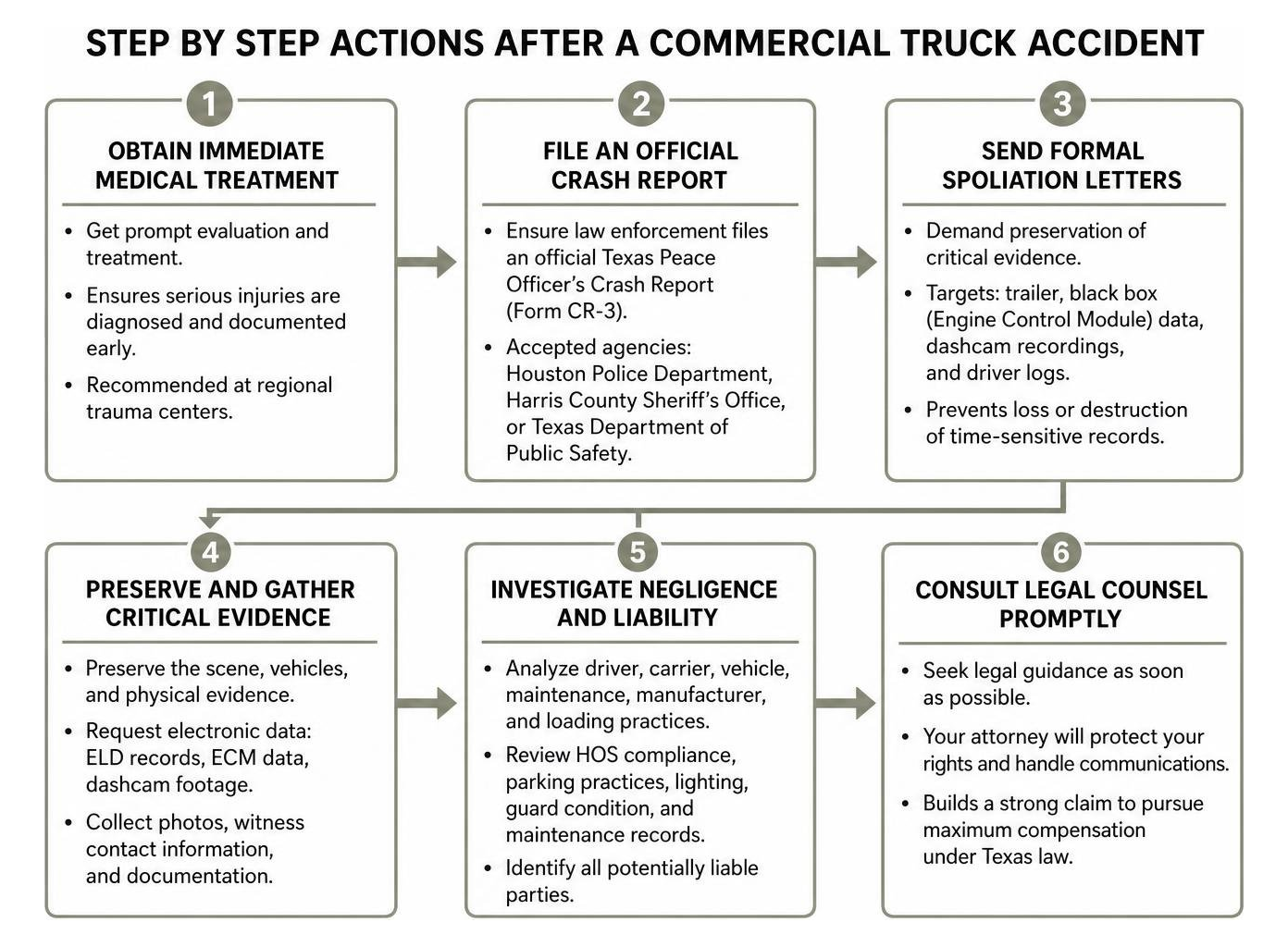
Critical Steps Following a Crash
- Obtain Immediate Medical Treatment: Prompt medical evaluation at regional trauma centers like Memorial Hermann-Texas Medical Center or Ben Taub Hospital ensures serious injuries, including traumatic brain injuries and spinal damage, are diagnosed and documented immediately.
- File an Official Crash Report: Ensure the Houston Police Department, Harris County Sheriff’s Office, or Texas Department of Public Safety files an official Texas Peace Officer’s Crash Report (Form CR-3).
- Send Formal Spoliation Letters: Commercial trucking firms are only required to retain certain records for limited periods unless formally instructed to preserve them. A spoliation letter demands the preservation of the trailer, black box (Engine Control Module) data, dashcam recordings, and driver logs.
- Gather On-Scene Documentation: Photographs of guard damage, skid marks, road debris, lighting conditions, and trailer identification numbers establish critical physical evidence.
Navigating Texas Comparative Fault and Damage Recovery
Under Chapter 33 of the Texas Civil Practice and Remedies Code, injury claims are evaluated under a modified comparative negligence system, often called proportionate responsibility:
- The 51 Percent Bar Rule: You can recover damages as long as your share of responsibility for the crash is 50 percent or less. If you are found to be 51 percent or more at fault, Texas law prevents you from collecting compensation.
- Proportional Reduction: If you are awarded compensation but found partially at fault (for example, 15 percent at fault for driving slightly over the speed limit), your total financial recovery will be reduced by that exact percentage.
- Texas Statute of Limitations: In Texas, personal injury and wrongful death lawsuits must generally be filed within two years from the date the accident occurred. Missing this statutory deadline almost always results in a complete forfeiture of your right to seek legal remedies in court.
Victims and surviving family members may pursue both economic damages (medical bills, future therapy, lost income, lost earning capacity) and non-economic damages (pain and suffering, mental anguish, physical impairment, and loss of companionship).
Frequently Asked Questions About Houston Truck Underride Crashes
What is the difference between side and rear underride crashes?
A rear underride crash occurs when a passenger vehicle strikes the back of a trailer and slides beneath the cargo deck. Rear trailers are required by federal law to feature safety guards, although guard strength and condition vary widely. A side underride crash happens when a car collides with the exposed flank of a trailer—such as when a truck makes an improper U-turn, pulls across traffic, or changes lanes abruptly. Because side guards are not federally mandated, side underride collisions carry an exceptionally high risk of passenger cabin intrusion.
Can I recover compensation if I was partially at fault for an underride crash in Texas?
Yes. Under the Texas proportionate responsibility framework, you remain eligible to collect financial recovery as long as you are 50 percent or less responsible for the collision. The court will reduce your total damages in proportion to your determined percentage of fault.
What evidence is critical immediately following an underride collision?
Essential evidence includes the truck’s Engine Control Module (ECM) data, which captures speed, braking actions, and throttle position leading up to the collision. Other vital records include the driver’s Electronic Logging Device (ELD) hours-of-service records, dashcam video, post-crash inspection reports conducted by commercial vehicle enforcement officers, and the physical trailer itself to evaluate guard weld strength and metal integrity.
Navigating Complex Underride Claims with Westloop Law Firm
Truck underride collisions are legally complex and technically demanding. When a passenger vehicle slides beneath a heavy commercial trailer, the resulting injuries can alter a family’s life forever. Holding every responsible party accountable requires a detailed understanding of both state liability laws and federal motor carrier regulations.
At Westloop Law Firm, we are dedicated to helping injury victims and grieving families navigate the aftermath of commercial vehicle wrecks. In addition to our personal injury practice, our combined background in Texas probate law allows us to effectively manage wrongful death estates, protect the rights of surviving beneficiaries, and streamline probate matters alongside catastrophic accident litigation.
If you or a loved one has suffered injuries in an underride crash, explore our Houston truck accident resource guide to understand your options, learn more about our firm and practice areas, and take the first step toward securing the justice and compensation you deserve.