 Skip to content
Types of 18 Wheeler Collision Damages You Can Recover
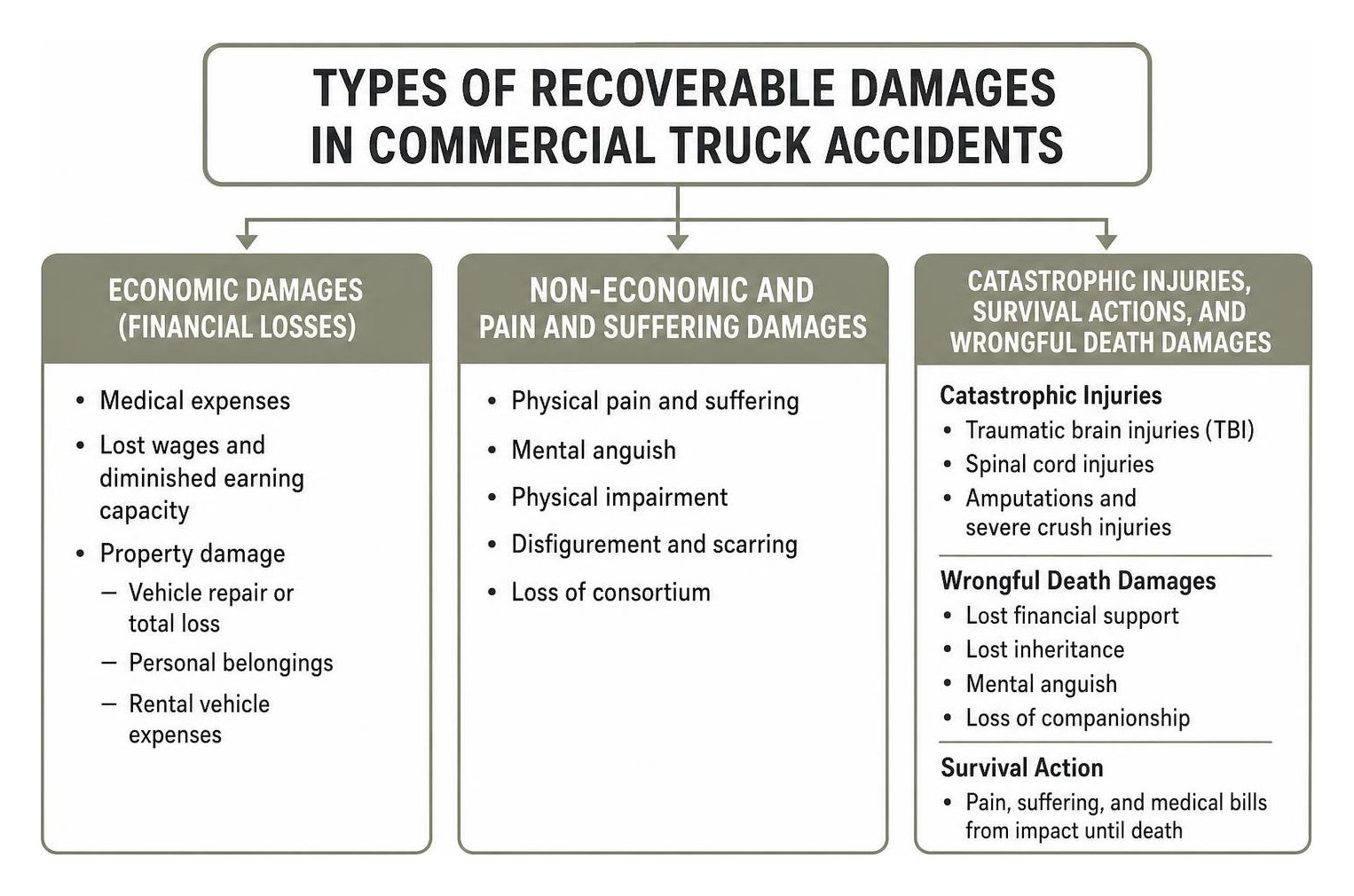
When a heavy commercial truck hits a passenger vehicle, the law divides potential compensation into specific categories under Texas civil law. In personal injury cases, compensation is broadly referred to as compensatory damages, which are designed to restore an injured person as closely as possible to the financial, physical, and emotional position they were in before the crash occurred.
These compensatory damages are broken down into two distinct categories:
- Economic damages: Tangible, out-of-pocket financial losses backed by bills, receipts, paystubs, and economic forecasts.
- Non-economic damages: Subjective, intangible losses that represent the personal, physical, and emotional toll of the collision.
In addition to compensatory damages, Texas law permits the recovery of exemplary (punitive) damages in specific situations involving gross negligence, malice, or intentional harm. Unlike economic and non-economic damages, exemplary damages are not awarded to repay you for your losses; they serve to punish the wrongdoer and deter similar conduct across the trucking industry. Under Chapter 41 of the Texas Civil Practice and Remedies Code, exemplary damages require clear and convincing evidence that the trucking company or driver acted with conscious indifference to the rights, safety, or welfare of others. Texas statutory caps limit exemplary damages to the greater of $200,000, or two times economic damages plus an amount equal to non-economic damages up to $750,000.
Calculating Economic 18 Wheeler Collision Damages
Economic damages represent every dollar that the collision costs you directly. Because commercial truck crashes often involve violent forces, economic losses can mount rapidly into hundreds of thousands of dollars.
Key economic components include:
- Past medical expenses: Emergency room care, trauma surgery, intensive care stays, diagnostic imaging, prescription medications, and inpatient hospitalization.
- Future medical treatment: Long-term physical therapy, additional surgeries, pain management, home health assistance, and medical devices.
- Lost income: Paychecks missed while recovering from your injuries, attending medical appointments, or resting under a doctor’s orders.
- Loss of earning capacity: Diminished lifetime earning potential if a permanent impairment prevents you from returning to your prior trade or working full-time.
- Property damage: The total loss or repair cost of your passenger vehicle, damaged personal belongings inside the car, and rental vehicle expenses.
Managing these expenses requires an organized approach to billing and insurance coordination. For practical guidance on handling these overwhelming expenses, our resource on handling steep truck accident medical bills covers medical liens, subrogation, and insurer delays in detail.
Non-Economic and Pain and Suffering Damages
The physical destruction of a commercial vehicle collision extends far beyond bills and invoices. Non-economic damages compensate you for the daily, lived reality of your trauma:
- Physical pain and suffering: The acute agony of fractures, surgeries, and burns, as well as lingering chronic pain from nerve or joint damage.
- Mental anguish: Psychological trauma, sleep disturbances, post-traumatic stress disorder (PTSD), anxiety, and depression caused by surviving a violent crash.
- Physical impairment: The loss of the ability to engage in daily routines, participate in sports, care for children, or maintain an independent lifestyle.
- Disfigurement and scarring: Permanent alterations to your appearance resulting from surgical scars, burns, or lacerations.
- Loss of consortium: The disruption of companionship, affection, and intimacy within a marriage or family relationship.
Insurance companies often downplay non-economic harms because they do not come with an invoice attached. Proving these damages requires detailed testimony from treating physicians, mental health counselors, family members, and personal daily symptom journals.
Catastrophic Injuries, Survival Actions, and Wrongful Death Damages
When a crash causes severe trauma or loss of life, the scope of damages expands significantly. In August 2026, data shows that over 5,340 people die annually in commercial truck collisions across the country, with 62% to 72% of fatalities occurring among occupants of passenger vehicles.
Catastrophic injuries include:
- Traumatic brain injuries (TBI): Ranging from severe concussions to permanent cognitive loss, requiring lifelong care and commanding settlements ranging from $250,000 to over $2,000,000.
- Spinal cord injuries: Paraplegia, quadriplegia, or severe herniations that mandate lifelong mobility equipment and home modifications.
- Amputations and severe crush injuries: Irreversible loss of limbs common in violent underride or multi-vehicle pileups.
When a commercial crash results in a fatality, Texas law allows surviving family members (spouses, children, and parents) to bring a wrongful death lawsuit for lost financial support, lost inheritance, mental anguish, and loss of companionship.
Additionally, a survival action may be brought under the Texas Civil Practice and Remedies Code on behalf of the deceased person’s estate to recover the pain, suffering, and medical bills the decedent experienced from the moment of impact until their death. Navigating the intersection of estate administration and personal injury litigation requires coordinated handling. For a full breakdown of these legal rights, consult our comprehensive 18 wheeler accident compensation guide.
How Commercial Insurance Limits and Federal Regulations Shape Settlement Values
The recovery ceiling in a passenger car collision is often restricted by state minimum auto policies (which in Texas can be as low as $30,000 per person). Commercial motor carriers operate under strict federal oversight that mandates much higher financial responsibility.
Under federal regulation 49 CFR §387.9, commercial carriers operating in interstate commerce must maintain substantial minimum liability insurance limits:
- $750,000 baseline: Required for for-hire carriers transporting non-hazardous property in vehicles over 10,001 pounds.
- $1,000,000 to $5,000,000: Required for carriers hauling hazardous materials, oil, or toxic substances.
- $300,000: Required for commercial vehicles under 10,001 pounds GVWR carrying non-hazardous freight.
Commercial insurance policies also often include an MCS-90 endorsement. This federally mandated endorsement guarantees that injured members of the public can recover compensation for negligence up to the statutory minimum, even if the trucking company failed to follow specific policy terms or reporting rules.
Understanding how policy limits dictate recovery is essential when calculating claim value. You can read a detailed commercial truck accident liability limits analysis to see how these federal standards establish the baseline for significant settlement recoveries. For a step-by-step review of the claims process, check our guide on filing a Houston trucking insurance claim.
How Multi-Party Commercial Liability Expands Recovery
Unlike typical car accidents where only the other driver is responsible, commercial trucking involves an entire supply chain. When damages exceed a single policy limit, identifying multiple at-fault parties allows for commercial policy stacking:
- The truck driver: Directly liable for negligent actions such as speeding, distracted driving, or driving while fatigued.
- The motor carrier (trucking company): Vicariously liable under the doctrine of respondeat superior, or directly liable for negligent hiring, improper training, and forcing drivers to violate safety rules.
- Freight brokers and shippers: Potentially liable for negligently selecting an unsafe carrier with a history of safety violations.
- Cargo loading companies: Liable if unbalanced, overloaded, or improperly secured cargo causes a rollover, jackknife, or shifting load crash.
- Truck and parts manufacturers: Liable under product liability law for defective brake systems, blown tires, or failing steering components.
- Third-party maintenance providers: Liable for substandard mechanical repairs or failing to identify critical brake wear during inspections.
Stacking these policies creates access to several layers of primary, umbrella, and excess liability coverage, ensuring that catastrophic injuries receive full financial consideration.
How Fault and Texas Laws Determine 18 Wheeler Collision Damages
Proving liability in an 18-wheeler collision requires showing that a party failed to meet their legal duty of care, directly causing the collision and resulting damages. In commercial trucking, proving negligence often relies on demonstrating violations of Federal Motor Carrier Safety Administration (FMCSA) regulations.
When a driver or trucking carrier violates mandatory federal rules—such as Part 395 (Hours of Service) or Part 396 (Inspection, Repair, and Maintenance)—that safety violation can serve as compelling evidence of negligence.
To understand why commercial claims are distinct, consider how they compare to typical passenger auto claims:
| Feature | Standard Car Accident Claim | Commercial 18-Wheeler Claim |
|---|---|---|
| Typical Insurance Minimum | $30,000 to $100,000 | $750,000 to $5,000,000+ (49 CFR §387.9) |
| Responsible Parties | Usually individual driver only | Driver, carrier, broker, loader, mechanic, manufacturer |
| Federal Oversight | State traffic laws only | Extensive FMCSA safety regulations |
| Critical Evidence | Police report, photos, witness testimony | Black box (ECM), ELD logs, telematics, inspection files |
| Average Settlement | $15,000 to $45,000 | $73,000 to $552,000+ (averaging $185,000 to $650,000 for semis) |
| Defense Strategy | Insurance claims adjuster | Rapid-response corporate legal defense team |
How Comparative Negligence Affects 18 Wheeler Collision Damages
Texas follows a modified comparative fault rule known as proportionate responsibility, codified under Chapter 33 of the Texas Civil Practice and Remedies Code. Under this rule:
- You can recover damages as long as you are 50% or less at fault for the crash.
- If you are found 51% or more at fault, you are completely barred from recovering any compensation.
- Your total compensation award is reduced in direct proportion to your percentage of fault. For example, if your total damages equal $500,000, but a jury finds you were 20% responsible because of a lane change, your recovery is reduced by 20% ($100,000), leaving a net recovery of $400,000.
Commercial insurance adjusters frequently use proportionate responsibility as a defense tactic, attempting to assign partial blame to the passenger car driver to reduce payouts or eliminate liability under the 51% bar.
Crucial Evidence Needed to Prove Full Claim Value
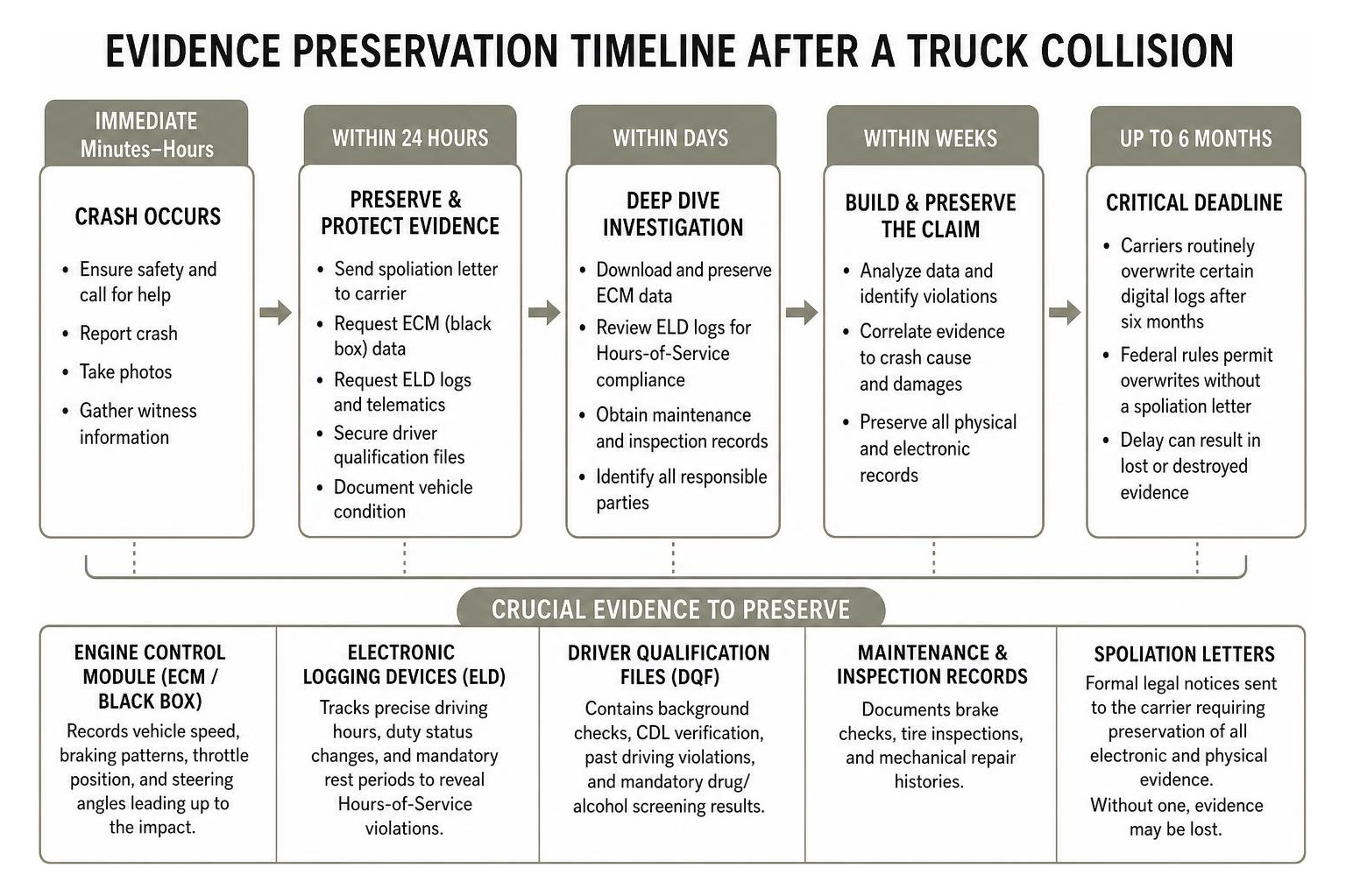
Commercial vehicle claims move fast because trucking companies deploy rapid-response investigators to the scene within hours. Key evidence must be protected immediately before it is lost, overwritten, or destroyed:
- Engine Control Module (ECM / Black Box): Records vehicle speed, braking patterns, throttle position, and steering angles leading up to the impact.
- Electronic Logging Devices (ELD): Tracks precise driving hours, duty status changes, and mandatory rest periods to reveal Hours-of-Service violations.
- Driver Qualification Files (DQF): Contains background checks, commercial driver’s license (CDL) verification, past driving violations, and mandatory drug/alcohol screening results.
- Maintenance and Inspection Records: Documents brake checks, tire inspections, and mechanical repair histories.
- Spoliation Letters: Formal legal notices sent to the carrier requiring them to preserve all electronic and physical evidence. Without a prompt spoliation letter, federal rules permit carriers to routinely overwrite certain digital logs after six months.
Major freight corridors in Houston regularly see severe commercial wrecks that demonstrate the critical importance of preserving this evidence. For example, dramatic incidents like the local crash reporting on Katy Freeway 18-wheeler collisions highlight the extreme physical destruction that occurs when heavy trucks lose control on busy interchanges.
Critical Steps to Protect Your Truck Crash Claim in Houston
Taking deliberate actions immediately after a crash can protect both your physical recovery and your legal rights:
- Call 911 immediately: Ensure emergency medical responders and law enforcement dispatch to the scene. The official Texas Peace Officer’s Crash Report provides vital initial documentation of the parties, vehicles, and road conditions.
- Seek a full medical trauma evaluation: Even if adrenaline masks your pain, undergo an immediate medical evaluation at an emergency room or urgent care center. Latent injuries like concussions, internal bleeding, and soft tissue damage often take 24 to 48 hours to manifest.
- Gather evidence at the scene: If you are physically able and safe to do so, photograph the truck, trailer DOT numbers, license plates, passenger vehicle damage, skid marks, road conditions, and traffic control signals.
- Collect witness details: Obtain names, phone numbers, and addresses from any independent bystanders or motorists who witnessed the collision.
- Never give a recorded statement to the trucking insurer: Commercial adjusters call quickly to ask leading questions designed to obtain statements they can use to assign comparative fault. You are under no legal obligation to give a recorded interview to the other driver’s insurer.
- Follow medical treatment until Maximum Medical Improvement (MMI): Attend all follow-up appointments, physical therapy sessions, and physician evaluations. Calculating a settlement before reaching MMI risks leaving future medical costs unpaid.
For practical advice on managing the aftermath of a major crash, read our 6 smart Houston 18 wheeler accident claims tips to avoid common mistakes.
Frequently Asked Questions About 18 Wheeler Collision Damages
What is the average settlement payout for an 18-wheeler collision?
Across all commercial vehicle injury claims, verified case studies show an overall average settlement of approximately $103,654. However, for semi-truck collisions specifically, average settlement ranges typically fall between $185,000 and $650,000, with severe and catastrophic injury settlements regularly exceeding $1,000,000 to $5,000,000. Settlements vary depending on medical costs, lifetime lost earning potential, liability clarity, and commercial policy limits.
How long do I have to file an 18-wheeler accident lawsuit in Texas?
Under the Texas Civil Practice and Remedies Code Section 16.003, the standard statute of limitations for personal injury and wrongful death lawsuits is two years from the date of the incident. Waiting too long can permanently bar your claim. More importantly, critical digital evidence like black box data and ELD records can be overwritten within weeks if formal legal steps are not taken right away.
How are pain and suffering damages calculated in commercial truck cases?
Insurance companies and attorneys calculate non-economic damages primarily through two methods:
- The Multiplier Method: Total economic damages (medical bills, lost earnings) are multiplied by a number typically ranging from 1.5x to 5x (or up to 7x for severe truck collisions), depending on injury permanency, pain levels, and life disruption.
- The Per Diem Method: A daily financial rate (often based on your daily working wage) is assigned and multiplied by the number of days you are expected to suffer from the injury.
Protect Your Legal Rights and Future Financial Recovery in Houston
A collision with an 80,000-pound commercial vehicle can disrupt your health, livelihood, and financial stability in an instant. Trucking motor carriers and commercial insurance providers act quickly to protect their own bottom lines, deploying investigators and defense teams to minimize claim payouts.
At WestLoop Law Firm, our team is dedicated to standing up for injured individuals and grieving families throughout Houston. With our combined background handling both serious personal injury litigation and complex estate administration, we are uniquely equipped to manage multi-party commercial claims, catastrophic injury cases, and wrongful death survival actions on behalf of estates.
You do not have to confront multi-billion-dollar trucking insurers alone. To learn more about navigating your claim, explore WestLoop Law Firm’s ultimate Houston truck accident guide or contact WestLoop Law Firm today to schedule a confidential case review.