 Skip to content

Protect Your Finances With a Durable Power of Attorney in Houston
What to do first
- Choose a trusted person to handle your financial matters if you cannot.
- Decide which powers that person needs, such as paying bills or managing bank accounts.
- Complete a Texas durable power of attorney while you can make your own decisions, then sign it before a notary.
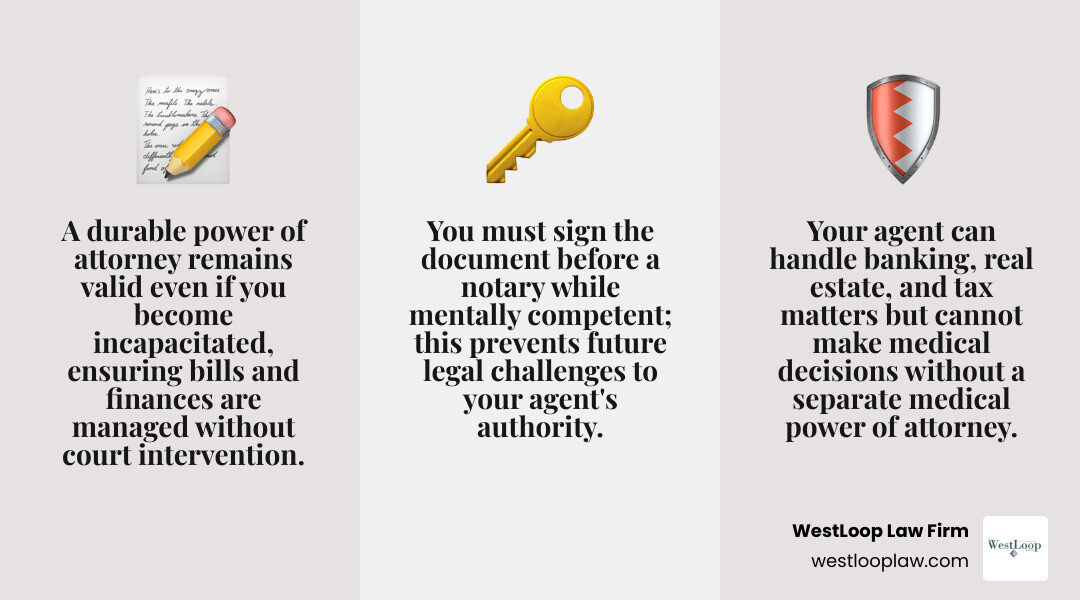
A durable power of attorney lets your chosen agent manage the financial matters you authorize, even if you later become incapacitated. That can help keep bills paid during a long recovery after an injury. It does not give the agent authority to make medical decisions; Texas uses a separate medical power of attorney for that. A properly prepared durable power of attorney in Houston can protect your family from unnecessary court involvement and financial disruption. Consulting a Houston elder law attorney or a Houston asset protection lawyer helps ensure your financial directives align with your long-term goals.
What Is a Durable Power of Attorney in Houston Under Texas Law?
A durable power of attorney is an essential legal instrument designed to protect your personal estate, business, and family wealth from unexpected life events. Under the Texas Estates Code, this document allows you (the principal) to name a trusted individual or entity (the agent or attorney-in-fact) to manage your property, finances, and legal commitments.
Life in Houston moves fast. Whether commuting down I-10, navigating heavy traffic on Loop 610, or traveling along Beltway 8, an unexpected collision or sudden medical emergency can occur without warning. If you suffer severe injuries and become incapacitated, bills do not stop arriving. Mortgages on homes in the Heights, commercial leases near Downtown Houston, and property tax obligations across Harris County still come due.
Without a valid financial authorization, your loved ones could find themselves locked out of your financial accounts. Learning how to properly structure your affairs through a power of attorney in Houston allows your family to maintain financial stability without interruption.
Understanding the Difference Between General and Durable Power of Attorney
The primary distinction between a standard general power of attorney and a durable power of attorney centers entirely on what happens during mental incapacity:
- General Power of Attorney: Automatically terminates the exact moment the principal loses mental capacity or becomes disabled. If you suffer a traumatic brain injury or develop cognitive decline, a regular general power of attorney immediately becomes void—rendering it useless when protection is needed most.
- Durable Power of Attorney: Contains explicit statutory language ensuring the agent’s legal authority continues uninterrupted even after the principal experiences disability or incapacity.
- Court-Ordered Guardianship: A formal, public, and contentious probate court process where a judge decides who manages your personal and financial affairs when no valid power of attorney exists.
| Feature | General Power of Attorney | Durable Power of Attorney | Court-Appointed Guardianship |
|---|---|---|---|
| Validity During Incapacity | Ends immediately upon incapacity | Remains fully valid and effective | Initiated only after proven incapacity |
| Court Involvement | None | None | Extensive oversight by Harris County Probate Court |
| Privacy Level | High (Private agreement) | High (Private agreement) | Low (Public record and public hearings) |
| Creation Timing | While principal has capacity | While principal has capacity | After a person has already lost capacity |
| Cost & Delay | Minimal cost, immediate use | Minimal cost, immediate use | Significant legal fees, bonding, and delays |
Statutory Requirements for Executing a Durable Power of Attorney in Houston
To create an enforceable document in Texas, strict compliance with statutory guidelines is mandatory. Under Tex. Est. Code § 752.051, the instrument must be executed with specific formal elements:
- Legal Capacity: The principal must be an adult of sound mind at the precise time of signing.
- Writing and Designation: The document must be written, clearly identifying the principal and appointing the agent.
- Mandatory Durability Clause: The form must include explicit phrasing such as: “This power of attorney is not affected by subsequent disability or incapacity of the principal,” or equivalent statutory wording.
- Formal Acknowledgment: The principal must sign the document before an authorized officer, such as a licensed notary public.
Proper execution ensures that third parties recognize your agent’s standing when managing financial and medical affairs under a power of attorney becomes a time-sensitive reality.
Key Powers and Custom Provisions in a Texas Statutory Durable Power of Attorney

Under Texas Estates Code Chapter 751 and Chapter 752, the Texas statutory durable power of attorney provides a comprehensive framework listing powers labeled A through N, along with an overarching option O.
A principal can initial specific lines to grant limited authority or initial line (O) to provide comprehensive management over all listed categories.
Immediate vs. Springing Powers of Attorney
Texas law allows principals to decide when their agent’s powers take effect:
- Immediate Effectiveness: The agent possesses legal authority the moment the document is signed and notarized. This approach avoids operational delays during emergencies, enabling a trusted agent to pay urgent bills without producing medical certifications.
- Springing Effectiveness: Authority springs into effect only upon the principal’s verified medical incapacity or disability. While this structure offers peace of mind to principals concerned about premature agent action, it often creates administrative friction. Financial institutions and title companies routinely demand formal physician affidavits, written disability letters, and legal confirmations before honoring a springing power of attorney.
Specific Powers Requiring Express Authorization
To safeguard principals from unauthorized asset depletion, Texas law strictly dictates that certain high-impact actions cannot be performed unless they are explicitly authorized in the document. A general grant of authority over all statutory categories is insufficient for these critical matters:
- Making Gifts: The agent cannot make gifts of your property unless the power of attorney specifically grants gifting power, often restricted to the annual federal gift tax exclusion.
- Creating or Modifying Trusts: Establishing, revoking, or amending living trusts requires explicit, unambiguous authorization.
- Changing Beneficiary Designations: Modifying life insurance policies, annuities, or retirement accounts demands distinct textual inclusion.
- Delegating Authority: Designating sub-agents or delegating granted fiduciary authority to third parties.
Co-Agents, Successors, and Agent Compensation
When drafting your document, you may appoint multiple agents. Under Texas law, unless specified otherwise, appointed co-agents can act independently without requiring joint signatures.
You should also designate alternate successor agents to step in if your primary choice resigns, passes away, or becomes incapacitated. Additionally, Texas statutes permit agents to receive reimbursement for reasonable expenses and reasonable compensation for their fiduciary services, unless you state otherwise in the document’s special instructions.
Agent Fiduciary Duties, Liabilities, and Third-Party Acceptance
Being appointed an agent under a durable power of attorney is a serious legal responsibility, not an open checkbook. In Texas, an agent is held to the highest standard under the law: a strict fiduciary duty.
An agent must act in good faith, maintain unwavering loyalty to the principal, avoid conflicts of interest, preserve the principal’s existing estate plan, and manage assets prudently. Agents who breach these duties face severe civil liability, court-ordered restitution, and potential criminal penalties for financial exploitation.
Recordkeeping and Accounting Obligations
An agent must maintain exhaustive, detailed records of every transaction conducted on behalf of the principal. Under Texas Estates Code § 751.104, the principal can demand a formal written accounting at any time. If the principal is incapacitated, interested parties—such as family members or court-appointed representatives—can petition a Harris County court to compel the agent to provide a comprehensive accounting of all income, expenditures, transfers, and remaining assets.
Third-Party Acceptance Rules and the 7-Day Requirement
Historically, banks and title companies frequently rejected valid powers of attorney out of caution or arbitrary internal rules. Texas modernized Chapter 751 to address this issue directly.
When presented with a statutory durable power of attorney, a financial institution has clear statutory timelines. The institution must accept the document, request an agent’s certification under penalty of perjury, or request an attorney’s opinion letter. Once those requested certifications are provided, the institution generally has 7 business days to accept or refuse the power of attorney. If a financial institution wrongfully refuses to honor a valid statutory durable power of attorney, it can be held liable for court costs and attorney’s fees incurred to compel acceptance.
Termination, Revocation, and Avoiding Costly Guardianship in Harris County
A durable power of attorney serves as your primary defense against an expensive, public guardianship proceeding in the Harris County Probate Courts. If you become incapacitated on I-45 or Beltway 8 and lack a valid durable power of attorney, your family may be forced to retain a guardianship attorney in Houston to seek emergency judicial authority over your estate.
Court-appointed guardianships require multiple attorney appointments, ongoing court oversight, annual bond payments, and public hearings. A well-crafted power of attorney eliminates these burdens by establishing clear private authority beforehand.
How to Revoke or Terminate Agent Authority
Under Texas law, an agent’s authority and the durable power of attorney itself terminate under specific circumstances:
- Principal’s Death: A power of attorney terminates immediately upon the death of the principal. An agent cannot access accounts, sell assets, or execute contracts after the principal passes away.
- Written Revocation: A principal with legal mental capacity can revoke a power of attorney at any time by executing a formal written revocation and delivering copies to the agent and financial institutions. Following the correct process to revoke power of attorney in Houston ensures outdated designations are legally canceled.
- Divorce: If your spouse was appointed as your agent and you subsequently divorce, their authority is automatically revoked by Texas statute unless the document explicitly states otherwise.
- Appointment of a Permanent Guardian: If a court appoints a permanent guardian of your estate, the durable power of attorney terminates automatically.
Common Mistakes to Avoid with a Durable Power of Attorney in Houston
Executing a durable power of attorney without thorough legal preparation can leave your family exposed to procedural rejections:
- Using Outdated or Generic Templates: Online forms often lack critical Texas-specific statutory protections, resulting in rejection by local banking branches.
- Failing to Record Real Estate Powers: Under Texas law, if an agent conducts real property transactions—such as selling a home in Memorial or leasing commercial property in Midtown—the durable power of attorney must be recorded with the Harris County Clerk within 30 days after the instrument is filed for recording.
- Overlooking Digital Assets: Omitting explicit authority over online banking portals, investment accounts, and business platforms can leave your agent locked out during an emergency.
- Neglecting Cross-Document Alignment: A durable power of attorney must align seamlessly with your overall plan, which is why coordinating with a Houston estate planning lawyer prevents conflicting legal instructions.
When auto accidents along the 610 Loop or severe personal injury claims leave an individual physically impaired, having an organized estate framework prevents financial chaos. In personal injury contexts, understanding how Texas personal injury claims work—including Personal Injury Protection (PIP), the 51% modified comparative-fault bar (which bars recovery if you are found more than 50% at fault), and the strict two-year statute of limitations—ensures that an appointed agent can properly pursue claims and manage settlement proceeds without delay.
Frequently Asked Questions About Texas Durable Powers of Attorney
Does a durable power of attorney allow medical decisions in Texas?
No. A durable power of attorney governs financial, legal, and business matters. To designate someone to make healthcare decisions, communicate with doctors at the Texas Medical Center, and review medical records, you must execute a separate medical power of attorney, HIPAA release authorization, and living will and healthcare power of attorney directive.
Can a financial agent access bank accounts after the principal passes away?
No. An agent’s authority ends the precise moment the principal passes away. After death, authority transfers to the designated executor named in the principal’s will or an administrator appointed through the Harris County Probate Court during formal estate administration.
Where should a durable power of attorney be filed in Houston?
In Texas, you do not need to file a durable power of attorney with a court or government agency for general financial and banking use. However, if your agent needs to buy, sell, encumber, or manage real estate, the original or a certified copy of the document must be formally recorded in the deed records of the Harris County Clerk’s Office. Keep the original document in a secure, accessible location and provide certified copies to your named agent and primary financial institutions.
Securing Your Houston Financial Legacy and Next Steps
Establishing a durable power of attorney gives you control over who manages your hard-earned assets if unexpected illness or severe injury strikes. Rather than leaving your family to navigate costly court oversight at the Harris County Civil Courts at Law or Probate Courts, a tailored Texas statutory power of attorney establishes an immediate, private safety net.
At Westloop Law Firm, our team understands how to coordinate asset management, probate safeguards, and personal injury protections. Connect directly with our Houston estate planning legal team or find us on Google via Westloop Law Firm to create a comprehensive plan that protects your family, your property, and your financial future.