 Skip to content

Understanding Your Rights with a Houston Fatal Motorcycle Lawyer
If you’re looking for a Houston fatal motorcycle lawyer, here’s what you need to know right now:
What can a Houston fatal motorcycle lawyer do for your family?
- File a wrongful death claim on behalf of eligible family members (spouse, children, parents)
- Pursue compensation for funeral costs, lost income, medical bills, and loss of companionship
- Investigate the crash and preserve critical evidence before it disappears
- Handle insurance companies so your family doesn’t have to
- Meet the 2-year statute of limitations under Texas law for wrongful death claims
Losing someone in a motorcycle crash is devastating. One moment, life is normal. The next, your family is facing grief, hospital bills, and a flood of calls from insurance adjusters.
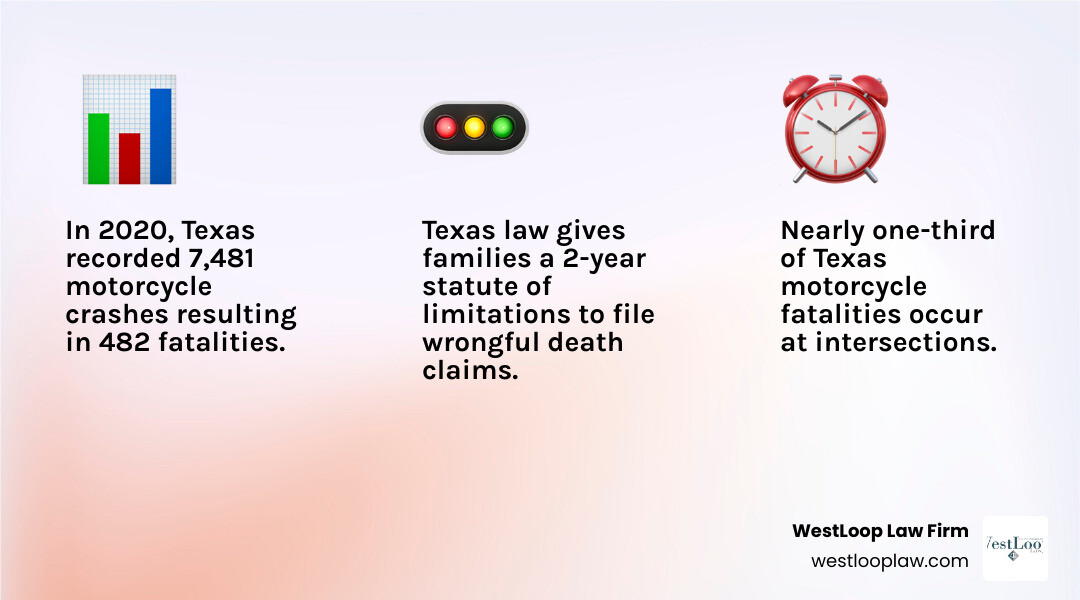
Texas roads are unforgiving for motorcyclists. In 2020 alone, there were 7,481 motorcycle crashes in Texas, resulting in 482 fatalities. Nearly one-third of all Texas motorcycle fatalities happen at intersections — many of them in busy Harris County corridors like Interstate 10 and Loop 610.
What makes this even harder: families are often approached by insurance companies within days of the crash, before they’ve had time to grieve — let alone understand their legal rights.
Texas law gives surviving family members the right to pursue justice. But the process is complex, time-sensitive, and full of pitfalls that can reduce or eliminate what your family is owed.
This guide walks you through exactly what your rights are, how Texas law applies, and what steps to take after a fatal motorcycle crash in Houston.
Related content about Houston fatal motorcycle lawyer:
When a fatal crash occurs, Texas law provides two distinct pathways for families to seek financial recovery and justice: the Texas Wrongful Death Act and Survival Actions. Understanding the difference between these two legal concepts is essential, and a dedicated Houston fatal motorcycle lawyer can help you handle both.
The Texas Wrongful Death Act
Under the Texas Wrongful Death Act, certain surviving family members can file a lawsuit to recover compensation for the losses they have personally suffered due to the death of their loved one. This is not about the pain the deceased felt; rather, it is about the hole left in the lives of the survivors.
Texas law strictly limits who can file a wrongful death claim. Eligible family members include:
- The Surviving Spouse: Even if the couple was separated, a legally wedded spouse has the primary right to file.
- The Children: Both minor and adult children can pursue a claim for the loss of a parent.
- The Parents: Surviving parents can file for the tragic loss of a child, regardless of the child’s age.
Siblings, cousins, and long-term unmarried partners do not have the legal standing to file a wrongful death claim under Texas law. If eligible family members do not file a claim within three calendar months of the death, the executor or administrator of the deceased’s estate can file instead, unless all eligible family members explicitly request otherwise. For a deeper look into this legal process, you can read our wrongful death lawsuit Houston guide.
Survival Actions
While a wrongful death claim covers the family’s losses, a survival action is designed to recover the damages the deceased person could have claimed if they had survived the crash. The deceased person’s personal injury claim “survives” their passing.
The personal representative or executor of the deceased’s estate files a survival action. Any compensation recovered through a survival action goes directly to the estate and is distributed according to the deceased’s will, or via Texas intestate succession laws if there was no will. Working with a knowledgeable Houston wrongful death attorney ensures that both pathways are utilized to secure full legal relief.
Common Causes of Fatal Motorcycle Crashes on Houston Highways
Houston’s massive highway system is notorious for heavy traffic, aggressive driving, and rapid lane changes. For motorcyclists, traveling on these roads is inherently dangerous. Because motorcycles are significantly smaller than passenger vehicles, they are easily lost in blind spots, especially on fast-moving, multi-lane freeways.
Our legal team frequently represents families in cases involving the most common causes of wrongful death on our roads. When we look at motorcycle crashes specifically, several recurring factors stand out:
- Intersection Collisions: Nearly one-third of all Texas motorcycle fatalities occur at intersections. The most common scenario involves a passenger vehicle turning left directly in front of an oncoming motorcycle because the driver failed to yield the right-of-way or misjudged the motorcycle’s speed.
- Speeding: In 2019, 33 percent of motorcyclists involved in fatal crashes were speeding at the time of impact. Excessive speed reduces the time any driver has to react to sudden changes in traffic.
- Distracted Driving: Drivers texting, using navigation apps, or otherwise distracted on busy corridors like Loop 610 or Interstate 10 frequently fail to notice motorcyclists until it is too late.
- Impaired Driving: Alcohol is a massive contributor to fatal crashes. In Texas, 42 percent of motorcyclists fatally injured in crashes were under the influence of alcohol at the time of the collision.
- Lane Changes and Blind Spots: Drivers changing lanes without checking their mirrors or blind spots often sideswipe motorcyclists or force them off the road.
Motorcyclists are highly vulnerable in these situations. The table below illustrates the extreme difference in vulnerability between a passenger vehicle occupant and a motorcycle rider:
| Crash Factor | Passenger Vehicle | Motorcycle |
|---|---|---|
| Structural Protection | Steel frame, crumple zones, roof support | None |
| Safety Features | Airbags, seatbelts, safety glass | Helmet and riding gear only |
| Average Weight | 3,000 to 4,000 lbs | 300 to 800 lbs |
| Roadway Visibility | High | Low (easily hidden in blind spots) |
| Ejection Risk | Low (if belted) | Extremely High |
Because of this physical disparity, riding a motorcycle is approximately 26 times more deadly than traveling in a car. When passenger car drivers fail to share the road responsibly, the results are often fatal. If you are seeking answers after a tragedy on our local highways, we invite you to read more about seeking justice after a fatal Houston collision.
Texas Motorcycle Safety and Licensing Laws
Texas has specific laws designed to keep riders safe, but insurance companies often try to use these laws against families after a crash.
First, Texas requires a Class M license to legally operate a motorcycle. If a rider did not have this license, insurance companies will try to claim they were incompetent or at fault, even if the other driver clearly ran a red light. Second, lane splitting — the practice of riding between lanes of stopped or slow-moving traffic — is illegal in Texas. If a rider was lane splitting when the crash occurred, it can heavily impact the liability determination.
How Texas Law Handles Fault and Insurance Tactics
Pursuing a legal claim after a fatal crash requires dealing with both complex state laws and aggressive insurance adjusters. Knowing what to expect can help you protect your rights.
Modified Comparative Negligence (The 50% Bar)
Texas operates under a modified comparative negligence system, also known as the “proportionate responsibility” rule. Under this law, a plaintiff can recover damages as long as they are not more than 50 percent responsible for the crash.
If the jury finds that the deceased motorcyclist was 20 percent at fault (for example, for traveling slightly over the speed limit) and the other driver was 80 percent at fault (for running a stop sign), the total compensation award will be reduced by 20 percent. However, if the jury decides the motorcyclist was 51 percent or more at fault, the family is completely barred from recovering any compensation.
Because of this rule, insurance companies will work tirelessly to shift even a small percentage of blame onto the motorcyclist. They know that every percentage point they pin on the rider is money they save.
Common Insurance Company Tactics
Insurance companies are businesses focused on protecting their bottom line. When facing a high-value claim like a fatal motorcycle accident, they often employ tactics to minimize payouts:
- Unfair Rider Bias: There is a persistent societal bias that motorcyclists are reckless thrill-seekers. Insurance adjusters exploit this stereotype, assuming the rider must have been speeding or riding unsafely.
- The “Quick Settlement” Trap: Adjusters may reach out to a grieving family within days of the crash, offering a quick settlement. These early offers are almost always lowball figures designed to close the case before the family realizes the true financial impact of their loss.
- Recorded Statement Requests: Adjusters will ask you to give a recorded statement to “help speed up the process.” In reality, they are looking for any phrasing they can use to twist your words and minimize their driver’s liability.
- Exploiting Helmet Use: If the rider was not wearing a helmet, the insurance company will argue that the rider was negligent, even though helmet use does not cause the crash itself.
To learn more about how to protect your family from these tactics, consult our comprehensive Houston motorcycle accident attorney guide or check out our resource on finding a motorcycle accident lawyer Houston Texas.
Proving Negligence with a Houston Fatal Motorcycle Lawyer
To win a wrongful death or survival action, we must prove that the other driver’s negligence caused the crash. Building a rock-solid case requires gathering and analyzing multiple types of evidence:
- Police Accident Reports: The official report from the Houston Police Department or Harris County Sheriff’s Office provides crucial initial details, citations issued, and diagrams of the scene.
- Eyewitness Statements: Independent witnesses who saw the crash can provide unbiased accounts of what happened.
- Accident Reconstruction: We frequently work with accident reconstruction professionals who use physical evidence (skid marks, vehicle damage, debris patterns) to recreate the crash in a digital format.
- Surveillance and Dashcam Footage: Nearby business security cameras, red-light cameras, or dashcams from other motorists can provide indisputable proof of the collision.
- Black Box Data: Many modern passenger vehicles contain Event Data Recorders (EDRs) that log speed, braking, and steering inputs in the seconds leading up to a crash.
Securing this evidence quickly is vital before skid marks fade, vehicles are repaired, or video footage is overwritten. For a step-by-step breakdown of how this evidence is used to build a claim, read our Houston wrongful death lawyer guide.
Recovering Damages with a Houston Fatal Motorcycle Lawyer
The financial and emotional toll of a fatal crash is immense. Under Texas law, families can pursue compensation for both economic and non-economic damages.
Economic Damages (Measurable Financial Losses)
- Medical Bills: Any medical care the deceased received between the time of the crash and their passing, including emergency room treatment at local facilities like Ben Taub Hospital or Memorial Hermann Hospital.
- Funeral and Burial Costs: The expenses associated with laying your loved one to rest.
- Lost Earning Capacity: The financial support the deceased would have provided to their family over the course of their expected working life.
Non-Economic Damages (Intangible Emotional Losses)
- Loss of Companionship and Society: Compensation for the loss of love, guidance, comfort, and companionship that the deceased provided.
- Mental Anguish: The emotional pain, grief, and sorrow suffered by the surviving family members.
- Loss of Consortium: Damage to the marital relationship.
Punitive Damages (Exemplary Damages)
In rare cases where the defendant’s actions were exceptionally reckless or intentional — such as a drunk driver with multiple prior DWIs or a commercial driver operating a vehicle with known, catastrophic brake failure — a jury may award punitive damages. These are designed to punish the wrongdoer and deter similar behavior in the future.
Handling these distinct damage categories requires a deep understanding of Texas civil law. Consulting a qualified wrongful death attorney Houston is the best way to ensure your family pursues the full value of your claim.
Immediate Steps for Families After a Fatal Houston Collision

When a fatal crash occurs, the immediate period following the crash can feel like a blur. While taking legal action is likely the last thing on your mind, taking a few key steps early can protect your family’s future:
- Request the Official Crash Report: Contact the law enforcement agency that responded to the crash (such as the Houston Police Department) to obtain a copy of the crash report. This usually takes 5 to 10 business days.
- Preserve the Motorcycle and Riding Gear: Do not repair, sell, or dispose of the motorcycle, helmet, or riding gear. This physical evidence can provide crucial details about the point of impact, speed, and the safety precautions the rider took.
- Do Not Give Recorded Statements: If the other driver’s insurance company calls you, politely decline to give a statement or sign any documents until you have spoken with a lawyer.
- Initiate the Probate Process: Because a survival action must be filed on behalf of the deceased’s estate, you will need to open a probate case in Harris County to have a personal representative appointed. This is a critical step that many traditional personal injury firms have to outsource, but handling both the injury claim and the probate process under one roof ensures nothing falls through the cracks.
- Consult an Attorney Early: The sooner a lawyer can begin investigating, the better your chances of preserving fleeting evidence and securing witness testimony.
If you need immediate assistance managing these early steps, our Houston wrongful death accident attorney resources and car accident wrongful death lawyer guides can help point you in the right direction.
Frequently Asked Questions About Houston Fatal Motorcycle Claims
What is the statute of limitations for a fatal motorcycle crash in Texas?
In Texas, the statute of limitations for filing a wrongful death or survival action lawsuit is generally two years from the date of the person’s death. Failing to file a lawsuit before this deadline passes usually means your family loses the right to pursue compensation forever.
There are very few exceptions to this rule. Additionally, if the crash involved a government vehicle (such as a city bus or municipal maintenance truck), you may have as little as six months to file a formal notice of claim. It is always best to speak with an attorney as soon as possible to ensure all deadlines are met.
Can we file a claim if the rider was not wearing a helmet?
Yes. Under Texas law, riders over the age of 21 are permitted to ride without a helmet if they have completed an approved safety course or carry a qualifying health insurance policy.
If the rider was legally riding without a helmet, the insurance company cannot use that fact to escape liability for causing the crash. However, if the cause of death was a head or traumatic brain injury, the defense may argue that the rider’s failure to wear a helmet contributed to the severity of the injury. A skilled lawyer can counter these arguments by focusing on the driver’s negligence that caused the crash in the first place.
How does the probate process affect a wrongful death lawsuit?
To pursue a survival action (which recovers damages for the deceased’s medical bills, pain, and suffering prior to death), a probate estate must be opened. The court must formally appoint an executor or personal representative to act on behalf of the estate.
This representative is the only person legally authorized to file and settle a survival action. Because wrongful death claims and probate issues are deeply intertwined in fatal crash cases, working with a firm that handles both personal injury litigation and probate administration saves families time, stress, and unnecessary legal fees.
Securing Justice and Financial Recovery for Your Family
Losing a loved one is one of the most painful experiences a family can endure. You shouldn’t have to carry the heavy burden of legal battles, probate courts, and aggressive insurance companies on your own.
At Westloop Law Firm, we offer a unique approach for families in Houston. We combine deep knowledge of personal injury litigation with experience in Texas probate law. This means we can seamlessly handle both your wrongful death lawsuit and the estate administration process required to secure survival damages, keeping your legal journey as smooth and stress-free as possible.
Our legal team is dedicated to holding negligent drivers accountable and helping your family find the financial stability you need to move forward. To learn more about our team, visit our page on Westloop Law Firm Attorneys or explore the Westloop Law Firm Homepage.
We offer free, confidential consultations to help you understand your options without any financial obligation. Contact us today to schedule your case review.