 Skip to content

What to Do After a Truck Delivery Accident in Houston
What to do first:
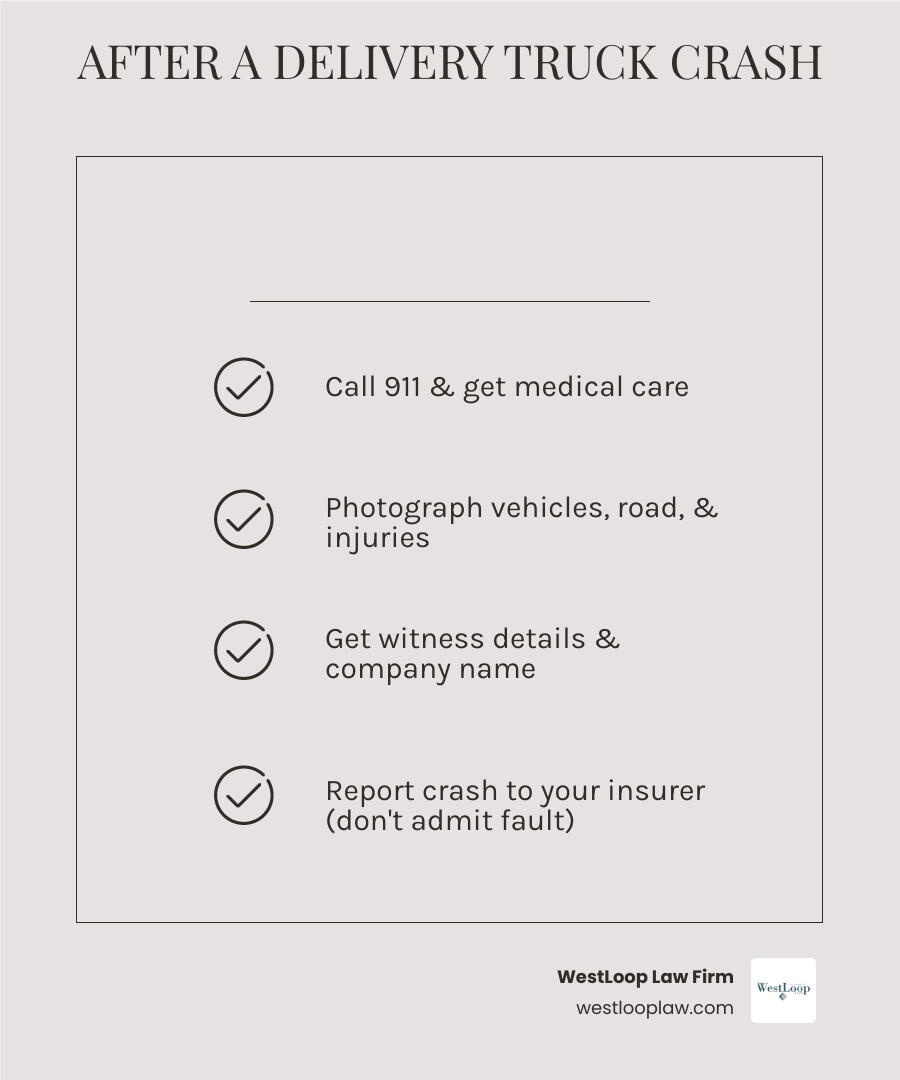
- Call 911. Get medical care, even if your injuries seem minor.
- Photograph the vehicles, road, and your injuries if it is safe. Get witness contact details and the delivery company’s name.
- Ask how to obtain the crash report. Keep your medical records, bills, and proof of missed work.
- Report the crash to your insurer, but do not guess about fault or accept a quick settlement from the fleet’s insurer before you know the full cost of your injuries.
A claim involving a truck delivery accident in Houston may involve both the driver and the company that put the truck on the road. Preserve evidence early: driver records, inspection logs, and vehicle data may help show what happened. WestLoop Law Firm can help injured Houstonians assess their claim and deal with a commercial fleet insurer. Get a free consultation with a Houston truck accident lawyer.
Easy Truck Delivery accident Houston word list:
Common Causes of a Truck Delivery Accident in Houston and Evolving Roadway Hazards
Navigating the bustling transportation network of Harris County presents daily challenges for Houston motorists. With major interstate arteries like Interstate 10, Interstate 45, Loop 610, and Beltway 8 carrying thousands of commercial vehicles every hour, the risk of a commercial collision remains high. The explosion of e-commerce and last-mile urban logistics has dramatically increased the density of delivery vehicles competing for road space with passenger cars.
Commercial carriers operate under intense consumer demand for rapid transit times. As shipping companies enforce rigid delivery schedules, drivers encounter compressed delivery windows and mounting corporate pressure. When courier services prioritize speed over highway safety, dangerous roadway conditions follow.
Driver Fatigue, Tight Deadlines, and Highway Congestion
Houston’s sprawling geography and notorious rush-hour traffic jams force commercial couriers to navigate continuous stop-and-go conditions. To maintain delivery quotas, operators frequently push past safe physical limits, violating federal Hours-of-Service limitations. Prolonged hours behind the wheel lead directly to driver fatigue, slower reaction speeds, and impaired road judgment.
Driver distraction also plays a major role in metropolitan wrecks. Delivery drivers must constantly monitor turn-by-turn route applications, handheld parcel scanners, and dispatch communications while attempting to change lanes on congested corridors like Loop 610 or I-10. When an impact occurs at highway speeds, victims often suffer severe trauma requiring emergency transport to Level I facilities such as Memorial Hermann-Texas Medical Center. In these complex collisions, analyzing commercial vehicle black box data helps reveal critical electronic evidence, including vehicle speed, braking inputs, and hours driven prior to the crash.
Mechanical Failures, Pre-Trip Inspections, and Federal Tire Tread Violations
Commercial delivery vehicles log thousands of miles each month through intense Texas heat and punishing road conditions. When transport carriers fail to implement routine maintenance, mechanical systems degrade rapidly, creating severe highway hazards. Common mechanical issues include worn brake assemblies, steering system breakdowns, defective suspension components, and compromised tires.
Federal Motor Carrier Safety Regulations establish strict mechanical safety thresholds for commercial operators. Under 49 C.F.R. Section 393.75(b), commercial motor vehicle steer tires must maintain a minimum tread depth of at least 4/32 of an inch. Commercial couriers are legally obligated to conduct thorough pre-trip inspections before operating on public roads. When trucking companies cut corners, navigating trucking regulations violations becomes essential for holding the carrier accountable.
The critical role of mechanical inspection standards is demonstrated in the appellate case Houston Distributing Company, Inc. v. Lucile Benson court opinion from the Texas First Court of Appeals. The case evaluated a multi-vehicle collision involving a 14-wheeled delivery truck on Highway 6 during wet road conditions. Although the fleet carrier retained records showing steer tire tread flagged at 4/32 of an inch weeks prior to the collision, the litigation highlighted how courts analyze whether specific tire wear constitutes a substantial factor causing the wreck or merely creates a background condition.
Modern Fleet Hazards: Box Trucks, USPS Rigs, and Delivery Drones
Houston’s commercial transit corridors are filled with diverse commercial vehicles, ranging from neighborhood parcel vans to heavy regional logistics freighters. Each vehicle category presents unique roadway dangers:
- Commercial Box Trucks: Medium-duty box trucks feature significant blind spots and high centers of gravity. As highlighted in a SH 288 box truck crash report, a single box truck collision near Holmes Road shut down multiple northbound freeway lanes for hours, illustrating how medium-duty fleet wrecks can paralyze regional transit.
- Heavy Postal and Freight Semi-Trucks: Large commercial tractor-trailers create substantial underride collision hazards. A severe incident featured in the West Sam Houston Parkway fatal USPS truck collision report detailed a fatal crash near the 10001 block of West Sam Houston Parkway North where a rear-end impact caused an 18-wheeler rollover on an elevated highway overpass.
- Autonomous Delivery Devices: The modern delivery ecosystem also features emerging autonomous technology. As documented in a Highway 6 commercial delivery drone crash investigation, an autonomous delivery device suffered an in-flight malfunction and deployed an emergency parachute directly into active traffic lanes near Timber Creek Place Lane.
Proving Corporate Liability and Proximate Cause Under Texas Law
Pursuing compensation after a crash involving a commercial carrier requires navigating Texas personal injury law. Lawsuits filed in Harris County Civil Courts at Law or Harris County District Courts demand a clear strategy targeting every responsible corporate entity. Because logistics corporations often structure delivery fleets through complex layers of subsidiaries, third-party freight brokers, and independent contractor agreements, establishing liability requires focused investigation through Houston commercial vehicle accident litigation.
Vicarious Liability Versus Negligent Entrustment in Commercial Fleets
When pursuing claims against a commercial delivery enterprise, Texas tort law provides two primary paths for establishing corporate liability: vicarious liability and direct corporate negligence.
Under the doctrine of respondeat superior, an employer is held vicariously liable for the negligent actions of its employee if the driver was operating within the direct course and scope of employment at the moment of the crash.
Alternatively, claims of negligent entrustment, negligent hiring, and negligent supervision hold the motor carrier directly accountable. In these actions, the injured party establishes that the business entrusted a commercial motor vehicle to an unqualified, unlicensed, or reckless driver, or placed a defective vehicle into public service without proper pre-trip maintenance inspections.
Establishing Proximate Cause in a Truck Delivery Accident Houston Case
Winning a personal injury lawsuit against a commercial fleet requires establishing proximate cause. Under Texas law, proximate cause consists of two mandatory legal elements:
- Cause in Fact (Substantial Factor): The plaintiff must establish that the defendant’s act or omission was a substantial factor in bringing about the injury, without which the harm would not have occurred. Proving that an action merely created a condition making the crash possible is legally insufficient.
- Foreseeability: The injured party must demonstrate that a person of ordinary intelligence should have anticipated the danger created by their negligent act.
Bridging causation gaps requires solid objective evidence. Securing electronic logging device records, detailed maintenance logs, and vehicle computer data allows injured motorists to establish a direct causal chain connecting commercial safety violations to the collision.
How to Handle Commercial Fleet Insurers After a Houston Delivery Crash
Corporate fleet insurers deploy experienced adjusters and defense teams to minimize payouts immediately following an accident. Securing fair recovery requires understanding insurer tactics and taking proactive measures toward getting full compensation after a Houston delivery driver accident.
Immediate Steps at the Crash Scene to Preserve Fleet Evidence
The steps taken immediately following a commercial collision significantly impact the success of a subsequent legal claim. Motorists should follow these critical measures:
- Contact Law Enforcement Immediately: Ensure the Houston Police Department, Harris County Sheriff’s Office, or local constables dispatch units to investigate the scene and file a Texas Peace Officer’s Crash Report (Form CR-3).
- Document the Scene Thoroughly: Capture wide-angle and close-up photographs showing vehicle resting positions, skid marks, commercial carrier USDOT numbers, cargo damage, and traffic signals.
- Identify Witnesses: Collect names, telephone numbers, and written statements from neutral third-party witnesses before they depart.
- Issue Formal Spoliation Letters: Corporate carriers frequently purge internal digital records, dashcam video, and electronic engine data within weeks. A formal legal spoliation notice legally requires the carrier to preserve all electronic and physical evidence, which is a vital part of knowing what to do after a truck wreck in Houston.
Navigating Insurance Adjusters, PIP Benefits, and the Two-Year Statute of Limitations
When dealing with insurance adjusters, injured motorists must exercise extreme caution. Commercial adjusters routinely request recorded statements or attempt to provide low initial settlement offers before the injured person fully understands the scope of their medical needs. You are under no legal obligation to give a recorded statement to the delivery company’s insurance provider.
While pursuing damages against the at-fault commercial carrier through a Houston trucking insurance claim, motorists can use their own Personal Injury Protection (PIP) coverage. Under Texas insurance rules, PIP provides immediate, no-fault financial benefits for medical expenses and lost wages up to policy limits.
Under Texas Civil Practice and Remedies Code Section 16.003, personal injury claims are subject to a strict two-year statute of limitations. Missing this statutory filing deadline permanently bars an injured victim from recovering damages in a Texas court of law.
Overcoming the Texas 51 Percent Modified Comparative-Fault Bar
Commercial fleet insurance adjusters frequently attempt to shift blame onto passenger vehicle drivers to limit liability under Texas Civil Practice and Remedies Code Chapter 33. Texas enforces a 51 percent modified comparative-fault rule:
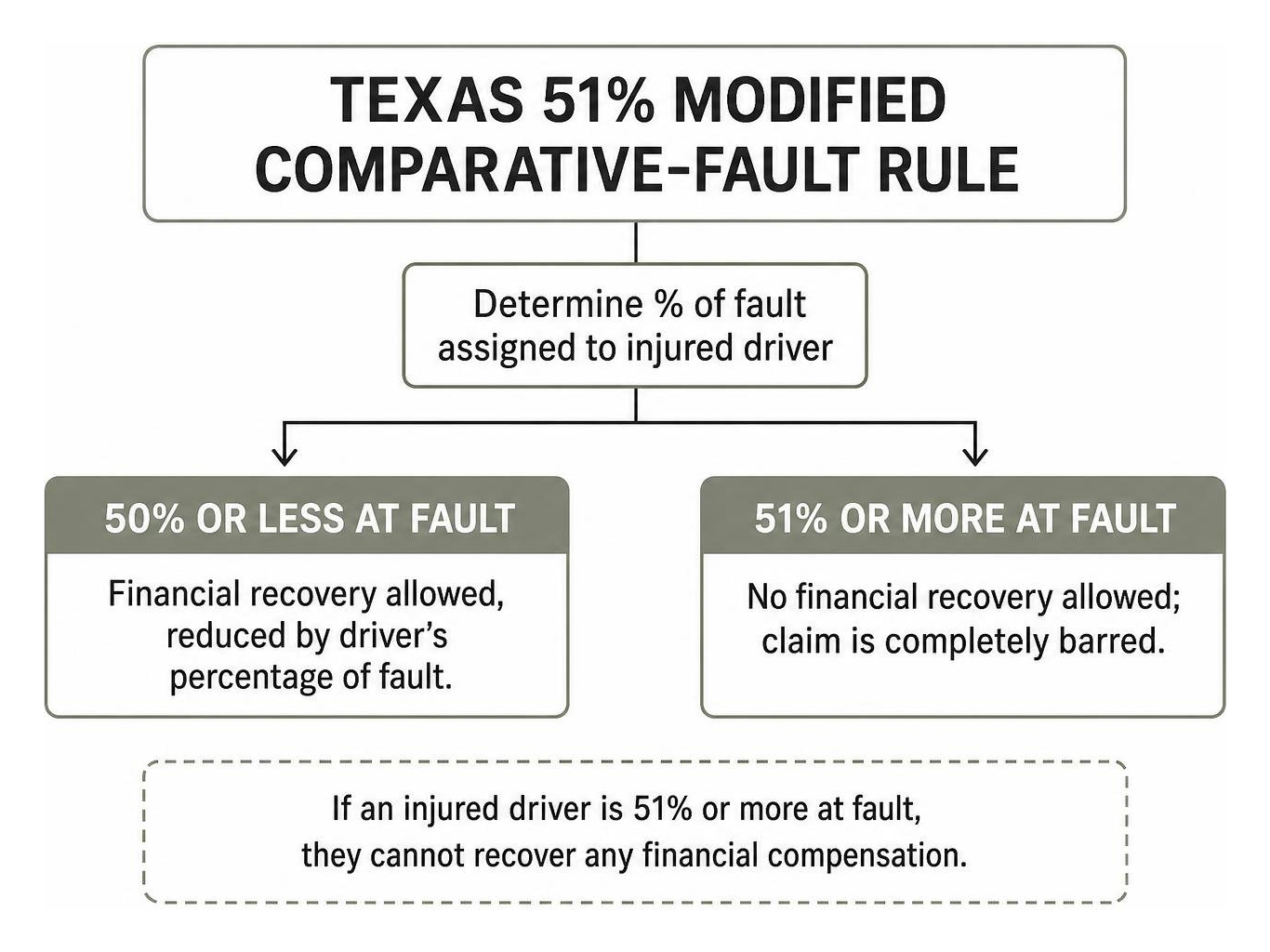
Under this proportionate responsibility framework:
- If an injured driver is found to be 50 percent or less at fault, their total financial recovery is reduced proportionally by their percentage of responsibility.
- If an injured motorist is determined to be 51 percent or more responsible for causing the wreck, they are completely barred from recovering any financial compensation from the other parties.
Harris County Jury Verdicts and Delivery Fleet Compensation Realities
Evaluating commercial delivery injury claims requires understanding the Harris County civil court environment. Verdicts and settlement outcomes vary widely based on injury severity, corporate culpability, and the quality of evidence presented at trial.
Evaluating Damages After a Truck Delivery Accident in Houston
Under Texas civil law, victims of commercial vehicle collisions are entitled to seek both economic and non-economic damages, including:
- Current and Future Medical Expenses: Emergency care, surgery, rehabilitation, medications, and long-term in-home assistance.
- Lost Income and Diminished Earning Capacity: Compensation for missed work and reduced future earning ability caused by permanent impairments.
- Physical Pain and Mental Anguish: Compensation for physical suffering, psychological trauma, and reduced quality of life.
- Physical Impairment and Disfigurement: Damages awarded for permanent scarring, mobility loss, or disability.
Commercial delivery accidents also take place away from major freeways. For instance, in a notable Harris County loading dock delivery truck verdict, a Harris County jury awarded $12,910,975.76 to a plaintiff struck by a delivery vehicle while standing in an industrial loading dock.
Why Harris County Delivery Truck Verdicts Range from Medians to Multimillions
Jury outcomes in Harris County demonstrate substantial range. Statistical analyses of commercial vehicle jury trials in Harris County reflect a median verdict of approximately $22,000, with a typical recovery range spanning between $8,200 and $102,285 across standard disputed claims.
However, when corporate gross negligence, egregious driver safety violations, or catastrophic physical injuries are proven in court, jury awards can escalate into multimillion-dollar figures. If a crash results in fatal injuries, surviving family members may pursue wrongful death and survival actions to recover funeral costs, loss of financial support, and emotional damages. In instances involving gross corporate neglect, Texas juries may also award punitive damages to penalize the carrier and deter future reckless conduct.
Frequently Asked Questions About Houston Delivery Truck Crashes
How long do I have to file a delivery truck accident claim in Harris County?
Under Texas Civil Practice and Remedies Code Section 16.003, you generally have two years from the date of the collision to file a personal injury or wrongful death lawsuit. Failing to file your claim within this statutory window will permanently bar your right to seek financial recovery in a Texas court. In cases involving government-operated delivery vehicles, formal administrative notice periods can be significantly shorter, often requiring action within 90 to 180 days.
What if the delivery driver was an independent contractor rather than an employee?
Major shipping networks frequently classify couriers as independent contractors to limit corporate liability. However, commercial logistics companies can still be held liable if they maintain operational control over delivery procedures, enforce dangerous driving quotas, or commit independent acts of negligence such as negligent driver screening or poor vehicle maintenance. Injured motorists can often pursue claims against commercial freight brokers and corporate parent insurance policies.
Can I recover damages if I was partially at fault for the collision?
Yes, provided your share of responsibility does not exceed 50 percent. Under Chapter 33 of the Texas Civil Practice and Remedies Code, Texas operates under a modified comparative fault rule. As long as you are 50 percent or less responsible for the collision, you can recover compensation, though your final financial recovery will be reduced by your percentage of fault. If you are found 51 percent or more at fault, Texas law prevents you from recovering any damages.
Protecting Your Rights After a Commercial Delivery Crash in Houston
Collisions involving commercial delivery vehicles involve complex corporate liability structures, strict federal safety standards, and aggressive commercial insurance defense teams. Holding negligent transport carriers accountable requires swift evidence preservation, thorough investigation of maintenance records, and a firm grasp of Texas personal injury law. For comprehensive guidance on commercial injury claims, review our Houston truck accident ultimate guide.
If you or a family member suffered injuries in a commercial vehicle wreck, the dedicated attorneys at WestLoop Law Firm provide steadfast representation across Houston, Harris County, and the surrounding regions. Our team understands both personal injury litigation and complex probate matters, providing compassionate and effective legal advocacy to help you secure the full compensation you deserve. Contact our Houston office today to discuss your legal options.