 Skip to content

What to Do After a Texas Truck Accident
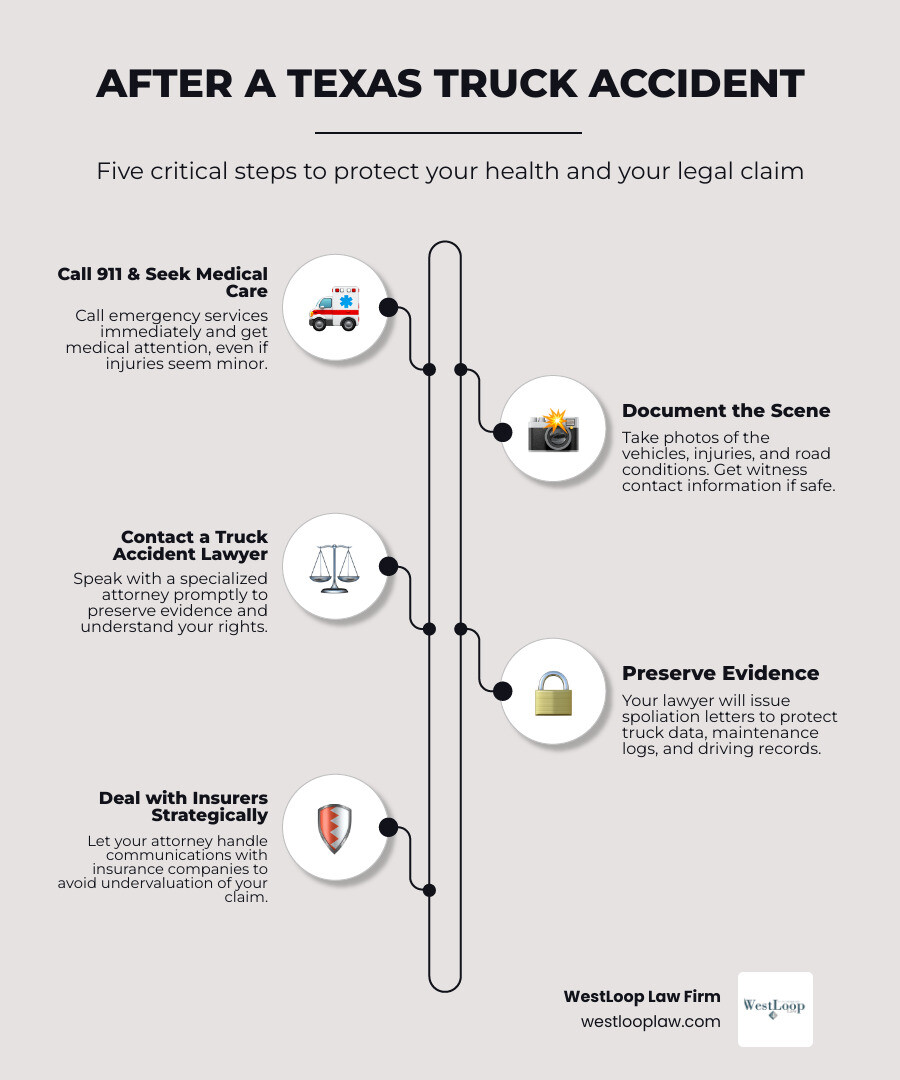
What to do first:
- Call 911 and get medical care, even if your injuries seem minor.
- Take photos and get witness contact details if you can do so safely.
- Speak with an attorney soon. Truck records and other evidence may be lost if no one acts to preserve them.
Retaining a qualified truck accident lawyer Texas families can rely on ensures critical evidence is protected immediately after a collision. A Texas trucking accident attorney can investigate the driver and trucking company, deal with insurers, and help you seek payment for medical bills, lost wages, and other losses. In Houston, where heavy freight traffic is part of daily life, partnering with a dedicated Houston truck accident law firm protects your rights when claims involve multiple liable parties. An experienced Houston trucking accident lawyer will guide you through each phase of the recovery process.
Understanding Texas Commercial Truck Crash Statistics and Leading Causes
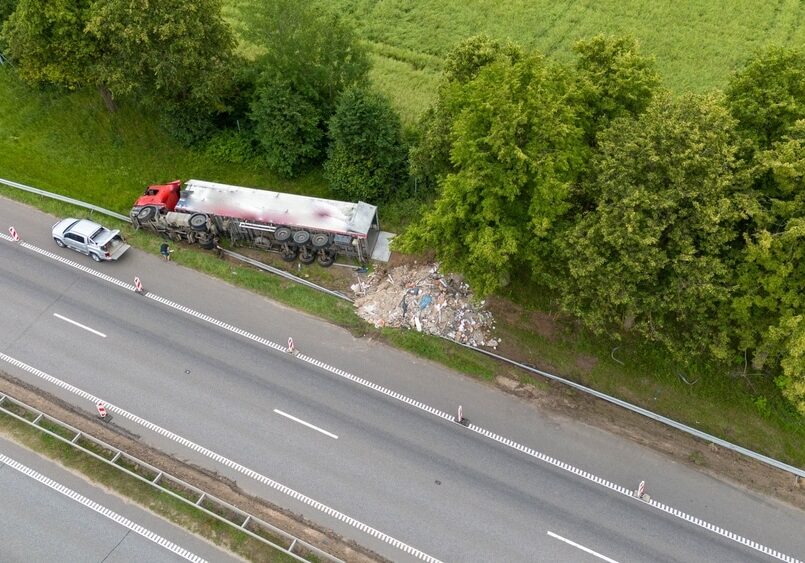
Texas continues to lead the nation in commercial vehicle volume and, unfortunately, catastrophic traffic collisions. With the Port of Houston, extensive rail hubs, and a sprawling energy sector, thousands of 18-wheelers travel our roadways every single day. Commercial trucks in Texas are involved in more than 30,000 crashes annually, with approximately 10% resulting in serious bodily injuries or fatalities.
Looking at broader data, in 2021 alone, 5,700 large trucks were involved in fatal collisions across the country, and Texas recorded the highest number of deaths at 891 individuals. Texas accounts for roughly 10% of all fatal large truck wrecks nationwide. In 2020, Texas saw 1,200 truck accident fatalities—a 15% jump from the previous year. Furthermore, in 2022, Texas recorded 2,200 large truck crashes that caused injuries, leaving 1,200 people with severe, life-altering harm.
When our team at Westloop Law Firm investigates these collisions across Harris County and surrounding areas, we consistently uncover several preventable causes:
- Driver Fatigue: Despite strict federal regulations, intense delivery quotas lead drivers to stay behind the wheel past legal driving limits.
- Distracted Driving: Operating dispatch systems, navigation units, cell phones, or eating while managing an 80,000-pound rig.
- Speeding and Aggressive Driving: Rushing along congested Houston corridors like Loop 610, I-10, or Beltway 8, leaving inadequate stopping distance for sudden traffic slowdowns.
- Improper Cargo Shifts: Unbalanced or poorly secured freight inside a trailer can shift rapidly during a turn, triggering dangerous jackknife or rollover wrecks.
- Blind Spot Incidents: Commercial trucks have massive “no-zones” along their sides, directly behind the trailer, and just under the front cab.
- Brake and Equipment Failure: Poorly maintained air brakes, bald tires, and broken suspension parts compromise a driver’s ability to steer or stop in an emergency.
When corporate negligence leads to devastating crashes, partnering with an established Houston trucking accident lawyer ensures that all liable parties are held accountable.
Texas Trucking Regulations and Fault Liability Laws
Commercial trucking operations are governed by a complex web of rules, including Federal Motor Carrier Safety Administration (FMCSA) safety standards and Texas Department of Transportation (TxDOT) codes. These rules cover everything from strict commercial driver licensing (CDL) protocols to mandatory daily vehicle inspections and regulated Hours of Service (HOS) limits designed to eliminate fatigued driving.
When an 18-wheeler wreck occurs, state liability rules dictate how financial compensation is awarded:
The 51% Modified Comparative-Fault Bar
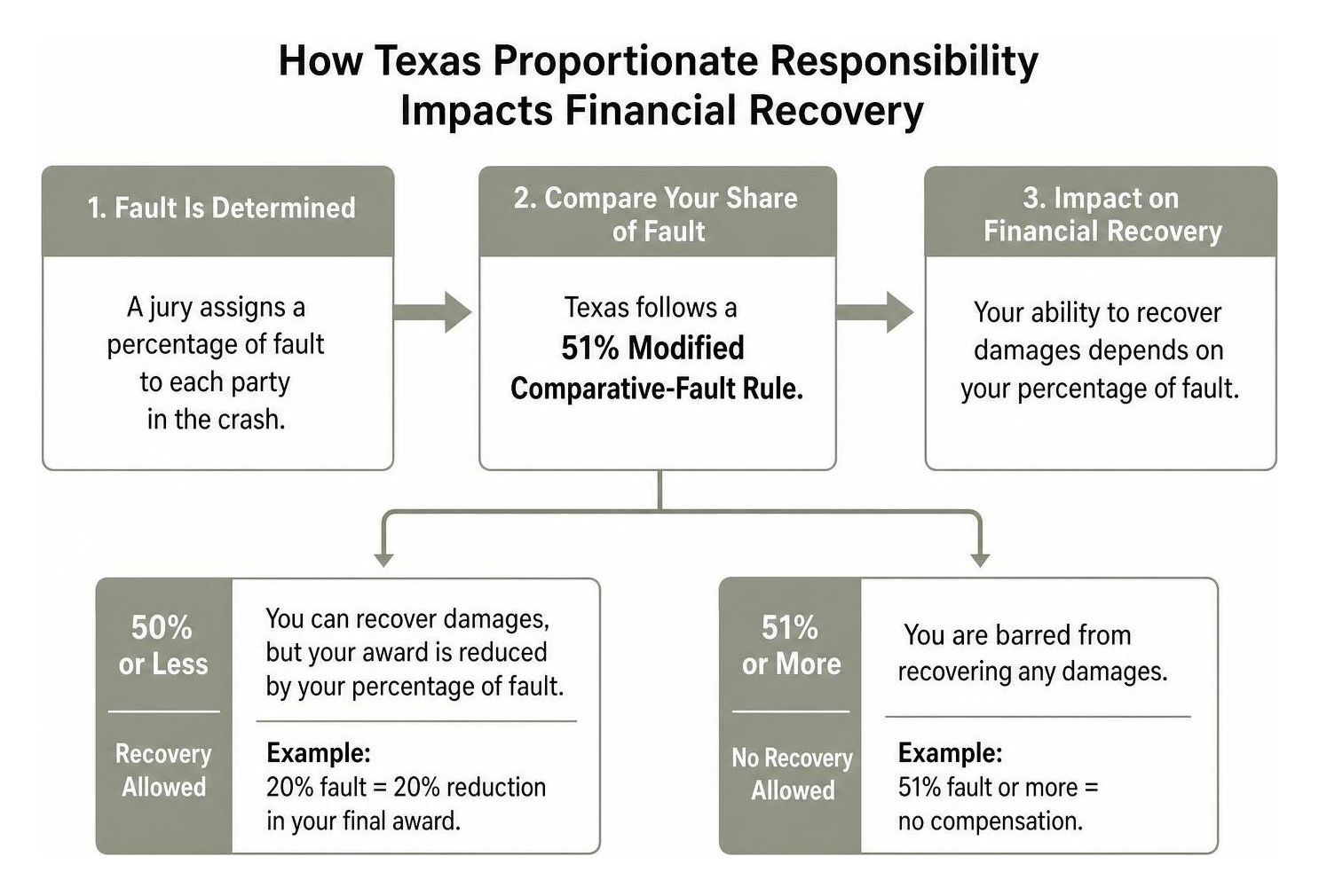
Texas Civil Practice and Remedies Code Chapter 33 outlines the state’s proportionate responsibility rule. Under this 51% modified comparative fault system, an injured person can recover damages only if their share of fault is 50% or less. If a jury determines you were 51% or more responsible for the wreck, you are completely barred from receiving any compensation. If you are found to be 20% at fault, your final monetary award is reduced by that exact 20%.
The Two-Year Statute of Limitations
In Texas, an injured victim generally has exactly two years from the date of the collision to file a formal personal injury lawsuit in a venue such as the Harris County Civil Courts at Law. In the tragic event that a loved one passes away due to injuries sustained in a collision, qualifying surviving family members have two years from the date of death to bring a wrongful death action. Failing to file before this statutory window closes permanently revokes your right to seek financial recovery.
Working alongside a dedicated trucking accident lawyer in Texas protects your rights within these strict time constraints.
Why You Need a Truck Accident Lawyer Texas Victims Can Rely On
Commercial trucking crashes are fundamentally different from ordinary passenger car collisions. Large trucking fleets and their insurers deploy aggressive rapid-response defense teams to crash scenes within hours to protect corporate interests. Facing them alone leaves injured people vulnerable to misleading settlement offers and buried evidence. Partnering with a dedicated truck accident lawyer Texas victims can count on levels the playing field against major transportation corporations.
Lawsuits handled by an experienced attorney have a success rate of about 90%, compared to only 50% for unrepresented individuals. Working on a contingency fee basis allows you to secure vigorous legal representation without paying any upfront, out-of-pocket legal fees; our firm only gets paid if we successfully recover compensation for your case.
How a Truck Accident Lawyer Texas Compares to a General Injury Lawyer
Handling an 18-wheeler crash requires knowledge of federal shipping statutes, electronic onboard systems, and corporate freight contracts.
| Feature | General Personal Injury Lawyer | Dedicated Truck Accident Lawyer |
|---|---|---|
| Regulatory Knowledge | State traffic codes and basic auto liability | FMCSA safety rules, TxDOT codes, hazmat shipping laws |
| Investigation Capabilities | Police reports and vehicle damage photos | ECM black box downloads, telematics, safety audit reviews |
| Defendant Identification | Focuses strictly on individual drivers | Evaluates motor carriers, cargo loaders, leasing companies |
| Accident Reconstruction | Basic crash scene diagramming | Dynamic heavy vehicle modeling and multi-body simulations |
| Financial Resources | Standard case funding | Substantial resources to combat massive corporate insurers |
Navigating these claims requires an experienced commercial truck accident attorney who understands how to hold multiple corporate entities responsible.
How a Truck Accident Lawyer Texas Investigates Trucking Companies
A proper investigation extends far beyond the physical point of impact. We evaluate:
- Driver Qualification Files (DQFs): Background checks, medical certificates, training records, and prior driving infractions.
- Maintenance and Inspection Records: Systematic brake check records, tire replacement histories, and pre-trip driver inspection reports.
- Dispatch Logs and Communications: Dispatcher instructions that may have pressured drivers to violate safety protocols to make on-time deliveries.
- Safety Audits and Compliance Histories: Historical patterns of safety citations tracked by the FMCSA safety management system.
An experienced 18 wheeler accident lawyer in Houston uses these records to uncover systematic corporate negligence.
Critical Steps and Evidence Required to Prove Your Commercial Claim
Proving liability after a crash on I-45 or the Eastex Freeway requires acting quickly before critical electronic and physical evidence is altered or discarded.
Crucial Evidence in Commercial Vehicle Crash Investigations
Commercial trucks are equipped with advanced digital technologies that provide an objective record of what happened right before a collision:
- Engine Control Module (ECM) Black Box: Records commercial vehicle speed, braking application, engine RPM, steering input, and seatbelt usage immediately prior to impact.
- Electronic Logging Devices (ELD): Modern digital logs track driving hours, duty status changes, and GPS locations in real time.
- Toxicology and Post-Accident Screening: Mandatory drug and alcohol testing conducted on commercial drivers within federal post-crash testing timeframes.
- Formal Spoliation Letters: Formal legal notices sent to motor carriers instructing them to preserve onboard camera footage, dispatch records, and maintenance logs.
Reviewing a comprehensive truck accident guide helps illustrate how these technical elements come together during litigation.
Immediate Steps to Protect Your Rights After a Texas Crash
To build the strongest possible foundation for your legal claim, take these essential steps:
- Contact Emergency Services: Call 911 immediately so Houston Police, Harris County Deputies, or state troopers secure the scene, provide a formal crash report, and clear traffic along busy thoroughfares.
- Seek Immediate Medical Care: Go directly to a nearby facility, such as Memorial Hermann or Ben Taub Hospital, to ensure hidden head trauma or internal bleeding is properly diagnosed and documented.
- Document the Crash Scene Thoroughly: Capture detailed pictures and videos of all vehicles, skid marks, road conditions, debris fields, and DOT numbers displayed on the truck cab.
- Gather Independent Witness Information: Collect names, phone numbers, and addresses from any motorists or bystanders who saw the collision.
- Protect Your Insurance Rights and Utilize PIP: Check your auto policy for Personal Injury Protection (PIP) coverage, which provides immediate financial support for medical expenses and lost wages regardless of who caused the collision.
- Decline Recorded Statements: Do not provide recorded statements or sign settlement releases for the trucking company’s insurance adjuster before consulting an attorney.
Following a detailed truck accident legal guide ensures that every available legal protection is utilized after a serious commercial crash.
Recoverable Damages and the Insurance Settlement Process in Texas
The average settlement for a truck accident case in Texas is between $50,000 and $500,000, with many cases settling for over $1 million when catastrophic injuries or wrongful death occur. Because commercial carriers are required to carry insurance policies often ranging from $750,000 to over $5 million, there are substantial resources available to cover extensive damages.
Injured victims can pursue economic, non-economic, and sometimes exemplary damages:
- Economic Damages: Past and future medical expenses, hospital bills, rehabilitation costs, home health care, lost wages, diminished future earning capacity, and property damage.
- Non-Economic Damages: Physical pain and suffering, emotional distress, mental anguish, permanent physical impairment, disfigurement, and loss of enjoyment of life.
- Exemplary (Punitive) Damages: In situations involving gross negligence—such as a motor carrier knowingly deploying an unlicensed driver or falsifying maintenance records—Texas courts may award exemplary damages to punish the wrongdoer and deter similar behavior.
Securing total compensation requires working alongside an experienced Texas trucking accident attorney who knows how to hold trucking companies and their insurers accountable.
Frequently Asked Questions About Texas Truck Accident Claims
What is the average settlement for a commercial truck accident in Texas?
While settlements typically range between $50,000 and $500,000, claims involving severe trauma, permanent disabilities, or loss of life frequently exceed $1 million. The final value depends on medical costs, lost income, insurance policy limits, and the clarity of liability.
How long do I have to file a truck accident lawsuit in Texas?
Under Texas law, the statute of limitations is two years from the date the accident occurred. If you are pursuing a wrongful death claim, you have two years from the date of the victim’s passing. Missing this strict statutory deadline permanently bars you from seeking financial recovery.
How does Texas modified comparative fault affect my compensation?
Texas follows a 51% modified comparative fault rule. You can recover damages as long as you are 50% or less responsible for the crash. Your final settlement or verdict will be reduced by your percentage of fault. If you are found to be 51% or more at fault, you cannot recover any compensation.
Securing Meaningful Advocacy for Injured Families in Houston
Overcoming the aftermath of an 18-wheeler wreck can feel overwhelming, but you do not have to carry the financial, physical, and legal burden alone. Choosing a dedicated truck accident lawyer Texas families trust can make all the difference in the outcome of your case. At Westloop Law Firm, we combine a deep understanding of personal injury law with extensive probate knowledge. This background allows our firm to guide families through both complex truck injury claims and wrongful death estate matters.
Whether your crash occurred along I-10, Highway 290, or the 610 Loop, our team is ready to stand by your side, protect crucial evidence, and advocate for the financial compensation you deserve. Reach out to our Houston office today to schedule a free, confidential case review.