 Skip to content
Why a Houston Semi Truck Construction Zone Is Dangerous — and What You Need to Know

Semi truck construction zone crashes are one of the most serious road hazards on Houston highways. Here’s a quick breakdown of what makes them so dangerous and what the numbers show:
- Most common cause: Driver inattention
- Rear-end collisions: About 15% more frequent in work zones than on open roads
- Stopping distance: A fully loaded semi can need up to two football fields to stop safely
- Blind spots: 20 feet in front, 30 feet behind the trailer, plus large side blind spots
- 2023 nationwide: ~101,000 work zone crashes; more than 300 involved a commercial vehicle and resulted in a fatality
- Texas context: Construction zones on highways like I-10, Loop 610, and I-270 see some of the heaviest truck traffic in the country
Orange cones. Flashing signs. Narrowed lanes. For most drivers, a construction zone means a brief slowdown. For a semi truck, it can mean something far more serious.
Large commercial trucks weigh up to 80,000 pounds when fully loaded. They need more room to turn, more distance to stop, and more time to react. When a work zone suddenly narrows lanes, shifts traffic, or eliminates the shoulder — those challenges multiply fast.
In Missouri alone, 83 people were killed and 3,757 were injured in construction zone accidents over a five-year period. Texas highways like I-10 through Houston see similar pressure from non-stop freight traffic rolling through active work zones around the clock.
If you were hurt in a work zone crash involving a semi truck in Houston, understanding how these accidents happen — and who is responsible — is the first step toward protecting yourself.
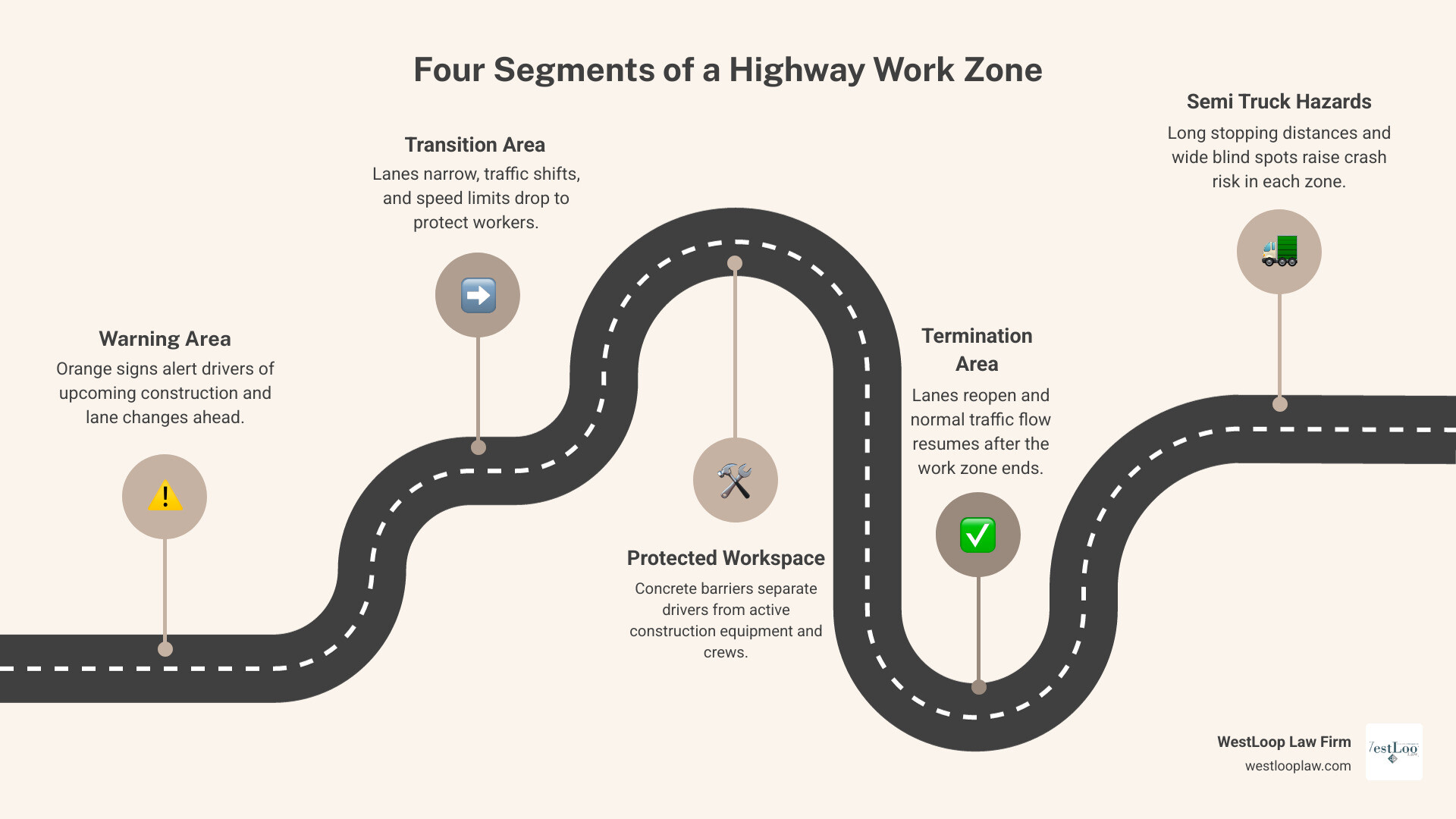
Semi truck construction zone terms to know:
- Trucking regulations violation lawyer
- Trucking black box data
- Houston trucking firm negligence
Why a Semi Truck Construction Zone Presents Unique Hazards on Houston Highways
Driving a passenger car through a Houston work zone can be stressful enough. Now, imagine navigating that same stretch of road behind the wheel of an 18-wheeler.
A semi truck construction zone is a high-risk environment. The physical size and weight of commercial motor vehicles (CMVs) make them poorly suited for the sudden changes in road design that construction projects require. When a highway is modified for repairs, the margin of error for a truck driver drops to near zero.
Narrow Lanes and Shifting Traffic Patterns on I-10 and Loop 610
If you regularly drive on I-10, Loop 610, or US-290 in Houston, you know that construction lanes are incredibly tight. Transportation agencies often squeeze lanes down from their standard 12-foot width to 10 or 11 feet to make room for work areas.
For a standard semi-truck, which is already about 8.5 feet wide (not including mirrors), these narrow lanes leave only inches of clearance on either side.
Furthermore, work zones frequently feature:
- Sudden Lane Shifts: Sharp S-curves redirect traffic onto temporary lanes or contraflow lanes. A truck’s high center of gravity makes it highly susceptible to swaying or tipping during these rapid maneuvers.
- Concrete Barriers: Heavy concrete “Jersey barriers” are placed right next to the active traffic lanes. This means there is absolutely no shoulder. If a truck driver needs to make an emergency maneuver, there is nowhere to go.
- Uneven Pavement: Grinded asphalt and temporary metal plates can cause a heavy trailer to bounce or pull to one side, risking a side-swipe collision with vehicles in adjacent lanes.
How Blind Spots and Stopping Distances Impact a Semi Truck Construction Zone
A fully loaded tractor-trailer traveling at highway speeds requires the length of two football fields to come to a complete stop. When a construction zone forces a sudden drop in speed, a truck driver who is not fully alert simply cannot stop in time.
Additionally, large trucks have massive blind spots—often called “No-Zones”—extending:
- 20 feet directly in front of the cab
- 30 feet directly behind the trailer
- Wide areas along both sides of the truck, particularly on the right side
In a work zone, passenger vehicles often try to merge quickly in front of trucks or linger in these blind spots. If the truck has to make a sudden lane adjustment due to a lane closure, a catastrophic collision is highly likely.
If you or a loved one has been involved in such a crash, consulting an experienced Houston semi-truck accident attorney can help you understand your options for recovering damages.
Common Causes of Commercial Vehicle Crashes in Texas Work Zones
Work zone accidents are rarely simple. They are usually the result of a chain reaction of driver errors, poor road design, or inadequate signage.
According to data from recent years, rear-end collisions are about 15% higher in work zones than in non-work zones. This statistic highlights just how difficult it is for drivers to manage their speed and spacing when road patterns change unexpectedly.
| Crash Factor | Work Zone Crash Rate | Non-Work Zone Crash Rate | Key Danger |
|---|---|---|---|
| Rear-End Collisions | ~15% Higher | Baseline | Sudden braking, tailgating |
| Driver Inattention | Number One Cause | High | Missing warning signs, lane shifts |
| Speeding (Fatalities) | ~40% of Fatal Crashes | Varies | Inability to stop in time |
Understanding these hazards is a core part of any commercial truck accident attorney Houston guide, as identifying the root cause of the crash is essential for establishing liability.
Driver Inattention and Distracted Driving
The single most common cause of work zone crashes is driver inattention. When a driver is distracted by a cell phone, a GPS device, or is suffering from driver fatigue, they miss the critical warning signs placed in the “warning area” of the work zone.
In Houston, a distracted truck driver on the Southwest Freeway might fail to notice a “Lane Closed Ahead” sign. By the time they realize traffic has ground to a halt, it is too late. The resulting rear-end collision can crush smaller passenger cars, often requiring emergency medical transport to local facilities like Memorial Hermann Hospital or Houston Methodist Hospital.
Speeding and Failure to Yield Near Construction Equipment
Excessive speed is a massive factor in Texas traffic fatalities. When a semi-truck enters a semi truck construction zone without slowing down to the posted temporary speed limit, they put everyone at risk.
Work zones are highly dynamic. They often feature:
- Flaggers: Workers directing traffic manually.
- Mobile Work Zones: Utility crews or road stripers that move slowly along the highway, appearing with much less warning than permanent construction setups.
- Heavy Equipment: Slow-moving dump trucks, excavators, and pavers entering and exiting the highway.
When a truck driver fails to yield to this equipment or ignores flaggers, the consequences are devastating for both the construction workers and other motorists on the road.
Safety Tips for Driving Near a Semi Truck Construction Zone
Whether you are behind the wheel of an 18-wheeler or driving a compact car next to one, sharing the road safely in a work zone requires patience, defensive driving, and preparation. If you have been injured due to a driver’s failure to follow these basic safety steps, you may be eligible to file a semi-truck accident claim.
Maintaining Safe Following Distances and Mirror Checks
For truck drivers, managing the space cushion around the vehicle is the best way to prevent a crash.
- Double Your Space Cushion: If you normally keep a 3- to 4-second following distance, double it in a work zone. If you are traveling below 40 mph, leave at least one second for every 10 feet of vehicle length. If you are traveling above 40 mph, double that distance.
- Frequent Mirror Checks: Truckers should check their mirrors every 8 to 10 seconds to keep track of smaller vehicles hovering in their blind spots.
- Signal Early: Give other motorists plenty of warning before making a move. Use turn signals well in advance of any lane shifts.
Safe Maneuvers in a Semi Truck Construction Zone
For passenger vehicle drivers, navigating around large trucks in a work zone requires a specific set of rules:
- Avoid the No-Zones: Never cruise alongside a semi-truck in a work zone. If you cannot see the truck driver’s face in their side mirror, they cannot see you.
- Merge Early and Predictably: When you see a “Lane Closed” sign, merge as early as possible. Do not wait until the last second to cut in front of a heavy commercial truck.
- Be Patient: Yes, construction delays are frustrating. But trying to zip past a truck in a narrowed lane on Loop 610 is a recipe for a side-swipe collision.
When driving near a semi-truck in a construction zone, smaller vehicles must account for the fact that trucks do not have the luxury of a shoulder to escape to if a driver makes an aggressive cut-off maneuver.
Infrastructure Damage and Legal Consequences of Work Zone Accidents
It is not just other vehicles that are at risk in a semi truck construction zone. Large trucks carrying oversized cargo or heavy construction equipment frequently strike overhead highway infrastructure, leading to massive traffic delays, millions of dollars in damages, and severe legal penalties.
Consider these real-world examples of what happens when truck drivers fail to measure their loads or ignore height restrictions:
- Overhead Sign Collapse: In one notable incident, a construction site tractor-trailer failed to lower its dump bed, striking an overhead sign and collapsing it across four lanes of traffic, resulting in a grueling 13-hour highway closure.
- Overpass Structural Damage: In another case, a semi-truck hauling an excavator struck an overpass on I-75, shutting down the entire northbound side of the highway due to falling concrete debris.
- Stiff Fines for Negligence: Infrastructure damage carries heavy financial penalties. A trucking company was forced to pay an eleven-thousand-dollar fine after a driver hauling an excavator sheared off part of the load against an overpass, on top of facing hundreds of thousands of dollars in civil liability for repair costs.
When a commercial vehicle damages public infrastructure, the trucking company, the driver, and even the cargo loaders can face intense legal and financial scrutiny.
Frequently Asked Questions About Houston Work Zone Truck Accidents
Who is liable for a semi-truck accident in a Houston construction zone?
Liability in a work zone crash can be highly complex. Depending on the circumstances, multiple parties may share responsibility, including:
- The Truck Driver: For speeding, distracted driving, or failing to maintain a lane.
- The Trucking Company: For hiring unqualified drivers or forcing them to violate hours-of-service limits.
- The Construction Contractor: For failing to set up proper warning signs, barriers, or lighting.
- Government Entities: If poor road design or improper maintenance contributed to the crash.
Because so many parties can be involved, working with a dedicated Houston truck accident law firm is essential for untangling the web of liability.
What should I do immediately after a work zone crash on a Houston highway?
If you are involved in a collision in a construction zone:
- Move to Safety (If Possible): If your vehicle is operable, try to move to a safe spot out of active traffic.
- Call 911: Request a police officer to document the crash. A formal police report is vital for your insurance claim.
- Seek Medical Attention: Go to an emergency room like Houston Methodist Hospital or Memorial Hermann, even if you feel fine. Adrenaline can mask serious injuries.
- Gather Evidence: Take photos of the scene, the construction signs, the damage to all vehicles, and get contact info from witnesses.
- Consult a Lawyer: Speak to an attorney before giving statements to the trucking company’s insurance adjusters.
How do narrow lanes in Houston construction zones increase truck accident risks?
Narrow lanes leave almost no room for error. A standard semi-truck takes up nearly the entire width of a temporary construction lane. If the truck driver is distracted for even a second, or if a sudden gust of wind catches the trailer, the truck can easily drift into an adjacent lane, causing a side-swipe or squeeze-play collision.
Secure Your Future: Partner with a Houston Truck Accident Law Firm
If you or a loved one has been injured in a collision within a semi truck construction zone on a Houston highway, you do not have to handle the physical, emotional, and financial burdens alone. Trucking companies and their insurers move quickly to protect their bottom lines, often sending investigators to the crash scene within hours.
We are here to help you level the playing field. At WestLoop Law Firm, we combine deep legal knowledge with a compassionate, client-first approach to ensure you receive the compensation you deserve for medical bills, lost wages, and pain and suffering. Whether your case involves a complex workplace injury claim or a highway crash, we will fight for your rights every step of the way.
To learn more about your options, explore our comprehensive Houston truck accident lawyers ultimate guide or get in touch with our legal team today for a free consultation. Let us handle the legal heavy lifting while you focus on your recovery.