 Skip to content

How to Get Houston Healthcare POA Forms That Reflect Your Wishes
What to do first
- Download the Texas Medical Power of Attorney form.
- Name someone you trust to make health care decisions if you cannot. Tell them what matters to you.
- Read the required disclosure statement. Sign the form before a notary or two qualified adult witnesses, then give copies to your agent and health care providers.
A standard form names your decision-maker, but it cannot explain every treatment choice you would make. In Texas, your agent can act only after your attending physician certifies in writing that you cannot make your own health care decisions. Clear conversations and written wishes can help your agent speak for you if that happens.
Easy houston healthcare poa forms word list:
What Are Houston Healthcare POA Forms and How Do Advance Directives Differ?
Under the Texas Health and Safety Code Chapter 166, advance directives allow you to maintain control over your medical care even if an unexpected injury or severe illness leaves you incapacitated. Whether you are navigating the heavy traffic on Loop 610, merging onto I-10 near Downtown Houston, or commuting along Beltway 8, sudden emergencies can occur without warning. Having the right documents in place protects your autonomy when admitted to local facilities like Memorial Hermann in the Texas Medical Center or Houston Methodist Hospital.
A Texas Medical Power of Attorney (MPOA) appoints a designated representative—known legally as your health care agent or proxy—to make medical treatment decisions on your behalf if you become unable to communicate. While a general durable power of attorney handles business and financial matters, as discussed in our guide on power of attorney for managing financial and medical affairs, an MPOA is exclusively focused on healthcare choices.
To ensure your intentions are respected, it is vital to understand the role of a living will and advance directive in relation to other Texas statutory forms.
| Document Type | Primary Purpose | When It Takes Effect | Key Limitations |
|---|---|---|---|
| Medical Power of Attorney (MPOA) | Names a surrogate agent to make personalized healthcare decisions. | Only after an attending physician certifies incapacity in writing. | Cannot consent to abortion, psychosurgery, or mental health commitments. |
| Directive to Physicians (Living Will) | States your specific wishes regarding life-sustaining treatments. | Applied when diagnosed with a terminal or irreversible condition. | Addresses only specific end-of-life treatment scenarios. |
| Out-of-Hospital DNR (OOH-DNR) | Directs emergency responders not to attempt cardiopulmonary resuscitation. | Immediately upon execution in non-hospital and public settings. | Limited strictly to resuscitation interventions; does not appoint an agent. |
| Declaration for Mental Health Treatment | Details preferences for electroconvulsive therapy, psychoactive drugs, and emergency mental health care. | Upon physician determination of mental incapacity. | Automatically expires after three years unless you remain incapacitated. |
Medical Power of Attorney vs. Directive to Physicians (Living Will)
Many people confuse a Medical Power of Attorney with a Directive to Physicians and Family or Surrogates (commonly known as a living will). While both are advance directives, they operate differently:
- Medical Power of Attorney: Grants broad discretionary authority to a living person who evaluates evolving clinical situations, consults with physicians, and makes real-time decisions aligned with your values.
- Directive to Physicians: Acts as your direct written instruction to medical staff regarding whether to withhold or withdraw life-sustaining treatment if you suffer from a terminal condition (expected to cause death within six months) or an irreversible condition.
Balancing a living will and healthcare power of attorney ensures that you provide both general decision-making authority and explicit guidance for end-of-life care. If a conflict ever arises between instructions in your living will and decisions made by your appointed proxy, Texas law dictates that the document executed later in time controls.
Out-of-Hospital DNR Orders and Mental Health Declarations
An Out-of-Hospital Do-Not-Resuscitate (OOH-DNR) order is designed for emergency situations outside a standard hospital room. If paramedics respond to a 911 call along I-45 or at your private residence, they are legally required to initiate full resuscitation efforts unless an official Texas OOH-DNR order is physically present or an identifiable Texas DNR bracelet is worn.

A Declaration for Mental Health Treatment allows you to make specific choices regarding psychoactive medications, convulsive therapy, and emergency mental health admissions. Unlike a standard MPOA—which remains effective indefinitely unless revoked—a Texas mental health declaration expires after three years unless you are incapacitated at the end of that three-year period, in which case it remains active until you regain capacity.
How to Obtain and Execute Houston Healthcare POA Forms Step-by-Step
Obtaining and executing valid houston healthcare poa forms requires following statutory protocols under Texas law. You can download the official document directly from the Texas Health and Human Services Medical Power of Attorney registry, available in both English and Spanish.
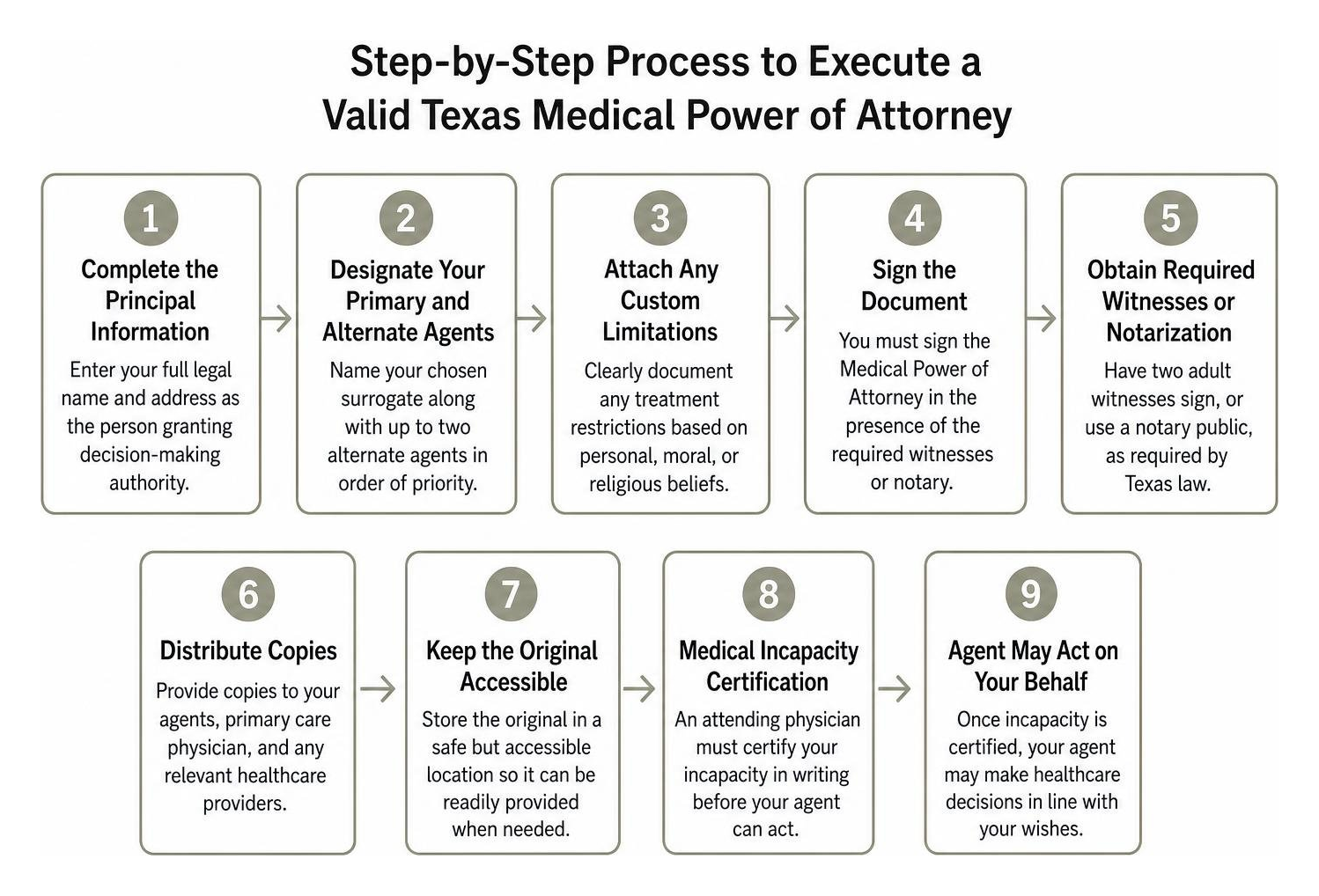
To make your form legally binding in Harris County, follow these steps:
- Complete the Principal Information: Enter your full legal name and address as the person granting decision-making authority.
- Designate Your Primary and Alternate Agents: Name your chosen surrogate along with up to two alternate agents in order of priority.
- Attach Any Custom Limitations: Clearly document any treatment restrictions based on personal, moral, or religious beliefs.
- Review the Mandatory Disclosure Statement: Read the statutory statement explaining the legal weight of the document.
- Sign and Execute: Sign the document either in the presence of a licensed Texas notary public or before two qualifying adult witnesses.
Legal Requirements for Valid Houston Healthcare POA Forms
To execute a valid healthcare proxy in Texas, the principal must be of sound mind and at least 18 years old. The state provides two options for execution:
- Option A (Notarization): Sign the document before a notary public. This option requires no additional witnesses.
- Option B (Two Qualified Witnesses): Sign the document in the presence of two competent adult witnesses who are at least 18 years of age.
If you choose the two-witness option, Texas law strictly restricts who can serve as a witness. At least one of the two witnesses must be an “unrelated” party who is not:
- Your designated health care agent or alternate agent.
- Related to you by blood or marriage.
- An attending physician or an employee of your attending physician.
- An employee of the healthcare facility where you are currently receiving care (unless they are solely a credentialed staff member not involved in direct care).
- A beneficiary of your estate or anyone with a claim against your estate upon your death.
Selecting and Naming an Eligible Healthcare Agent in Texas
Your health care agent should be someone who communicates clearly under pressure and understands your moral convictions. In Texas, you can name any competent adult aged 18 or older, with specific legal exclusions:
- You cannot name your treating healthcare provider or their direct clinical staff.
- You cannot name an employee of your residential care facility (such as an assisted living community or nursing home) unless that individual is also related to you by blood, marriage, or adoption.
Always appoint at least one alternate agent. If your primary proxy is unavailable, unreachable, or unwilling to serve during a critical medical juncture, the alternate agent can step in immediately without court intervention.
Scope of Authority, Legal Restrictions, and Activation Rules
A Medical Power of Attorney does not strip you of your decision-making rights the moment you sign it. The document takes effect immediately upon delivery to the agent only in terms of its legal creation, but the agent’s authority to make medical decisions remains dormant.
Your proxy can only make healthcare decisions after your attending physician examines you and certifies in writing that you lack the capacity to make your own medical decisions. If you are unconscious following a motor vehicle collision on Beltway 8, your agent handles treatment consents with hospital staff.
It is also important to note that executing an MPOA does not make your agent personally liable for your medical bills; you remain responsible for the cost of all medical care authorized on your behalf. For individuals navigating complex care planning alongside asset protection, our team at Westloop Law Firm assists families with comprehensive estate planning in Houston.
Medical Decisions an Agent Cannot Make Under Texas Law
Although a health care agent possesses broad authority to consent to, refuse, or withdraw medical treatments, Texas Health and Safety Code Section 166.152 establishes clear boundaries. Even with a fully executed MPOA, an agent cannot:
- Consent to voluntary or involuntary inpatient mental health facility commitments.
- Consent to convulsive treatments (such as electroconvulsive therapy).
- Consent to psychosurgery.
- Consent to an abortion.
- Consent to the neglect or withholding of comfort care designed to alleviate pain.
Default Texas Surrogacy Hierarchy When No POA Exists
If you become incapacitated without an executed Medical Power of Attorney, Texas Health and Safety Code Section 166.039 dictates a statutory hierarchy of who can make medical decisions for you:
- The patient’s legally recognized spouse.
- The patient’s adult children (acting with majority consent if multiple children participate).
- The patient’s surviving parents.
- The patient’s nearest living relative by blood.
If family members disagree or if no qualified surrogate is available, medical providers may have to petition the Harris County Civil Courts at Law or Harris County Probate Courts for an emergency temporary guardianship. Guardianship proceedings can cause delays in critical care, create substantial legal expenses, and generate unnecessary stress for your family.
When injuries result from negligence—such as a collision on I-10 or I-45—incapacity also complicates personal injury claims. Texas law requires claims to be filed within a strict two-year statute of limitations. Under Texas’s 51% modified comparative-fault rule, an injured person cannot recover damages if they are found to be more than 50% responsible for the accident. Additionally, maintaining Personal Injury Protection (PIP) on your auto policy provides immediate coverage for medical expenses regardless of fault while your legal proxy manages ongoing healthcare needs.
Updating, Revoking, and Managing Out-of-State Document Validity
A Texas Medical Power of Attorney remains effective indefinitely unless you specify an expiration date or legally revoke it. Under Texas law, you can revoke your MPOA at any time, regardless of your mental capacity, using one of several methods:
- Oral Notification: Informing your health care agent or attending healthcare provider directly that you are revoking the document.
- Written Revocation: Executing a formal written revocation notice and delivering copies to your medical providers.
- Executing a Newer Document: Signing a subsequent Medical Power of Attorney, which automatically cancels all prior designations.
- Divorce or Annulment: Under Texas law, if your spouse is named as your health care agent and your marriage is subsequently dissolved, annulled, or declared void, their designation is automatically revoked unless the document explicitly states otherwise.
If you have signed a healthcare proxy in another state and move to Houston, Texas recognizes that out-of-state directive to the extent that it complies with Texas law. However, because local healthcare systems are accustomed to Texas statutory language, executing a Texas-specific form prevents administrative friction during an emergency.
Local Resources to Obtain Houston Healthcare POA Forms
Houston residents have access to several free and accessible resources for advance directive forms and health coverage coordination:
- State Health Portals: Texas Health and Human Services offers free downloadable PDF versions of advance directives.
- Veterans Affairs: The VA Houston Health Care medical records office release procedures assist local veterans with updating advance directives and medical records using VA Form 10-5345a.
- City Health Initiatives: The City of Houston Office of Business Opportunity administers the Pay or Play (POP) program, which ensures contractors provide basic healthcare options or contribute to local health safety net programs supporting uninsured residents across the Greater Houston area.
When healthcare plans interact with insurers and public programs, standard forms such as the Texas standard prior authorization request form ensure requested treatments meet medical necessity requirements without administrative delays.
Frequently Asked Questions About Houston Healthcare Directives
When exactly does a Medical Power of Attorney take effect in Texas?
While the document is legally executed once signed and delivered to your agent, your agent has no power to make medical decisions until your attending physician certifies in writing that you lack the mental capacity to make your own healthcare choices. If you regain decision-making capacity, your authority automatically returns to you.
Is a Texas Medical Power of Attorney recognized if I travel to another state?
Most states recognize advance directives that were validly executed under the laws of the state where they were signed. However, state laws regarding witness qualifications and specific treatment exclusions vary. If you reside in multiple states or travel frequently, having your directives reviewed ensures interstate enforceability.
Can my agent override my direct verbal objections in a Houston hospital?
No. Under Texas law, your immediate verbal or physical objections to medical treatment always override the decisions of your health care agent, provided you can communicate your wishes at that moment, regardless of whether a prior incapacity certification was issued.
Securing Your Treatment Rights with Comprehensive Houston Estate Planning
Standard statutory forms provide a starting framework for medical decision-making, but generic forms cannot address complex medical conditions, unique family dynamics, or long-term estate coordination. Ensuring that your Medical Power of Attorney functions seamlessly alongside your living will, durable financial powers of attorney, and probate documents prevents future disputes and protects your loved ones during difficult times.
At Westloop Law Firm, our attorneys assist Houston individuals and families in preparing comprehensive advance directives, handling probate matters, and navigating complex personal injury recoveries. To establish an advance care plan that reflects your personal values and safeguards your healthcare choices, schedule a consultation with Westloop Law Firm today. You can also explore our core legal services directly on the Westloop Law Firm homepage.