 Skip to content
When a Houston Rideshare Accident Turns Your Life Upside Down
A Houston rideshare accident lawyer can be the difference between walking away with fair compensation and being left with unpaid medical bills, lost wages, and unanswered questions.
If you were hurt in an Uber or Lyft crash in Houston, here is what you need to know right now:
- You likely have a valid claim — whether you were a passenger, pedestrian, or another driver
- Multiple insurance policies may apply — depending on whether the driver’s app was on, off, or mid-trip
- Texas gives you two years to file a personal injury claim (Civil Practice and Remedies Code § 16.003)
- You do not pay upfront — rideshare accident attorneys in Houston typically work on contingency
- Acting fast matters — evidence like GPS logs, app data, and dashcam footage disappears quickly
Rideshare crashes in Houston are not like ordinary car accidents. When you call an Uber on Washington Avenue or get dropped off near I-10, you’re dealing with layered insurance policies, corporate legal teams, and a driver who is classified as an independent contractor — not an employee.
According to Uber’s own safety reports, there were 101 U.S. fatalities involving Uber rides in 2021. Separately, research from the University of Chicago found that rideshare services increased traffic fatalities by 2–3% in American cities. In Harris County alone, the Texas Department of Transportation recorded over 4,400 serious injury crashes in 2023.
The bottom line: these accidents are common, the insurance system is complicated, and you need someone in your corner.
Westloop Law Firm helps injured Houstonians cut through that complexity and fight for every dollar they deserve.
Terms related to Houston rideshare accident lawyer:
- Houston bicycle accident attorney
- Houston distracted driving lawyer
- Houston uninsured motorist lawyer
Understanding How Texas Rideshare Insurance Tiers Work
When you get into a collision with an Uber or Lyft in Houston, the first question is always: Whose insurance pays? Under Texas law, specifically Texas House Bill 100 and Texas Insurance Code § 1954.052, rideshare companies—formally known as Transportation Network Companies (TNCs)—must carry specific tiers of liability insurance.
Unlike a standard car wreck where you simply look at the at-fault driver’s personal policy, rideshare claims depend entirely on what the driver was doing on the app at the exact millisecond of the crash.
To help make sense of this legal maze, we have broken down the coverage levels mandated by Texas law:
| App Phase / Driver Status | Applicable Insurance Policy | Minimum Bodily Injury Limits | Property Damage Limits |
|---|---|---|---|
| Period 0: App is completely turned off | Driver’s personal auto insurance policy | $30,000 per person / $60,000 per accident (Texas minimums) | $25,000 |
| Period 1: App is open; driver is waiting for a ride request | Rideshare company’s contingent liability policy | $50,000 per person / $100,000 per accident | $25,000 |
| Period 2: Ride accepted; driver is en route to pick up passenger | Rideshare company’s primary commercial policy | $1,000,000 total third-party liability | Varies (often includes UM/UIM) |
| Period 3: Passenger is inside the rideshare vehicle | Rideshare company’s primary commercial policy | $1,000,000 total third-party liability | Varies (includes UM/UIM) |
Navigating these tiers on your own can feel like trying to drive through the Loop 610 construction during Friday rush hour. If you want to learn more about how these policies interact with local personal injury claims, check out our comprehensive guide on Texas Rideshare Injury Claims.
How a Houston Rideshare Accident Lawyer Decodes the Three Insurance Phases
To secure the financial recovery you deserve, a seasoned legal team must carefully analyze the driver’s app status. Let’s look closer at how a Houston rideshare accident lawyer decodes these three distinct phases:
- Period 1 (The “App On, No Ride” Phase): During this phase, the driver is online and looking for a fare. If they cause an accident, their personal insurance will almost certainly deny the claim because of a “commercial use exclusion.” This is where the TNC’s contingent liability policy steps in to provide backup coverage of $50,000/$100,000/$25,000.
- Period 2 (The “En Route” Phase): The moment a driver taps “accept” on a ride request, the massive $1 million commercial liability policy activates. This applies even if the passenger is not yet in the back seat. If an Uber driver hits you on their way to pick up a passenger in Midtown, this is the policy we target.
- Period 3 (The “Active Ride” Phase): This phase covers the entire duration of the trip, from the moment the passenger steps into the vehicle until they safely exit. It features the same $1 million commercial liability coverage, alongside essential Uninsured/Underinsured Motorist (UM/UIM) coverage.
Because these phases are so strictly defined, insurance carriers will do everything they can to argue that a driver was in a lower-coverage tier at the time of the crash. We know how to obtain the necessary digital logs to prove the exact phase of the ride. For a detailed breakdown of your rights in these situations, consult a seasoned Houston Rideshare Accident Lawyer.
6 Ways a Houston Rideshare Accident Lawyer Protects Your Rights
When you are recovering from physical trauma, the last thing you need is a stressful battle with multi-billion-dollar technology corporations. Having professional legal representation is your shield against aggressive insurance adjusters who want to minimize your physical and emotional suffering.

From the moment we take your case, we act as your voice, your investigator, and your advocate. If you are dealing with a collision anywhere in the metro area, it is vital to know your local rights; read more at Uber Accident Attorney in Harris County Know That.
Below are the six primary ways we work to protect your physical and financial recovery after a wreck.
1. Investigating the Cause of Your Houston Rideshare Collision
Rideshare drivers operate under unique pressures. Because they rely on their smartphones to make a living, they are highly prone to distracted driving.
In fact, rideshare drivers often have only 15 seconds to view and accept an incoming ride request on their screens. This constant pressure to interact with a phone while navigating high-speed corridors like I-10, the Southwest Freeway (US-59), or busy nightlife districts like Washington Avenue creates a recipe for disaster.
Other common causes of Houston rideshare wrecks include:
- Fatigue: Drivers working incredibly long hours across multiple apps to maximize their earnings.
- Sudden stops: Pulling over abruptly in the middle of traffic to drop off or pick up passengers in crowded areas like the Galleria.
- Speeding: Rushing to complete trips quickly to secure high-demand surge pricing.
We investigate every detail of your crash. We gather physical evidence, obtain traffic camera footage, and analyze the scene to establish exactly what happened. To see why this level of detail is so important, you can read more about local rideshare accident statistics.
2. Identifying All Liable Parties in Harris County
In a standard car crash, liability is usually straightforward: one driver hit another. In a rideshare accident, however, multiple parties may share the blame. We look at the big picture to make sure no stone is left unturned.
Potential liable parties include:
- The Rideshare Driver: If their personal negligence (like running a red light near Texas Southern University) caused the crash.
- The Rideshare Company (Uber/Lyft): While they classify drivers as independent contractors, they can still be held responsible under specific legal theories, such as negligent hiring or retention if they allowed a driver with a history of DWIs to remain on the platform.
- Third-Party Motorists: If another driver slammed into your rideshare vehicle, we can pursue compensation through their insurance policy.
- Vehicle Manufacturers: If a mechanical failure, like defective brakes, contributed to the collision.
If you were injured in surrounding areas, we also have localized insights to help you navigate these issues. Check out our resources for neighboring communities, such as our guide from an Uber Accident Attorney in Fort Bend County.
3. Navigating Complex Insurance Coverage Gaps
One of the most frustrating challenges after a rideshare crash is the “coverage gap.”
When a rideshare driver is offline (Period 0) and causes a crash, their personal auto insurance applies. However, if they are online but haven’t accepted a passenger yet (Period 1), their personal insurer will often deny coverage due to commercial use exclusions. At the same time, the rideshare company’s insurer might try to deny the claim, claiming the driver wasn’t actively on a trip.
This creates a dangerous gap where injured victims are left holding the bill. We know how to bridge this gap by holding corporate insurers accountable to the requirements set by Texas law.
We represent clients across the entire Houston metropolitan area, including northern suburbs. If your accident occurred north of the city, see how we can assist as an Uber Accident Attorney in Montgomery County.
4. Calculating the Full Value of Your Damages
You should never accept a quick settlement offer from an insurance company before knowing the full extent of your injuries. What feels like a minor neck ache today could turn into a lifetime of chronic pain and spinal complications tomorrow.
We help you calculate the true value of your claim, which includes both economic and non-economic damages:
- Medical Bills: Emergency transportation to trauma centers like Memorial Hermann Hospital or Ben Taub Hospital, surgeries, physical therapy, and future medical care.
- Lost Income: Wages lost while recovering, as well as any long-term reduction in your earning capacity.
- Pain and Suffering: Compensation for your physical pain, emotional distress, and loss of enjoyment of life.
- Wrongful Death Damages: If you tragically lost a family member in a fatal collision, we can help you pursue justice. Learn more about your options from a dedicated Wrongful Death Attorney Houston.
5. Protecting You from Predatory Insurance Tactics
Insurance companies are not in the business of paying out large settlements; they are in the business of protecting their bottom line. After an accident, an insurance adjuster might call you, acting friendly and asking for a “recorded statement to help speed up the process.”
Do not fall for this. They are looking for any statement they can use to twist the blame onto you or downplay the severity of your physical injuries.
Other common tactics include:
- Offering a fast, lowball settlement check before you have finished medical treatment.
- Delaying the claims process in the hope that you will grow desperate and accept less money.
- Claiming your injuries were pre-existing conditions unrelated to the crash.
We handle all communication with the insurance companies so you do not have to. We protect you from these predatory tactics and make sure your rights are respected. For more tips on how to handle these insurance adjusters, read our guide from an Uber Accident Attorney in Sugar Land TX Know This.
6. Filing Your Claim Within the Texas Statute of Limitations
In Texas, you have a strict window of time to file a personal injury lawsuit. Under the Texas Civil Practice and Remedies Code § 16.003, the statute of limitations for personal injury and wrongful death claims is two years from the date of the accident.
If you miss this deadline, you lose your right to seek compensation forever. While two years might sound like a long time, building a strong case takes months of preparation, including:
- Subpoenaing rideshare app data and GPS logs.
- Interviewing eyewitnesses before their memories fade.
- Consulting medical practitioners to outline your future care needs.
We ensure all legal documents are prepared accurately and filed well before any deadlines. If you live or were injured in the Katy area, you can learn more about how we handle these time-sensitive cases as an Uber Accident Attorney in Katy TX What You Need.
What to Do Immediately After a Rideshare Wreck in Houston
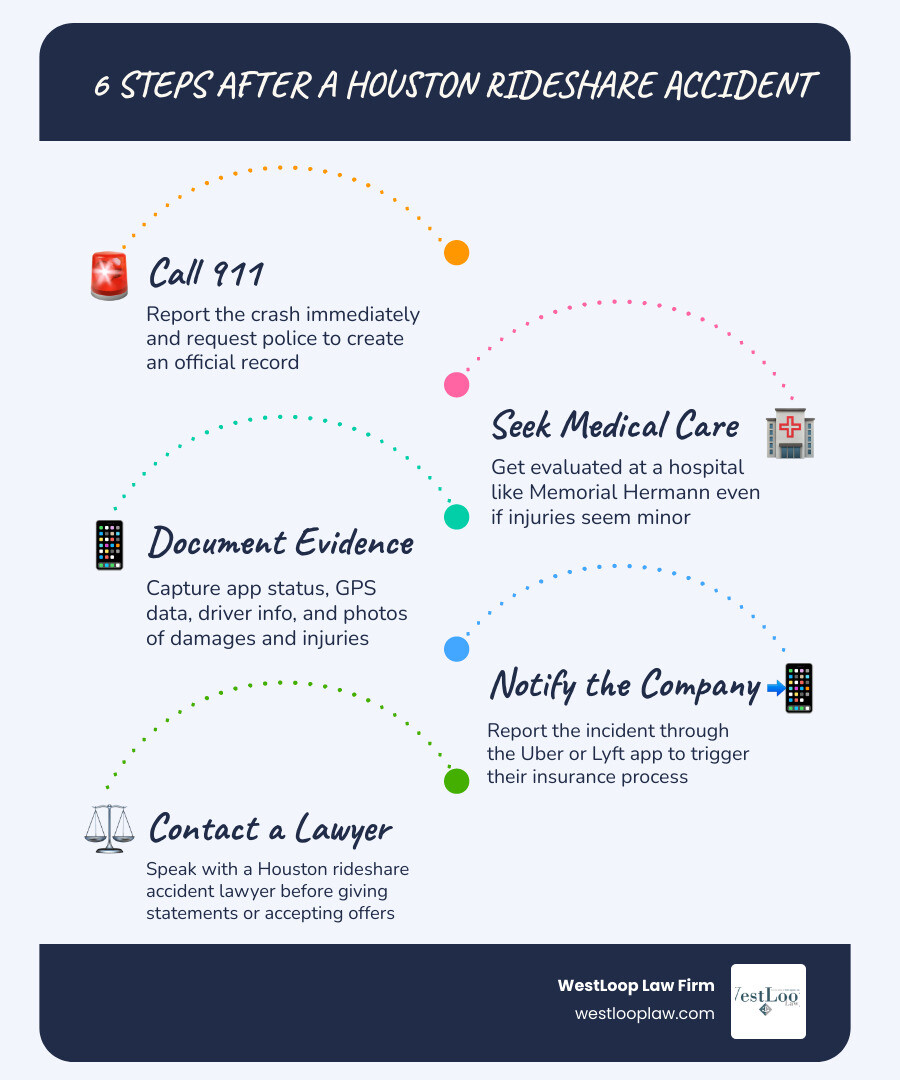
The steps you take in the minutes and hours following a rideshare crash can heavily impact your physical health and your future legal claim. If you find yourself on the side of the road after a collision, follow this checklist:
- Check for Injuries and Call 911: Your health is the top priority. Request police and medical assistance to the scene immediately.
- Obtain a Police Report: Ensure the responding officer files an official Texas Peace Officer’s Crash Report (CR-3). This report is vital evidence for proving fault.
- Seek Medical Attention Promptly: Go to an emergency room or urgent care clinic right away, even if you feel fine. Some injuries, like whiplash or concussions, do not show symptoms until days later.
- Document the Scene: Take photos and videos of all vehicles involved, their license plates, the road conditions, and any visible injuries.
- Collect Contact Information: Get the names, phone numbers, and insurance details of all drivers, passengers, and eyewitnesses.
- Keep Your Mouth Shut on Social Media: Do not post anything about the accident online. Insurance adjusters regularly monitor social media accounts looking for posts they can use to damage your case.
For a detailed walkthrough of handling a collision in the western suburbs, check out our guide on How to Handle a Rideshare Wreck in Katy.
Reporting the Crash to Uber or Lyft
You must report the accident to the rideshare company through their app as soon as possible. Both Uber and Lyft have built-in safety toolkits that allow you to report a crash directly from your trip history.
However, when submitting this report, keep your description brief and factual. Simply state that an accident occurred, provide the date and time, and avoid discussing fault or the severity of your injuries.
Once you have reported the crash digitally, your next step should be consulting with a legal team. If you want to explore your local legal options, you can read more about our services as a Houston rideshare accident attorney options provider.
Frequently Asked Questions About Houston Rideshare Accidents
To help you quickly find the answers you need, we have compiled a list of the most common questions clients ask us about Houston rideshare crashes.
Can I sue the rideshare company directly after a crash?
Suing a rideshare company directly can be highly challenging because they classify their drivers as independent contractors rather than employees. Under traditional Texas employment law, companies are generally not held liable for the negligent actions of independent contractors.
However, you can still seek compensation through their $1 million commercial liability insurance policies. Additionally, you may have a direct claim against the rideshare company if we can prove they were independently negligent—for example, if they failed to perform a proper background check on a driver with a history of reckless driving or failed to remove a driver after multiple safety complaints.
To learn more about corporate liability in personal injury cases, check out our resources at Personal Injury Lawyer Houston.
What if the rideshare driver was offline during the accident?
If the rideshare driver was completely offline (Period 0) and not using the app when the crash occurred, the rideshare company’s insurance will not cover the accident. In this scenario, the crash is treated like any standard car accident.
You will need to file a claim against the driver’s personal auto insurance policy. If their personal liability limits are not enough to cover your medical bills, you may need to use your own Uninsured/Underinsured Motorist (UM/UIM) coverage.
If you find yourself in this situation, a seasoned attorney can help you explore every available path to compensation. Discover how we assist in these standard car wreck cases at Car Accident Lawyer Houston.
How does a Houston rideshare accident lawyer prove fault?
Proving fault in a rideshare crash requires a mix of traditional physical evidence and modern digital data. We build a strong case by gathering:
- Rideshare App Data: GPS tracking logs, speed records, and app activity timestamps that show exactly what the driver was doing at the moment of impact.
- Dashcam and Surveillance Footage: Video from the rideshare vehicle, nearby businesses, or highway traffic cameras.
- Black Box Data: Information from the vehicle’s electronic control module showing braking and speed patterns.
- Eyewitness Statements: Accounts from passengers, other drivers, or pedestrians who saw the crash.
We also assist clients in southern coastal communities. If you were injured south of the city, see how we can help as an Uber Accident Attorney in League City TX.
We also serve clients throughout the region, including those looking for an:
- Uber Accident Attorney in the Woodlands TX
- Uber Accident Attorney in Pearland TX
- Uber Accident Attorney in Missouri City TX
- Uber Accident Attorney in Brazoria County
Conclusion
Getting into a rideshare accident in Houston can leave you feeling overwhelmed, but you do not have to face the recovery process alone.
At Westloop Law Firm, we focus on personal injury law, offering experienced legal representation to clients in Houston, Texas. Our unique approach ensures effective advocacy for clients seeking full compensation for their physical injuries, lost income, and property damage. We stand up to large insurance companies and corporate legal teams to make sure your voice is heard.
If you or a loved one was injured in an Uber or Lyft crash, reach out to us today. Let us handle the legal stress so you can focus on your physical recovery.
Contact Westloop Law Firm today to schedule your free consultation with a dedicated Car Accident Lawyer in Houston.