 Skip to content
How to Sue a Nursing Home for Wrongful Death
When a Loved One Dies in a Houston Nursing Home, You Have Legal Options
A nursing home death attorney is a lawyer who helps families sue care facilities when neglect or abuse causes a resident’s death. If your loved one died in a Houston nursing home and you suspect the facility is at fault, here is what you need to know right away:
Quick answers for Houston families:
- Who can file in Houston? In Texas, the surviving spouse, children, or parents of the deceased can file a wrongful death claim.
- What must be proven in Houston? The facility owed a duty of care, failed in that duty, and that failure directly caused the death.
- How long do you have in Houston? Texas law gives you two years from the date of death to file.
- What can you recover in Houston? Funeral costs, medical bills, pain and suffering, loss of companionship, and in some cases punitive damages.
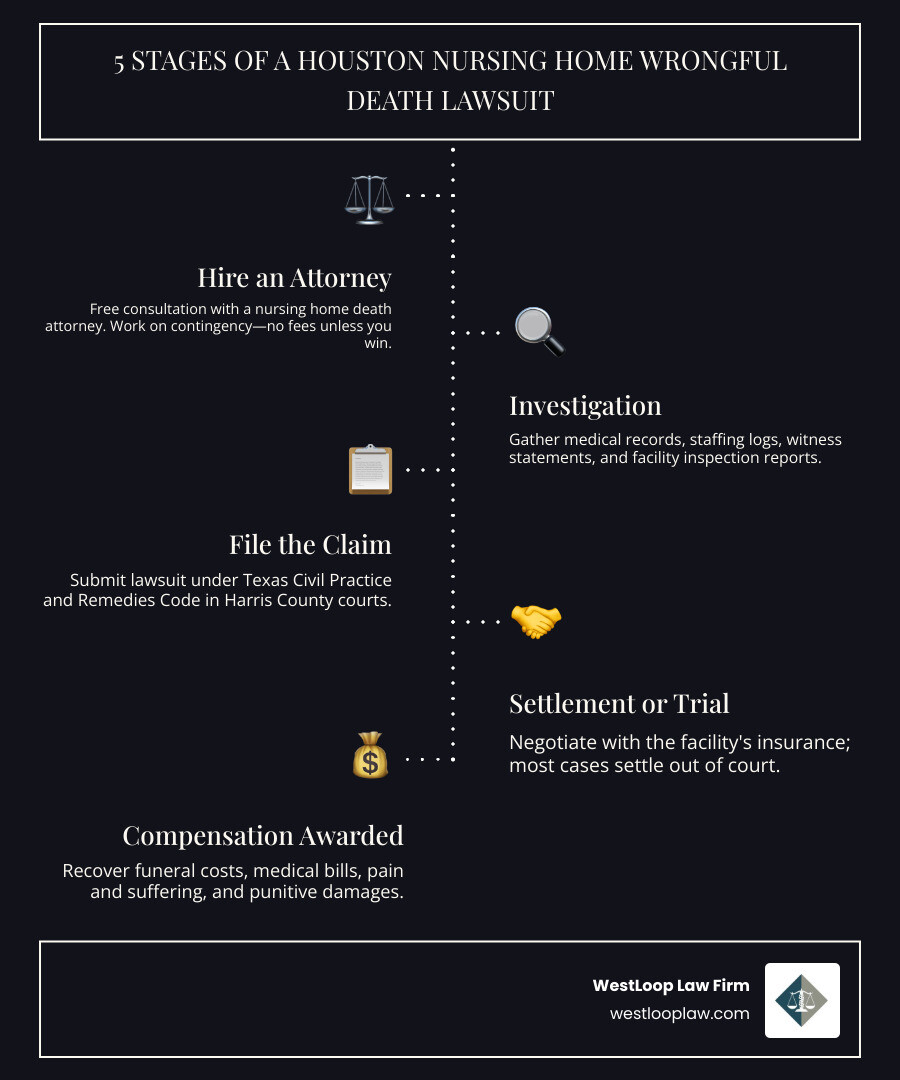
- What does it cost to hire a Houston nursing home death attorney? Most nursing home death attorneys work on contingency — no fees unless you win.
Every year, thousands of families across Houston and Texas place their trust — and their loved ones — in the hands of nursing home staff. Most expect safe, dignified care. Some get the opposite.
In Houston and across Texas, complaints about abuse, neglect, and exploitation remain a serious concern in long-term care settings.
When a Houston nursing home resident dies unexpectedly — from a fall, untreated bedsores, malnutrition, or medication errors — families are left grieving and confused. Was the death preventable? Did the Houston facility cut corners? Could someone be held accountable?
These are exactly the questions a Houston nursing home death attorney helps answer.
This guide walks Houston families through the process: from understanding what went wrong, to building a case, to pursuing compensation.
Houston terms you may see in a nursing home death case:
- Houston wrongful death attorney
- medical malpractice wrongful death attorney
- wrongful death attorney houston
Understanding Negligence and Fatal Neglect in Houston Care Facilities
When we talk about a wrongful death in a Houston care facility, we are usually talking about “negligence.” In plain English, negligence means the Houston facility failed to do what a reasonable facility should have done to keep your loved one safe.

To hold a facility near the 610 Loop or out in the Energy Corridor accountable, a nursing home death attorney must establish four specific legal pillars:
- Duty of Care: The Houston nursing home had a legal obligation to provide a safe environment and proper medical attention. This is established the moment your loved one is admitted.
- Breach of Duty: The Houston facility failed to meet the required standard of care. This could be anything from failing to turn a bedridden patient to ignoring a doctor’s orders.
- Causation: This is often the hardest part. We must prove that the breach of duty directly caused the death. For example, if a resident at a Houston facility near Memorial Hermann Southwest Hospital develops a bedsore that turns into sepsis, we link the lack of skin care to the fatal infection.
- Damages: There must be measurable losses, such as medical bills from the Texas Medical Center, funeral costs, or the emotional pain of losing a parent in Houston.
In Houston, we look toward Texas Health and Human Services (HHS) and the Texas Long-Term Care Ombudsman to investigate these breaches. If you suspect something is wrong in a Houston facility near the Sam Houston Tollway or the West Loop, it is vital to understand what is nursing home abuse so you can spot the warning signs before they become fatal.
Common Causes of Death Due to Neglect in Houston
Neglect isn’t always a single dramatic event; often, it’s a slow decline caused by “quiet” failures. Some of the most common causes of death we see in Houston nursing homes include:
- Bedsores (Pressure Ulcers): These are almost always preventable. If a resident isn’t moved, the skin dies, leading to deep wounds and deadly sepsis.
- Falls: Falls are a leading cause of nursing home fatalities. If a Houston facility fails to implement “fall precautions” for a high-risk resident, they may be liable for the resulting hip fracture or brain bleed.
- Malnutrition and Dehydration: If a resident loses more than 10% of their body weight, it’s a massive red flag. Houston staff may be failing to assist with eating or providing enough water.
- Medication Errors: Giving the wrong dose or the wrong drug can be fatal, especially for residents with heart conditions or diabetes.
- Wandering and Elopement: For residents with dementia, “elopement” (leaving the Houston facility unsupervised) is a nightmare. In the brutal Houston summer heat, a wandering resident can suffer a fatal heat stroke in under an hour.
Scientific research on elder mistreatment (https://doi.org/10.2147/RMHP.S70191) highlights that these issues are often systemic, stemming from facilities that prioritize profit over people. You can find more info about nursing home injuries to see how these “minor” injuries often spiral into Houston wrongful death cases.
The Role of a Nursing Home Death Attorney in Identifying Abuse in Houston
Sometimes, the cause of death isn’t neglect—it’s active abuse. This is a heartbreaking reality that requires immediate legal action in Houston.
A nursing home death attorney is trained to look for “red flags” that a Houston nursing home might try to hide:
- Physical Abuse: Unexplained bruising, broken bones, or signs of restraint.
- Sexual Assault: A horrifying but real threat to non-verbal or vulnerable residents.
- Financial Exploitation: If a loved one’s bank account was drained before their passing, it may indicate a staff member was exerting undue influence.
- Resident-on-Resident Violence: Houston facilities have a duty to protect residents from each other. If a known aggressive resident kills a roommate, the Houston facility is often liable for failing to supervise.
Learning how to recognize and respond to abuse is the first step in protecting other Houston residents and securing justice for your family.
How a Nursing Home Death Attorney Proves Liability in Houston
Houston nursing homes are heavily regulated, which means they generate a mountain of paperwork. The trick is knowing which papers to look for. When we take on a case, we go into “investigation mode,” gathering evidence that the Houston facility would rather keep buried.
| Type of Evidence | Why It Matters |
|---|---|
| Medical Records | Shows if treatments were skipped or if “accidents” were documented accurately. |
| Staffing Logs | Proves if the Houston facility was dangerously understaffed at the time of the incident. |
| Facility Inspection Reports | Shows a history of safety violations or “tags” from state inspectors in Houston. |
| Witness Statements | Includes accounts from other residents, visiting families, or “whistleblower” staff in Houston. |
| Police & Medical Examiner Reports | Provides an unbiased cause of death and notes any suspicious circumstances in Houston. |
We often coordinate with the Houston Police Department or the Harris County Institute of Forensic Sciences to review autopsy results. Often, a death certificate might list “natural causes,” but a deeper look reveals that those “natural causes” were triggered by a preventable fall or infection in a Houston nursing home. Our work as lawyers for nursing home neglect involves peeling back these layers to find the truth for Houston families.
Proving Systemic Failures in Houston Facilities
Many nursing homes in Houston, especially those along the I-10 corridor or near Beltway 8, are owned by large out-of-state corporations. These companies sometimes cut staffing levels to increase their bottom line.
When a Houston facility is understaffed, the remaining nurses are overworked and prone to making mistakes. This is “corporate negligence.” We look for training violations and patterns of poor care that suggest the death wasn’t just a one-time accident, but an inevitable result of how the Houston business was run. Understanding the “when and how” of nursing home abuse lawsuits is essential when taking on these corporate giants in Houston.
Working with a Nursing Home Death Attorney on a Contingency Basis in Houston
One of the biggest worries Houston families have is: “How can we afford to sue a big corporation?”
The good news is that we work on a contingency fee basis. This means:
- No Upfront Fees: You don’t pay us a dime to start the Houston case.
- We Take the Risk: We cover the costs of filing fees, expert witnesses, and medical record retrieval.
- We Only Get Paid if You Win: Our fee is a percentage of the final settlement or jury verdict. If we don’t recover money for you, you owe us nothing for our time.
This levels the playing field, allowing a grieving family in Houston to go head-to-head with a multi-million dollar insurance company. If you are unsure if you have a case in Houston, knowing when to hire a lawyer can help you make that first call with confidence.
Who Can File a Wrongful Death Claim in Houston?
In Texas, not just anyone can file a wrongful death lawsuit. The Texas Civil Practice and Remedies Code is very specific about who has “standing” to sue.
Typically, the following people can file:
- The Surviving Spouse: Even if they were separated but not divorced.
- The Children: This includes adult children and legally adopted children.
- The Parents: Of the deceased resident.
If none of these individuals file within three months of the death, the personal representative (executor) of the estate can file the claim instead, unless all the family members listed above specifically ask them not to. If you are navigating this, our guide on Houston wrongful death lawsuits provides a deeper dive into these requirements.
The Intersection of Probate Law and Wrongful Death
This is where things get a bit technical, but it’s where WestLoop Law Firm offers a distinct advantage. A wrongful death case often requires opening an estate in the Harris County Probate Court.
There are actually two different types of legal actions that often happen at the same time:
- Wrongful Death Claim: Filed for the benefit of the surviving family (for their loss of companionship and emotional pain).
- Survival Action: Filed on behalf of the deceased person’s estate (for the pain and suffering the deceased felt before they passed).
To bring a survival action, you usually need Letters Testamentary or Letters of Administration from a probate judge. Because we handle both injury law and probate, we can manage the entire process under one roof, ensuring the estate is handled correctly while we fight the nursing home. For more on this, see our resources on Houston elder law.
Statute of Limitations for Houston Death Claims
In Houston, you generally have two years from the date of your loved one’s death to file a lawsuit. If you miss this deadline, the court will almost certainly dismiss your case, no matter how much evidence of neglect you have.
There are very rare exceptions (called “tolling” or the “discovery rule”), but you should never count on them. The clock starts ticking the moment they pass away. That is why it is critical to review the steps to take in a lawsuit as soon as possible.
Compensation and Settlements for Houston Families
No amount of money can bring back a mother, father, or spouse. However, a settlement serves two purposes: it provides financial support for the survivors and acts as a “fine” that forces the nursing home to change its ways.
In a successful case, families may recover:
- Economic Damages: Medical bills from hospitals like St. Joseph Medical Center, funeral and burial expenses, and lost financial support.
- Non-Economic Damages: Pain and suffering, mental anguish, and loss of consortium (the loss of the relationship and love).
- Punitive Damages: In cases of “gross negligence” (where the facility knew about a danger but ignored it), a jury may award extra money specifically to punish the facility.
Our wrongful death attorneys in Houston are dedicated to ensuring every penny of these damages is pursued.
Factors Influencing Settlement Values
You might wonder, “What is my case worth?” The truth is, every case is different. The average payout for serious harm in a facility is around $400,000, but many cases involving clear neglect result in settlements of $1 million or more.
Factors that influence the value include:
- The Severity of Neglect: Was it a simple mistake or a week-long failure to provide water?
- Insurance Limits: Most Houston facilities carry significant insurance policies, but there are caps.
- The Deceased’s Health: While it’s sad, insurance companies often argue that an older, sicker resident’s life has less “financial value” than a younger person’s. We fight back against this “devaluing” of our elders.
For more eye-opening data, check out these 3 startling facts about Houston nursing home abuse.
Frequently Asked Questions about Nursing Home Deaths in Houston
What is the first step to take after a suspicious death in a Houston nursing home?
First, do not sign anything the nursing home gives you. Second, request an autopsy from the Harris County Medical Examiner if the death was unexpected. Third, call a nursing home death attorney to begin preserving evidence like surveillance footage and staffing logs before they “disappear.”
How long does a nursing home wrongful death case typically take to resolve?
Most cases take between 12 and 24 months. While many settle out of court, we prepare every case as if it is going to trial to ensure the insurance company takes us seriously.
Can I sue a Houston nursing home if my loved one was on hospice?
Yes. Being on hospice means a person has a terminal illness, but it is not a license for the facility to neglect them. If a hospice patient dies because they fell out of a bed that didn’t have rails, or because they were given the wrong medication, the facility is still liable for that “premature” death.
Conclusion
Losing a loved one to neglect is a heavy burden to carry in Houston. At Westloop Law Firm, we believe that our elders deserve better care in Houston nursing homes. By holding these facilities accountable, we aren’t just seeking a check—we are demanding a higher standard of care for every senior in Houston.
If you suspect that your loved one’s death was caused by poor care in a Houston nursing home, don’t wait for the facility to “investigate itself.” They won’t. You need an advocate who understands the intersection of injury law and probate to protect your Houston family’s rights.
Contact a Houston Wrongful Death Attorney at Westloop Law Firm today for a free, confidential consultation. We are located in Houston, TX, and we are ready to stand with you.