 Skip to content
Navigating the Path After a Loss: An Introduction to Houston Probate
Probate attorney Houston professionals guide families through the court-supervised process of settling an estate after a loved one passes away. This legal process, known as probate, is necessary to transfer assets from the deceased to their heirs. A qualified attorney is essential for navigating this complex journey.
What a Houston Probate Attorney Does:
- Initiates probate by filing the will with the court
- Assists executors with their legal and fiduciary duties
- Manages estate debts and creditor claims
- Resolves disputes between heirs and challenges to the will
- Oversees asset inventory and final distribution
- Steers Texas-specific probate laws and local court rules
Losing a loved one is difficult enough without the added stress of complex legal paperwork and deadlines. The Houston probate process can be overwhelming, with various proceedings and strict timelines. A single mistake can delay asset distribution or create personal liability for the executor.
Fortunately, Texas probate laws offer several pathways. Some estates qualify for simplified procedures like a Small Estate Affidavit (for estates under $75,000), while others need full court supervision. An attorney can identify the most efficient route for you. Many Houston probate attorneys work on flat fees, which are typically paid by the estate, providing cost predictability for the family.
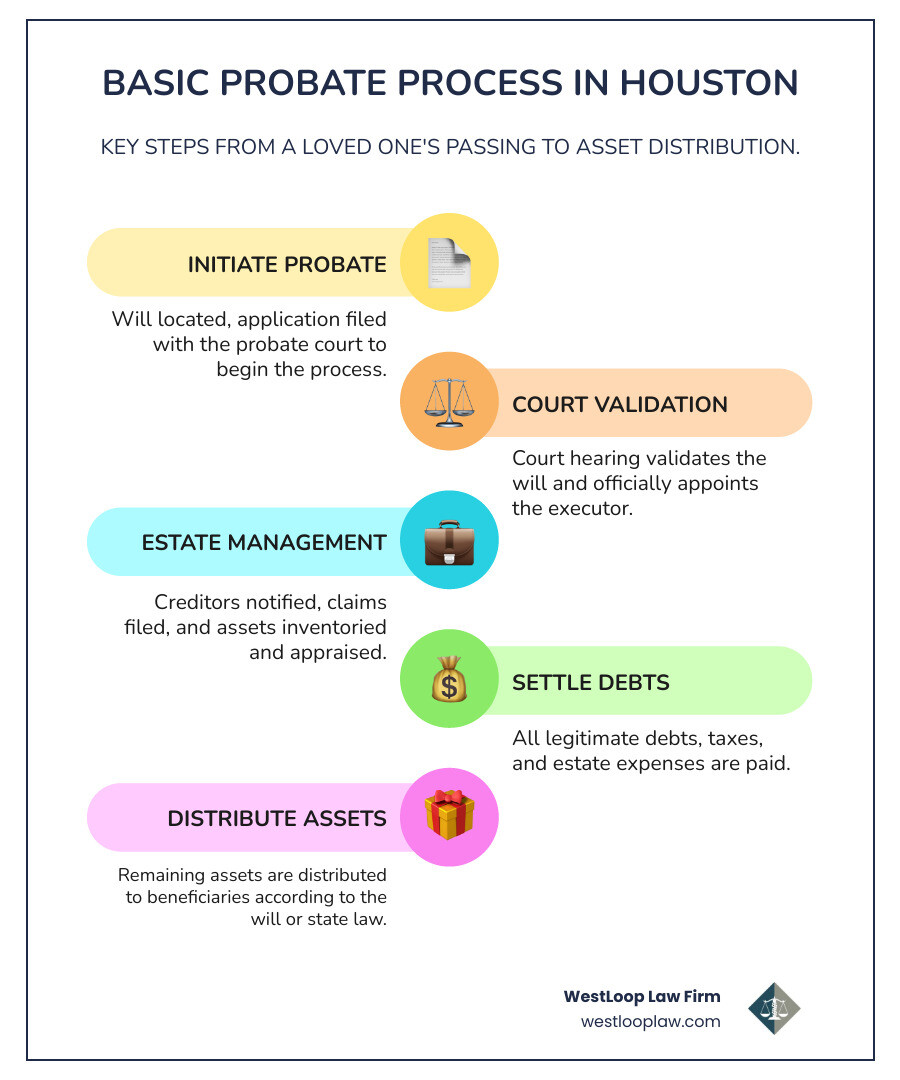
Understanding the Probate Process in Houston
When a loved one passes away in Houston, their property and assets must typically go through probate. This is the legal pathway to ensure debts are paid, assets are distributed, and your loved one’s wishes are honored according to the Texas Estates Code. A judge oversees the process, an executor manages the assets, and creditors are paid before the remaining assets go to the rightful heirs.

The process involves paperwork and deadlines, which is why most families work with a probate attorney Houston families trust. An attorney familiar with Harris County courts can handle the technical details while you focus on your family. The good news is that Texas offers several types of probate, and some are much simpler than others.
What is Probate and Why is it Necessary in Harris County?
At its core, probate is the legal process that validates a will and officially transfers ownership of a deceased person’s assets. Without it, you can’t legally access bank accounts, change the title on a house, or transfer a car. The property remains frozen in the deceased’s name.
Key functions of probate include:
- Validating a Will: The court confirms the will is legitimate and represents the deceased’s final wishes. If there is no will (a situation called dying intestate), the court identifies legal heirs according to Texas law.
- Protecting Creditors: Probate creates a formal process for creditors to submit claims, preventing surprise debts from appearing later. Once legitimate debts are paid, beneficiaries receive their inheritance with confidence.
- Transferring Title: The probate court provides the legal authority needed to transfer titles for real estate, vehicles, and investment accounts.
Harris County has specific local rules, making local knowledge from a Harris County Probate attorney invaluable.
The Different Avenues of Texas Probate
Texas law recognizes that not all estates are the same and provides several probate options. The best path depends on the estate’s size, whether there’s a will, and family dynamics.
- Independent Administration: This is the most common and efficient method in Texas. If authorized by the will or agreed upon by all heirs, the executor can manage and distribute the estate with minimal court supervision. This saves significant time and money.
- Dependent Administration: This involves extensive court oversight for nearly every action, from selling property to paying debts. It’s used when there’s no will or significant conflict, but it is more costly and time-consuming.
- Muniment of Title: A streamlined process for estates with a valid will and no debts (other than a mortgage). The court validates the will, which then serves as the legal document to transfer property, bypassing a full administration.
- Small Estate Affidavit: For estates valued under $75,000 (excluding the homestead), this non-court process allows heirs to present an affidavit to institutions holding the assets. It’s the simplest option but has strict eligibility requirements.
Choosing the right avenue is crucial. For a deeper look, see our guide on Probate Laws in Houston: Process for Residents.
| Type of Probate | Best For | Court Supervision | Timeline | Complexity |
|---|---|---|---|---|
| Independent Administration | Estates with a will authorizing it or all heirs agreeing | Minimal after initial appointment | 6-12 months typically | Moderate |
| Dependent Administration | No will or contested situations | Ongoing and extensive | 12+ months typically | High |
| Muniment of Title | Valid will, mainly real estate, minimal debts | Limited to will validation | 3-6 months typically | Low |
| Small Estate Affidavit | Estates under $75,000, no will, heirs agree | None (non-court process) | 1-2 months typically | Very Low |
The Indispensable Role of a Probate Attorney Houston
While it may be tempting to handle an estate without legal counsel, Texas probate law is intricate, with strict timelines and requirements. The emotional weight of grief can make navigating this process alone overwhelming. A probate attorney Houston families trust handles the complex legal details so you can focus on your family.
Our role extends beyond filling out forms. We provide comprehensive legal representation to protect you, ensure executors fulfill their fiduciary duties, and manage all court filings and deadlines accurately. At WestLoop Law Firm, our 25+ years of experience mean we can anticipate and avoid potential problems. We believe legal help should be accessible, which is why we often work on flat fees and offer payment plans for Houston probate cases, giving you financial predictability.
How a Houston Probate Attorney Resolves Common Disputes
Unfortunately, family dynamics and disagreements can turn probate into a contentious battle. This is when an experienced probate attorney Houston becomes critical. We are prepared to handle disputes through negotiation, mediation, or litigation.
Common probate disputes include:
- Will Contests: A will’s validity can be challenged on grounds of undue influence (where someone was pressured into changing their will) or lack of capacity (if the person was not of sound mind when signing). We gather evidence to protect the true intentions of the deceased.
- Fiduciary Litigation: This arises when an executor mismanages assets, engages in self-dealing, or fails to perform their duties. We hold fiduciaries accountable for breaching their sacred duty to the estate.
- Heirship Disputes: When there is no will, identifying the legal heirs can be contentious, especially in blended families. We assist in heirship proceedings to ensure the correct individuals inherit according to Texas law.
- Creditor Claims: We scrutinize all claims against the estate, challenging illegitimate debts to protect the assets for the rightful beneficiaries.
While we often use mediation to save time, money, and family relationships, we are always prepared to fight for your interests in court. Learn more on our Probate Litigation Attorney page and in our Probate Litigation Houston Guide 2025.
What to Expect When Working with a Probate Lawyer in Houston
The legal process can seem mysterious if you’ve never been through it. Here’s a look at our process:
- Free Consultation: We start with a free consultation (in-person, video, or phone) to discuss your situation, answer your questions, and outline your options.
- Document Gathering: Once you hire us, we provide clear checklists to help you gather necessary documents like the will, death certificate, and financial records.
- Court Filings: We prepare and file all required petitions with the Harris County probate court, ensuring accuracy and completeness.
- Court Appearances & Creditor Notices: We represent you at hearings and handle all legal formalities, including the required publication of notices to estate creditors.
- Inventory and Asset Management: We guide you in creating a complete inventory of estate assets, which must be filed with the court. We also help manage the payment of legitimate debts and taxes.
- Final Distribution: Finally, we oversee the distribution of the remaining assets to the beneficiaries, officially closing the estate and the legal process.
Throughout this journey, we provide personal attention and clear communication. For a detailed look, read our guide on What to Expect Working with a Probate Lawyer in Houston.
Proactive Planning and Related Legal Matters
The best time to think about estate planning is long before you need it. Proper planning ensures your loved ones are cared for and your wishes are honored, saving your family stress and money later. It’s not just for the wealthy; anyone who owns property or wants to protect their children can benefit.

As a Probate attorney Houston team, we see the difference good planning makes. Our experience in probate informs how we help clients create practical, personalized strategies. Learn more on our Probate and Estate Attorney page.
How Estate Planning Can Simplify or Avoid Probate
A key benefit of estate planning is simplifying or even avoiding the probate process, allowing for a faster, more private distribution of assets.
- Living Trusts: Assets placed in a living trust can be distributed by your chosen successor trustee directly to beneficiaries, bypassing probate court entirely.
- Beneficiary Designations: Naming beneficiaries on retirement accounts, life insurance, and bank accounts allows these assets to transfer automatically outside of probate.
- Transfer on Death Deeds (TODD): This tool allows Texas homeowners to designate an heir for their property, which transfers automatically upon death without court involvement.
- Powers of Attorney: A Durable Power of Attorney for finances and a Medical Power of Attorney for healthcare decisions are critical for managing your affairs if you become incapacitated, helping your family avoid a costly guardianship proceeding.
The right mix of these tools depends on your unique situation. For more on how these strategies work, see our guide on Inheritance Laws and Probate: What You Need to Know.
Understanding Guardianship in Houston
Guardianship is a legal process where a court appoints someone to make decisions for an incapacitated adult or a minor child. This may be necessary when a parent develops Alzheimer’s, an adult is severely injured, or a child loses their parents.
These proceedings take place in Houston’s Probate Courts, and our Probate attorney Houston team is equipped to guide families through this emotional process. Before pursuing guardianship, we always explore less restrictive alternatives like Powers of Attorney, Advance Healthcare Directives, and Special Needs Trusts, which preserve more independence and are less complicated.
When guardianship is unavoidable, we help you steer the court proceedings and fulfill your legal responsibilities, ensuring the ward’s best interests are the top priority. For more information, visit More info about Houston Probate Attorneys.
How to Choose the Right Houston Probate Lawyer
Choosing the right Probate attorney Houston is a critical decision. The right partner can alleviate stress, prevent costly mistakes, and ensure a smooth resolution. With over 40+ years of combined legal experience within our firm, we focus on probate, trust, and estate planning. Finding an attorney with specific knowledge who communicates clearly is paramount.
Here are key questions to ask during your initial consultation:
- How long have you been practicing probate law in Texas?
- What is your experience with cases like mine?
- How do you structure your fees for probate cases?
- What is your communication style and how often will I receive updates?
- Are you familiar with the Harris County Probate Courts?
- What potential challenges do you foresee in my case?
- Do you offer a free initial consultation?
We pride ourselves on providing personalized attention and clear guidance. For more tips, explore our page on the Best Probate Attorney Houston.
Key Factors to Consider
When comparing attorneys, focus on these factors:
- Experience and Focus: Look for attorneys with significant, dedicated experience in Texas probate law. A dedicated focus on probate, trust, and guardianship indicates a deeper level of knowledge.
- Fee Structure: Seek transparency. Many reputable Houston probate attorneys offer fixed fees and payment plans for uncontested cases, providing financial predictability.
- Communication Style: You need an attorney who is compassionate, communicates clearly, and keeps you informed. You should feel comfortable asking questions and expect prompt answers.
- Local Court Knowledge: An attorney with regular experience in Harris, Galveston, Montgomery, and Fort Bend counties will know the local court procedures, which can streamline the process.
Why You Typically Need a Lawyer for Probate in Texas
While DIY probate might seem appealing, it’s rarely feasible or wise in Texas.
In most Texas counties, including Harris, an executor or administrator must be represented by a licensed attorney. This is because you are acting as a fiduciary, representing the interests of beneficiaries and creditors. This rule prevents the unauthorized practice of law and protects all parties involved, as noted in policies like the Montgomery County Probate Court policy.
Probate courts have strict rules and deadlines. A single error can cause significant delays and costs, or even lead to personal liability for the executor. While very simple cases might use a Small Estate Affidavit, most family situations are too complex for a DIY approach. The peace of mind from hiring an experienced Probate attorney Houston is invaluable.
Frequently Asked Questions about Houston Probate
We’ve compiled answers to common questions to help clarify the probate process in Houston.
How much does a probate attorney cost in Houston?
Costs vary, but many Probate attorney Houston firms, including ours, offer flat fees for standard probate cases. This provides upfront cost certainty. We also offer affordable rates and payment plans. Importantly, attorney fees and probate costs are typically paid from the estate’s assets, not by the family personally. Always discuss fees during your initial consultation to ensure transparency.
How long does the probate process take in Houston?
A straightforward, uncontested probate in Houston generally takes 6 to 12 months. However, the timeline can vary significantly. A simple estate may settle in six months, while complex or contested cases involving disputes, tax issues, or property sales can take much longer. Delays can be caused by difficulties locating heirs, will challenges, or complex asset valuations. An experienced attorney can help steer the process as efficiently as possible.
Can I handle probate myself without a lawyer in Houston?
It is generally not advisable and often not permitted. In most major Texas counties like Harris, an executor or administrator represents the interests of others (beneficiaries and creditors) and therefore must be represented by a licensed attorney. Self-representation (“pro se”) is only possible in very limited situations, such as a Small Estate Affidavit (for estates under $75,000 with no will) or a simple Muniment of Title. The risks of making costly mistakes, missing deadlines, or incurring personal liability are high. Given the complexity, hiring an experienced Probate attorney Houston is the most prudent choice.
Secure Your Family’s Future with the Right Legal Partner
Losing a loved one is difficult enough without the added confusion of probate. Navigating wills, assets, and court deadlines while grieving can feel overwhelming. An experienced Probate attorney Houston can make all the difference.
At WestLoop Law Firm, we focus our practice on probate, trust, guardianship, and estate litigation. We serve families throughout Harris, Galveston, Montgomery, and Fort Bend counties with clear counsel and efficient resolutions. We provide personalized attention, explaining your options in plain language so you always feel informed. With over 25 years of combined experience, we are equipped to handle any probate situation, from simple estates to complex disputes.
You don’t have to steer this path alone. Let us shoulder the legal burden so you can focus on your family. Take the first step toward peace of mind. Get guidance for your case at the Probate Court in Houston, Texas.