 Skip to content
Houston power of attorney: Ultimate Guide 2026
Why Houston Power of Attorney Matters for Your Future
A Houston power of attorney is a legal document that lets you appoint a trusted person (your agent) to make decisions on your behalf if you cannot. This document is essential if you are injured, hospitalized, or otherwise unable to manage your financial or medical affairs.
Quick Facts About Power of Attorney in Houston:
- What it is: A legal document granting someone authority to act for you
- Who it helps: Anyone who becomes incapacitated or unable to make decisions
- Types available: Financial, Medical, Durable, and Limited POAs
- Key requirement: Must be signed while you are mentally competent
- Where it’s used: Banks, hospitals, real estate deals, and court proceedings
- How to revoke: Written notice while mentally competent
Life in Houston moves fast. An unexpected event on I-45, a sudden illness requiring a stay at Memorial Hermann Hospital in the Texas Medical Center, or an accident near the Galleria or along Westheimer Road can leave you unable to pay bills or make critical decisions.
Without a power of attorney, your family may need to pursue a lengthy and expensive court process called guardianship. This can take months and cost thousands, leaving your financial and medical affairs in limbo while critical decisions wait.
A power of attorney gives you control before a crisis hits. You choose who speaks for you, decide what powers they have, and protect your family from legal battles during an already stressful time.
Creating a power of attorney in Texas is straightforward. The document must be in writing, signed before a notary public, and contain specific language to ensure it remains effective if you become incapacitated.
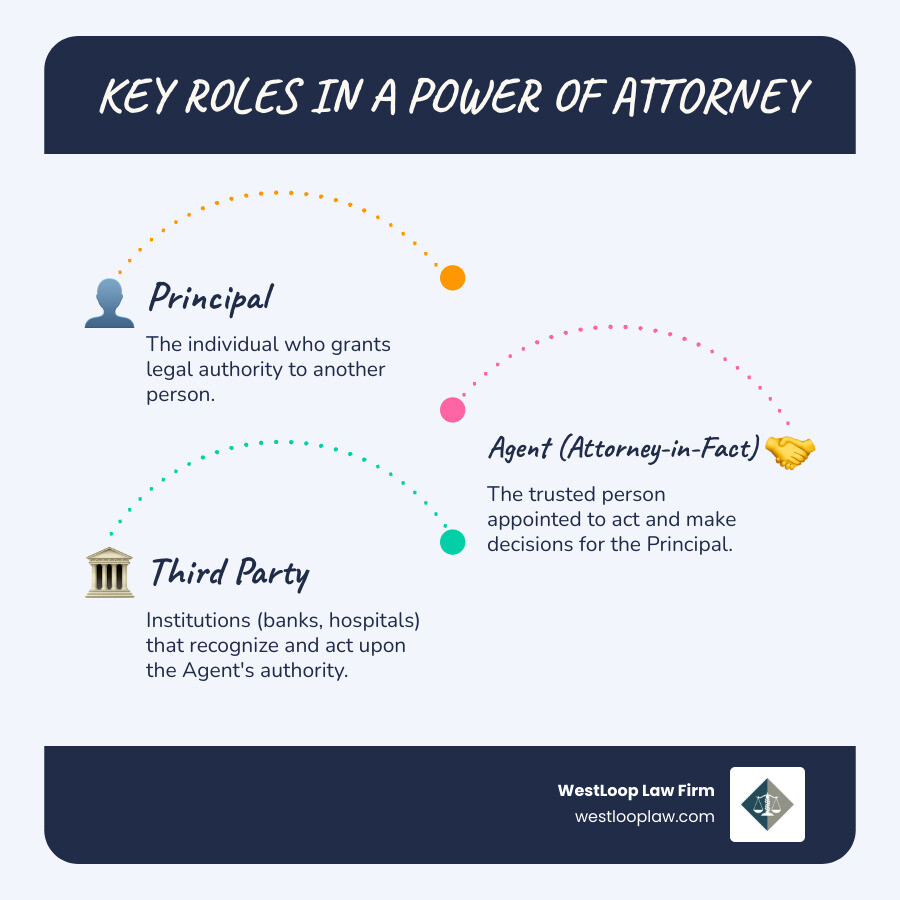
Houston power of attorney terms you need:
Understanding the Types of Power of Attorney in Texas
In Texas, a Power of Attorney (POA) is a key estate planning document that lets you grant authority to another person to act on your behalf. These documents are governed by the Texas Estates Code and come in several forms. Understanding the types is crucial when creating a Houston power of attorney.
Generally, a POA in Texas is either financial or medical. A complete estate plan often includes both. A financial POA (Statutory Durable Power of Attorney) covers your property and money, while a Medical Power of Attorney handles healthcare decisions. For more on durable powers, you can review the Durable Powers of Attorney in Texas guide.
Key Differences in POA Types
Here are the common types of POAs in Texas:
- General Power of Attorney: This grants broad powers to your agent but is less suitable for long-term planning because it typically terminates if you become incapacitated.
- Durable Power of Attorney: The cornerstone of estate planning, a durable POA remains effective even if you become incapacitated. This ensures continuous management of your finances, covering actions like paying bills, filing taxes, or selling property.
- Medical Power of Attorney: This document specifically allows your agent to make healthcare decisions for you if you are unable to communicate them. It does not grant any authority over your finances.
- Springing Power of Attorney: This POA only “springs” into effect upon a specific event, usually your incapacitation. However, proving incapacitation can cause delays, which is why many people prefer a durable POA that is effective immediately.
- Limited or Special Power of Attorney: This grants your agent very narrow powers for a specific task or time period, such as selling a single property while you are away. The POA terminates once the task is done or the time expires.
This table highlights the key difference between a General and a Durable Power of Attorney:
| Feature | General Power of Attorney | Durable Power of Attorney |
|---|---|---|
| Effectiveness during Incapacity | Terminates upon the principal’s incapacitation | Remains effective even if the principal becomes incapacitated |
| Common Uses | Temporary delegation of authority; specific business transactions | Comprehensive financial management; long-term incapacity planning |
| Termination | Specified time, task completion, death, revocation, incapacitation | Death, revocation, agent unavailability, court invalidation, divorce |
When a Durable Power of Attorney Takes Effect and Ends
A crucial part of your Houston power of attorney is deciding when it becomes active. For a durable financial POA, you have two options:
- Immediately upon signing: This is the most common and straightforward option, avoiding any delay or dispute about when you became incapacitated.
- Upon Incapacity: The POA only becomes effective once you are determined to be incapacitated, which usually requires certification from a physician.
A durable POA is designed to continue “not be affected by subsequent disability or incapacity of the principal.”
A financial power of attorney ends upon:
- Your Death: A POA is only valid during your lifetime.
- Revocation: You can revoke the POA at any time while mentally competent.
- Agent Unavailability: The POA may end if your agent dies, resigns, or becomes incapacitated and no successor is named.
- Divorce: If your spouse is your agent, their authority automatically ends upon divorce unless the POA states otherwise.
- Court Invalidation: A court can invalidate a POA if it was created improperly or if the agent is abusing their power.
Creating a Valid Houston Power of Attorney
Creating a valid Houston power of attorney is a vital step in protecting your future. Texas law, specifically the Texas Estates Code, has clear requirements to ensure these documents are legally enforceable.

While statutory forms are available, working with a Houston law firm like WestLoop Law Firm to draft a custom POA provides greater peace of mind. A custom document can be tailored to your unique circumstances, offering more clarity and avoiding the pitfalls of generic forms.
Key Legal Requirements for a Houston Power of Attorney
For a POA to be valid in Texas, it must meet these requirements:
- Age and Mental Capacity: As the principal, you must be at least 18 and of “sound mind,” meaning you understand the document and its consequences.
- In Writing and Signed: The POA must be a written document signed by you.
- Notarization: For a financial POA, your signature must be acknowledged before a notary public. A Medical POA can be notarized or signed before two qualified witnesses.
- Specific Wording for Durability: To ensure your POA remains effective if you become incapacitated, it must include specific language like, “This power of attorney is not affected by subsequent disability or incapacity of the principal.”
Choosing Your Agent (Attorney-in-Fact)
Selecting your agent is the most critical decision when creating a Houston power of attorney. This person will have significant authority, so choose someone who is:
- Trustworthy and Reliable: Choose someone you implicitly trust to act in your best interests.
- Financially Responsible (for Financial POA): Your agent should be capable of managing money and making sound financial decisions.
- Available: It is helpful if your agent lives in or near Houston and is willing to take on the role’s responsibilities.
- Name an Alternate Agent: Always name at least one successor agent as a backup in case your primary choice is unable to serve.
- Consider Co-Agents Carefully: Naming co-agents can lead to delays or disagreements. If you do, specify if they can act independently or must act together.
Steps to Create a Financial Power of Attorney
Follow these steps to create your financial Houston power of attorney:
- Select Your Agent(s): Choose a primary agent and at least one successor you trust to manage your finances.
- Choose the Powers to Grant: Decide what authority your agent will have. You can grant broad powers for all financial matters or limited powers for specific tasks.
- Draft the Document: Use a statutory form, like the Statutory Durable Power of Attorney form, or work with a Houston firm such as WestLoop Law Firm to create a custom document tailored to your needs.
- Sign Before a Notary Public: You must sign the final document in the presence of a notary public, who will verify your identity and witness your signature.
- Distribute Copies and Store the Original: Store the original in a safe, accessible place. Give copies to your agent(s) and consider providing them to your financial institutions to prevent future delays. If the POA covers real estate in Harris County or surrounding areas like Fort Bend County, file a copy with the county clerk’s office.
The Agent’s Role and When a POA Can Be Rejected
Once your Houston power of attorney is created, your appointed agent takes on significant responsibilities. This role includes a legal duty to act in your best interest.
Responsibilities and Duties of a Texas Agent
Your agent acts as a fiduciary, which is a legal duty to act with the utmost good faith and loyalty to you. In Texas, an agent’s duties include:
- Acting Loyally: The agent must act solely for your benefit and avoid any conflicts of interest.
- Acting with Care: They must manage your affairs with the same care and diligence as a prudent person would manage their own.
- Staying Within Granted Authority: The agent can only perform actions explicitly allowed in the POA document.
- Keeping Property Separate: Your agent must keep your assets separate from their own and never commingle funds.
- Maintaining Records: Your agent must keep accurate records of all transactions made on your behalf.
- Disclosing Their Role: When conducting business for you, the agent must state they are acting under a power of attorney.
Misusing a POA can lead to severe consequences for the agent, including civil liability and criminal charges.
When Houston Banks and Institutions Can Reject a POA
Even with a valid Houston power of attorney, a third party like a bank might hesitate to accept it. Texas law provides specific guidelines for when a durable POA can be rejected.
Texas law gives third parties a specific timeframe to either accept a POA, request additional certification, or reject it for a valid reason. They cannot unreasonably refuse a valid POA. However, an institution can legally reject a POA if it has:
- A good-faith belief the POA is invalid (e.g., it was revoked or you have passed away).
- Knowledge the agent is acting outside the scope of their authority.
- Suspicion of financial abuse or other criminal activity.
- Reason to believe the transaction would violate state or federal law.
- Conflicting instructions from multiple agents.
- Evidence the POA was not properly executed (e.g., it lacks a notary’s signature).
For a complete list of statutory reasons, you can refer to Texas Estates Code 751.206. If you believe your POA is being wrongly denied by a Houston bank, we can help you understand your legal options.
The Importance of a POA in Your Houston Estate Plan
A Houston power of attorney is a vital part of any comprehensive estate plan. It acts as your financial protector and personal advocate when you are unable to act for yourself, ensuring your life continues with minimal disruption.
What Happens Without a POA in Harris County?
Imagine becoming incapacitated from an accident on the Katy Freeway or a sudden illness. Without a power of attorney, your family cannot legally step in to manage your affairs. They would likely need to start a guardianship proceeding in Harris County probate court. This process is:
- Costly: Guardianship involves significant legal and court fees that can drain your savings.
- Time-Consuming: The process can take months, delaying payment of bills and critical medical decisions.
- Public: Guardianship proceedings are public record, exposing your personal and financial life.
- A Loss of Control: A judge, not you or your family, decides who manages your affairs.
- Divisive: Disagreements among family members can lead to contentious and stressful legal battles.
A Houston power of attorney helps you avoid this intrusive and expensive process, keeping control within your family and preserving peace of mind.
Common Misconceptions About a Houston Power of Attorney
POAs are often misunderstood. Here are some common myths:
- Myth: An Agent Has Unlimited Power. False. An agent’s authority is strictly limited to the powers you grant in the document. You can grant broad or very specific powers.
- Myth: A POA is Valid After the Principal’s Death. False. A power of attorney automatically ends the moment you pass away. It is a tool for managing your affairs during your lifetime, not for distributing assets after death, which requires a will or trust.
- Myth: A POA Cannot Be Revoked. False. As long as you are mentally competent, you can revoke your power of attorney at any time.
- Myth: POAs Are Only for the Elderly or Ill. False. Accidents and illnesses can happen at any age. A POA is a smart planning tool for any adult over 18.
Revoking or Changing Your Power of Attorney
As life changes, you may need to update or revoke your Houston power of attorney. You can do so at any time, as long as you are mentally competent.
Here are the steps to revoke or change your POA:
- Create a Written Revocation: Draft a formal document stating you are revoking the POA. Sign it before a notary public.
- Notify Your Agent: Provide a copy of the written revocation to your current agent so they know their authority has ended.
- Inform Third Parties: Send copies of the revocation to any banks, healthcare providers, or other institutions that have a copy of your old POA.
- Destroy Old Documents: Retrieve and destroy all copies of the old POA to prevent confusion.
- Create a New POA: If you wish to appoint a new agent or change the terms, create a new Houston power of attorney following all legal requirements.
Frequently Asked Questions about Houston Powers of Attorney
We often get questions from our Houston community about powers of attorney. Here are some of the most common inquiries:
Does a Power of Attorney need to be filed with the court in Texas?
Generally, no. A Houston power of attorney does not need to be filed with a court to be valid. However, if the POA involves real estate transactions (like selling property), it must be filed with the county clerk’s office (e.g., in Harris County) to be effective for those transactions.
What is the difference between a Power of Attorney and a Living Will?
While both are key estate planning documents, a Houston power of attorney and a Living Will (or Advance Directive) have different functions:
- Power of Attorney: Appoints an agent to make financial or medical decisions for you if you become unable to do so.
- Living Will (Advance Directive): States your own wishes for end-of-life medical care if you become terminally ill. It provides direct instructions to doctors, rather than appointing a decision-maker.
A Medical Power of Attorney and a Living Will work together to ensure your wishes are followed.
How much does it cost to get a Power of Attorney in Houston?
The cost of a Houston power of attorney varies. While statutory forms have minimal upfront cost, they may not cover your unique needs. Working with a law firm like WestLoop Law Firm to draft a custom POA provides comprehensive protection and ensures the document is custom to your specific situation. This investment is often far less than the cost of a guardianship proceeding, which your family might face if you become incapacitated without a POA.
Secure Your Future with a Houston Power of Attorney
Creating a Houston power of attorney is a proactive and responsible step in safeguarding your future and providing clarity for your loved ones. It empowers you to maintain control over your financial and medical decisions, even when you can’t voice them yourself. By planning ahead in Houston, you can:
- Ensure your financial affairs are managed without interruption.
- Guarantee your healthcare wishes are respected at local facilities such as Houston Methodist Hospital or Memorial Hermann Hospital.
- Prevent the need for costly and public guardianship proceedings in Harris County probate courts near Downtown Houston.
- Alleviate stress and potential disputes for your family during difficult times.
At WestLoop Law Firm, we understand the complexities of Texas law and the unique needs of Houston families from areas like the Energy Corridor, Midtown, and the Heights. We can help you steer the options, from a Statutory Durable Power of Attorney to a Medical Power of Attorney, ensuring your documents are legally sound and reflect your precise intentions. Our team can assist in customizing your POA to include specific provisions, appoint alternate agents, and address any particular concerns you may have.
Don’t leave your future to chance or burden your family with uncertainty. Taking the time to establish your Houston power of attorney now is an act of foresight and care. Contact us to discuss your Houston estate planning needs and take the first step toward securing your peace of mind.