 Skip to content
Houston Car Accident Death: 3 Devastating Causes
Understanding the Reality of Houston Car Accident Deaths
Houston car accident death incidents occur with alarming frequency across our city’s roadways. If you’re trying to understand the scope of this tragedy, here’s what the data shows:
Key Statistics on Fatal Houston Car Accidents:
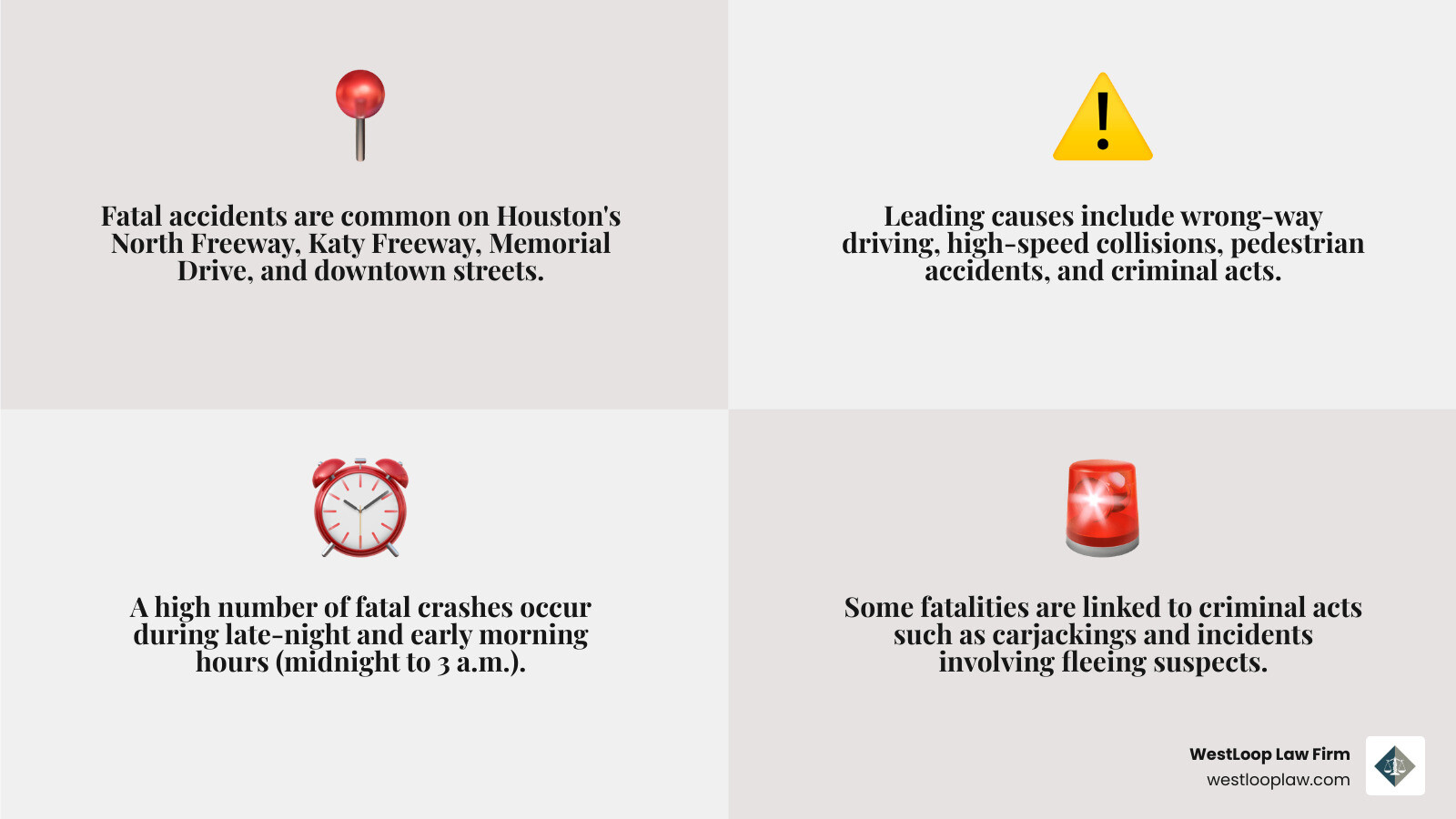
- Most Common Locations: North Freeway (I-45), Katy Freeway (I-10), Memorial Drive, and downtown areas like Travis and Lamar Streets
- Leading Causes: Wrong-way driving, high-speed collisions, pedestrian accidents, vehicle rollovers, and criminal acts like carjacking
- Time Patterns: Many fatal crashes occur during late-night and early morning hours (midnight to 3 a.m.)
- Vehicle Types: Multi-vehicle collisions often involve SUVs, sedans, and commercial trucks
- Criminal Connection: Some fatalities result from fleeing suspects or violent crimes that escalate into crashes
The streets of Houston see heartbreaking tragedies every week. Recent Houston Police Department reports document crashes where innocent bystanders lost their lives—including a carjacking incident near Travis and Lamar Streets that ended with a fatal collision, killing the driver of a Kia Soul who had nothing to do with the initial crime.
These aren’t just statistics. They’re mothers, fathers, children, and friends whose lives ended on our freeways and city streets.
For families left behind, the aftermath brings overwhelming grief alongside crushing financial burdens. Medical bills from final hospital stays. Funeral expenses. Lost wages when the primary earner is gone. The legal questions can feel impossible to steer while you’re mourning.
Understanding what led to these crashes—and what legal options exist—is the first step toward justice and recovery.
Common Causes of Fatal Accidents on Houston Roads
The busy streets and sprawling freeways of Houston are unfortunately no strangers to tragic accidents. When we examine the causes behind a Houston car accident death, several patterns emerge from police reports and investigations. These patterns often point to common human errors, dangerous driving behaviors, and sometimes, unforeseen circumstances.
One significant cause is wrong-way driving, as tragically seen on major arteries like the Katy Freeway. Such incidents often lead to devastating head-on collisions, which are among the most lethal types of crashes. For instance, a fatal crash at 6600 Katy Freeway involved a silver BMW traveling the wrong way—westbound in eastbound lanes—striking a silver Tesla Cybertruck head-on. The impact was so severe that the BMW caught fire, and the Tesla was then hit by a Freightliner 18-wheeler. The male driver of the BMW was pronounced deceased at the scene, and the Tesla driver was left in critical condition. This single incident highlights the catastrophic potential of wrong-way driving. You can learn more about this specific investigation here: Investigation into Fatal Crash at 6600 Katy Freeway .
High-speed collisions are another frequent contributor to fatalities. When vehicles travel at excessive speeds, drivers have less time to react, and the force of impact in a crash is exponentially greater, increasing the likelihood of severe injury or death. This is often compounded by drivers failing to maintain a single lane, leading to vehicles veering off the road or into other lanes.
Pedestrian accidents, particularly on or near freeways, also account for a heartbreaking number of deaths. Pedestrians attempting to cross busy highways are incredibly vulnerable, as vehicles often travel at high speeds, and drivers may not anticipate their presence.
Driver impairment, whether due to alcohol, drugs, or extreme fatigue, significantly reduces a driver’s ability to operate a vehicle safely. Impaired drivers often exhibit delayed reaction times, poor judgment, and reduced coordination, making them a danger to everyone on the road. Similarly, distracted driving, such as texting or using a phone while behind the wheel, diverts a driver’s attention from the road, leading to preventable accidents.

Scenarios from Houston Police Department Reports
Houston Police Department (HPD) reports provide a stark look at the varied and often tragic scenarios that lead to fatal accidents. These detailed accounts help us understand the circumstances surrounding each Houston car accident death.
Rollover accidents, for example, can be extremely dangerous, especially if occupants are not properly restrained. We’ve seen reports of drivers being ejected from their vehicles, leading to immediate fatalities. At 2700 North Freeway, a gray Mazda 3 traveling at high speed struck a barrier and rolled over, ejecting its 31-year-old female driver, who died at the scene. This initial incident then triggered a chain reaction, involving a Lexus, a Ford Fusion, a Honda Civic, and a fifth unnamed vehicle. The driver of the Lexus, who had exited their vehicle after striking the Mazda, was subsequently struck by the Ford Fusion.
Head-on collisions, as mentioned with wrong-way driving, are almost always devastating. But they can also occur from drivers losing control or attempting unsafe maneuvers.
Pedestrian crossings on freeways present unique and perilous situations. At 4400 North Freeway, a male pedestrian was struck and killed by a white GMC Sierra pickup truck while attempting to cross the main lanes of the freeway from east to west. The driver of the pickup remained at the scene and was determined not to be impaired, highlighting the danger of pedestrians on freeways. More details on this incident can be found here: Investigation into Fatal Crash at 4400 North Freeway .
Failure to maintain a lane is a recurring theme in many fatal accident reports. On the Katy Freeway service road at 7900, a 28-year-old female driver in a silver Ford Fusion struck a pole after continuing straight instead of making a left turn, resulting in her death. Similarly, on Memorial Drive at 6800, a 28-year-old male driver of a blue Chevrolet Tahoe was traveling at a high rate of speed, failed to maintain a single lane, left the roadway, and struck several trees, leading to his demise.
Even seemingly straightforward intersections can become deadly. At 2900 Mangum Road, a white Chevrolet Tahoe making a left turn was struck by a white BMW 320i traveling northbound. The impact ejected two backseat passengers from the Tahoe, one of whom, a male, was pronounced deceased at the hospital. These diverse scenarios underscore the many ways a Houston car accident death can tragically occur. These causes are often the basis for wrongful death claims, which we discuss further here: The most common causes of wrongful death.
The Dangers of Criminal Acts Leading to Crashes
Beyond typical traffic violations, criminal acts can escalate rapidly, turning into fatal car accidents that endanger innocent lives. Carjacking incidents, in particular, pose a significant public safety risk. When a suspect forcibly takes a vehicle and then flees, the ensuing chaos often involves high speeds, reckless driving, and a disregard for traffic laws, making a crash almost inevitable.
These situations can transform a property crime into a violent one, with devastating consequences. Fleeing suspects, often desperate to escape apprehension, drive erratically, placing themselves, other drivers, and pedestrians in extreme danger. Police chases, while necessary to apprehend criminals, inherently carry risks, and sometimes innocent bystanders become victims of the fleeing suspect’s actions.
The tragic reality is that a criminal act, like a carjacking, can set off a chain of events that leads directly to a Houston car accident death. This highlights the unpredictable and dangerous nature of such crimes, where the intent to steal can inadvertently result in murder. When such a tragedy occurs, families of the victims often face complex legal battles, seeking justice for their loved ones. Our firm can help steer these challenging situations: Houston Car Accident Death.
Case Study: How a Downtown Carjacking Led to a Houston Car Accident Death
One of the most striking examples of how a criminal act can lead to a fatal crash unfolded recently in downtown Houston. This incident serves as a grim reminder of the unpredictable dangers on our roads and the ripple effect of violent crime. A carjacking, a violent act in itself, escalated into a multi-vehicle crash, resulting in an innocent person’s death and a city struggling with the aftermath. The Houston Police Department (HPD) and the Harris County District Attorney’s Office have been actively involved in investigating and prosecuting this tragic case.
The Initial Incident: A Mother and Son Carjacked
The horrific sequence of events began just before 1 a.m. on a Saturday morning near Travis and Lamar Streets in downtown Houston. A mother and her 12-year-old son were in their Ford Edge SUV when a disturbance occurred. As the mother reportedly got out of her car to investigate, a suspect jumped into her vehicle, attempting to steal it.
In a desperate attempt to prevent the theft, the mother tried to intervene. The suspect then shoved her out of the car, and as he began to drive off, he struck her with her own vehicle. Miraculously, her 12-year-old son, who was in the passenger seat, managed to escape from the vehicle’s passenger side before the suspect sped away. The mother sustained injuries, but her exact condition was not immediately detailed beyond being struck. This initial act of violence and the subsequent theft set the stage for the tragic events that followed. For those who experience such traumatic events, understanding legal recourse can be a crucial step toward healing: Houston Car Accident Death.
The Tragic Aftermath: A Deadly Collision
The suspect, now fleeing in the stolen Ford Edge SUV, drove recklessly through the downtown streets. His flight from the scene culminated in a devastating multi-vehicle crash. The stolen SUV first clipped a Toyota pickup truck and then slammed violently into a Kia Soul. The impact was so severe that the Kia Soul rolled over, causing immediate and fatal injuries to its driver. The driver of the Kia died at the scene, an innocent bystander caught in the wake of another’s criminal actions.
The driver of the Toyota pickup truck was taken to the hospital as a precaution but was not seriously injured. The carjacking suspect, despite causing such a destructive crash, sustained only minor injuries and was transported to Memorial Hermann hospital for treatment.
Following the crash, HPD officers took the suspect into custody. The Harris County District Attorney’s Office reviewed the case and accepted a murder charge against the suspect, recognizing the direct causal link between his criminal actions and the death of the Kia driver. This incident underscores the profound legal and emotional consequences that can arise from such a violent act, particularly when it leads to a Houston car accident death. If you or someone you know has been affected by a similar incident, understanding the role of an attorney can be vital: Accidental death attorney.
The Legal Aftermath of a Fatal Houston Crash
When a fatal crash occurs in Houston, the immediate aftermath is often chaotic and heartbreaking. However, for the families left behind, the tragedy often extends into a complex legal journey. This journey can involve seeking justice through wrongful death claims, navigating criminal proceedings against responsible parties, and dealing with the various agencies involved, from the HPD Vehicular Crimes Division to the Harris County District Attorney’s Office. Understanding this legal process is crucial for those seeking compensation and accountability.
Understanding Wrongful Death Claims in Texas
In Texas, a wrongful death claim allows certain family members to seek compensation when a loved one dies due to another party’s negligence or intentional act. This is distinct from criminal charges, which focus on punishing the offender. A wrongful death lawsuit aims to provide financial relief and acknowledge the profound loss experienced by the surviving family.
So, who can file a lawsuit? Under Texas law, only the surviving spouse, children, and parents of the deceased can file a wrongful death claim. If none of these parties file a lawsuit within three months of the death, the personal representative of the deceased’s estate may file the claim, unless all eligible family members request that it not be filed.
The types of damages that can be recovered in a wrongful death claim are extensive and aim to compensate for both economic and non-economic losses. These can include lost earning capacity of the deceased, medical and funeral expenses, loss of companionship and society, mental anguish, and sometimes even punitive damages designed to punish particularly egregious conduct.
A critical aspect of wrongful death claims is the statute of limitations, which typically dictates how long you have to file a lawsuit. In Texas, this period is generally two years from the date of death. Missing this deadline can mean losing your right to pursue a claim. Central to any wrongful death claim is proving negligence—that the at-fault party failed to exercise reasonable care, and this failure directly led to the death. Our firm can help you understand these specific laws and determine if you have a claim: Who can file a wrongful death lawsuit in Houston?.
Navigating the Legal Process After a Houston Car Accident Death
Navigating the legal process after a Houston car accident death can be incredibly daunting, especially while grieving. Our firm understands the challenges families face during this time and is here to guide you through every step.
The process typically begins with gathering comprehensive evidence. This includes obtaining police reports, which provide crucial details about the accident, including witness statements, initial findings, and sometimes even citations issued. Accident reconstruction can be vital in complex cases, where professionals analyze physical evidence to determine the sequence of events, speeds, and forces involved.
Dealing with insurance companies is another significant hurdle. Insurers often aim to minimize payouts, and their initial offers may not adequately cover the full extent of your losses. It’s important to approach these discussions with caution and legal guidance to ensure your rights are protected.
Finally, if a fair settlement cannot be reached, filing a lawsuit becomes necessary. This involves formal legal proceedings, including findy (exchanging information with the opposing side), negotiations, and potentially a trial. Each step requires meticulous attention to detail and a deep understanding of Texas personal injury law. Our firm is committed to handling these complexities, allowing you to focus on healing. For a detailed look at the legal process, visit: The legal process of filing a lawsuit with your wrongful death attorney.
Frequently Asked Questions about Fatal Houston Car Accidents
Losing a loved one in a car accident is an unimaginable tragedy. Many questions arise in the wake of such an event, especially concerning the legal and financial implications. Here, we address some of the most common inquiries families have after a fatal Houston car accident death.
What are the first steps to take after a loved one dies in a Houston car accident?
The immediate aftermath of a fatal accident is overwhelming, but certain steps are crucial to protect your rights and future legal options:
- Notify Authorities: Ensure the police and emergency services are aware of the accident. The official police report will be a vital piece of evidence.
- Secure the Scene (if possible and safe): If you are at the accident scene, take photos and videos, and gather contact information from witnesses. However, your safety is paramount.
- Do Not Admit Fault: Avoid making statements that could be interpreted as admitting fault, even if you are unsure of the circumstances.
- Seek Medical Attention: If you were involved, get checked by medical professionals, even if you feel fine.
- Contact a Legal Representative: Reach out to a law firm that handles wrongful death cases as soon as possible. They can guide you through the process, protect your interests, and ensure all necessary steps are taken.
For a more comprehensive guide on the initial steps, please refer to: Houston wrongful death attorney: first steps.
Who can be held liable for a fatal car accident in Texas?
Determining liability in a fatal car accident can be complex, as multiple parties might share responsibility. In Texas, potential liable parties can include:
- The At-Fault Driver: The most common scenario, where the driver’s negligence (e.g., speeding, distracted driving, impaired driving) directly caused the accident.
- The Driver’s Employer: If the at-fault driver was operating a vehicle as part of their job duties (e.g., a commercial truck driver, delivery driver), their employer might be held liable under vicarious liability laws.
- A Vehicle Manufacturer: If a defect in one of the vehicles (e.g., faulty brakes, airbags) contributed to the accident or the severity of injuries, the manufacturer could be held partially or fully responsible.
- A Government Entity: In some cases, poor road design, inadequate signage, or a lack of maintenance by a city, county, or state entity could contribute to an accident, leading to potential liability.
- A Bar or Restaurant: Under Texas’s Dram Shop Act, an establishment that over-served alcohol to an intoxicated person who then caused a fatal accident could be held liable.
What kind of compensation can be recovered in a wrongful death lawsuit?
A wrongful death lawsuit aims to compensate the surviving family members for the financial and emotional losses they endure due to their loved one’s death. The types of compensation that can be recovered include:
- Lost Earning Capacity: The income the deceased would have likely earned over their lifetime had the accident not occurred.
- Medical and Funeral Expenses: Costs associated with the deceased’s final medical care and funeral arrangements.
- Loss of Companionship and Society: Compensation for the emotional pain, suffering, and loss of the love, comfort, and guidance the deceased provided.
- Mental Anguish: Damages for the severe emotional distress, grief, and sorrow experienced by the surviving family members.
- Loss of Inheritance: The amount of money or property the deceased would have accumulated and passed on to their heirs.
- Punitive Damages: In cases of gross negligence or intentional misconduct, punitive damages may be awarded to punish the at-fault party and deter similar behavior in the future.
Understanding these potential damages is crucial for ensuring that the compensation sought truly reflects the full scope of your loss. For more detailed information on filing such a lawsuit in Houston, please visit: How to file a wrongful death lawsuit in Houston, TX.
Seeking Justice for Your Loved One
Losing a family member in a preventable accident is an indescribable devastation. The sudden void left by a loved one, especially due to someone else’s negligence or criminal actions, can be overwhelming. While no legal action can ever truly replace what you’ve lost, pursuing a wrongful death claim can provide a sense of justice and alleviate the significant financial burdens that often follow such a tragedy.
The legal journey after a Houston car accident death can be complex, filled with intricate laws, challenging negotiations with insurance companies, and the emotional toll of recounting painful events. Understanding your rights and the legal options available to you is crucial during this difficult time.
At WestLoop Law Firm, we are committed to providing compassionate and dedicated legal representation to families in Houston who have lost loved ones in fatal car accidents. We understand the unique challenges you face and are here to help you steer the legal process, ensuring that your voice is heard and that those responsible are held accountable. You don’t have to face this alone. For guidance and support during this challenging time, please do not hesitate to Contact a Houston wrongful death attorney for guidance.